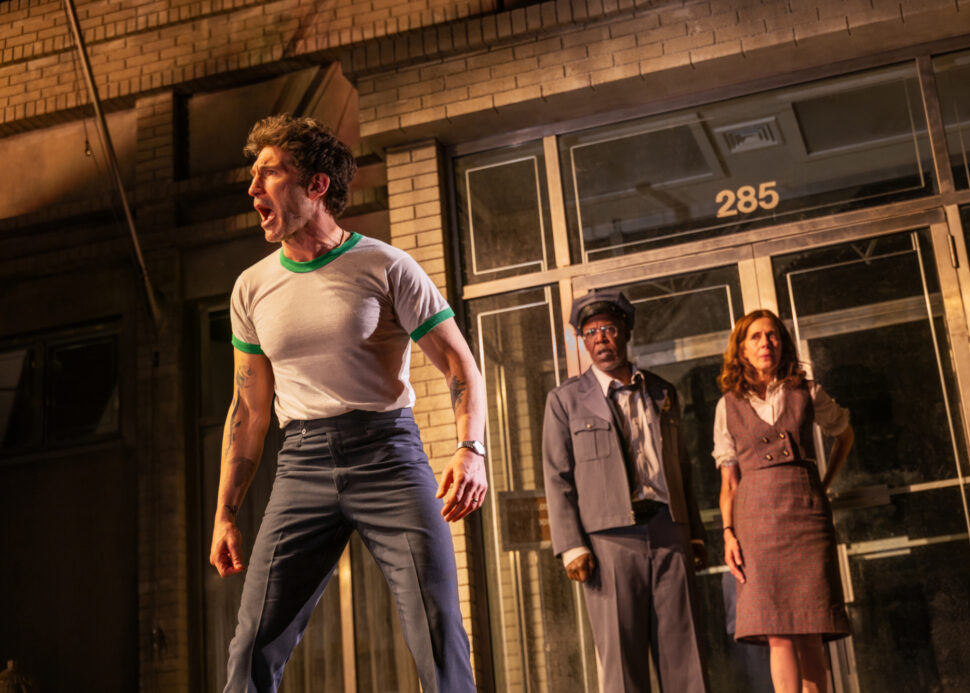
The Broadway Theatre Review: A strong cast anchors a gripping story that never quite finds its frequency
By Ross
The first sound is not a voice, but a search. A crackle of radio static fills the theatre as a dial turns, sliding past frequencies in search of something clear enough to hold onto. It is a small, precise choice, but it feels telling. Before anything has even begun, Dog Day Afternoon establishes itself as a story in motion, unsettled, trying to tune into the right signal on a sweltering Brooklyn afternoon in 1972.
When the set slowly turns to reveal the interior of the Chase Manhattan Bank, the mechanics of the world fall into place with careful detail. A security guard manages the door. Customers drift in and out, exchanging fragments of conversation about life, love, and secrets. The day is nearly over. For those who know the story, a sense of inevitability hangs quietly in the air. For those who do not, there is a growing curiosity about how quickly everything might come undone.
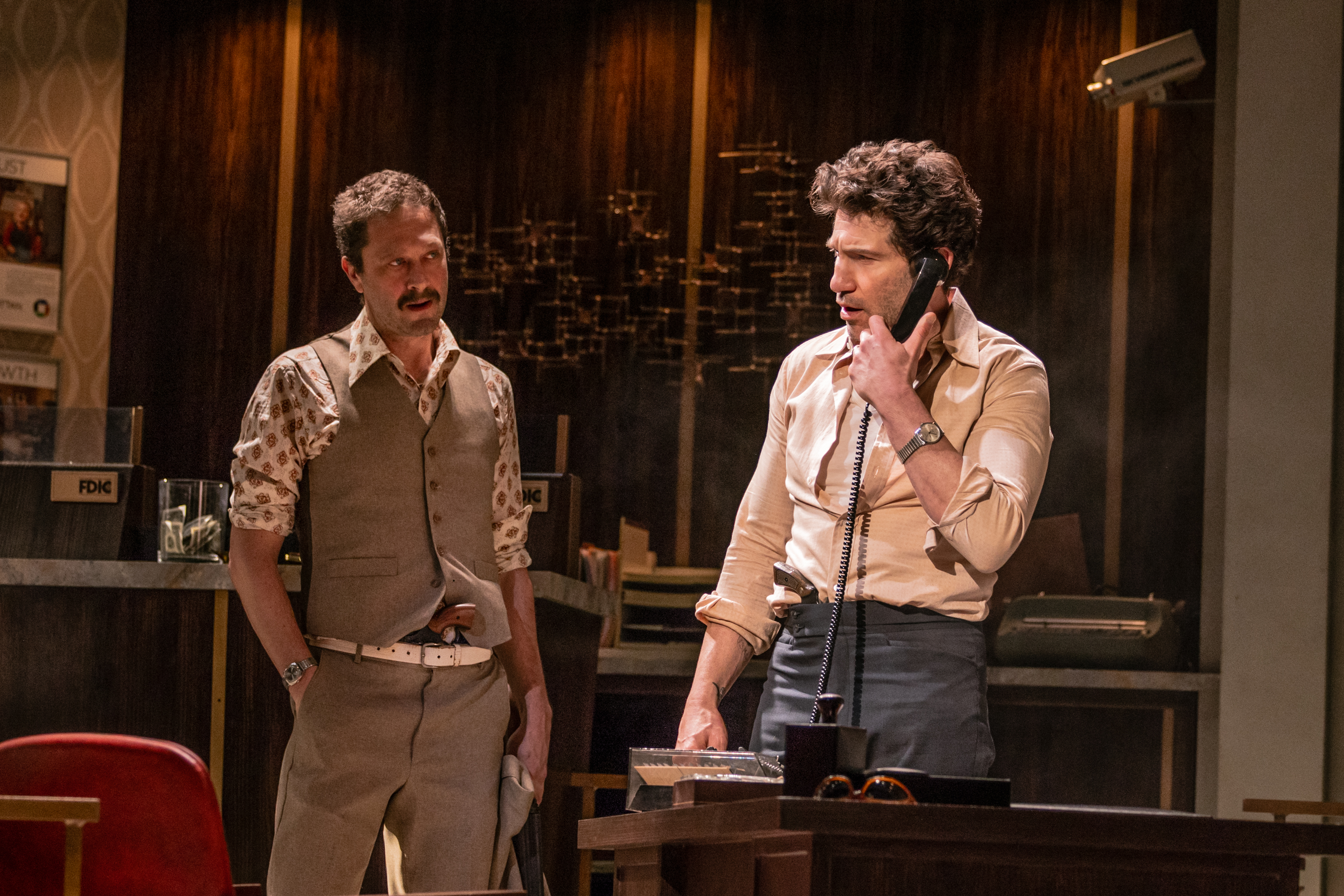
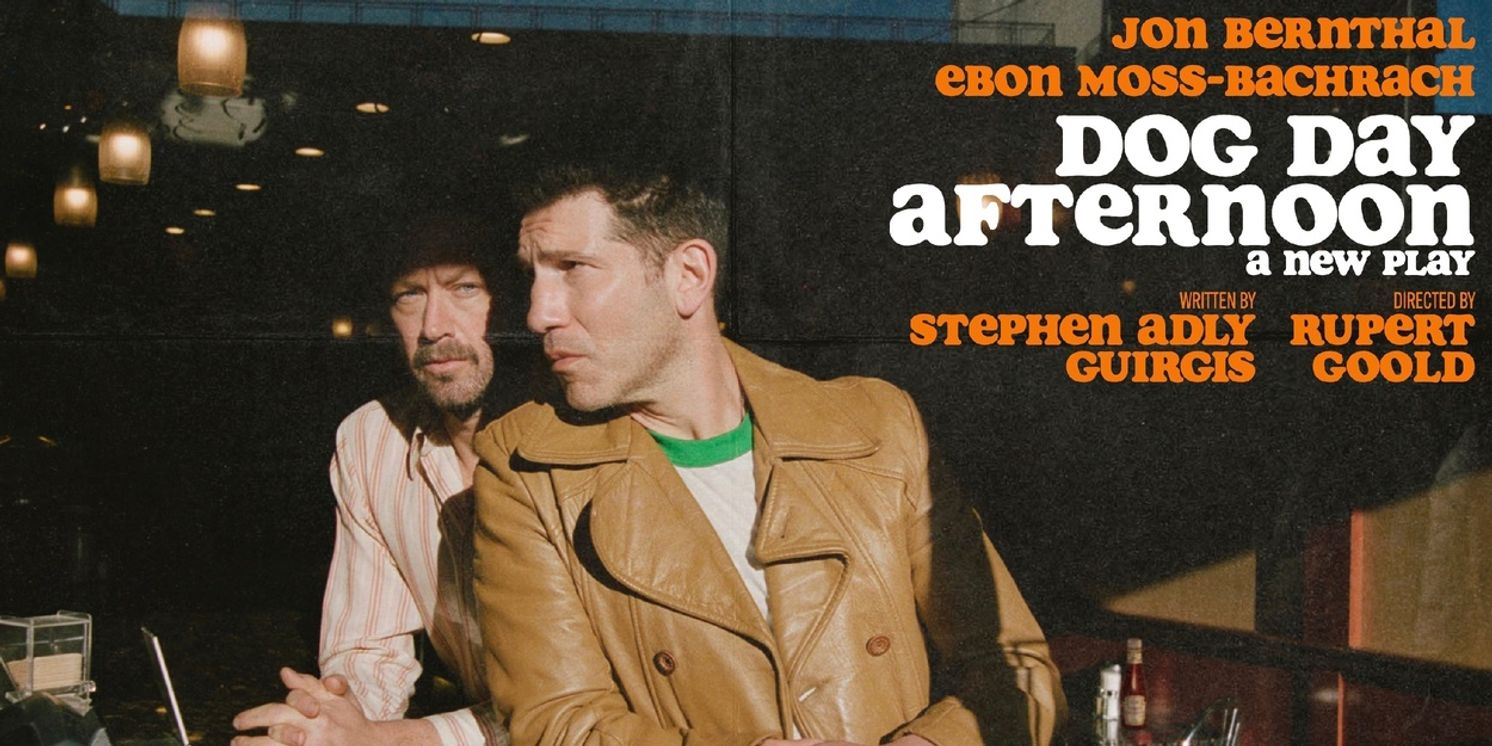
That unraveling begins the moment Jon Bernthal’s Sonny steps on the August Wilson Theatre stage. His line, “Everyone wants to be an exception,” lands with a disarming charm that defines much of what follows. It is a gentle deception, the softest moment in what becomes a situation spinning beyond his control almost immediately. The robbery fails before it even begins. This is where Dog Day Afternoon, written by Stephen Adly Guirgis (Halfway Bitches…) and directed by Rupert Goold (Broadway’s Patriots), finds both its footing and its central challenge.
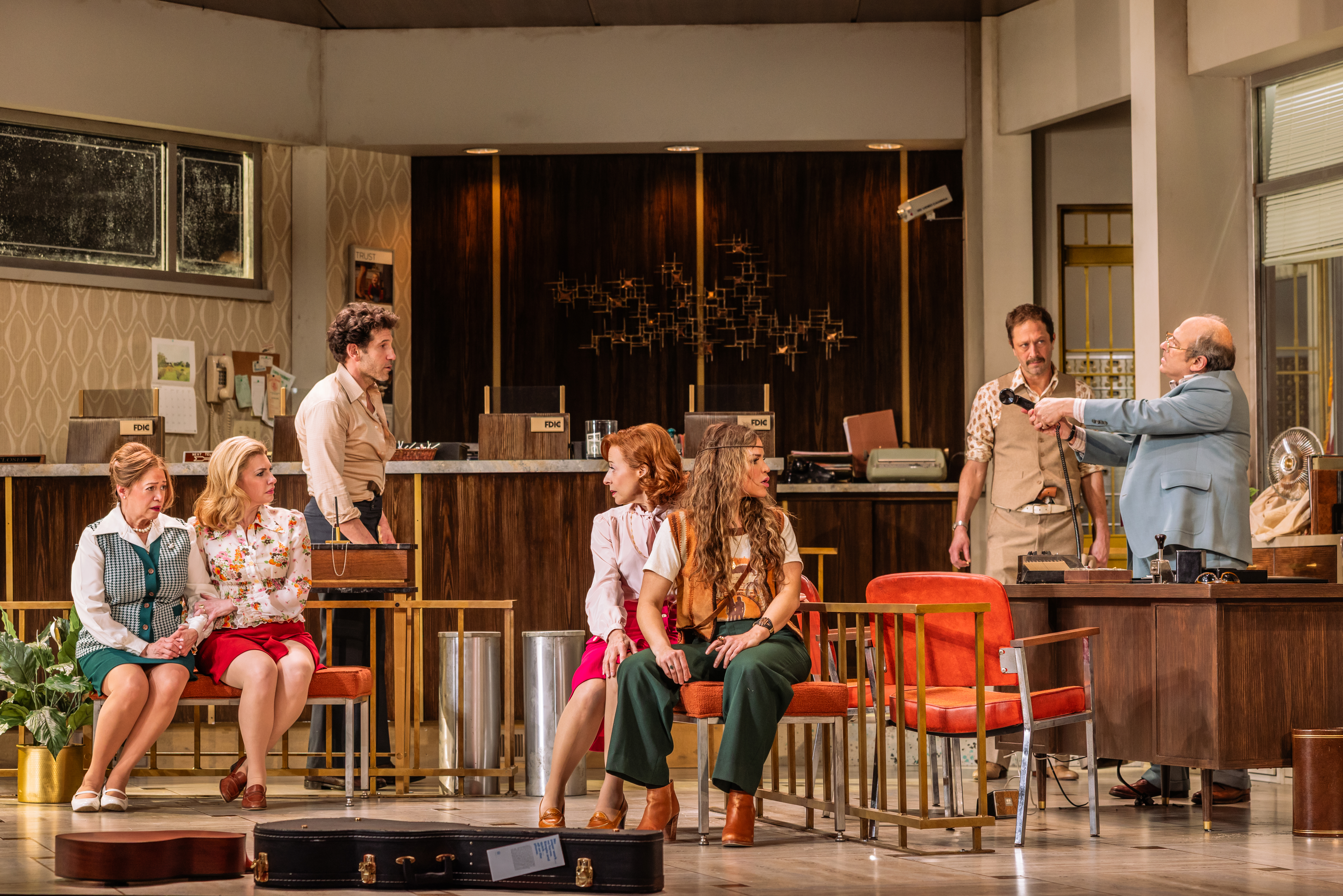
The premise is built for tension. A bank robbery turns into a hostage situation. The heat rises. A crowd gathers outside. The stakes should tighten with each passing moment. And at times, they do. Bernthal’s Sonny is empathy wrapped in nervous bravado. Ebon Moss-Bachrach’s Sal, his partner and friend, carries an unpredictable edge, his chaotic energy flickering in a way that suggests real danger, like a cornered raccoon. His connection to Sonny, part loyalty, part desperation, is one of the most compelling elements in the production. Yet the play never fully commits to that tension. Instead, it keeps shifting frequencies.
The early scenes are sharp and often very funny. The dialogue crackles with a lived-in rhythm, lines like “It’s hot as a two-dollar bill” and strong costuming by Brenda Abbandandolo (MTC’s Mary Jane), ground the play in a specific time and tone with ease. But as the situation escalates, the production repeatedly releases the pressure it works so hard to build. Humour interrupts where dread might deepen, and what should feel like a tightening spiral becomes a pattern of rise and release. The play never quite decides whether it is a tense hostage drama or a fractured dark comedy with moments of danger. In searching for both, it never fully locks into either. This is where the production begins to drift.
The hostages remain present, but rarely feel in immediate jeopardy. That is not for lack of effort from the ensemble, including Wilemina Olivia-Garcia, Andrea Syglowski, Elizabeth Canavan, Paola Lázaro, and Michael Kostroff, who all do excellent work with the small coins they are given, finding texture and humanity in interactions that might otherwise pass unnoticed. Yet the production does not always give those moments the weight they deserve. The negotiations unfold, but without the urgency that might give them consequence. Even as Sonny insists, “The people are on our side,” an idea that never really finds its frequency, the play leans into the spectacle of the moment rather than its personal story or consequences. What begins as a desperate, barely believable act gradually becomes something more observational, a situation we watch rather than one we feel.
Still, there is much to admire within the performances. Jessica Hecht (MTC’s Summer, 1976), as the head teller, delivers the most consistently compelling work of the evening. She has that rare ability to make the smallest gesture feel considered, to turn routine into revelation. I found myself completely absorbed watching her handle even the smallest transaction, making it something shaped and specific, her control of tone and posture quietly anchoring the scene. It is the kind of performance that holds your attention without ever asking for it.
Bernthal, with Hecht by his side, remains committed throughout, working to hold the emotional center even as the production around him rotates out of his grip. His Sonny is driven by a need to be understood, to be seen as decent within an increasingly impossible situation. That effort is visible, even when the structure does not fully support it.
The design reflects this same imbalance. The bank itself is meticulously detailed, a fully realized environment that feels alive and specific, thanks to the fine work of set designer David Korins (Broadway’s Ragtime) and lighting designer Isabella Byrd (Off-Broadway’s Prince Faggot). In contrast, the police staging area, headed by a compassionate Detective Fucco (John Ortiz), feels noticeably less defined, rolled into place, and serving its function without adding texture. The difference is striking, and it subtly undercuts the intensity and authority of the world beyond the bank’s walls.
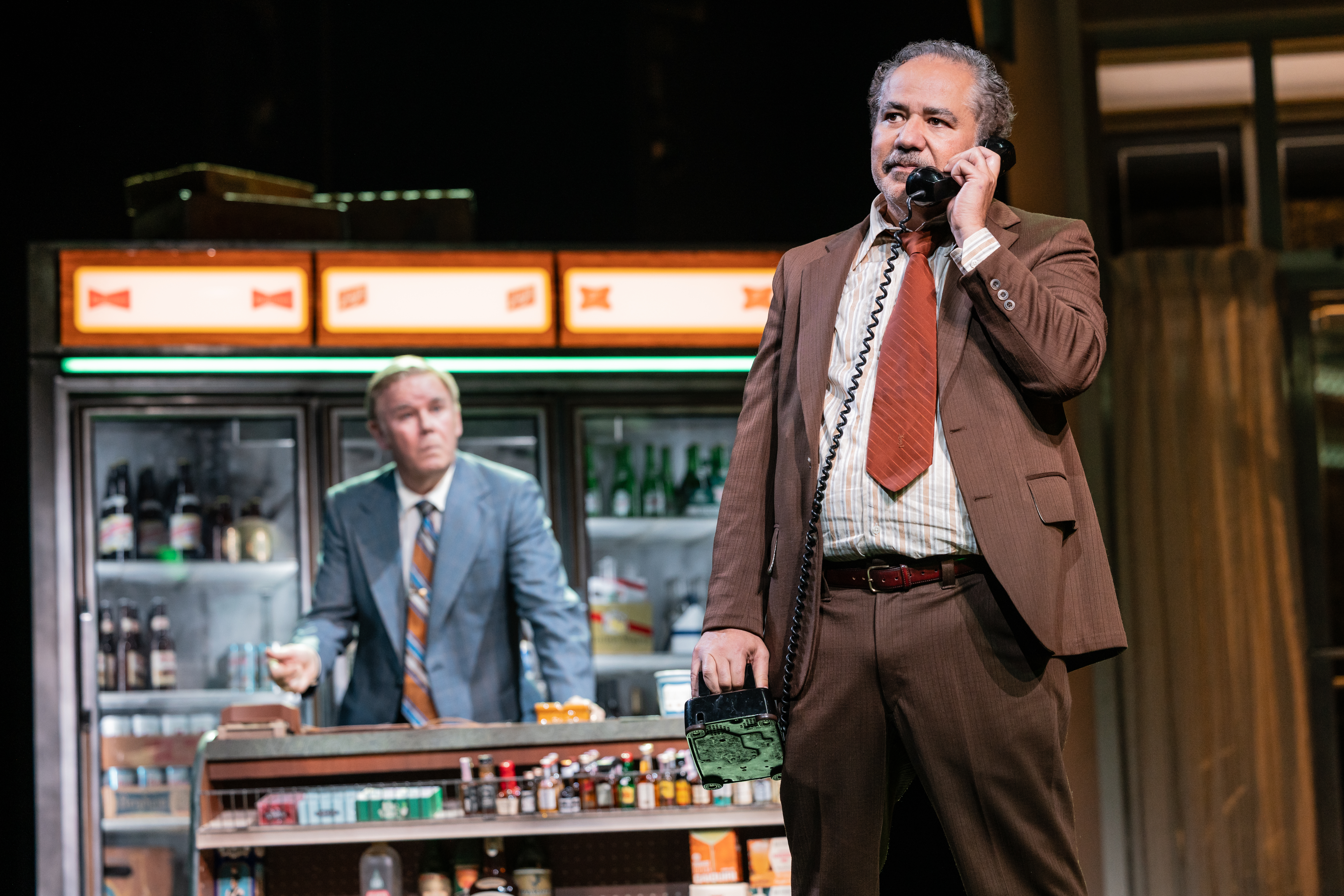
The introduction of Leon (Esteban Andres Cruz) adds another layer, one that carries emotional and cultural weight. The production approaches the character with care, staying grounded in the period without pushing too far in either direction. Yet the relationship never quite takes hold as a driving force. It feels present, but not fully integrated, another thread that begins to tighten before slipping away.
In the final stretch, the sense of searching becomes more pronounced. The helicoptered-in resolution arrives, almost too abruptly, and several threads that had begun to take shape fall away. The emotional impact of that final frame does not land with the force it might have, not because the material lacks weight, but because the production has not held onto the seriousness of it all long enough. What remains is a story filled with compelling moments, strong performances, many funny moments, and a fascinating foundation, but one that never quite settles into a clear radio signal.
I wrote earlier about the anticipation surrounding Dog Day Afternoon, and later about the tension offstage. Sitting in the theatre now, what lingers is not the noise around it, but the sense of something just out of reach within it. The potential is there, visible in flashes, carried by performers who push toward something more sustained than the structure allows, bringing us back to that first sound. The static. The dial turning. The search for the right frequency. The story moves forward, and the tightness grows louder. But the signal never quite locks in, and the emotional core, though present, flickers rather than fully playing loud and true on a hot summer’s day in Brooklyn, 1972.
 front mezz junkies