The London Theatre Review: Flowers for Mrs. Harris – The Musical
By Ross
“All I ever need is here, right here,” Ada tells us pretty much right off the bat. And the funny thing about the statement inside the 2016 musical version of Flowers for Mrs. Harris starring the fantastically talented Jenna Russell (West End/Broadway’s Sunday in the Park…), is that it is not exactly true. Yet it is, and in this adaptation of Paul Gallico’s sweet-natured novel about a grieving widowed apartment cleaner who, after a run-in with a gloriously designed couture dress hanging in a closet at a wealthy client’s home in Belgravia, sets her own wide-eyed sights on purchasing a Dior dress for herself. The beautiful thing about this breathtaking idea and this movie is that it holds the two opposing things together, stitching them into the same piece of cloth with an expert steady hand. Not the easiest thing to do, yet Russell does a brilliant job sewing those ideas all together for us so we can understand. And be amazed. I wish as strongly as when she first laid eyes on that dress.
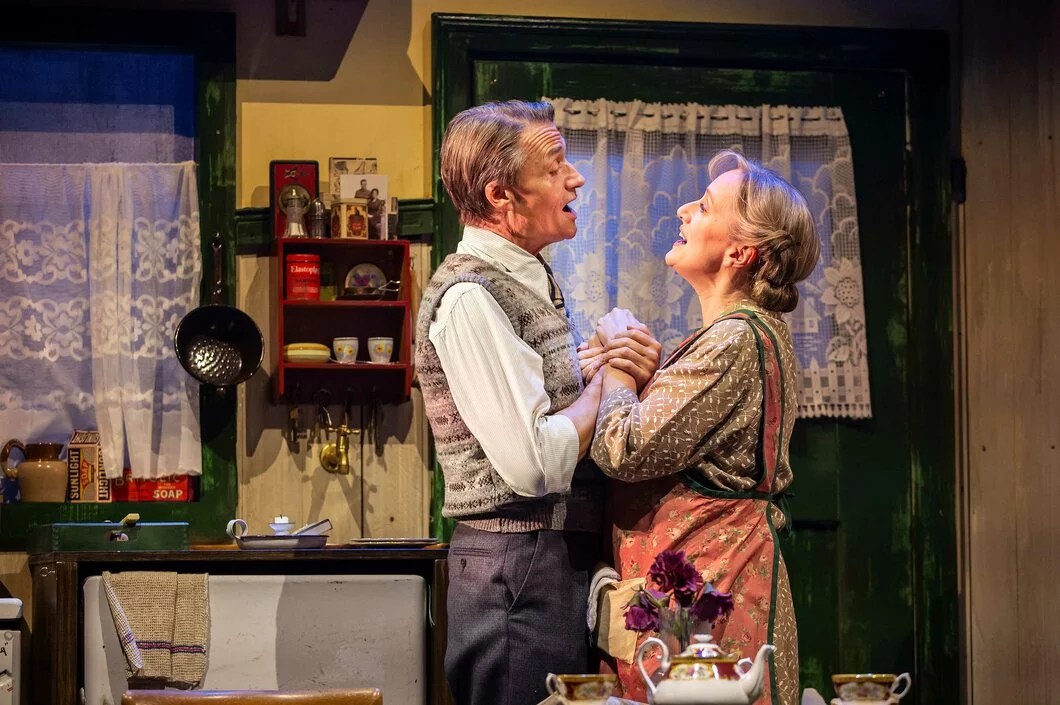
Set just after the Second World War, as directed with care by Bronagh Lagan (The Duchess Theatre/West End’s Cruise), the energy of the rotating home of Ada and the gentleness of Russell shines gently, encapsulating post-war London and the hardness of life on those cobbled streets. Ada Harris, as portrayed most generously by Russell, shares a lovely engaging moment with her kind husband, Albert, played tenderly by Hal Fowler (West End’s Aspects of Love). The scene coaxes us into Ada’s love for him over tea at her kitchen table, as they lovingly discuss flowers, the value of a penny, and the ultimate meaning of love and personal satisfaction. Yet, within those moments of engagement, we can’t ignore the subtle tinges of mourning that seem attached to her heart. With rationing, blackouts, and bomb sites still very much a part of everyday life, it becomes clear that Albert did not make it back from the war. Yet, Ada finds that she still needs him here to fend off the disquieting emotions that are coming to the surface on, what appears to be, their wedding anniversary. She’s a strong focused positive-minded soul, especially in the hands of the magnificent Russell, but soon after learning the sad truth of his death, we are given access to her feelings of loss, albeit not exactly loneliness. It is there, in her inner strength that we find that tender engagement with her heart, and with this simple, yet caring musical adaptation.

It’s the perfect picture of a working-class household in the mid-1940s, filled with quiet care and a strong attachment. That is until the power goes off, as it tends to do from time to time. Albert disappears into the darkness, only to be replaced by Ada’s good friend, fellow housekeeper, and confident, Violet, played most perfectly by Annie Wensak (CFT / Noel Coward’s Half A Sixpence). This is how Ada is surviving, The two need one another with a casual desperation, as much as they need routine and work, and together these two fine actors find union and connection almost instantly. Times are tough for these two widows, and even though Albert has always urged her to take a holiday, sell his old watch, and treat herself to some happiness, she buckles down and uses work to satisfy her soul and give her some level of inner peace.
Ada Harris spends her days dusting, darning, polishing, and scrubbing. She uses her warmth and resilience to provide care and cheer for the people that she works so lovingly for; a retired Major (David McKechnie) with some bottled-up anger about corners and obstacles that get in the way of his inner joy; a depressed accountant Bob (Nathanael Campbell) frustrated with his life choices but too scared to try something else; a neurotic, struggling self-absorbed actress Pamela (Charlotte Kennedy) who Bob is secretly and shyly worships from a far; and an older Russian Countess (Pippa Winslow) who longs for a return to the inner comfort of her homeland. They all desire, struggling to find meaning in these difficult times and in their complicated situations, but all are too afraid or nervous to act.
Round and round they hopelessly circle, complaining to Ada, but struggling to make a move. We feel their pain and desperation, yet somehow, even with some fine performances by this crew of actors playing double duty (they fare much better in Paris), we struggle as well. It’s difficult to find the unflinching empathy that Ada does, as she tries with all her heart to breathe hope and life into their tortured souls with her unending positive outlook. It is clear that this is the very thing they need from the maternal Ada, but, on this one particular day, when a Dior dress appears before her, something changes for the earthbound Ada, something that she never saw coming, and never would have believed was waiting for her around just the type of corner that the Major is so distrustful of. Ada is the one who needs to want something now, and she has to find the courage to fly forward. To bloom in a way she never knew she needed to.
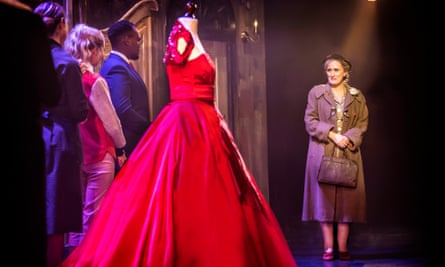
When we first meet Ada, she is a content woman, cleaning up other people’s messes with maternal care, and spending time after a long day’s work engaging simply her best friend Violet. But that glimpse of something else changes everything. It’s a vision of something so beautiful that Ada has a difficult time taking it in. It enlivens this woman and sets her off on a journey of discovery and engagement that will shift all those around her, including us, even if we know this tale already from the book or the most recent film version (starring a wonderful Leslie Manville). “If you hate the thing, change it“, she says, and after seeing the colorful vision, Ada’s outlook and direction are forever altered. And it comes when she least expects it.
Ada, for the first time in her well-structured simple life, comes face to face with something that sits most beautifully and firmly outside the simple pure existence she lovingly embraces, and she is dumbfounded. She stares, barely able to take it in. Hanging like a piece of art (“It is a piece of art“, she discovers), a ravishing Christian Dior dress, at first glance, sets her head spinning and her world flipping. Its beauty throws her off balance, enchanting her to such a level that she decides quite suddenly to alter her pathway forward. Even if no one in her life understands, and why should they, she can hardly understand it herself, as it is “foolish to the core“. But is it?
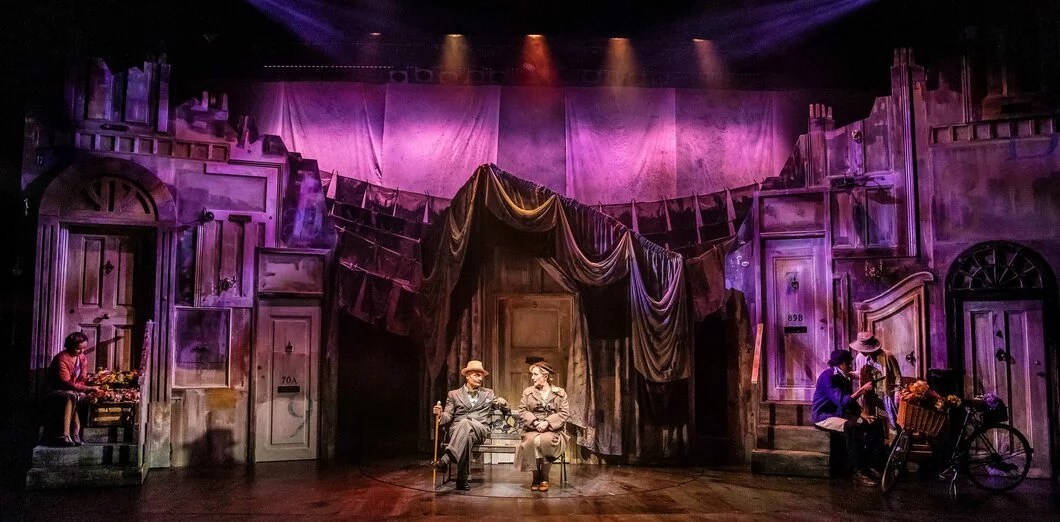
The gloominess of London is all over that stage, draped and hanging in the background, grey and functional, designed almost too literally by Nik Corrall (The Who’s Tommy at Greenwich Theatre), with gentle lighting by Adam King (The Mack Theatre’s Oh What A Lovely War). The space is a wall of doorways, opening and closing to opportunities that are taken, and sometimes not. It almost looks like a typical British farce (similar to the West End production of Noises Off I saw the night before), but these doors are crafted more for a symbolic sense than a comedic routine. Ada Harris grabs hold of that magical epiphany that she has been given, and her mindset is forever changed. She hasn’t thrown away her values or herself for the chance to wear a Dior dress, but discovers something inside her that wants, for just the sake of wanting beauty and art in her life. It doesn’t make sense to her best friend, Violet, at first. Why would it? Ada struggles to understand it herself, but Russell shines out exquisitely. It’s something monumental; Ada’s inner truth of needing something just for herself, and in the most unselfish way possible brings Violet back into her fold as we all rally behind this impossible venture.
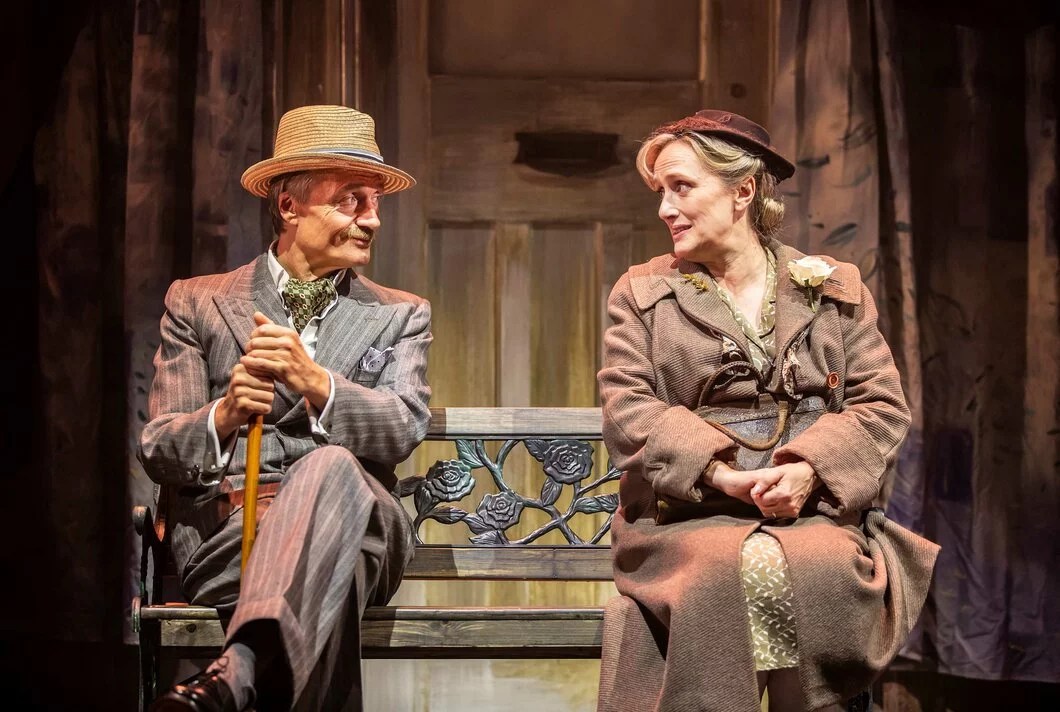
She gives in to Albert’s plea, finally allowing her to treat herself to something that simply gives her pleasure, without losing her core sense of self. So off she goes, on a hard-fought journey to get herself to Paris so she may purchase an evening gown; a gown that has no place in her life. It doesn’t make sense, to her or to Violet, but in her determined desperation, sticking out like flowers in a vase, there is an inspiring nonsensical mission to do something more than she ever dared to dream. Something that is “made to make you feel a different way” about beauty and life. But how can a life made up of numerous ‘three shillings per hour’ slots ever deliver her the £450 it would cost to fulfill her Parisian dream? She has no other option than to find a way, so Ada, with the help of the now-convinced Violet, dive in relentlessly, working as only they know how. With a little bit of luck, and after 2½ years of sacrificial hard work and determination, Ada achieves her dream, boards a plane, and is off to Paris on a day trip to purchase a dress that means much more to her than any dress could or ever would.
Capturing the kind humanity of the Paul Gallico novella on which it is based, this revival, with a smartly arranged book by Rachel Wagstaff (West End’s Birdsong) and a somewhat stirring (but also somewhat unmemorable) score by Richard Taylor (West End’s The Go-Between), lovingly attempts to find some echoes of Sondheim’s melodic complexities inside the natural interactions of Ada’s world. We hear the stitching, but it never fully engages as clearly as it does in Sondheim, at least in Lagan’s unraveling. The music and lyrics by Taylor do float out with a caring energy like a sweet floral scent carried on a gentle breeze, but without grabbing hold. Yet, with Russell leading the parade to Paris, it does find its way to feeling mostly genuine and engaging, “Shirt by shirt, shawl by shawl.” Russell’s Mrs. Harris is clearly the emotional and sentimental core of this show, delivering the goods honestly and clearly, matched most touchingly by Fowler’s Albert and Wensack’s engaging Violet. It’s melodic and touching, and although it is not an inspirational revelation, the kind gentleness that is at its core is a spectacular testimony to Russell and the way she embodies Ada’s positive outlook and warm-hearted nature.
The first act cuts in wisely to the fabric of the show, laying out the pieces that act two will sew together. There is a location shift, and London finally fades away, and becomes Paris in Act Two. Unfortunately for this production, they have not swapped out one identifiable skyline for another. All remains grey in the background, with far too little of a shift to really draw us into this other, more magical world. We have to work hard to fully capitulate, and feel the excitement that Ada is experiencing as she makes her way into her dream state, the Dior store. Not surprisingly, she doesn’t quite get the welcome she imagined. It’s clear she doesn’t look the part, just ask the French cleaning lady (Annie Wensak doing double duty) who doesn’t know quite what to make of her. Those in power arrogantly treat her with disdain and ultimately wish she would just go away. But we know Ada’s superpower, even if she doesn’t quite know it herself (and maybe that is part of it), and through her empathetic engagement and honesty, she finds the sentimental heart in all those who, at first, had dismissed her.
The well-tuned cast dutifully plays double duty in Paris, with very different, yet similar themed roles. Kelly Price (Menier’s The Secret Diary of Adrian Mole) rises up beautifully portraying a sophisticated ‘vendeuse’ with a warmer heart than first anticipated. “Every woman is a princess, n’est-ce pas?” she states, eventually, while Charlotte Kennedy (West End’s Les Miserables) surprisingly finds a somewhat more relatable and engaging role as a couture model missing chocolate cake and a simpler, kinder life. Nathanael Campbell (Manchester Royal Exchange’s Guys & Dolls) finds greater authenticity as a Dior account manager who awkwardly (and a bit over-anxiously) loves the beautiful model from a distance; David McKechnie (West End’s Chicago) plays a pompous manager who doesn’t have a charitable heart anywhere to be found; and Hal Fowler transforms himself miraculously from loving English husband into a Marquis who is equally as captivated by Ada’s lovely and gentle nature. The cast finds more depth in Paris than they have created and unpacked in London, drawing us more in, possibly because we have aligned ourselves more fully with the slight discomfort that Ada, as worn by Russell, has to figure out while hanging around the streets of Paris. Or maybe their parts just make more emotional sense in Paris.
I’m not sure, but as the couture dresses float in, descending down those (not so visually) elegant stairs with a poor attempt at grace and beauty, we can’t help but feel this disconnect. This is where the production doesn’t really do the show justice, never feeling like we have truly been transported far and away from what Ada knows and lives through daily. The clothes on the wire still hang in the background, and the greys of London still hold their sway over this doorway setting. A time when it really needed to match Ada’s wide-eyed delight. Costume designer Sara Perks (Mischief Theatre’s Mind Mangler) works hard to bring forth the glamour of Paris, as best she can, but it doesn’t quite do the trick, seemingly carrying some of the same limitations that the set designer had to deal with. But Russell keeps the emotional core true and beautifully balanced, even while clutching tight to her handbag as she is swept away in a Dior fitting. Her voice continues to fill the space with the subtlety and shining strength required to keep us invested in her and this show.

It’s a tender and sweet story, one that won’t alter or challenge your view of musical theatre, nor will it expand that horizon, but the lovely care delivered by Mrs. Harris remains, as does the discomfort and heaviness of her newly made friends as it parallels what she has left behind in London. Russell manages to squeeze every moment of kindness out of every touching detail, as director Lagan arranges the power around her gentle approach. Lives are altered by her kindness and attention, and she leaves behind a beauty much greater than any Dior dress could, at every turn and gesture. It’s a loving arrangement to behold, and the message, although not very subtle, radiates a floral bouquet that is as simple as it is sweet.
Mrs. ‘Arris Goes to Paris is the title of Paul Gallico’s 1958 novel that was published as Flowers for Mrs. Harris in the UK. It was the first in a series of four books about the adventures of a London charwoman who transforms the lives of everyone she meets. The ending of this amiable musical drips in gentle sweet sentimentality that never feels overly florid, but that’s mainly because of Russell’s vulnerability. Her achievement is as pure as Ada’s outlook. Mrs. Harris seems to know a thing or two more about kindness and love than I do, and it was a joy to be swept up by Russell as has happened many times before over the years (Regent’s Park’s Into The Woods). It’s a perfect little adventure to dive into during my London Theatre Trip of 2023, especially after the rich heaviness of Donmar’s Next to Normal. Flowers for Mrs. Harris didn’t whip up tears like the press quotes suggested it would, but it didn’t disappoint either. Russell deserves all the flowers and accolades she gets in the end. I only hope Ada comes across my doorstep one day, I could use a good housecleaning and a dash of her loving attention. But who couldn’t?

 front mezz junkies
[…] Flowers for Mrs. Harris the Musical Blooms Bright at Riverside Studios […]
LikeLike