The Off-Broadway Theatre Review: Ruth Stage’s Lone Star
By Dennis W.
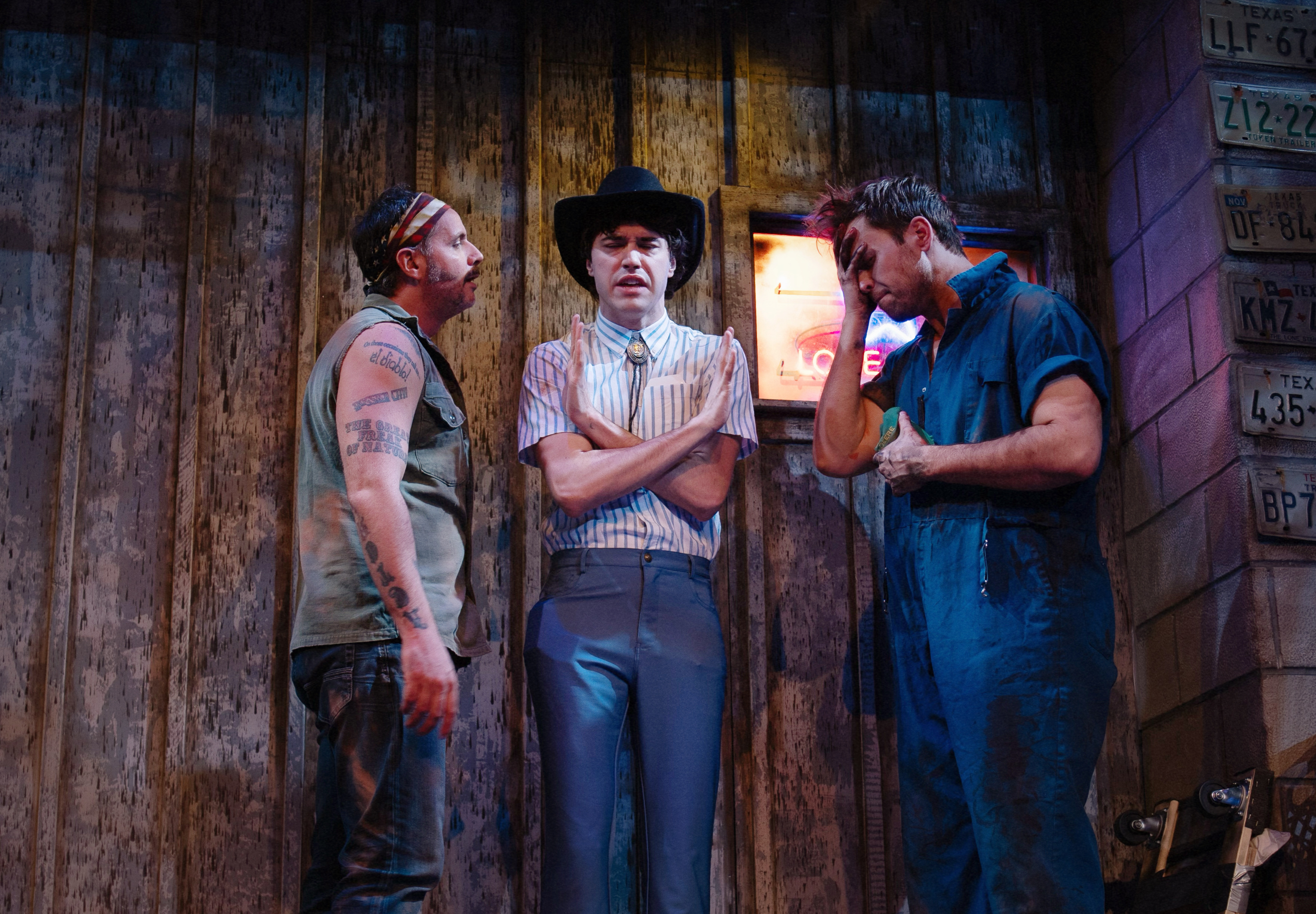
Hey, grab yourself a six-pack and head out to Angel’s Bar (at NYC’s Theatre Row) where Ray, Roy, Cletis, and Elizabeth will meet you in the backyard. It’s just a place to hang out, where tired old lawn furniture and a few milk crates hiding in the scrub go before they retire to the junk pile. It’s the early 1970s, and there isn’t much to do in the backwater town of Maynard, Texas, as a matter of fact, the town almost disappeared not too long ago.
The main players, Roy and Ray, in Ruth Stage’s Lone Star written by James McLure (Original Adaption by Ruth Stage) seem to be the brothers. They exist here, living out a dark comedy about a psychological casualty of war who comes home. It begins with a substantial monologue and mini-concert by Roy’s wife, Elizabeth, played by Ana Isabelle (Off-Broadway’s I Like It Like That). She is trying to save her marriage to her high school sweetheart, a former soldier who came home from Vietnam two years ago and suffers from PTSD (which was not even acknowledged by the military until the 1980s). Isabelle gives an adequate performance but it feels very odd that she is alone on stage talking about how her husband’s condition has and is affecting her, him, their life together, their family, and their strained marriage. What’s odd is that when she’s finished she leaves, not to be seen again, until just before the final curtain.

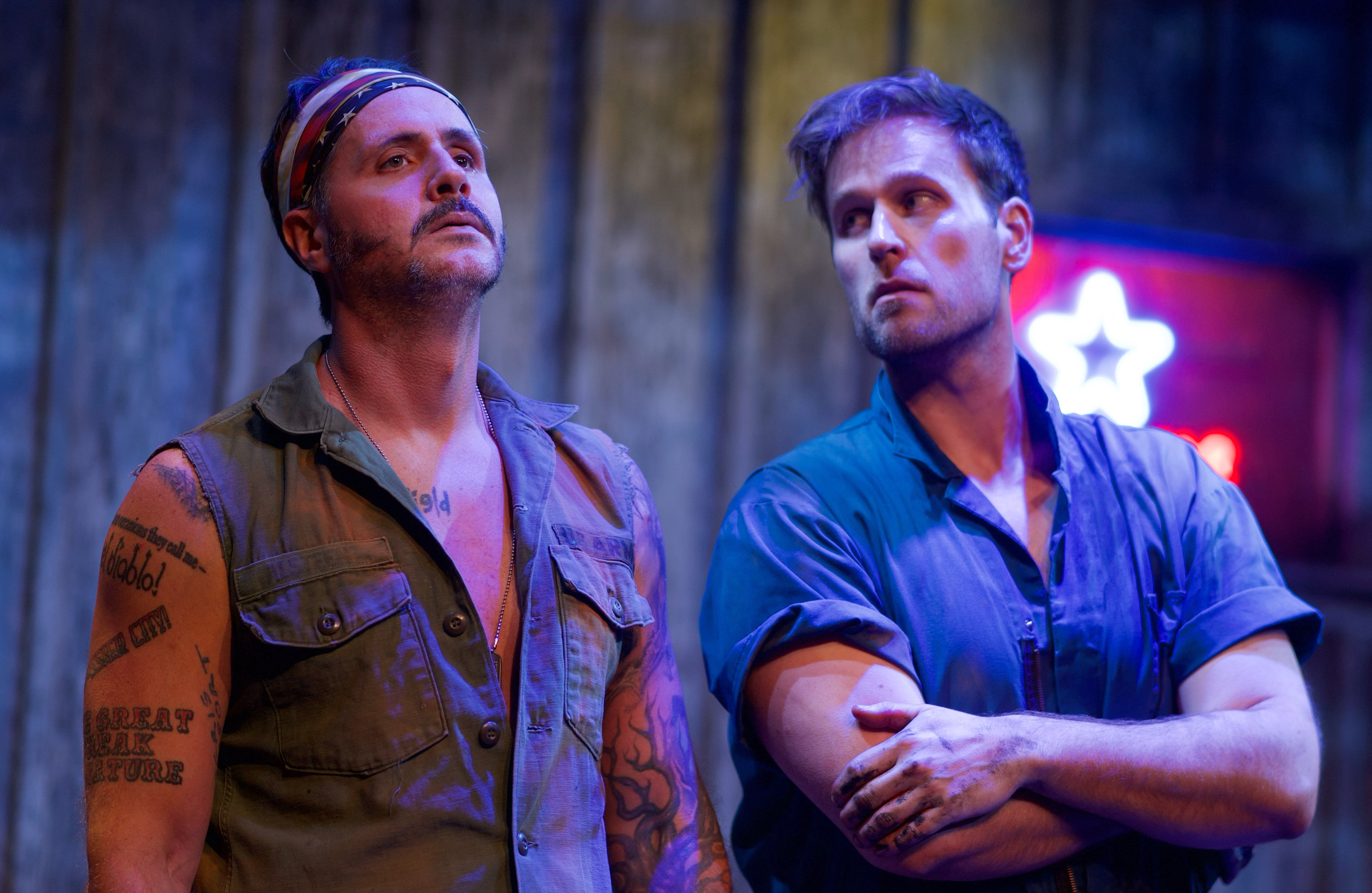
Ray, the somewhat dimwitted brother, played by Dan Amboyer (Netflix’s ‘Uncoupled‘) arrives first in the backyard of Angel’s Bar. Amboyer seems to have captured the “not so bright” tone of the younger brother who isn’t as dumb as you might expect. He’s actually pretty smart in handling some surprises that are about to unfold. Ray is followed out in the backyard by his alpha male brother, Roy with tattooed arms, a shirt with cut-off sleeves, and a bandanna, played by Matt de Rogatis (Off-Broadway’s Cat on a Hot Tin Roof). The two “good old boys”, Ray and Roy (their names tell you a lot about them and their family as Ray points out), gear up for a night of beers and man talk. Tonight’s conversation begins with the questions; where was Roy and what he was doing these past two days after disappearing without a word – not that he hasn’t done that before. There’s a lot of hollering as the two boys talk about the good old days, Vietnam, Roy’s pink 1959 Thunderbird, sexual exploits, and love of country. The actors have good chemistry and you can see their combative sibling relationship living and breathing before us. It’s strong and honest, as they reminisce about growing up and raising hell together with Roy taking the lead, but all this talk doesn’t seem to take us anywhere new. Most of it is a rehash of what we found out during Elizabeth’s opening monologue.
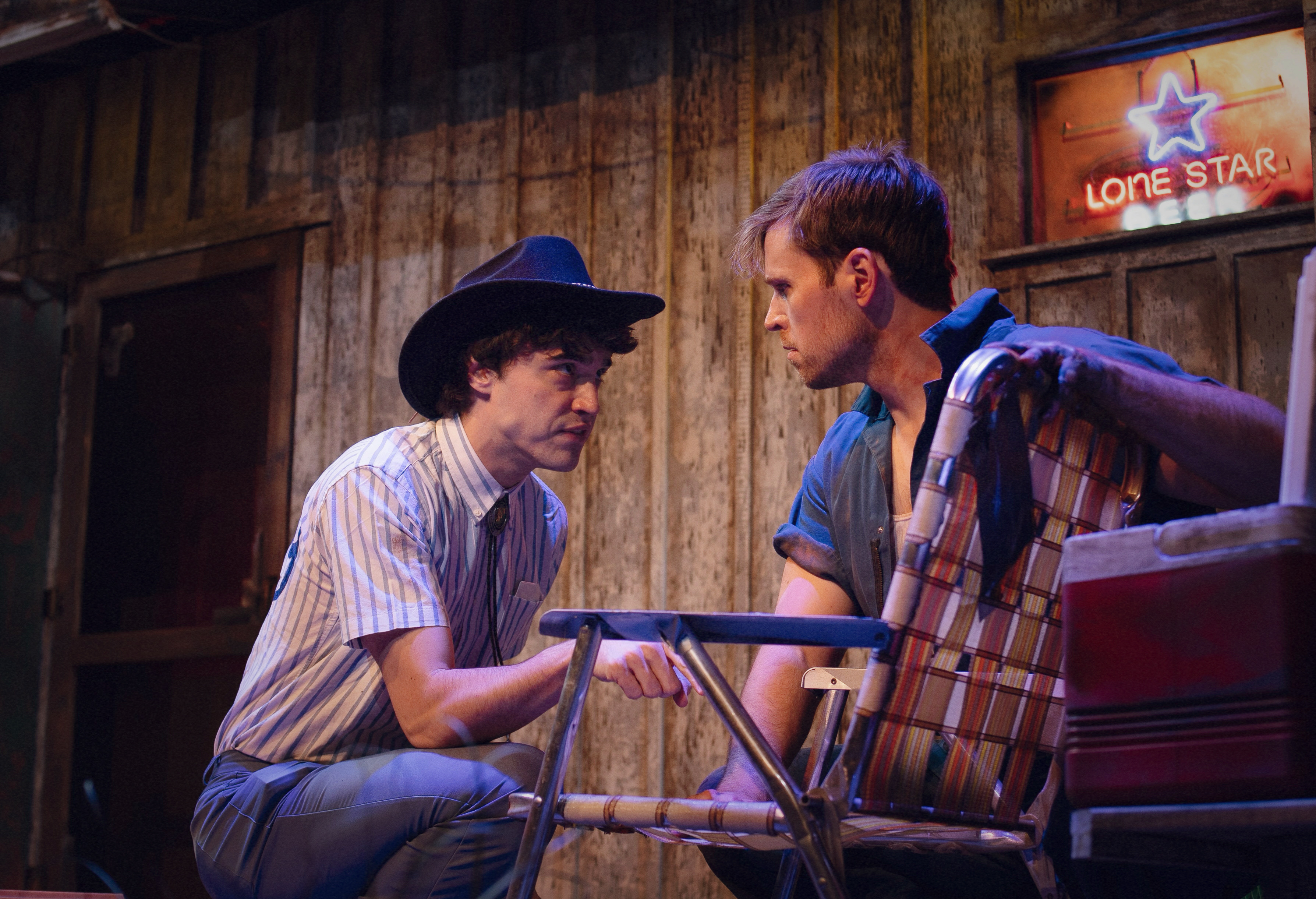
Finally, there is some tension: Ray’s high school friend, Cletis, who Roy hates with a passion arrives. He’s the antithesis of Ray and Roy, and as played by Ryan McCartan (Roundabout’s Scotland, PA), Cletis is exactly what you might expect. He’s the perfect nerd with high-water pants, a buttoned-up shirt, loafers, and, of course, a pocket protector filled with pens. He comes in with what should be catastrophic news for Roy, but Ray has his own bombshell to toss into the mix. You would expect fireworks, especially from a veteran who is suffering from PTSD, but what you actually end up getting is ‘good old Roy’ who puts his arm around his brother’s shoulders and heads on home. You get quiet defeat. But, who knows how long that will last.
Director Joe Rosario (Off-Broadway’s Cat on a Hot Tim Roof) only has a small space to work with on that stage as designed by Matthew Imhoff. The set fills much of the space giving the effect of a rundown bar with the back door of Angel’s opening to a small porch leading to a narrow yard with ample clutter. Rosario’s direction is a bit linear but works within the space available.
Lone Star loses its way as it propels forward, with slow brother Ray not really as out of touch as he seems, macho Roy dealing with the trauma of PTSD, long-suffering Elizabeth, and the nerd Cletis, who’s managing his father’s appliance store and is better off than the brothers. In many ways, the evening that we are privy to, out back behind Angel’s chugging Lone Stars, seems to be just like yesterday and probably just like tomorrow, even with all of its Lone Star revelations.

 front mezz junkies