
The Off-Broadway Theatre Review: A.R.T./NY’s Shadows
By Dennis W.
A.R.T./ New York Theaters recently hosted a Face to Face Films production of the world premiere of Anthony M. Laura’s new play, Shadows at the Jeffrey and Paula Gural Theatre. It sets out to explore the life of professional singer Lindsy Elle Cooper, played by Katia Mendoza, making her off-Broadway debut, who finds her life at a turning point. Her career is flagging and her personal life is about to experience a huge change. As she attempts to get her singing career back on track by touring with the much younger and more successful pop star 13-year-old Jessa King, played by Alexandra Rooney (Off Broadway’s Girl with the Red Hair), Lindsy’s life takes a huge turn when she meets former ballet dancer Kensley Lennon Coleman, played by Annie-Grace Payne also making her off-Broadway debut, who turns out to be the love of her life. But, as fate would have it Kensley has “terminal cancer” and Lindsy has an early onset of Alzheimer’s Disease to complicate both the love story and Lindsy getting her career back.
Playwright Anthony M. Laura, who also directs, took on a big challenge to pack all this into one two-act play. The complicated back story is treated as an aside as it is almost non-existent except for a few lines of dialogue about Lindsy’s meeting Kensley after a concert and how Lindsy and her sister Ariana Cooper, played by Colleen Wright, need the money from the tour. Laura says his goal for the play is to explore “what happens when two incredibly unforeseen and tragic events occur simultaneously and how it impacts our love of each other and the world.” But the events don’t seem to happen that way since Lindsy’s early onset isn’t really diagnosed until the second act when Kensley has already died.
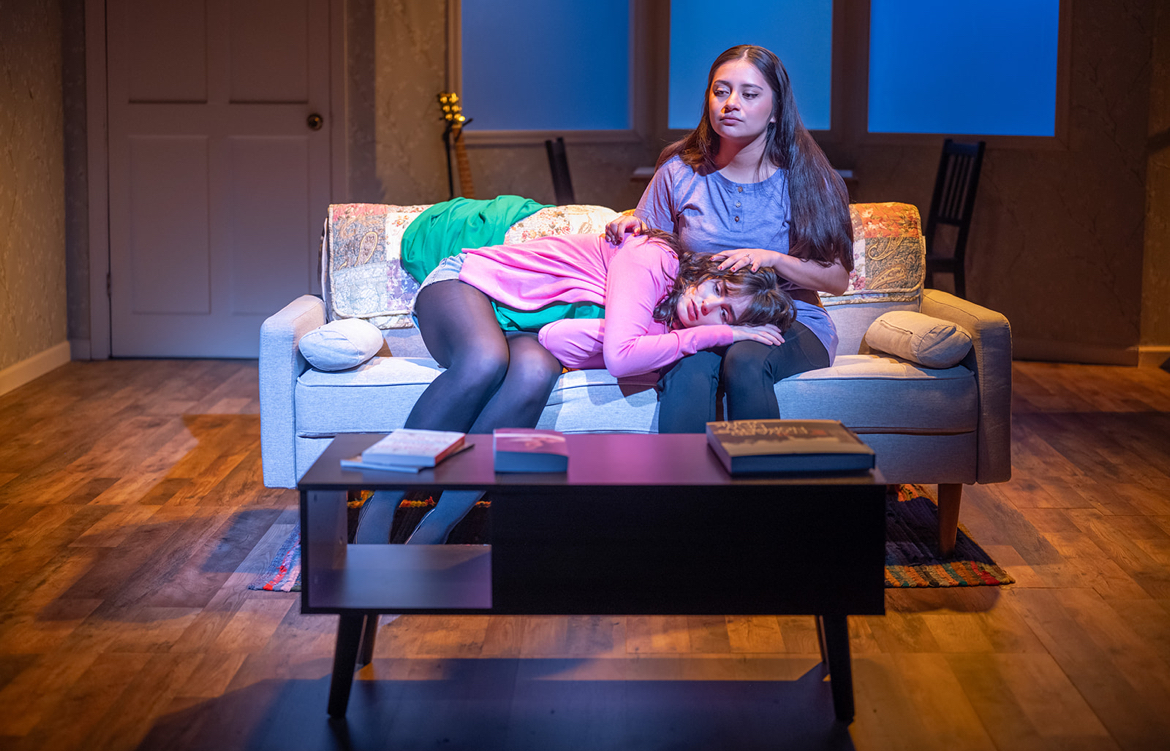
Mendoza’s Lindsy falls short of the very difficult task set forth before her. Not only is she a pop star on the decline with money issues but she has a girlfriend who is dying of terminal cancer. That’s a lot, even before knowing about Lindsy’s own diagnosis. Mendoza and Payne, who plays her love interest Kensley, don’t seem to have any chemistry, especially in the love scenes. The linear direction doesn’t allow them to be naturally flirtatious with each other. They are both a bit wooden; not embracing their love story or one another in any emotional manner. Payne has a terminal illness but we don’t see any evidence of it as we move from diagnosis to the decision to put her in hospice care. Her character remains constant with no emotional swings or any physical indications of decline. She plays a former ballet dancer but we don’t see that in her physicality. She doesn’t carry herself like a dancer but part of that could be costuming because she’s wearing ballet slippers that are made for dancing not walking. Mendoza’s acting came to life in the second act, especially in her Alzheimer-related monologues examining the progression of her disease. In those moments, she infuses her words with panic and terror. I only wish that she could have brought that kind of commitment to her other relationships.
The set design by Hayley Wallenfeldt misses the mark and doesn’t help reinforce the story. The sterile traditional living room and bedroom resemble a furnished apartment, not a lived-in home. It’s a bit tired and dated. The script says she’s living in her childhood home that she shares with her sister/manager who is also a musician but it is devoid of any connection to the entertainment business. All we see are a couple of record awards tucked away on a bedroom wall even though her mother was described as a kind of stage mom. There is no costuming credit which is noticeable because each character has one outfit for act one and another for act two. Mendoza even sleeps in her hers and does the entire play in stocking feet, which is distracting.

Laura’s Shadows is an ambitious play, weaving together a complicated back story with the trauma of two catastrophic diseases, yet we don’t really see the intertwining of this kind of trauma with love in our characters. Lindsy and Kensley are both very stoic about Kensley’s cancer diagnosis, and there are no emotional scenes about what’s ahead for her treatment or her death. Laura says his goal is to “allow the audience to leave having not witnessed tragedy but love” but unfortunately that ideal is not realized. Kensley just isn’t around to experience Lindsy slowly seeing her life disappear.

 front mezz junkies