
The Toronto Theatre Review: Canadian Stage’s Hamlet in High Park
By Ross
The first few moments of Canadian Stage’s Dream in High Park production of Shakespeare’s Hamlet takes its time, extending just a little too long for an opening (and a little too short in the bigger scheme of things) for my liking. But the staging certainly draws us, elevating the energy in the air with a mystical musical edging and a foreboding that gives us hope for what wickedness might come from this production crafted with a quick footing by director Jessica Carmichael (Shaw’s The Clearing). Edited down into a packed and tight under-2-hour event, the unraveling of this tormented prince meanders in and gives us an entry point that is sharply different from the original. With a compelling wandering and the surprise inclusion of the fine Ophelia, played quite beautifully by the engaging Beck Lloyd (Theatre Rusticle’s The Tempest), this Hamlet is stirring the pot with an altered vantage point to peer in, and I must admit, the idea was intriguing.
The edited formulation, set in a non-descriptive timeframe against the tumultuous backdrop of political intrigue and familial betrayal, excitedly delivers the iconic tale of Hamlet with expressive energy and engagement. It hurriedly follows the young man, played with solid intent by a strong Qasim Khan (Coal Mine’s Hedda Gabler) as he grapples with existential questions of life, death, and revenge. But here, the play and the direction draw us into the fray with Ophelia’s sing-song lines spoken early on, teased out from a much later time in the play and plot. She wanders through the crowds, holding a bouquet of sticks, leading us to wonder where this rearrangement is leading us. Is she going to be our ghostly guide through the tragic tale of her Hamlet? Or is the foreshadowing a device formulated to add a layer of awareness that we will understand later on? I can’t say, to be honest, even now, days after witnessing the production, but it did pick me up and make me lean in with a curiosity that normally isn’t associated with this well-worn play.

The music, orchestrated by sound designer Chris Ross-Ewart (Coal Mine’s The Sound Inside), sets the mood, ringing and chiming in a feeling of mystery and dread as if the guard had seen a ghost. Which he tells us he had, nights prior. He, Barnardo, peers out into the abyss searching for something or someone, leading us to peer out with him as the play, and our butts, settle themselves for the beautiful night ahead. The opening does the trick, quieting the crowded outdoor stage filled to its edges with audience members ready to be swept in and away. “Murder most foul” is described in the unweeded garden, a strongly gated product courtesy of set and costume designer Joshua Quinlan (Stratford’s Casey and Diana), with a solid lighting design by Logan Raju Cracknell (Bad Hats/Soulpepper’s Alice in Wonderland), as the guards (Prince Amponsah as Barnardo and the underused Breton Lalama as Marcellus) and the finely crafted Horatio, played with clever understanding by Stephen Jackman-Torkoff (Stratford’s Richard II), give in to a ghostly watch and engage the framework with an expert tongue.
“Answer made it none,” they inform Hamlet, as they draw him out and into the framing, unaware of the uncertainty and tragedy they are delivering into his hands. But the ghost floats in, played mysteriously well by James Dallas Smith (Soulpepper/Native Earth’s Where The Blood Mixes), that is until he removes his ghostly mask. In those moments, the mystery that was created and hanging over the figure in the night air dissipates, giving the apparition a more human-like energy, and surprisingly, erases all the fantastical misty energy that the production had so masterfully mined. But it is only a minor bump on this pretty short road to tragedy and ruin, but it does foretell a fault line that never fully disappears into the night.

As the newly married and crowned royal couple take their place, Hamlet’s mother, Gertrude, played by the always reliable and forever fascinating Raquel Duffy (Coal Mine’s Appropriate), and Hamlet’s power-hungry Uncle, now Step-father and King, Claudius, played wisely and wonderfully by Diego Matamoros (Tarragon’s Post-Democracy), excel at creating a desperate edge and regal holding, filled with a desire for stability; not by creating it, but by demanding it of all those around them, including their troubled Hamlet. The framing and speed of the production seem to work in an exhilarating manner, at least for the set-up but somehow falters within itself as it moves forward towards the clash that we all know is coming.
The pacing flies fast and efficiently through the text, giving us, for example, several interesting vantage points to take in, like the father/son dynamic of Sam Khalilieh (Tarragon’s El Terremoto) as Polonius, and a somewhat awkward and inauthentic Dan Mousseau (Soulpepper’s The Seagull) as Laertes. The murdered Polonius is given an interesting framing in his exit, guided by Hamlet’s ghost as if he is the cloaked figure of Death in the bigger sense of the title. It was a bit clumsy in its handling, yet the idea is compelling. As was his symbolic fabric corpse pulled away by Hamlet only to be left halfway up the stairs for the remainder of the play. It was given only a half exit, and I kept imagining that the production would have to address that situation at some point. But it never was, as if Polonius’ body was meant to remain on stage, half-removed for the duration. With no explanation or understanding of the ‘why/wherefore art thou’.
His son’s reentry in grief is also one that felt something more akin to drunkenness than an engaging pure emotional state. Failing to give him a weighted moment of emotional connection to his grief and, in turn, to us, as he steps into a murderous plot with, what seems, little coaxing or manipulation; a framing that is required for us to truly feel the tragedy of his death.
The periodless production does give us a generally appealing formula that plays out well across the stage, finding complimentary pairing in the cast. Delivered comically well by Amelia Sargisson (Centaur’s The 39 Steps) and Christo Graham (Stratford’s Grand Magic), we are gifted with a cute juvenile Rosencrantz and Guildenstern. They are both a welcome inclusion, even if they feel connected to a different type of production miles away from the one that is living and dying around them. Sargisson also gives us a more compelling view into a gravedigger, void of aging and history. It’s connecting and wise, filled with tender attachment, and in that skull-embracing moment, there is an emotional truth that is unearthed, bringing an understanding and truth for the quick ride forward.
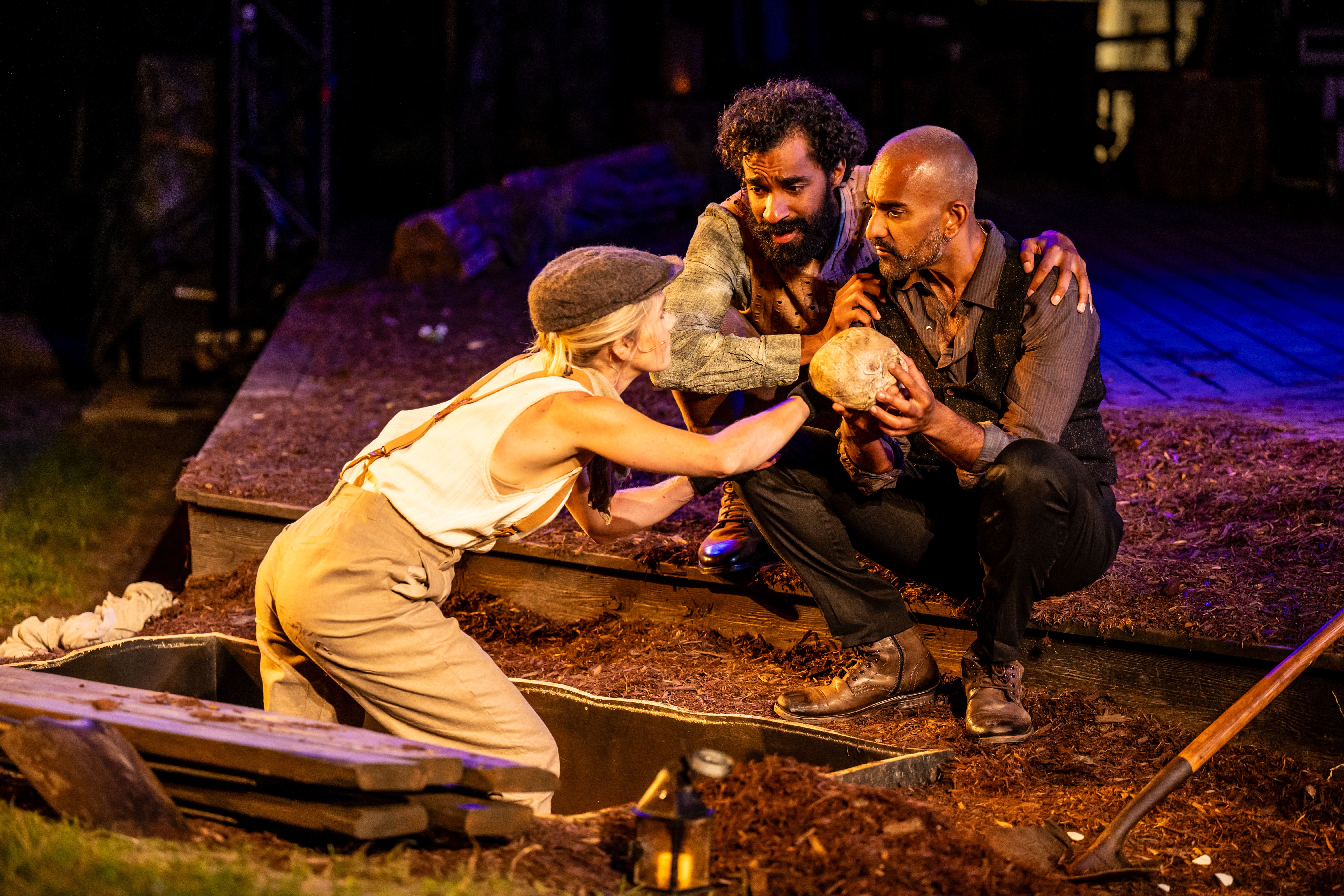
On my way home, after taking in the newly condensed version of Hamlet that Canadian Stage is presenting at the High Park’s amphitheater, I couldn’t help but be drawn back to rewatch Season One’s final episode of “Slings and Arrows“, a darkly comic Canadian TV show set in the fictional New Burbage Festival, a Shakespearean theatre festival similar to the real-world Stratford Festival. The show’s first season focuses on the staging of Hamlet, and the action movie star that was hired by the festival to star in their production. Through some Benedict Arnold maneuverings by the General Manager of the festival, aimed to sabotage the star’s performance and thus the production (and gain power and control of the festival, a nod to Hamlet’s mother, Gertrude, one might say), the movie star, played impeccably and deliciously by Luke Kirby (“Take This Waltz“), loses his faith and questions his ability to play this formidable Shakespearian lead. He falters, fleeing (unsuccessfully) to England, or LA in this case, much like the confused Shakespearian character he is trying to escape. (“You can use that on stage,” says his Ophelia.)
The reason that I love this television show is the way these characters talk about (and love) the text and those formidable plays. With the writers’ and the actors’ attention to detail and the undercurrents of emotionality, the show gave me a deeper understanding of those Shakespearean characters and the plays, inviting us in to share in their passion for creating meaningful art and theatre. Paul Gross’s character masterfully pulls the text apart and gifts the scared actor his devotion, direction, and understanding of the part, very much like he attempted to do with that ‘terrible’ actress (a very good Sabrina Grdevich) who is, before her tragic ghostly fall from the stage, tasked with playing Ophelia (watch that scene here). Luckily for us and everyone at the New Burbage Festival, her understudy, the magically Rachel McAdams (‘Mean Girls‘), takes over the part and delivers the goods extraordinarily.

On the play’s opening night, the magnificent Paul Gross (“Due South“) leads the nervous lead actor backstage through the play, guiding him in his understanding of the story, and informing him, much to his and our surprise, that “It’s not that big of a play. Think of it as six soliloquies. Count em off with me“. And he does, going through the six monologues as the performance drives forward, explaining, much to the relief of the movie star actor, that he just needs to nail these six speeches, and that everything else in between is just filler. If he can do that, everyone will go home happy and fulfilled. In many ways, he’s so right. But he’s also so wrong, in more ways than one can imagine.
In this abridged production of Hamlet, produced by Canadian Stage, shortened from its typical 3-hour+ running time to something just under 2 hours (without an intermission – bring a pillow, trust me on this), one of the biggest discoveries made is that all that filler in between isn’t exactly required to move the plot forward, but without it, we definitely feel the loss of the weight it brings to the play. All those deleted set-up moments are more required than we ever fully realized. They give the play its emotional grounding and the psychological landscape for these characters to fully stand upon. Without those ‘fillers’, those six soliloquies lose a lot of their weight and emotional depth, becoming something akin to well-known recitable pieces from a famous play that fill the air with our remembrance of them. They don’t deliver themselves into our hearts and minds when the ground they are meant to be built upon has been lost or edited away. Here lies the biggest problem with this Hamlet. As directed and revamped by Carmichael, when we take Shakespeare’s longest and most famous of his plays and cut it down to a more ‘manageable’ size for an outdoor intermissionless event, we feel the loss more than any grief that is being delivered on that stage.
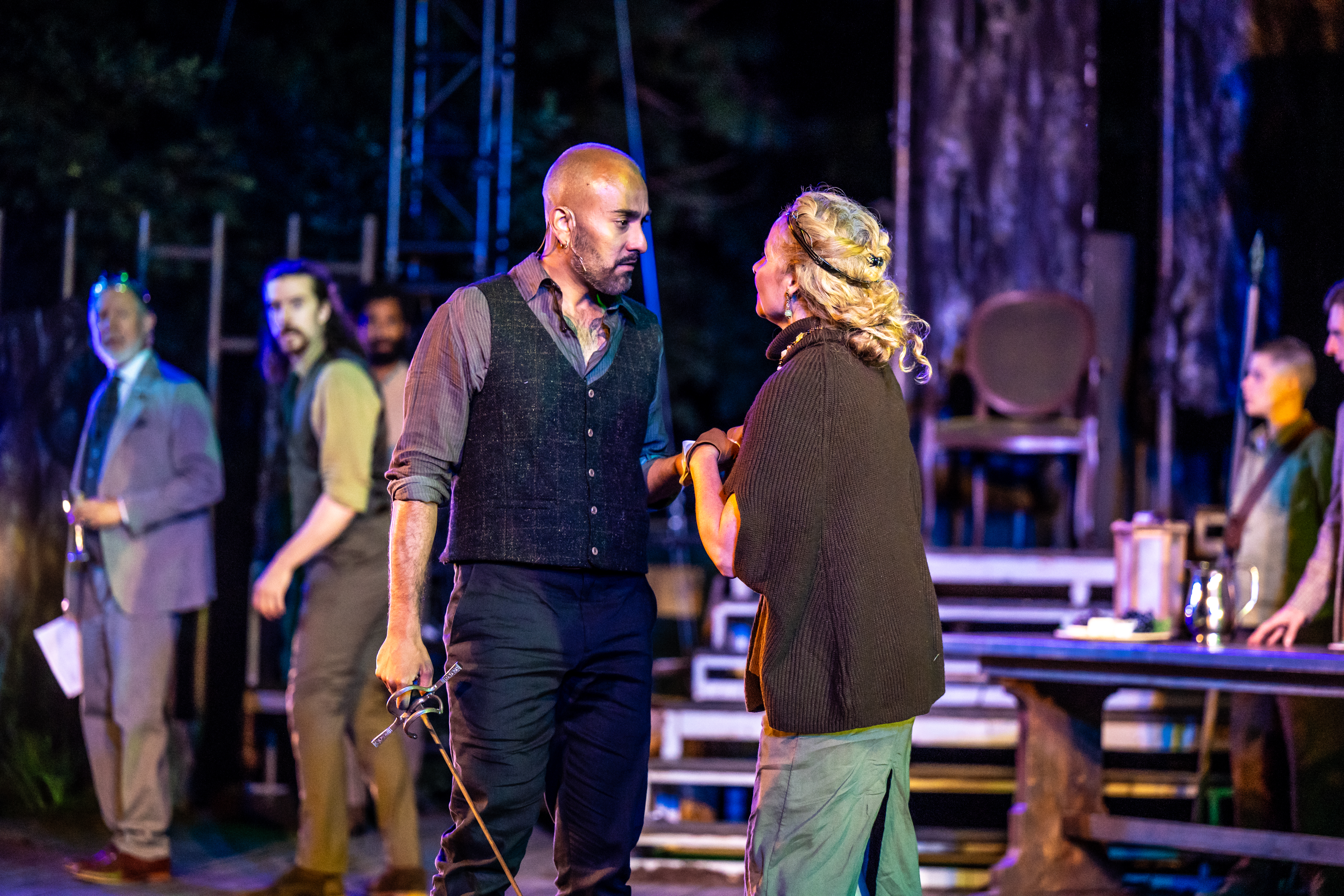
HAMLET runs July 21st through September 1st. Performances take place Tuesday through Saturday at 8:00pm with Sunday performances now offered at 7:00pm. For tickets and information, click here.

 front mezz junkies
[…] with a chaotic but focused eye by Jessica Carmichael (Canadian Stage’s Hamlet in High Park), The Born-Again Crow flies hard and fast into a mixed bags of nutritious symbolism […]
LikeLike
[…] the required comic joy to fulfill the task, like the playful Christo Graham (Canadian Stage’s Hamlet in High Park) in the very funny role of the young shepherd; Marissa Orjalo (Stratford’s Les […]
LikeLike
[…] into focus when a lawyer by the name of James Chesterman, well performed by Qasim Khan (CS’s Hamlet in High Park), stops by to inform him that he has been left a healthy sum of money in an […]
LikeLike