
The Toronto Theatre Review: Buddies in Bad Times Theatre’s Roberto Zucco
By Ross
The opening of Buddies in Bad Times‘ Roberto Zucco is as sharply unique and highly armed as possible, alerting us to sounds heard by their ears, and sneaky visuals creeping and lurking in the background. Elevating the chapter with resonating abstractionisms, two guards banter in a Beckett-like battle about the meaning of life and the impossibility of escape. It perfectly captures the nature of this forceful play. And our titular character, Roberto Zucco, the supposedly charmed hero who runs across the rooftops of this 1980s European prison setting that opens up this fascinatingly rich and absurdist dreamscape that alters and rotates itself around the man and the story that he participates within. Making his grand escape from an impossible-to-escape prison, much to the amazement of these two expert creations, this fantastically adept beginning of a compellingly complex and sometimes frustrating play by Bernard-Marie Koltès, with a creatively strong 1997 translation by Martin Crimp (Royal Court Theatre’s translation of Ionesco’s The Chairs), wall-crashes down magnificently on a mother coming face to face with her killer son who rarely stops his determined unwinding even when (or if) we get a bit lost in his fall inwards towards the sun.
Rarely doing “the things that people do,” Koltès, a French avant-garde playwright and theatre director best known for his plays: La Nuit juste avant les Forêts (The Night Just Before the Forests, 1976), Sallinger (1977), and Dans la Solitude des Champs de Coton (In the Solitude of Cotton Fields, 1986), ransacks the most complex of killer creatures forward into our compromised laps, and asks us to run with his evil self as he bounces from one violent attack to another. Based on the psychopathic killer and Public Enemy number one, Roberto Succo, the playwright’s final play Roberto Zucco draws us into the man’s grand escape through the dark and mysterious spaces of his complex abstraction without any profound introspection or insight into motive and drive.
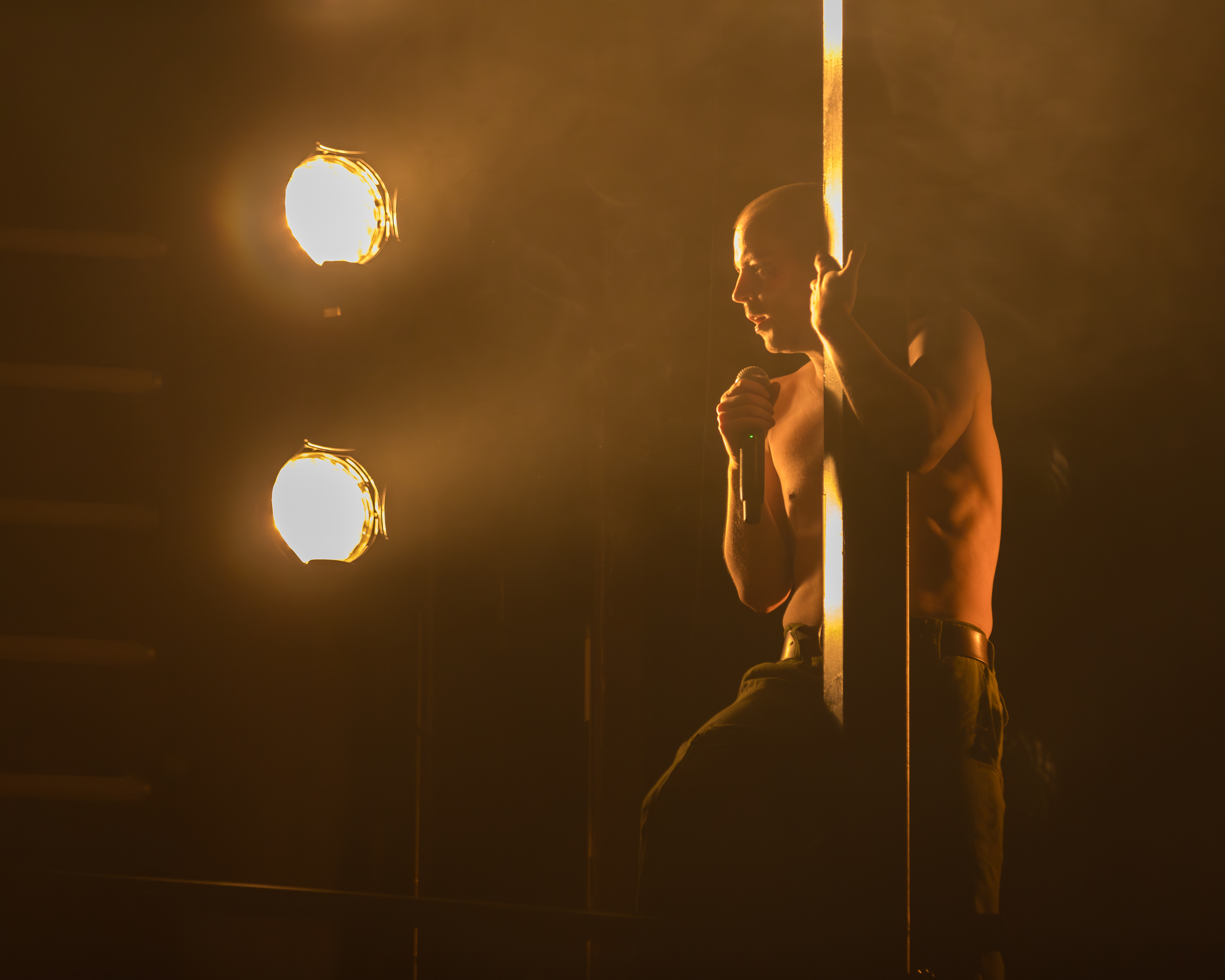
Smashing what others protect, Roberto Zucco, played with a strong sense of purpose by Jakob Ehman (Soulpepper’s Idomeneus), flings and climbs the pretty-faced killer through chaptered interaction after interactions, scrolled out in LED over (far too much) on the side. He vibrates with a desperate but convoluted determination to kill without guilt or compassion, ignoring the melancholy and the noir feelings drenched in pink. Written as he was dying of AIDS in 1989, Koltès doesn’t hold back from the cigarette-smoking complexity of this Greek tragedy descendent, that spirals out beyond the logical and straightforward. It’s a sordid tale of anger and pain, breathing into the violence with a darkly composed wit and sense of threat and danger.
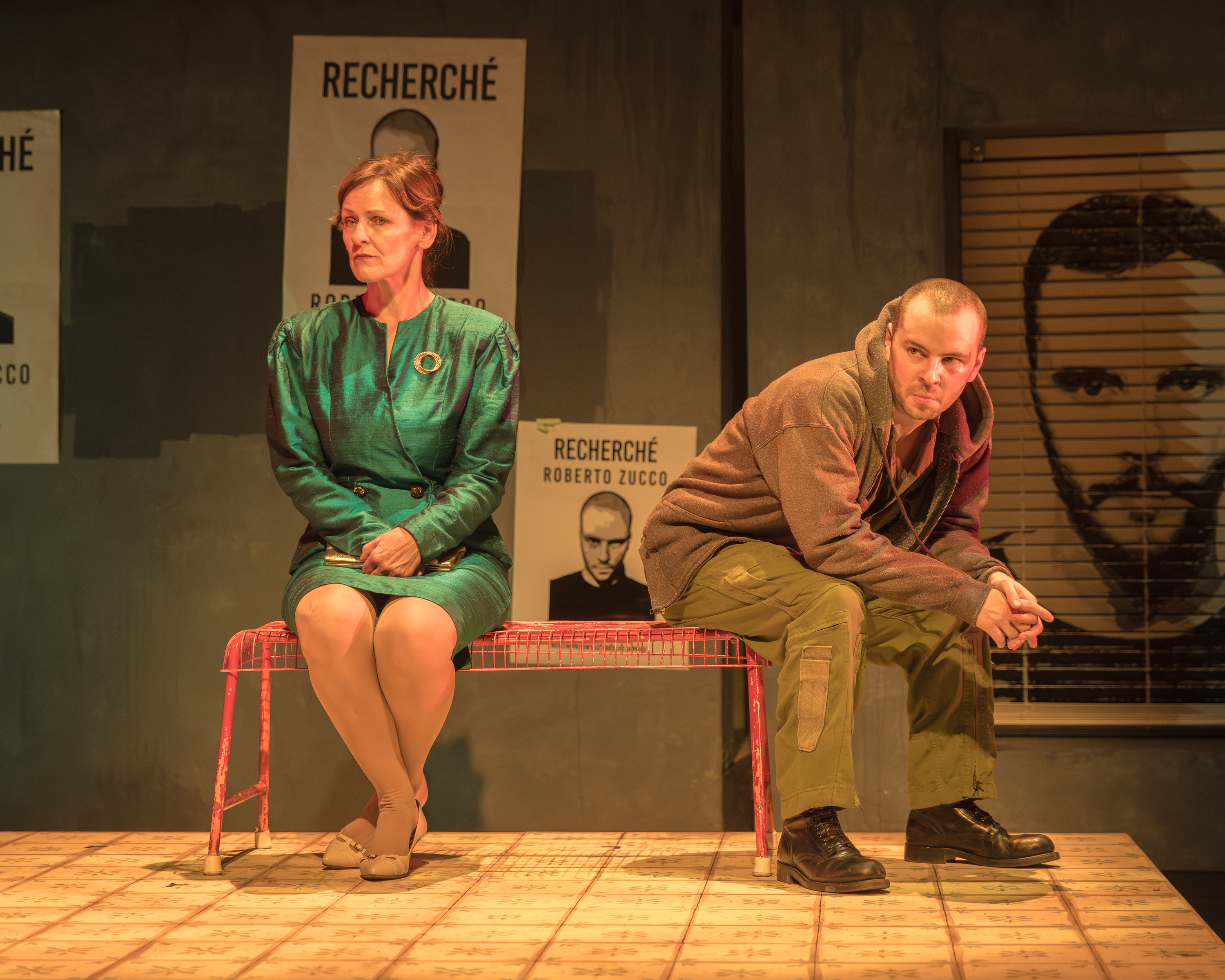
Directed with superb sharp intent by ted witzel (Paradigm’s Scavenger’s Daughter), the energy is unleashed on a miraculous segmented backdrop, painted and plastered with images that incite and warn. Accented to absolute perfection by costumes and set designer Michelle Tracey (Tarragon’s Behind the Moon), with captivating lighting by Logan Raju Cracknell (Studio 180’s Four Minutes Twelve Seconds) and a powerful sound piped in with great effect by sound designer and composer Dasha Plett (We Quit’s 805-4821), the play shifts and moves across an ever-changing landscape peppered with angry parents, desperate children in need, slightly empathetic call girls, and pimps that don’t care beyond the amount paid for a young woman being sold cheap by a compromised brother. The determined insightful cast; Samantha Brown (Studio 180’s My Sister’s Rage), Fiona Highet (CS’s Let’s Run Away), Daniel MacIvor (CS’s The Inheritance), Kwaku Okyere (CS’s Choir Boy), and Oyin Oladejo (Soulpepper/Obsidian’s Three Sisters), never disappoints, drawing out authentic, yet stereotypical cardboard-cutouts of characters that never fail to connect and divulge their complex intentions, even within a framing that is as segmented and unfixed as the back wall.
The play finds and unpacks formulas of absurdisms, first playing with a pair of well-cast security guards on a quiet night watch that is anything but, and then flowing into numerous monologues spoken to silent partners who stay mute to the barrage of words thrown their way. It’s “no easy job to be transparent,” inside a wonderland of well-phrased speeches delivered by well-tuned actors finding some sort of meaning in their ramblings. The actors excel in every role given, from ‘elegant lady’, a superb Highet, to ‘old gentleman’, delightfully embodied by MacIvor, against a wall of warnings as the police, beautifully and excitedly portrayed by MacIvor and Oladejo, meander garrulously in their search for the killing spree criminal.
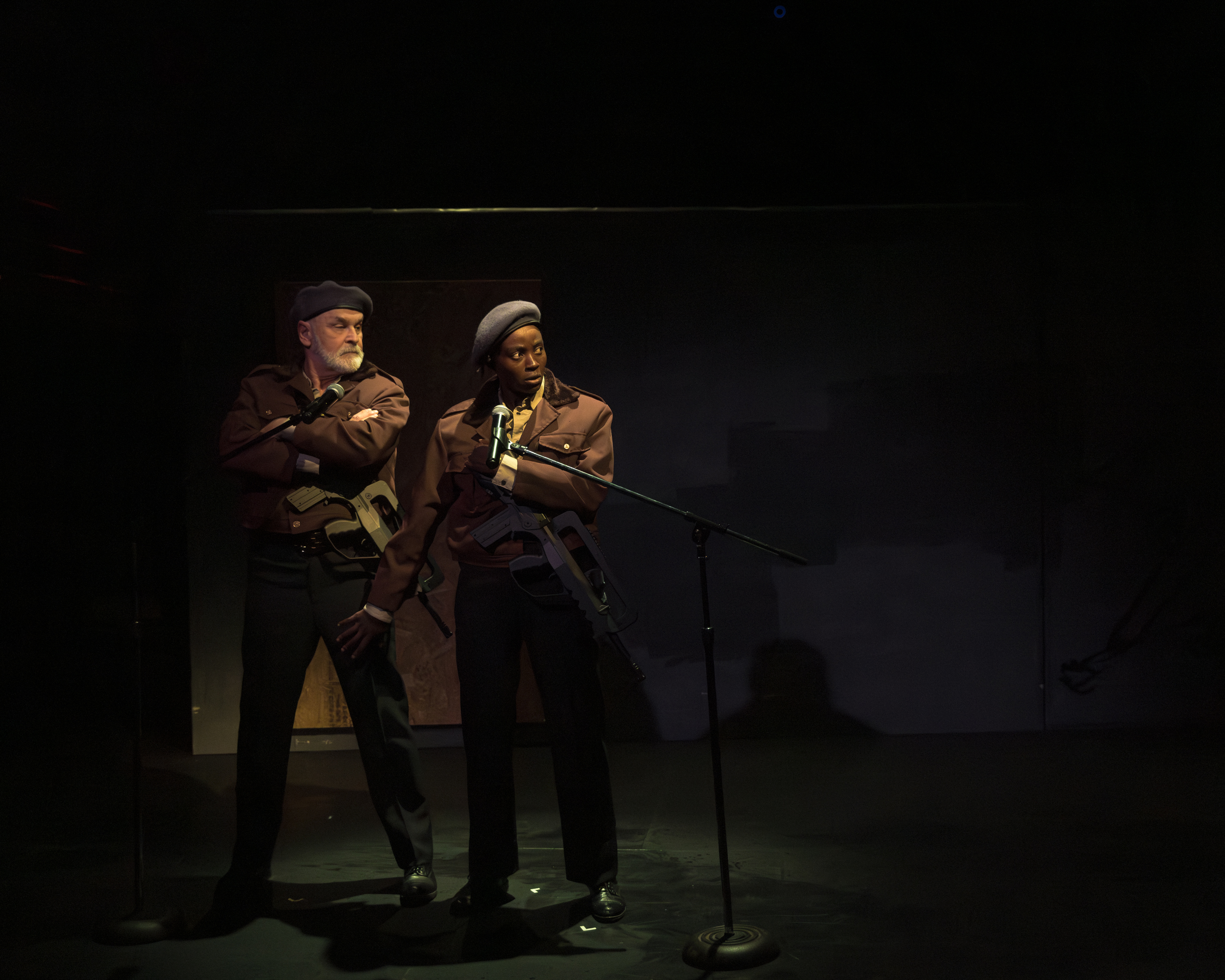
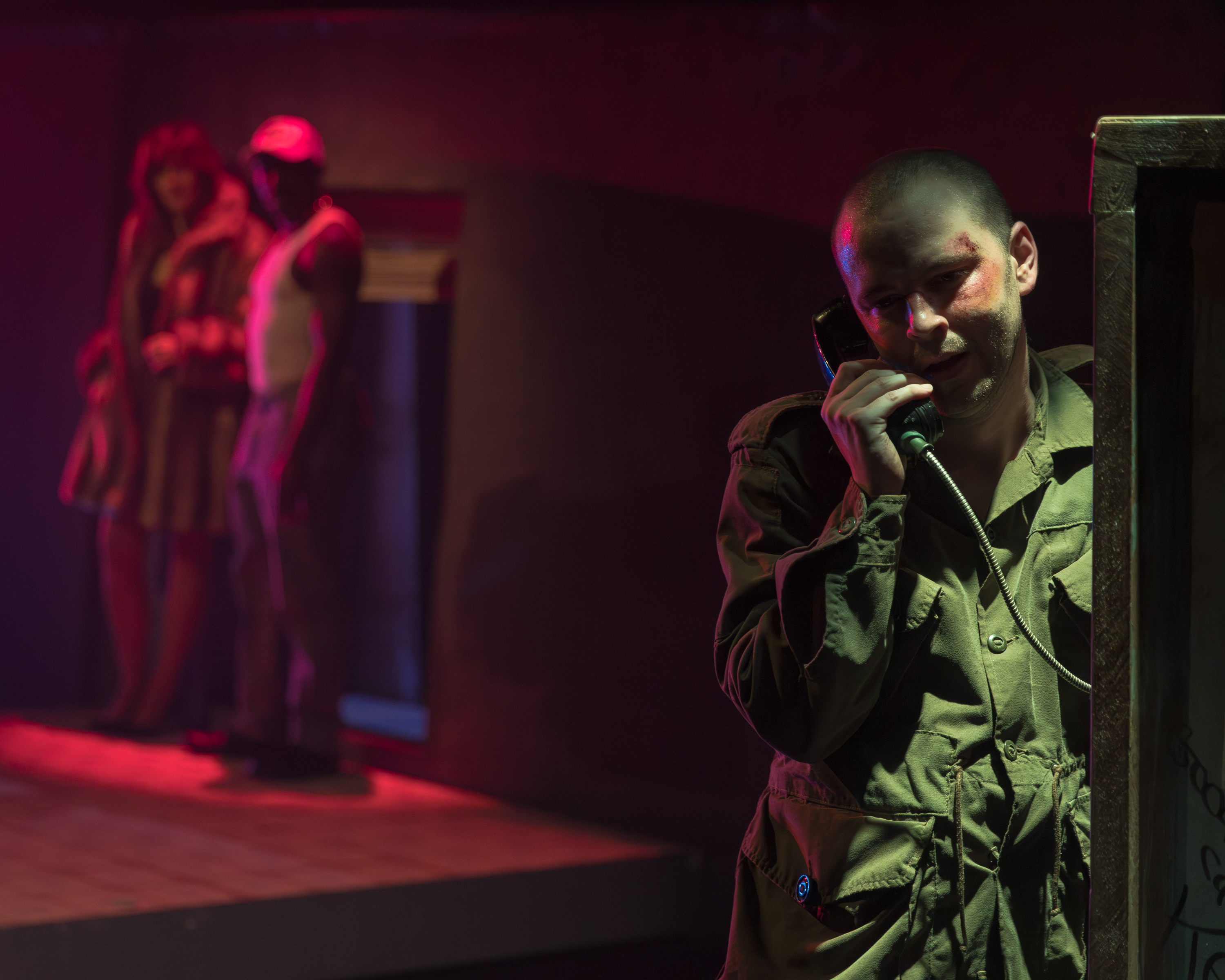
The runaway killer flies from scenario to scenario, finding sordid forms of empathy and fear in almost every room he stumbles into. It completely engages and invigorates, mainly because of the talented cast, not the ambiguous meaning that forever escapes our senses. The abstract philosophy of a play flies forward in a quick 95-minute production, filled with stunning, captivating imagery and complex ideas that somehow stumble as it falls towards an ending that feels more like mock mythology than hazy symbolism. The search is on for the complex making of a meaning within Roberto Zucco, as a distorted voice repeats and reinforces the previous scene’s final line to great effect. The lone character of ‘girl’, portrayed with clarity by Brown, tries to uncover a reason for the life lived and the virginity given, but the corruption of the world around her leaves the character’s uncorrupted self little to hold on to.
Sharp, jagged, deep, and abstract, Roberto Zucco speaks truths that are almost too angled to contemplate, abstracting meaning in Shakespearean-like frameworks, with one titled “Ophelia” while characters resembling Hamlet‘s guards and ideas of stray dogs fighting comically make their way into the spotlight impressively and passionately. I’m not convinced I truly understand the violent formulations or the brotherly love that was in this house, nor the abstractionisms that exist running through Buddies’ Roberto Zucco, but one can not escape the magnificent imagery that swings out in this superb production, full of sound and fury – courtesy of the superb design team – but what does it signify? I hope not nothing, but I might need a chat with Gislina Patterson (We Quit’s 805-4821), the play’s dramaturg, to really get to the heart of this killer composition and the meaning of it all.
Roberto Zucco runs until October 5 at Buddies in Bad Times Theatre, Toronto. Tickets are available here.
 front mezz junkies
[…] handsome doctor husband, Richie, embodied powerfully by Kwaku Okyere (Buddies in Bad Times’ Roberto Zucco). June, with an AI assist from Buddy (Augusto Bitter), pokes hard at her young husband as their […]
LikeLike
[…] storytelling, directed with a casual hand by ted witzel (Buddies in Bad Times Theatre’s Roberto Zucco) from a script by ghostwriter Lauren Gillis, meanders around a contrived setup that involves a […]
LikeLike
[…] Buddies Flies Absurdly High with the Twisted and Brilliant “Roberto Zucco” Goblins:Macbeth. Photo by Tim Nguyen. […]
LikeLike
[…] portrayed and pretended with a sharp clarity. The anxiously endearing Jakob Ehman (Buddies’ Roberto Zucco) finds unpolished complexity in his portrayal of John, the central character and player in this […]
LikeLike
[…] in Bad Times Artistic Director ted witzel (BuddiesTO’s Roberto Zucco) announced their Pride Month programming, with over 20 shows, concerts, events, and parties taking […]
LikeLike
[…] Horn, SATE, Divine Brown for A Streetcar Named Desire (Soulpepper Theatre Company)Dasha Plett for Roberto Zucco (Buddies in Bad Times Theatre)John Gzowski and Suba Sankaran for Mahabharata: Part One: Karma: The […]
LikeLike
[…] Written by Susanna Fournier (Lulu v. 7: Aspects of a Femme Fatale) | Directed by ted witzel (Buddies’ Roberto Zucco) […]
LikeLike
[…] with striking and effective lighting by Logan Cracknell (Buddies’ Roberto Zucco) and sound by Adam Campbell (Stratford’s The Goat, or Who is Sylvia?). Nolan’s language […]
LikeLike
[…] by Julie Fox (Stratford’s R+J) with sharply defined costuming by Michelle Tracey (Buddies’ Roberto Zucco), compelling lighting by Bonnie Beecher (Coal Mine’s People, Places and Things), and a crisp […]
LikeLike