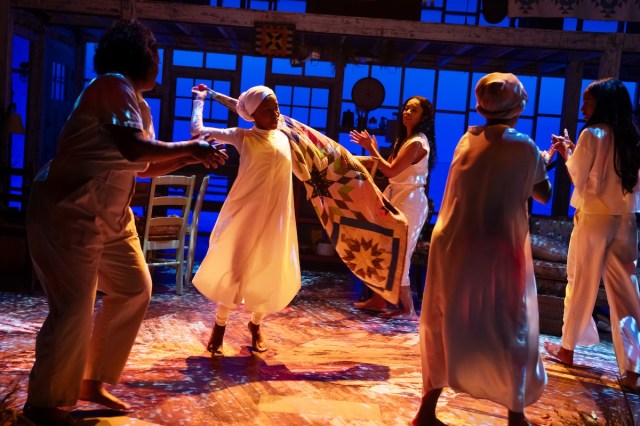
Photo by Julieta Cervantes.
The Off-Broadway Review: LCT’s The Blood Quilt
By Ross
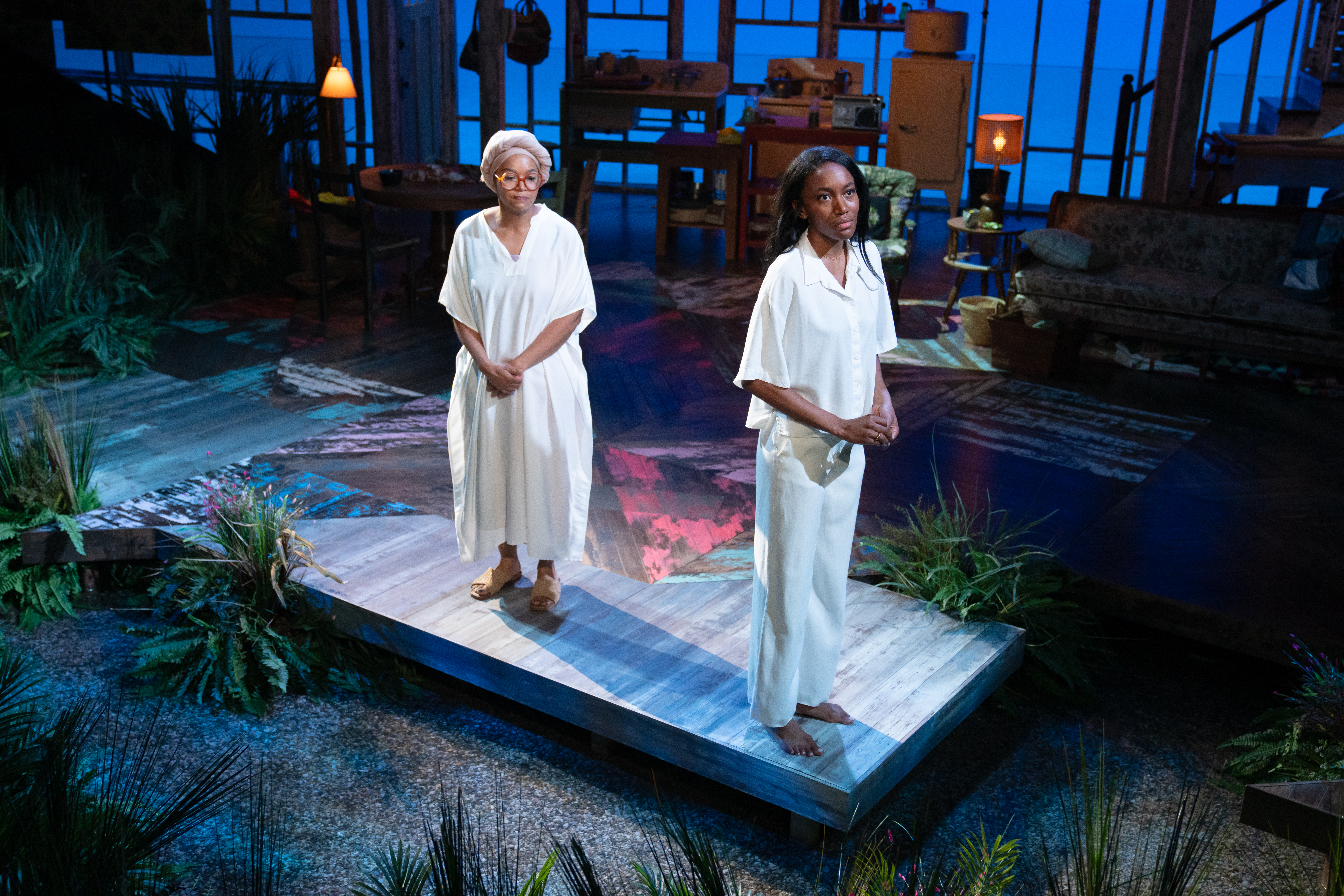
Spirits and evil shadows seem to be floating on the waves that projectively crash into the living room that stands center stage of the Lincoln Center Theater‘s The Blood Quilt, a new play delivered with thought and engagement by playwright Katori Hall (Tina – The Tina Turner Musical). It’s a beautifully created symbolic framing, as the waves attempt to wash away all the buckets of sourness, anger, pain, and hurt that are blood-stitched into the very fabric of all those quilts that hang in abundance around the overly complicated set, designed with intent by Adam Rigg (Broadway’s Illinoise). A storm is approaching, that is clear, even if the visualization of it is haphazard and intermittently profiled, with flashes of thunder, courtesy of the tender lighting design by Jiyoun Chang (Broadway’s Stereophonic) and projections by Jenette Oi-Suk Yew (Broadway’s Left on Tenth) that is backed by a solid sound design by Palmer Hefferan (LCT’s Becky Nurse of Salem). When presented, it is a powerful statement, but it’s too randomly applied to really carry the weight that is intended.
Yet, as the sisters gather, weeks after the death of their mother, their shattered camaraderie is ever present and apparent. They are there to dive into the yearly family tradition of quilting, but that’s not all swirling in the undercurrent. The tension and fragility of their union are forever being challenged, and as directed with a wild but somewhat overwrought hand by Lileana Blain-Cruz (LCT’s The Skin of Our Teeth), the surging of anger and jealousy overflows from within, as we watch these four adult sisters grapple with years of trauma, resentment, and disconnection. They each seem to have a very different connection to each other and their now-deceased mother, as they were fathered each by a different man, who had a very different unique framing with their mother. Secrets and lies are stirred to the surface of this dangerous storm surge, as is the case with most family drama plays, and all that they inherited from their relationship with their mother will now need to be addressed and understood before the resentment and the hurt can float far out into the sea.

Photo by Julieta Cervantes.
The half-sisters are all well-formed and articulated by a cast of solidly connected actors. Their interpersonal disconnection is obvious, as is their unity, but some turbulent waters need to be navigated before their familial ferry can land safely in the harbor. Clementine, compassionately portrayed by Crystal Dickinson (Public’s cullud wattah), is the one who stayed behind and took care of their sick mother without much support from her siblings. Gio, boldly embodied by Adrienne C. Moore (Public’s For Colored Girls…), is the second oldest, and maybe the one with the largest bucket of sourness to unpack before them all. She drowns herself in a never-ending flow of beer and marijuana, hoping to dull the pain so it doesn’t flair up as harshly as it probably does internally. She’s the power keg waiting to explode, drunkenly and harshly on all the come in close. Cassain, played with a dark intensity by Susan Kelechi Watson (Public’s Good Bones), is the third daughter, trying to be present but distracted by the care of her daughter, Zambia, played a bit too postured by Mirirai (PH’s If Pretty Hurts…). This shifting and ever-developing daughter has been forcibly brought along to engage in the family tradition of creating a quilt to hang alongside the hundreds that hang like family portraits all around them. These three sisters know the deal, and engage with each other in sharply defined complex attachment styles that echo a history of unsaid problems, masked by familial tradition and distraction, yet somehow held together by an idea shaped by tradition and history.
Coming together on the isle of Kwemera, a fictional island off the coast of Georgia, home of the last “Gullah community“, to sew a quilt in honor of their mother, the overall initial composition is that everything would go along as typically as ever. There would be, of course, a few flare-ups between siblings and daughters, as they try to reengage with one another over the retelling of familial stories of their mother. Also there would be a few more intense historical tales told connected to all the quilts and the Jernigans women who have been creating them. For the sake of Zambia, but also for the fragile thread that holds these women together.
The quilted works of art are stitched with the blood of all the women that had come before them, including the tale of their great-great-great-great-grandma Ada and her centerpiece that hangs up above like the Last Supper in their familial home. The small stitched rectangle holds a tremendous ache and arch of history for these women. The story goes it was slowly unstitched over time, square by square, and given away to her children who were taken away from her and sold, one by one, to a distant enslaver. These stories resonate clearly, particularly the antebellum tragedy of two young slave lovers who would rather drown themselves together in that same body of water than be separated forever by their enslavers.

The three sisters share something communal in that house, even if we see the sparks of discontent hovering in the air around them, but an all-consuming house fire is lit when the fourth sister arrives, unannounced from Los Angeles. Amber, dynamically portrayed by Lauren E. Banks (Apple’s “Roar“), is loved by some, worshiped by one, and despised by another. She is the one who really got away from all this, removing herself from the tense engagements that linger, to go to the best schools she could get herself to, to become a successful entertainment lawyer in California. She never made it back home for her mother’s funeral, a fact that will soon be focused on and rolled out. Yet, she decided to show up, much to everyone’s surprise, for the quilting weekend, barely making it across the water, by a hired boat, before a storm locked them all together inside that island home for the weekend. Very metaphoric, this framing, and a solid setup for family drama.
Their mother left behind a plan for the next quilt. It’s a difficult star pattern, for the sisters to gather around that quilting table, cutting and stitching pieces of themselves together to create a sense of unity and connection. The metaphors are huge, and a bit overly stitched into the fiery unpacking, but also carry with them meaning and commentary as years of lasting resentments flow forward fueled by the contentious relationships each had with their mother. Amber is the ‘golden child’ the little bird who made her mother the most happy, possibly as a result of the difficult and dangerously violent relationship the rebellious Gio had with that same woman Their mother was “good at leaving the difficult behind,” one sister states, referring to the pattern, but more symbolically the phrase takes a shaper aim at the fractured and contentious relationship each sister has and had with her other sisters.

The fury they all throw at one another is alarming and emotionally clear, albeit sometimes overwhelmingly dramatic to take in all at once. Amber is the one I found myself more firmly connected to, until, of course, she called herself a “fiscal Republican” (she lost me there). She’s the logical, proactive one, fueled by her success and her determination, but purposefully distanced from the spirituality of the family dynamic. Continually supported in her stance by her niece, she stands up against the onslaught with righteous indignation, formulated from her years of feeling like and knowing she is the “other, other sister.” It seems their mother has not paid property taxes on the house for the last seven years, and the amount due is too great for any of the sisters, including Amber, to save it from being seized by the state. A plan must be made, Amber says, quite correctly, bypassing sentimentality to get to the financial heart of the problem. Dressed in the elegant style of an L.A. lawyer, costumed expertly by Montana Levi Blanco (Broadway’s A Strange Loop), with a long weave somewhat firmly stitched in, courtesy of the solid hair and wig design by Krystal Balleza (Broadway’s Six), her solution involves selling their historically tied-up-in-blood quilts to the highest bidder, as ‘Mona Lisas of the South‘. And to no one’s surprise, this quilting circle of siblings does not take on that idea well at all but fight back hard as only these sisters can.
Heirlooms are generally considered sacred, especially in family dramas of a certain type, igniting storms and bloody battles between siblings, enflamed by differences in values and social and economic situations. These sisters go at each other like four tornados trapped inside a hurricane at the bottom of the sea, hurling insults and judgment without any reflection, determined to win at any cost, even if it means destroying all those around them, and the house they all stand to lose. They fling accusations and historical hurts with wild pointed abandonment, changing sides and their anger-fueled focus within a blink of an eye and a flash of thunder. They play their roles with solid intention, underscoring their emotional space with authenticity and emotional clarity, but in those moments, the wildness of their pain and the force of their wonton attacks start to overwhelm the play, forcing my body to sit back in my seat and disconnect just a bit from their heartbreaking anger in order to survive.

They are all deeply wounded creatures, including the youngest who overly masks her discontent with her ever-changing involvement, commitment, and rebellion with the world around her. There is also a side stitch that involves HIV and the symbolic prickling idea of tradition infecting the family when the family already feels much diseased. The misunderstanding around HIV by everyone on that stage, including the playwright who never brings in the discussion of whether one is detectable or not, didn’t sit well on this psychotherapist’s shoulders, but the history that is unveiled in the tight stitching of stories told is what holds The Blood Quilt together. The ending feels somewhat forced and too quick in terms of resolution with a too-literal approach to some faulty arrangements within the play to get it to the end of the storm. There’s a beauty in the ancestors-dancing-in-the-ocean metaphor that stands at the core of this generally fine play, but overall, I left the Lincoln Center Theater pretty much unmoved by this family drama and the mystical ideas that were floated out and rained down upon near the end. They all sing, “Well done” to the thunder and the storm, but in my mind, that’s taking it one stitch too far.
 front mezz junkies
[…] space, and therefore, the play by a realistic and overwhelming force, and in the recently reviewed The Blood Quilt, that force was a symbolic, yet authentic storm that kept the sisters locked in together in the […]
LikeLike
[…] Adrienne C. Moore, The Blood Quilt […]
LikeLike
[…] Adrienne C. Moore, The Blood Quilt […]
LikeLike