The Toronto Theatre Review: Tarragon Theatre’s Feast
By Ross
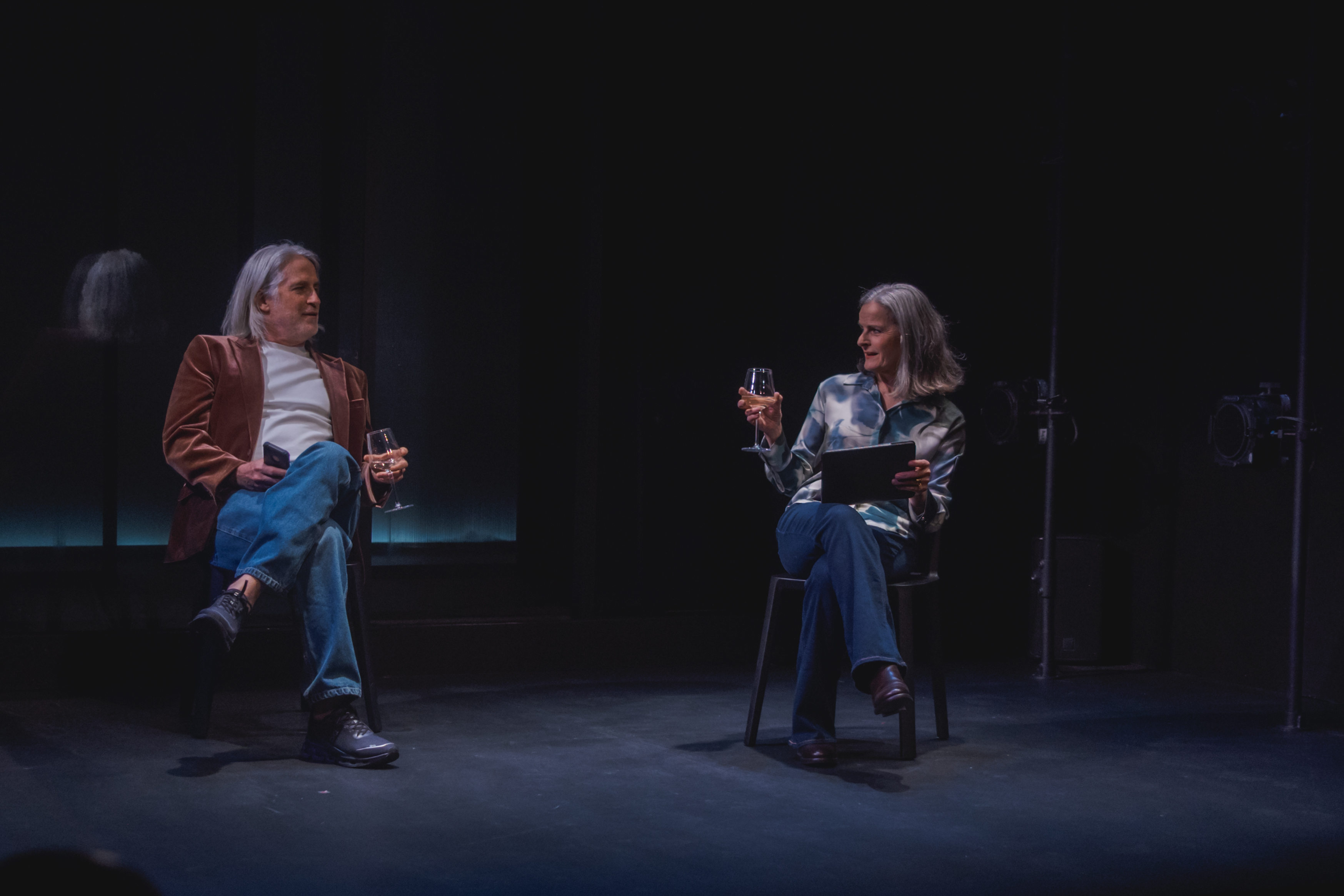
“We all have all that we could want,” says one of the fractured characters that exist in the crumbling world of Feast, the new, wildly interesting and complex play by Guillermo Verdecchia (Flashing Lights; dir: Tarragon’s El Terremoto) on stage at Toronto’s Tarragon Theatre. That is before everything seems to burn, overturn, and poison them away by indulgent acts of global consumerism from the serenity we first were privy to, all over a glass of white wine. The threesome we are introduced to, as directed with abstract assuredness by Soheil Parsa (Factory’s Wildfire), presents well, but has a “stunted magnolia” quality, pointed out with clarity by their daughter, Isabel, played solidly by Veronica Hartiguela (Crow’s The Bidding War), who, as she watches with passive interest, sees only a “kinda slow death” as her parents chat as always on what appears to be a sunny porch at their beautiful home.
Mark and Julia, as portrayed with exacting purpose by Rick Roberts (Stratford’s The Goat, or Who is Sylvia?) and Tamsin Kelsey (CS’s The Other Place), seem to have it all together. Their marriage is presented as solid, although maybe the sky around them is really too blue for them to notice how out of whack they seem to be. That is until the plane takes off, the snow starts to fall in Rome, the fires take over their weekend mountain retreat, and the torrential rains come down flooding the basement of what once felt like their safe, nostalgic home, filled with adult kids who don’t seem to be, either there or very connected, swimming like mad in their own separation and anxiety. That’s when things start to crack and disconnect in the world around them, maybe similarly to their inside technology-obsessed sanctuaries, where the air is always controlled to be perfect and light.

Something starts to impact and influence the appetite for more when a connective framing is left behind, and the familiar Starbucks-colored world starts to not feel as soothing as it used to, especially when globetrotting to cities far removed from their familiar geography. There’s a deluge in the sliding-glass framework of their security and comfort, designed impeccably by set and projections designer Kaitlin Hickey (Coal Mine’s Yerma) with carefully constructed lighting by Chris Malkowski (H+B’s Measure For Measure), distinct costumes by Christine Ting-Huan 挺歡 Urquhart (Shaw’s The Orphan of Chao), and an amazingly precise sound design by Thomas Ryder Payne (Coal Mine’s People, Places and Things) that gives us a sneak peek inside the inner maelstrom of hungers that are creeping into their idyllic life. It’s a captivatingly clear set-up, etched with ideas around capitalism, environmental destruction, climate change, mass migration, and forced cultural, geographic, and human displacement, to name just a few. And it’s all brought on by a slow erosion of human rights and the deep, destructive wave of global conflict and persecution, served up within three compelling narratives that make for an overwhelmingly complex, disturbing meal that is almost too much to swallow in one sitting.
Oddly enough, I couldn’t help but ponder, while watching this somewhat overly long play filled with abstractionisms, of another complex play, Brian Friel’s Faith Healer, that tries, with somewhat stronger results, to sum up the separating lives of three characters and their intertwined narratives using an actual separation of framings to reveal their divergent vantage points. Friel’s play consists of four monolgued-segments revealing three players and protagonists that ratchet up the tension and fill out a sordid story of a past power possessed by the sick and dead soul before. Its emotional entanglements conjure up a tragedy played out slowly before us, yet somehow, unlike Verdecchia’s intense, but overly drawn-out play, the narratives become more detailed and known with each. Yet, somehow, Feast manages, inside all of its intelligent unwrapping of complex trauma and the insatiable human appetite for more and more authenticity and connection, to become less engaging and emotional. It seems, with all the abstract flights taken, the deeper we dive into the desperate hunger that biblically storms the sanctuary and upends the boat, the less we feel for these three.

Maybe it’s too smart or tries too hard to secure the perimeter of a too large property when looking for the real secure deal, surrounded by a plague of poison frogs that aren’t cooked properly. It’s difficult to say, yet each of the three dramas, albeit fascinating and intellectually intense, carries a weight that probably exceeds the baggage allowance, and together, they start to drown the overall impact. We begin to step back from the escalation, especially when Roberts’ hungry character, Mark, aligns his increasing instability with the Mephistophelean creation, Chukuemeka, played with michevious charm by Tawiah M’Carthy (Soulpepper/Obsidian’s Three Sisters). With his new, all-too-obliging guide, Mark’s off-balanced need to feed his desperate helplessness swoops in, drawing our unfocused attention to the simmering power dynamics that exist in colonization and capitalism, where money can be thrown at problems of security and authenticity without actually engaging with the fiery soul that burns all around us. My stomach started to feel overwhelmed with all these flavors and formulas served up, and at one point, I couldn’t take another bite.
The actors do find compelling authenticity in these floundering characters. Roberts and Kelsey unpack complications and spirals that deliver, as does M’Carthy with his flipping of the switch, but it is inside Hortiguela’s Isabel, who speaks so clearly on our mutually shared helplessness and our chaotic self-destruction of the planet as a whole, where we find a soulful connection. We are all sitting passively by, watching as the fires burn down mountains and rains wash away our worlds, while some take selfies using those signs of the apocalypse as backdrops. Isabel’s framing feels clear and disturbing, spoken from our collective hearts, echoing our own internal monologue, which is desperate to find a way out. Yet, like sirens on the rocks singing warnings to those who don’t want to hear the music as cautionary tales, those melodies (and our blindness) become beautiful beaconings that will eventually devour our curious souls and leave us destroyed and dying on the beach. Or obsessively seeking shelter against the storms behind guarded walls and a forest of security cameras aimed at protecting us from what lurks outside the perimeter.
Longing for a return to something already lost, baked in nostalgia and romantic ideas, becomes the fixation and the realization of the troubled souls inside Verdecchia’s Feast, and although the ingredients presented in this solid production almost overwhelm our digestive system, there is enough to keep us tuned in and interested, for the most part. But the three don’t intersect enough for a completely satisfying dish, no matter how well the meal has been cooked and presented. There are too many flavors for one plate at this Feast, making me wish the playwright had found a way to tell each of these morsels of self-inspection in a more compact creation, removing some of the unneeded side trips to abstractions that muddy the shores. Maybe a faith-healing separation or flavoring reduction would help our digestive tract from being overwhelmed, and we could stay with the feeling of being here, present, and not as wobbly as I felt.
 front mezz junkies
[…] truth, and the chemistry among them makes the ensemble, which includes Cornij, Farhang Ghajar, Veronica Hortigüela, and Dan Mousseau, pulse with vitality. There’s a generosity in their acting — an openness that […]
LikeLike