
The TIFF Film Review: Philippe Falardeau’s “Lovely Day” and Mathieu Denis’s “The Cost of Heaven”
By Ross
There’s a particular kind of Canadian film that sneaks up on you; bright and welcoming at first glance, then slowly, almost imperceptibly, peeling away its charm to reveal something deeper and searching underneath. Both “Lovely Day” (“Mille secrets mille dangers“), the new feature from Philippe Falardeau, and Mathieu Denis’s haunting “The Cost of Heaven” (“Gagne ton ciel“) belong squarely to that lineage. Premiering one after the other at TIFF, they form an accidental but striking dialogue: two films in French, English, and Arabic that orbit the same questions of identity, inheritance, and the quiet ache of wanting more.
Falardeau’s” Lovely Day” digs in with music from another land and a nervous groom trying to steady his difficult stomach. Alain, portrayed beautifully by Neil Elias (“Threesome“), is about to be married, but his day and his digestion are on different tracks. He stands outside an orange globe restaurant, slurping on a drink, the air thick with his nerves, as the film starts looping through the hours before the ceremony in an anxious, funny, and deeply humane spiral. There is “a chance to have fun,” he tells himself. “To celebrate. To make peace with the past.” But that kind of peace, it turns out, isn’t so easily found or declared.
As timelines repeat and overlap, Falardeau plays with memory and fate, wedding-day chaos and existential dread. The structure feels like a dance of memories and emotional trauma. Alain’s unreliable, but loving best man, his long-divorced parents, and the memory of an old friend who betrayed him all swirl in and out, ringing up each encounter and revealing a new layer of history, guilt, and grace.
Falardeau (“Et si…“), adapting Alain Farah’s semi-autobiographical novel, threads the film with wit and melancholy in equal measure. Every comic beat: a botched toast, a queasy glance, an overzealous family argument, lands with a pang of honest recognition. What might have been a conventional wedding farce instead becomes a meditation on inheritance and healing. The shame Alain carries in his gut isn’t just biological; it’s cultural, familial, and generational. Falardeau’s camera watches him turn it over, scene by scene, until laughter and sorrow become indistinguishable.
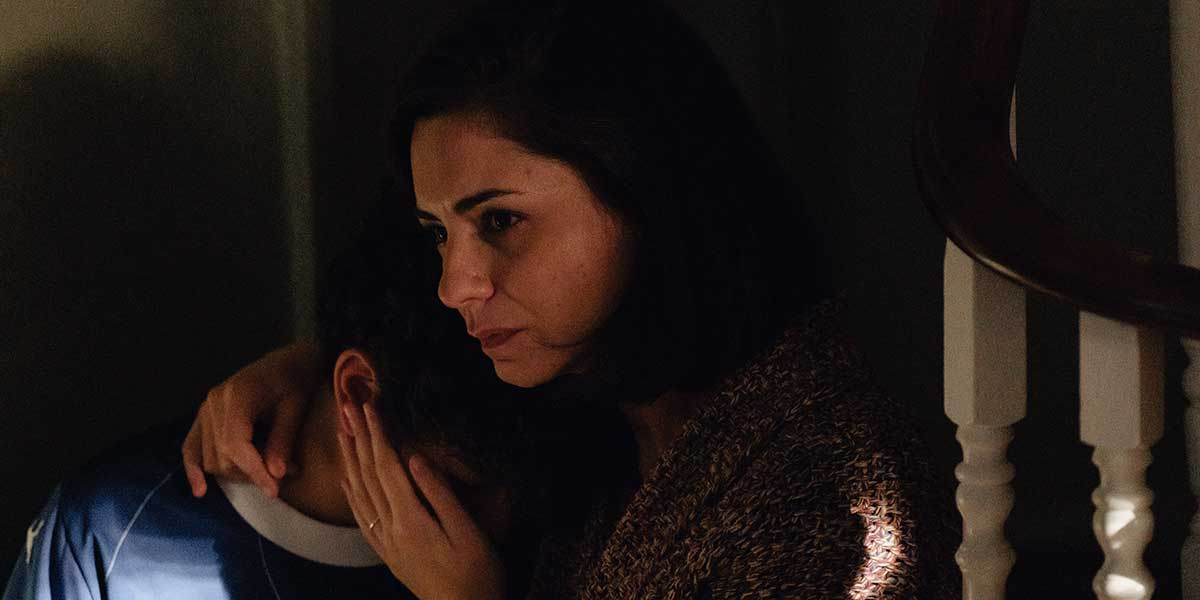
If “Lovely Day” is a film about reconciliation, about forgiving the ghosts of one’s past, “The Cost of Heaven” is its fumbling reflection. The film shines bright, driving forth a moral corrosion that grows when we stop looking at what really is around us, and find the road to forgiveness. Where Falardeau finds light and levity, Denis finds disturbance and delusion.
Based on a true Montreal crime story, “The Cost of Heaven” delivers us Nacer, strongly portrayed by Samir Guesmi (“Ibrahim“), a man who once had nothing and now believes he needs everything. A family man with love in his home and warmth in his community, Nacer is nevertheless consumed by a gnawing hunger for money, for status, and for proof that his life matters. The opening scene, filmed with the quiet precision of a parable, finds him transfixed by a Lexus showroom bathed in golden light. He stares not just at the cars, but at the mystical dream of what it means to the world if he is driving one.
Denis (“Corbo“), working with cinematographer Sara Mishara (“Drunken Birds“), gives the film a cool, luminous texture that feels deceptive and superficial. The images undercut by the ugliness of Nacer’s descent shine bright on the surface, like a new car that loses its value the moment it drives off the lot. His story unspools quickly, like a morality play rewritten as a modern thriller: each act of desperation another sleight of hand, another coin trick he hopes will make wealth appear out of thin air. But what vanishes instead is his morality and his soul.
The parallels between these two films are unmissable. Both center on men caught between love and illusion, trapped by what they’ve inherited, whether a stomach full of shame or a mind full of ambition. Both speak to a uniquely Canadian sensibility: multicultural yet claustrophobic, ambitious yet quietly guilt-ridden. And both filmmakers use language — three of them, in fact, to trace the fractures between generations and the layered selves that are formed in translation.
Falardeau, ever the humanist, guides us toward forgiveness. His film ends not with catharsis but with acceptance, a recognition that chaos, family, and failure are all part of the same fragile circle. Denis, on the other hand, takes us to the edge of ruin. Nacer’s world collapses in on itself, the camera closing tighter as his fantasy of success devours everything in its path. Together, these films present a double portrait of modern manhood and moral disorientation: one laughing through its tears, the other staring into the abyss. They’re about what we inherit from our parents and what we pass down despite ourselves. They’re about the fragile scaffolding of dreams, and how easily it buckles under the weight of wanting too much.
Both directors are working at the top of their form. Falardeau, with his generous eye and love of contradiction, finds poetry in the panic of a wedding day. Denis, with his meticulous craft and moral gravity, transforms a local tragedy into something timeless, a warning about the illusion of the “good life.” Each film, in its own way, ends where the other begins: “Lovely Day” finds serenity after chaos departs, “The Cost of Heaven” finds chaos after evaporating serenity.
In a year when global cinema seems preoccupied with destiny and downfall, from Oedipus retold on stage to antiheroes reborn on screen, these two Canadian works feel like companion prayers. One whispers: Forgive yourself. The other warns: forget yourself, and you lose everything. And somewhere between those two voices lies the quiet truth of living. That there is a price of peace, the cost of heaven, and the love that lives inside a lovely (but difficult) day.

 front mezz junkies