The Off-Broadway Theatre Review: Lincoln Center Theater’s Kyoto
By Ross
“The times you are living in are fucking awful.” The statement drops early and direct in Kyoto, echoing through the rest of the play like a warning that no one really wants to hear. Our narrator, as horrible a man as one can lobby for, says it almost gleefully, as if the world’s collapse is just another negotiation that he must win. He lists the horrors we know all too well: wars, greed, inequality, violence, and finally the one that sears our core: “a planet literally burning down.” It’s hard not to nod along, complicit and exhausted, almost grateful for the honesty, until we’re forced to confront the irony that the man naming the truth is the same one who figured out how to turn it into leverage.
At Lincoln Center’s Mitzi E. Newhouse Theater, Kyoto, the new play by Good Chance Theatre founders Joe Murphy and Joe Robertson (The Jungle) unfolds as an intense, intelligent, and sometimes exasperating circular rodeo of moral failure disguised as diplomacy. Directed with determination by the legendary Stephen Daldry (Broadway’s The Inheritance) and Justin Martin (Broadway’s Prima Facie), the production runs madcap circles to stay in touch and on time, capturing both the theatricality and the suffocation of the 1997 climate summit that promised a global agreement to save the planet, but delivered only an idea and a somewhat complicated agreement. Was it a failure, even when the gavel came down triumphantly? That is the question at the center of this circle, and we lean in with interest.
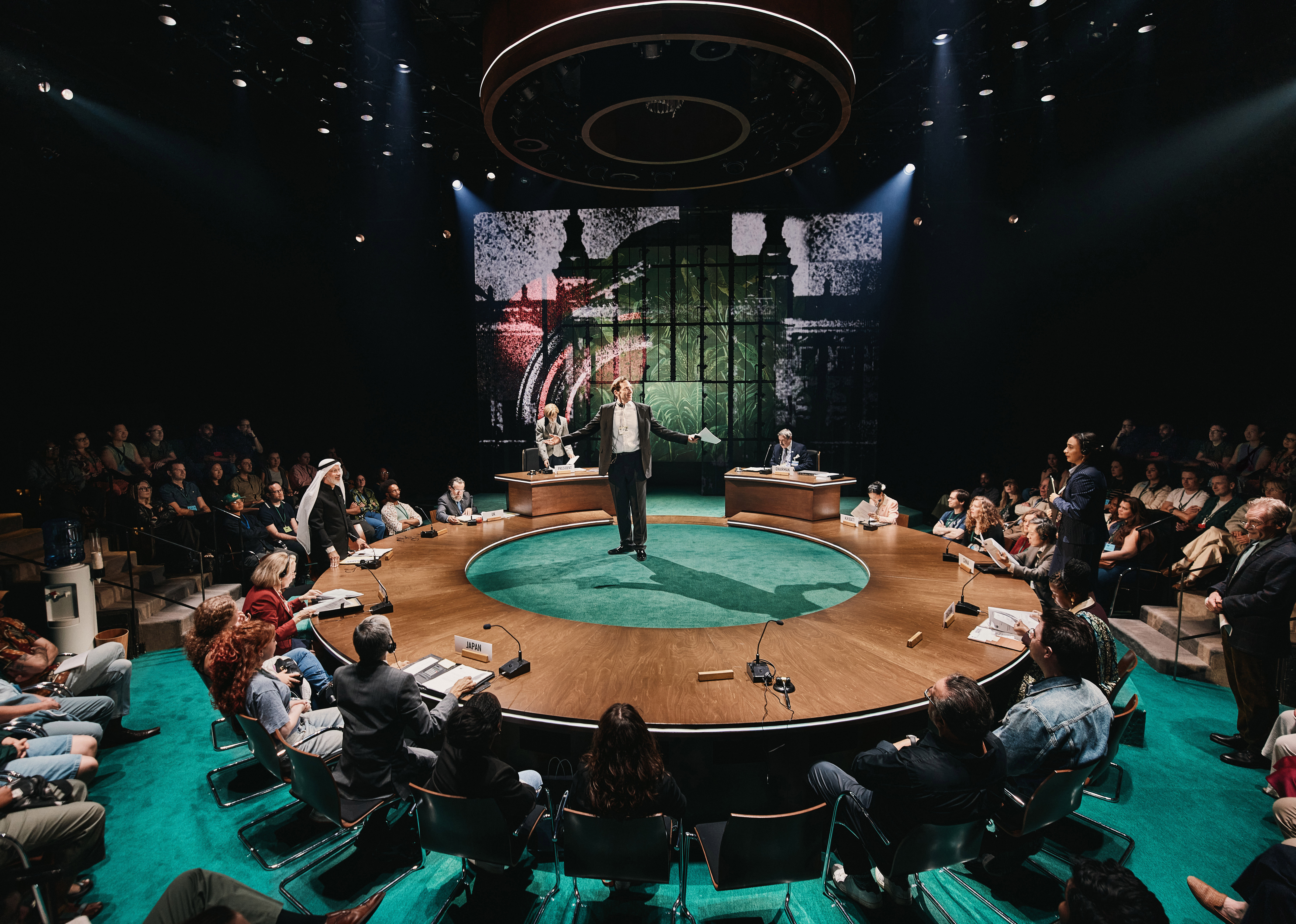
Yet, what we are given in this fascinating unraveling is a world negotiating its own doom, planted on a circular, sterile playing field designed cleverly by Miriam Buether (Broadway’s Patriots), enhanced by the engulfing video projections by Akhila Krishnan (West End’s Dr. Strangelove). Images flicker around us like a modern fever dream, forcing us to take note, even when we’d rather look away. Nightmarish TikTok reels of chaos, and the planet’s pain are filtered through screens and soundbites, and we can barely contain are sadness in our own destructive contributions. It’s a world gone mad, but one we instantly recognize and must, uncomfortably, take some ownership in.

Our guide through is Stephen Kunken (Broadway’s Enron), who magnetically portrays Don Pearlman, the American lawyer and strategist whose job is not to save the Earth but to make sure no one else can. Stalling and strategizing is what gives Kunken his slippery charisma, the kind that smiles while it colludes and condemns. He’s funny, articulate, and completely despicable, a man who treats cynicism as a form of sport, and unfortunately for us all, he’s very good at it. His wife, played with delicate restraint by Natalie Gold (“Succession“), circles the stage as a secondary, continually asking him whether he’s on the right side or the wrong one. We find ourselves wanting more from her and her morality, but her role in this debacle is clearly not the point. For Pearlman, the only right side is the one that wins, but we all know the truth. Watching him feels uncomfortably close at hand. He could be anyone standing behind a podium today, spinning scientific facts into fog and calling it strength and leadership.
Across the debate table and divide sits Jorge Bosch (“More Than Friends“) as the Honorable Raul Estrada-Oyuela, the Argentinian director of the conference, and the play’s quiet conscience. His performance, alongside powerhouses like Kate Burton (Broadway’s Present Laughter) as USA, Erin Darke (MTC’s Vladimir) as Germany, Roslyn Ruff (LCT’s The Skin of Our Teeth) as Tanzania, and Dariush Kashani (Broadway’s Oslo) as Saudi Arabia, carries an epic, monumental weight and global ache. Bosch’s Estrada-Oyuela somehow holds the proceedings together with a grace that feels almost impossible inside such exhausting chaos, with each and every gesture suggesting a man who knows what is at stake. We can feel it in our bones how much he believes that consensus, however fragile, is the only thing keeping the world from literally burning up and burning down. When he finally slams down the gavel, forcing an agreement everyone knows is flawed, his victory feels like a victory laced with mourning and relief, all melting together like the icecaps. He says no one will remember the compromise itself, only that they agreed, and that’s the devastating truth that feels more prophetic with each passing year.

The play can be exhilarating, but also exhausting. The negotiations stretch on, thick with technical language and moral, emotional fog. But that’s maybe part of its point. Kyoto refuses to make the conversation simple, because it isn’t, and it also denies the tendency to make it personal, particularly between him and his wife, or his unseen son. The script’s language is beyond precise, the arguments looping, and the framework claustrophobically circular, mimicking the bureaucratic rhythms that so often choke change before it begins. At times, it surprises us, becoming almost musical; the sound of dysfunction, delay, deflection, and miscommunication, of people drowning in their own language, stance, misunderstanding, and good intentions, but in a rhythmic way that we didn’t feel was possible.
There are also moments of real insight and beauty. The production’s precision, its layered use of sound and video, its flashes of genuine wit, all dutifully build toward a final formula that feels both hopeless and completely human. We leave overwhelmed, informed, exhausted, and uneasy. The feeling is deliberate, well-deserved, and oddly exciting. Kyoto doesn’t flatter us with easy outrage. It asks us to sit in the discomfort of recognition, to admit that the systems we built to save the world might be the same ones ensuring its end. And then go home and remember to reuse and recycle. What lingers most in our frayed consciousness is the silence after that first line, when we realize that he was right all along, both now and back then. The times we are living in are truly awful, but what’s worse is how familiar that all sounds when spoken so honestly.

 front mezz junkies
[…] Step at @sohoplaceSuzie Miller – Inter Alia at National TheatreJoe Murphy and Joe Robertson – Kyoto at […]
LikeLike