
The Off-Broadway Theatre Review: Samuel Beckett’s Endgame
By Ross
He stands, staring, questioning the room and, in a way, his own existence. Each movement is deliberate, one halting step at a time, as if testing the floor beneath him for meaning and safety. A ladder is pulled in and placed, leading nowhere, yet providing a glimpse through those high, circular windows. He climbs, pulls back the curtains, and scans the horizon with a faint chuckle that seems to come from another dimension. What he sees, we’ll never fully know. But the gestures that opens Endgame feel enormous, a man peering out into Beckett’s universe, trying to understand why he’s still here and why he’s still paying attention and obeying.
Then, with a slow, almost ceremonial motion, he unveils what’s been hidden beneath a set of sheets: a man in a chair, motionless, perhaps sleeping, perhaps dying, and two garbage cans that hold, in true Beckettian fashion, just as many questions as they do answers. It’s an image that is both comic and terrible, tender and absurd.
As conjured by Garry Hynes (BAM’s The Beauty Queen of Leenane) and Druid Theatre, now being presented at the Irish Arts Center, this production inhabits the same haunted landscape as its counterpart, Waiting for Godot, with the same dry air and the same ache of repetition. But where Jamie Lloyd’s Broadway version stretched out and back toward the possibility of arrival, Druid’s Endgame folds inward, asking what remains when hope itself has burned out.
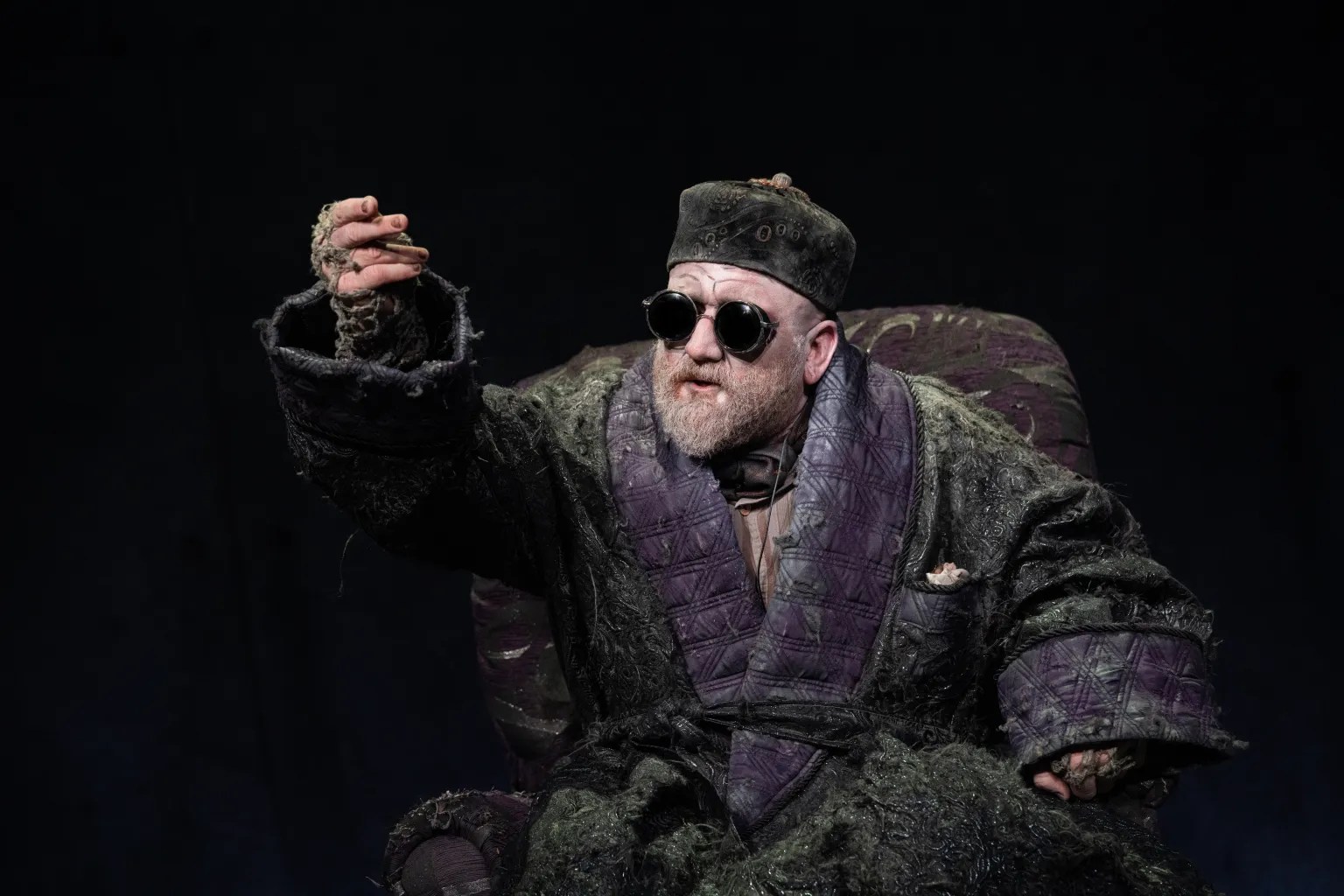
In a way unknown to either, it becomes a fascinating companion piece to Coal Mine Theatre’s Godot. Yet, this Endgame feels like the inevitable next chapter (or book) within the same universe, well-formulated and delivered, but long after the sun went down and time caved in. The set, designed by Francis O’Connor, vibrates in the same way as the Broadway Godot, with the cylinder home now turned on its end, and compacted into a bunker of bleak greyness, yet magnificent in its precision. It’s a stark landscape that traps its characters, yet fills the mind with shuffling motion. It’s a place where ideas drop and collide with Beckett’s cruel humour and tender despair, and we can’t look away.
The relationship between Hamm and Clov echoes the tangled dependency of Pozzo and Lucky, yet with a sharper intimacy based on a questionable bond. Aaron Monaghan (Druid’s Epiphany) as Clov, all nervous angles and desperate energy, moves like a marionette half-aware of his strings, whereas Rory Nolan (Gate’s Death of a Salesman) as Hamm commands with both grandeur and decay. He’s that demanding blind man, not only in sight but in spirit. When Clov reports the arrival of a boy near the end, it feels like an echo of Godot’s young messenger, arriving out of nowhere with a flicker of change that never quite becomes redemption. Still, it alters something. The servant’s world trembles, and so, perhaps, does ours.

As always with Beckett, the text offers no easy reading, but in Hynes’s hands it becomes less a riddle than a meditation. Within this world of stasis and stuckness, we discover our own waiting, wanting, and willfulness. The line “Nothing is funnier than unhappiness” lands like both a punch and a sigh, as does Hamm’s plea to Clov, “Have you not had enough?” And by the end, we’re not sure who’s more free: the blind man or the one who can see but cannot go.
There’s a moment when Marie Mullen (Broadway’s The Music Man) as Nell announces her presence from one of the bins, her voice both human and ghostly. It lands like a distant memory of love or sanity, and in this world, that’s a radical act. Watching her and her counterpart, Bosco Hogan (Gate’s Wuthering Heights) as Nagg, it’s impossible not to feel the sting of our own mortality, when a society numbed by repetition waits for meaning to return. Watching Endgame now, especially after the Coal Mine Theatre’s brilliant Canadian Godot, something powerfully cyclical crawls out of the can, crying, proof that it’s still alive, and still very hungry for treats. This Godot companion piece is not at all a sequel but a closing bracket that is tilted on its side and sealed. In Godot, two men wait for meaning. In Endgame, meaning has already died, and all that’s left is the act of persistence. Yet that persistence feels almost somewhat hopeful, a possibility of life through the smallest acts of care, cruelty, and habit.
Endgame, as delivered by Druid at the Irish Arts Center, resonates. It finishes as it “should finish”: unresolved, yet somehow complete. This is the end-stage game, played true and honest, of Beckett’s human experiment with characters circling extinction but still, somehow, reflectively moving like pawns and Kings. And in that persistence and paradox, there is art, and something akin to grace.

 front mezz junkies