The Broadway Theatre Review: Art on Broadway
By Ross
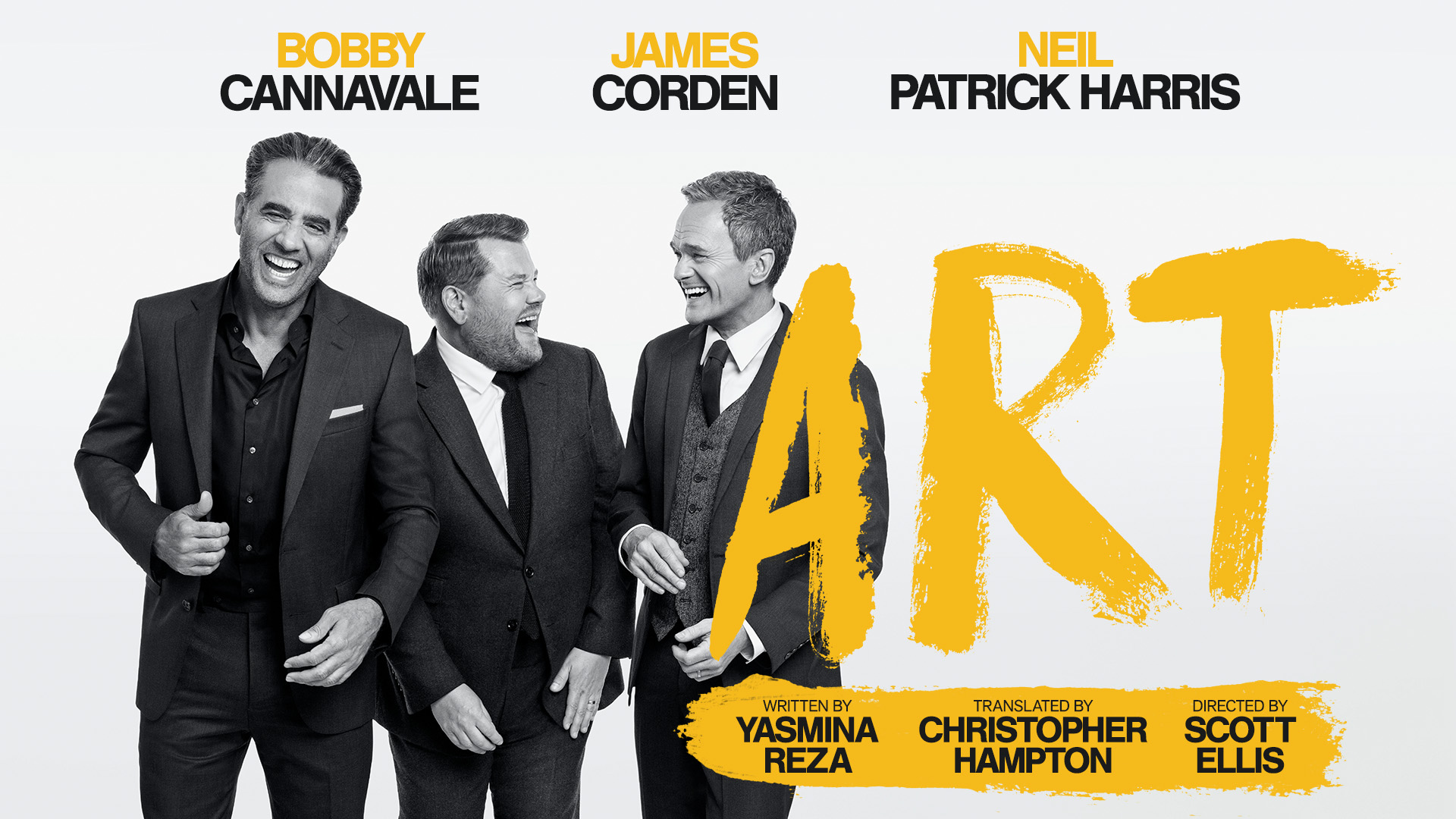
“You’re missing the serious point,” he says as a tidy bit of irony creeps its way into Art, the starry revival that recently opened on Broadway. The production feels uncannily like the star painting at its center, an object whose value has been assigned, inflated, and reinforced not because it’s inherently revelatory, beautiful, or detailed, but because we’ve been culturally instructed to treat it as such. This celebrated play by Yasmina Reza (God of Carnage), with a translation by Christopher Hampton (The Father), has always been a slender little thing; a clever chamber piece about friendship, ego, and the absurdity of taste that entertains. But this revival, directed with glossy precision by Scott Ellis (2ST’s Take Me Out) and powered by the wattage of three marquee names, seems less sharply interested in expanding the grey interior than in presenting a polished, bankable version of it. The result is a handsome replica of a moderately good play, elevated primarily by glossy star power and the commercial machinery surrounding it.
The casting is both the main attraction and the clearest giveaway. Bobby Cannavale (BAM’s Medea), an actor I adore watching as he always uncovers something unexpected, leans hard into the gruffness of Marc. He’s so forcefully pushy and self-righteous that it becomes difficult to locate the underlying hurt and vulnerability that makes his betrayal sting. This gruffness, although more NYer than Parisian, where this play supposedly takes place, is a side of the actor we have become almost too accustomed to seeing within his performances. He is a man who wants to be admired, and his fury springs not from aesthetic principles but from the subtle panic of losing his place in a hierarchy he assumed was forever fixed. Neil Patrick Harris (MCC’s Shit. Meet. Fan.), by contrast, plays Serge with a cool, almost academic detachment. A framing that we have also started to attach to the roles this actor likes to portray: superior, aloof, lightly amused, and not particularly convincing as someone capable of the passion he claims to feel for his costly white canvas. And then there is James Corden (NT’s One Man Two Guvnors), who delivers the most grounded and affecting performance of the three. His depiction of Yvan fits very neatly inside Corden’s pointed resume: a fraying bundle of nerves, a man who wants desperately to be liked, and whose long-suffering, absolutely magnificent monologues. The audience laughs with him, happily, but they also pity him, and that ambiguity becomes the most interesting tension onstage.
What the performances never fully resolve is the fundamental issue of motivation and connection. Reza’s structure relies on the three men staying in the room together for far longer than most of us would or could tolerate. The production gestures at a few reasons, both in the direction and in Reza’s text. It could be their pride, competitiveness, or emotional fear and inertia, but it never really solidifies in a way that makes the whole interaction authentic or compellingly deep. Carnnavale does find one beautiful moment of emotional honesty, unloading his feelings of abandonment by his friend, Serge, but it doesn’t hang in the air long enough to grab hold of. And when Harris’s Serge uses the tactic “If you leave, he wins” to keep Corden’s Yvan from walking out after being insulted by his ‘best friend’, it lands as a functional device rather than a revealing or honest one, as very little has been crafted into their communal friendship to make one determined to figure this all out. The cruelty the men inflict on one another feels outsized compared to the fragility of the relationships we’re told they share. For a play ostensibly about friendship, this revival struggles to make the friendship itself legible as it comes out of the gate angry and swinging basically from the get-go.

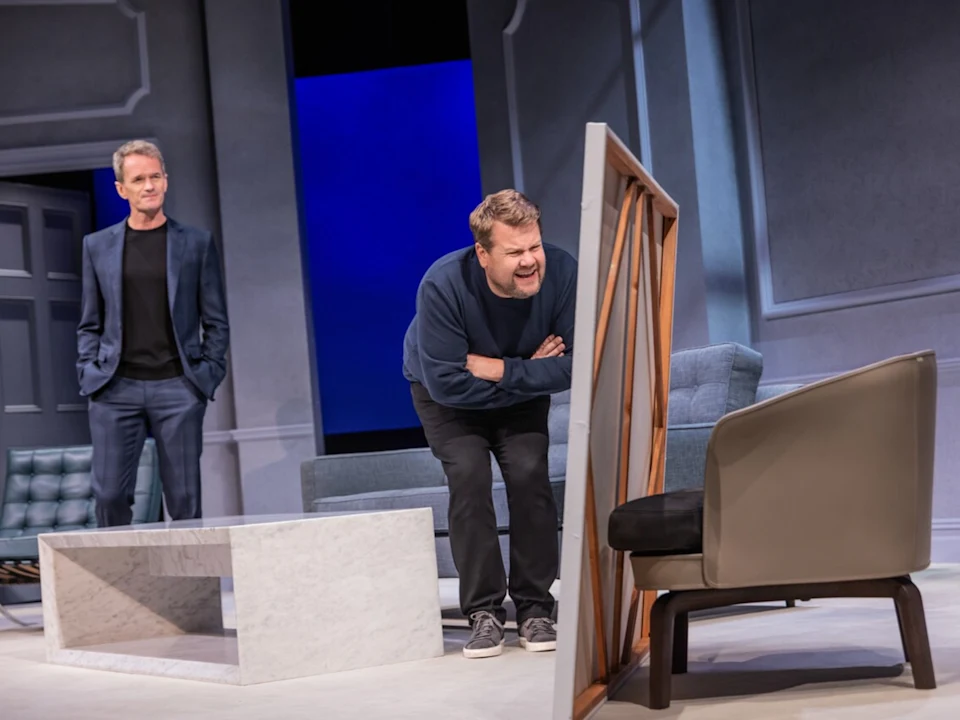
Ellis’s staging is solidly clean and controlled, polished in the way expensive Broadway revivals tend to be. The handsome, minimal, slightly hollow and disjointed set, designed by David Rockwell (Broadway’s Pirates!), mirrors the dramaturgy more than perhaps intended: elegant, proportioned, and full of negative disconnected space that doesn’t quite add up to meaning or sincerity. The lighting by Jen Schriever (2ST Broadway’s Mother Play) and sound by Mikaal Sulaiman (Broadway’s The Roommate) glide unobtrusively along, creating a cushiony environment for the actors, and Kid Harpoon’s original music provides the right urbane sheen. Nothing in this production feels misjudged, but little feels discovered. There is a core of honest and complex contemplation painted within the play, but it doesn’t seem to have made its way authentically into this rendering. Those ideals live in the hard-to-define and see off-white lines hidden inside a production designed to reassure and placate, rather than provoke.
All of which makes the star casting feel less like creative interpretation and more like commercial calculus. Art can be, and has been, an incisive, brittle comedy about masculinity, insecurity, and the fragility of taste. Here, it plays more like a Broadway-branded luxury good: pleasurable enough, immaculately packaged, and priced according to the fame of its creators, not the weight of its ideas. I couldn’t help but think of the television lore of Betty White and Rue McClanahan switching their offered roles in “Golden Girls” to play the opposite of what everyone expected of them. And I wished someone had mentioned this idea to these actors, as that famed role reversal is what elevated that iconic show (I also secretly fantasized about a role exchange like Laura Linney and Cynthia Nixon so expertly did in Broadway’s The Little Foxes. Now that would have been something to see). Yet, here, this play just circles itself, returning to clever but obvious observations without accumulating much force or surprise. Corden’s monologues land beautifully, a handful of sharply written lines still find their targets, but the overall effect is one of competent, commercial charm rather than an exciting revelation.
This one-toned piece of Art feels valuable in the way the painting is described as valuable: because we are told it is, because culture has declared it so, and because star names and Broadway structure lend it importance. Whether that importance is earned is another question entirely. This revival offers a pleasant enough evening with three talented performers, but like Serge’s prized white canvas, it ultimately left me admiring the polish more than the faint diagonal lines of substance and meaning one can see if we could lean in closer and squint.
 front mezz junkies
[…] Gays delivers exactly that. The design work by Alexander Dodge (scenic), James + AC (costumes), Jen Schriever (lighting), and Sinan Refik Zafar (sound) provides a slick, well-appointed playground for the […]
LikeLike