
The Broadway Theatre Review: Oedipus on Broadway
By Ross
The moment that Mark Strong’s handsome frame fills that massive opening screen, a sensation passes through Broadway’s Studio 54 Theatre. It’s impossible to ignore, as the political parallels fling themselves at us, from both sides, connecting our emotional and intellectual hearts to the production in an instant. We feel a particular thrill pulse through the theatre in those first filmed moments of Oedipus, Robert Icke’s massively intoxicating, Olivier Award-winning adaptation. But surprisingly, what struck me most this time around was how much of that charge forms in the stillness beside him, in the composed presence of Lesley Manville. I felt the same reverberation before, when I was lucky enough to see this production in London’s West End, where this sleek political thriller first grabbed me and didn’t let go. It’s an astonishing piece of work, one that has only deepened and darkened on its journey across the Atlantic.
There is an utter brilliance in writer/director Icke’s reimagining that lives and descends in its simple, devastating clarity, just like he did with his phenomenally detailed The Doctor. But with his adaptation of Oedipus, it is in the way he takes on a myth that is so culturally over-familiar that we’ve practically grown immune to its horror. Yet somehow, he has restored its devastating power through precise storytelling and terrifying plausibility. In his creation, he has replaced a royal palace with an election night office. Press briefings in front of cameras now stand in for iconic proclamations. And most powerfully, as before, a stop-clock diligently counts down the minutes toward victory, and his doom. The prophecy, delivered magnificently by the twitching Teiresias (a strong Samuel Brewer, returning from the West End production), remains a thrilling and disturbing moment, as we engage with a prophet who seems to channel both mysticism and madness, with just enough lucidity to terrify. The interaction doesn’t feel ancient or distant; it feels like modern opposition research waiting to drop. The result is a contemporary political tragedy that pulsates with recognizable ambition, ego, and the terror of discovery that the story you’ve built your life around is, at its core, a lie.
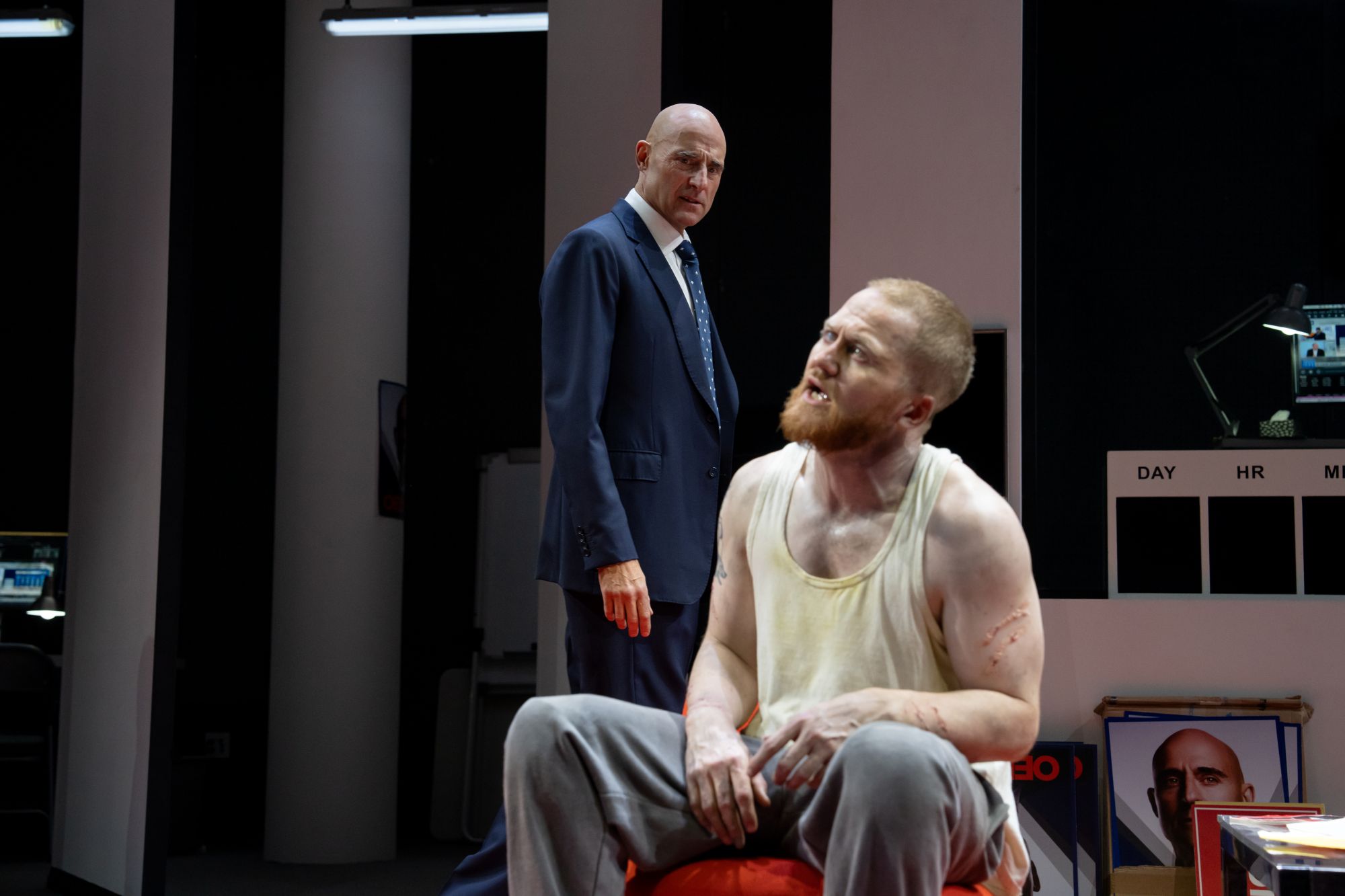
Mark Strong (Young Vic/West End/Broadway’s A View From the Bridge), reprising his Olivier-nominated performance, remains utterly transfixing and intensely driven, shifting from caring to rage within seconds. Handled solidly with intention and charisma, his Oedipus stands tall, confident, and righteous, a true statesman built of intelligence and clarity. But what’s remarkable this time around is how his certainty now carries a faint shudder of something desperate beneath it, as if some part of him senses the underlying rot in the foundation long before he allows himself to acknowledge it. His unraveling isn’t a collapse; it’s a slow, tight erosion, and watching Strong chart that interior disintegration is devastating.
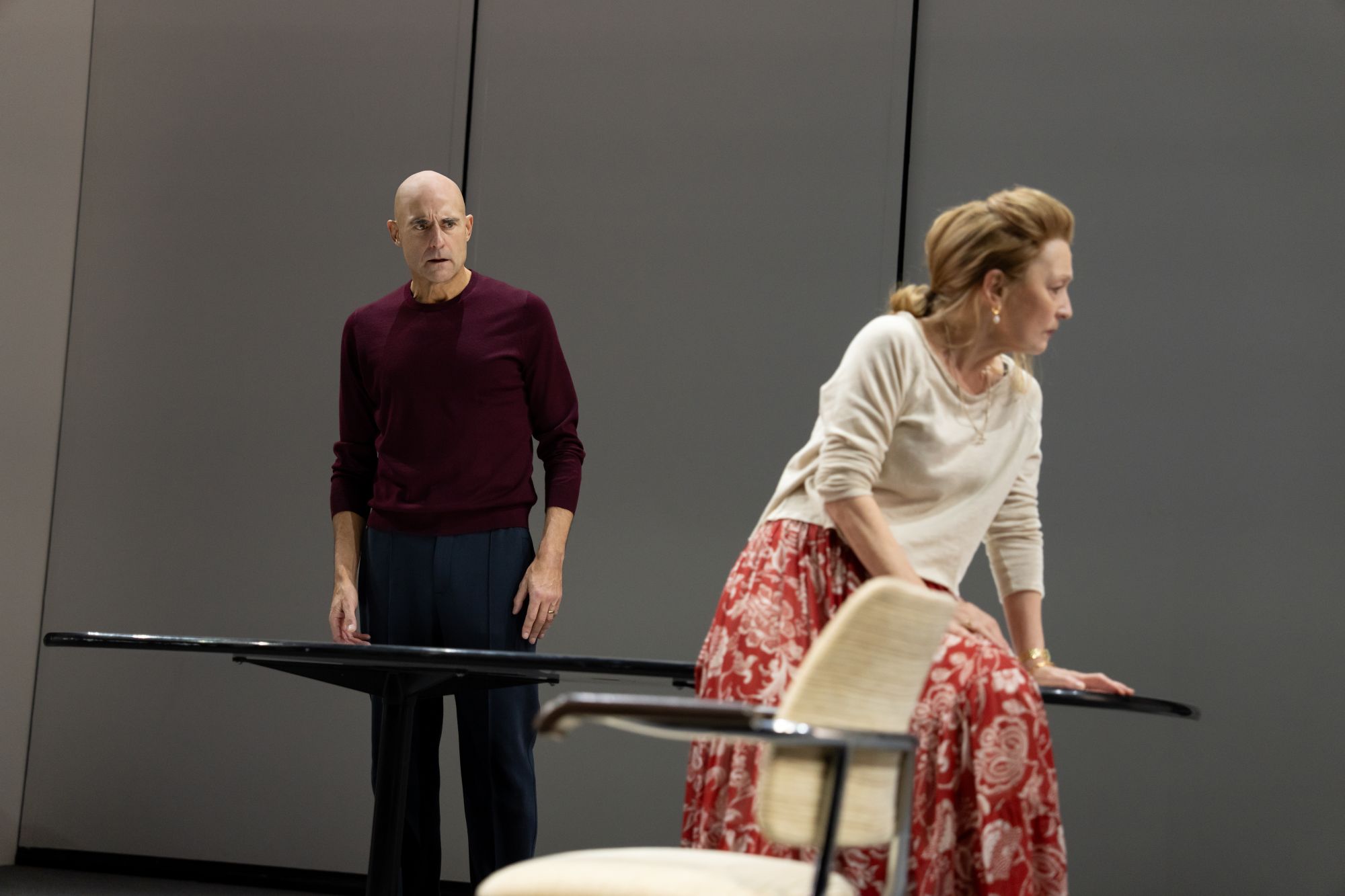
Parallel to him, and often surpassing him in emotional precision, is the formidable Lesley Manville (Bristol Old Vic/BAM’s A Long Day’s Journey Into Night), reprising her Olivier-winning turn as Jocasta. She is extraordinary to watch, as every gesture, every restraint, and every moment of careful recalibration feels richer and deeper than before. Her performance operates like the production’s moral frequency, vibrating with unknown dread long before the truth is revealed. And in fact, when that happens, the horror is never actually spoken out loud to each other. It is telegraphed by their stance and their stare. A pin could be heard dropping anywhere in that theatre as we watch her, and then him, put the disturbing pieces together. But saying it clearly aloud is something neither can actually do. Together, they create some of the most intelligent, emotionally exact acting and internal reckoning you’ll see on Broadway this year. Tony nominations are inevitable.
Around them, the company knits the tragedy into a full and living world. John Carroll Lynch (“Fargo“) is a superb addition as Creon. He is measured, grounded, subtly compassionate in ways that complicate Oedipus’s paranoia and exasperate it. Jordan Scowen (BBC’s “Casualty“) and James Wilbraham (BBC’s “Rogue Heroes“) reprise their roles as Eteocles and Polyneices, bringing the same raw, volatile sibling chemistry that makes their scenes land with remarkable human weight. Olivia Reis (MCC’s Shit. Meet. Fan.) as Antigone, new to the company, is especially gripping in her open-eyed and rebellious stance. She shivers with the kind of youthful certainty and uncertainty that both anchors and endangers her. [And on a personal side note: every time I watch the Oedipus story, I quietly scold myself for not brushing up on the future tale of Antigone. There is a small scene between Olivia Reis and Anne Reid, who plays Antigone’s grandmother, that hints at future battles I only half-remember, and I suspect it would register with even greater force if I came in better armed with her arc.] The ensemble surrounding them: Bhasker Patel, Teagle F. Bougere, Ani Mesa-Perez, Reid, Brian Thomas Abraham, Denise Cormier, Karl Kenzler, and Oliver Rowland-Jones, creates a world that feels lived-in and politically believable. And although their coming and going sometimes feels forcibly choreographed rather than organic, the overall flow of the piece feels dynamic and engaging.

The design team continues the immaculate, quietly devastating work they delivered in London. Hildegard Bechtler’s set strips itself bare as the night wears on, leaving the family emotionally naked within an increasingly sterile political machine where there is no room or space to hide. The costumes by Wojciech Dziedzic slice through character dynamics with minimalistic precision. Natasha Chivers’s lighting is expertly cool, exacting, and merciless, tightening the vise as the countdown clock ticks toward self-knowledge. The sound design by Tom Gibbons hums beneath the action like a gathering storm, and Tal Yarden’s video design adds the necessary modern sheen that makes this feel far more like a present-tense political reckoning than a retelling of a 2,500-year-old myth. It’s all stunningly cohesive, each element quietly conspiring with Icke’s vision to dismantle Oedipus from the inside.
This epic story of Oedipus has been rattling around my mind as of late having recently seen and written about Spontaneous Theatre’s wickedly sharp Goblin:Oedipus and the Abbey Theatre Dublin’s haunting and majestic adaptation, The Boy. With those themes swirling together in this abundance, unpacking different attitudes and postures that this tale contains, Icke’s production emerges triumphant. Its emotional intelligence somehow seems even more impressive than before, the second time around. Where those two other pieces deconstruct the myth through satire or rupture, quite magnificently, I’ll add, Icke’s Oedipus achieves its ultimate power by leaning into the human disaster at the center of the tale. It doesn’t mock the prophecy or exaggerate the tragedy. It simply shows how a man of great intention, great pride, and great blind spots can walk himself, step by step, into the very fate he believed he could outrun. Whereas Goblin:Oedipus cleverly illuminates the absurdity and The Boy beautifully exposes the cosmic ache, this adaptation of Oedipus powerfully reveals the crushing inevitability, underscoring how each interpretation, in its own distinct way, reveals why the myth continues to echo.

By the time Strong and Manville arrive at the final moments, he, broken and raw; she, shattered beyond recognition, the audience is silent in that unmistakable way that marks real theatrical communion. It is the silence of people who have been holding their breath without realizing it. The tragedy lands not because we didn’t know what was coming, but because Icke and his cast make us feel, minute by minute, how every choice, every misreading, every refusal to look inward builds the cage that eventually closes around them.
Oedipus on Broadway is not just a successful transfer, but a revelation. It is everything a contemporary adaptation of a classical text should be: clear, essential, and most importantly, very much alive. Icke has crafted something magnificent, relevant, and deeply human, and Strong and Manville perform it at a level that feels almost transcendent. I loved this production in London. I love it even more now. And I suspect Broadway will not only embrace it, but it will feel its aftershocks long after the curtain falls.
 front mezz junkies
[…] Broadway’s Oedipus & Spontaneous Theatre’s Goblin:Oedipus in […]
LikeLike
[…] ticking-clock device never translates into escalating tension. Unlike the recent West End/Broadway Oedipus, where each passing second raises the temperature and ignites the air, High Noon remains curiously […]
LikeLike
[…] sharpened by the steadfast, clinical, pressure-cooker approach of Robert Icke (Broadway’s Oedipus). The idea of Shakespeare unfolding against a literal digital countdown feels like a provocation […]
LikeLike