The London UK Theatre Review: National Theatre’s Playboy of the Western World
By Ross
Rain lashes the stage as John Millington Synge’s masterpiece comedy The Playboy of the Western World arrives at the National Theatre, with bodies moving through the darkness in what feels like a ritual of mourning and loss. It is a striking opening image, one of many in Caitríona McLaughlin’s visually ambitious revival, but also an early signal of the production’s central tension. This is a conflicted, wide-open Playboy rich in atmosphere, symbolism, and theatrical scale, yet one that often feels more preoccupied with visual metaphor than with the sharp, dangerous wit and narrative clarity that give Synge’s work its enduring singular bite.
First staged in 1907, The Playboy of the Western World is a play built on provocation. Synge’s dark rural comedy literally caused riots for its irreverent portrayal of Irish life, its frank treatment of sexuality, and its gleeful dismantling of heroism. At its core is a dangerous but sly joke: a young man becomes a local legend, a “playboy“, not for what he is, but for what a bored, isolated community wants him to be, maybe even needs him to be. Violence is eroticised, storytelling becomes the strongest currency, and admiration and desire turn on a dime once the fantasy they built collapses into reality. The play thrives on its intense verbal dexterity and the windy pressure of gossip ricocheting inside a single room. Its comedy is sharp and stormy because its cruelty is real, and its lyricism works best when tethered to that unsettling bite.
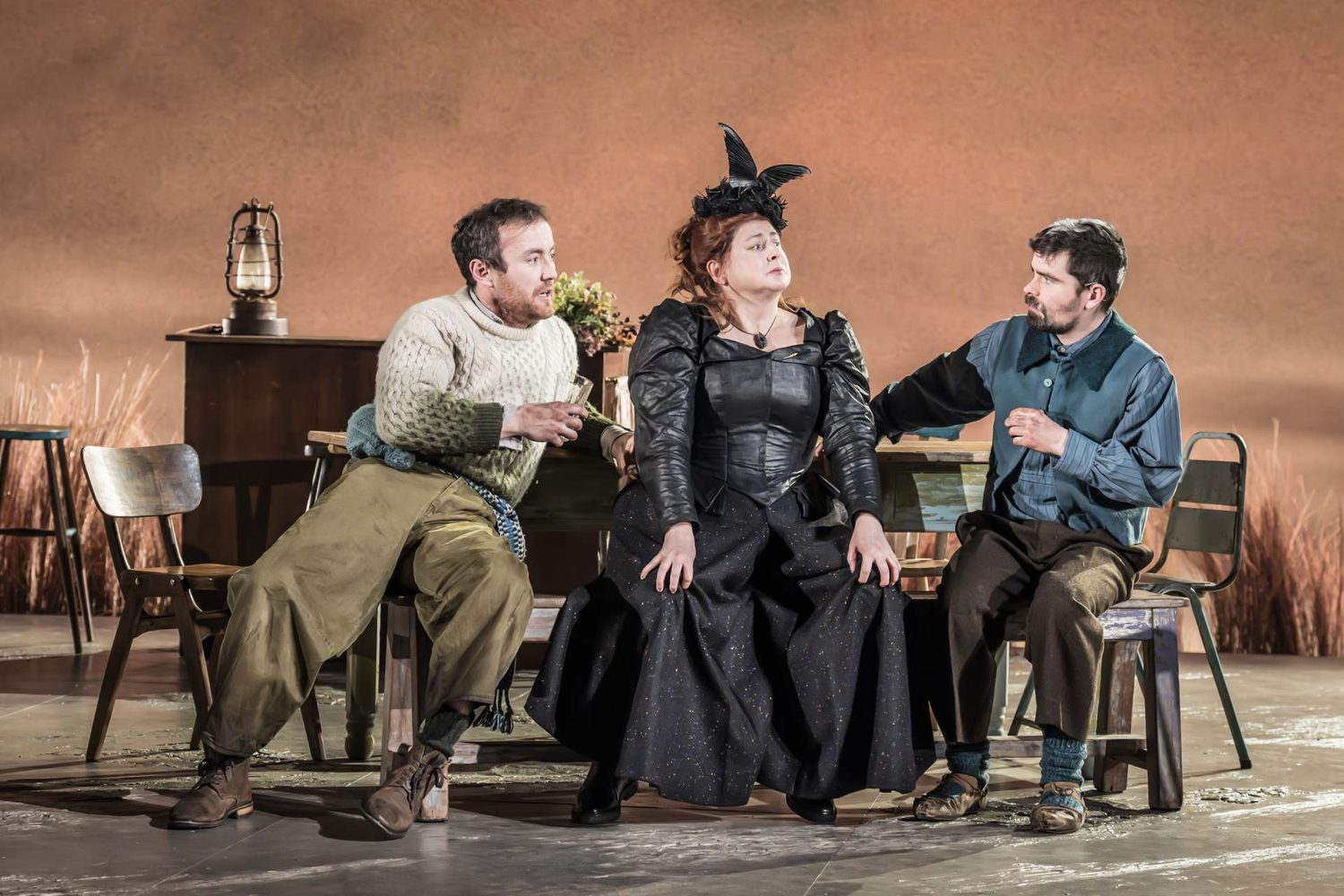
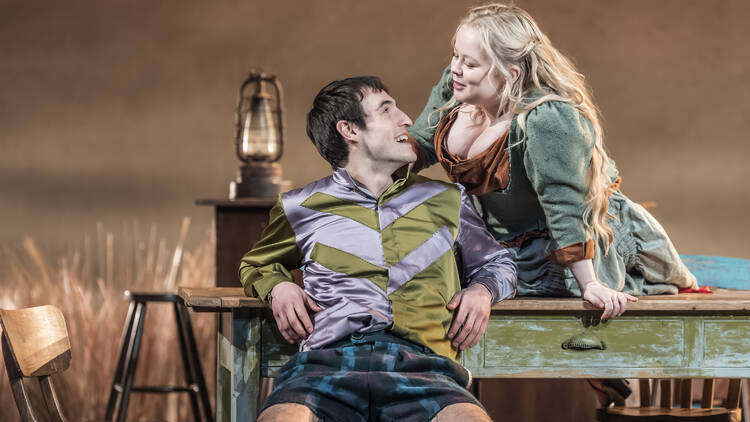
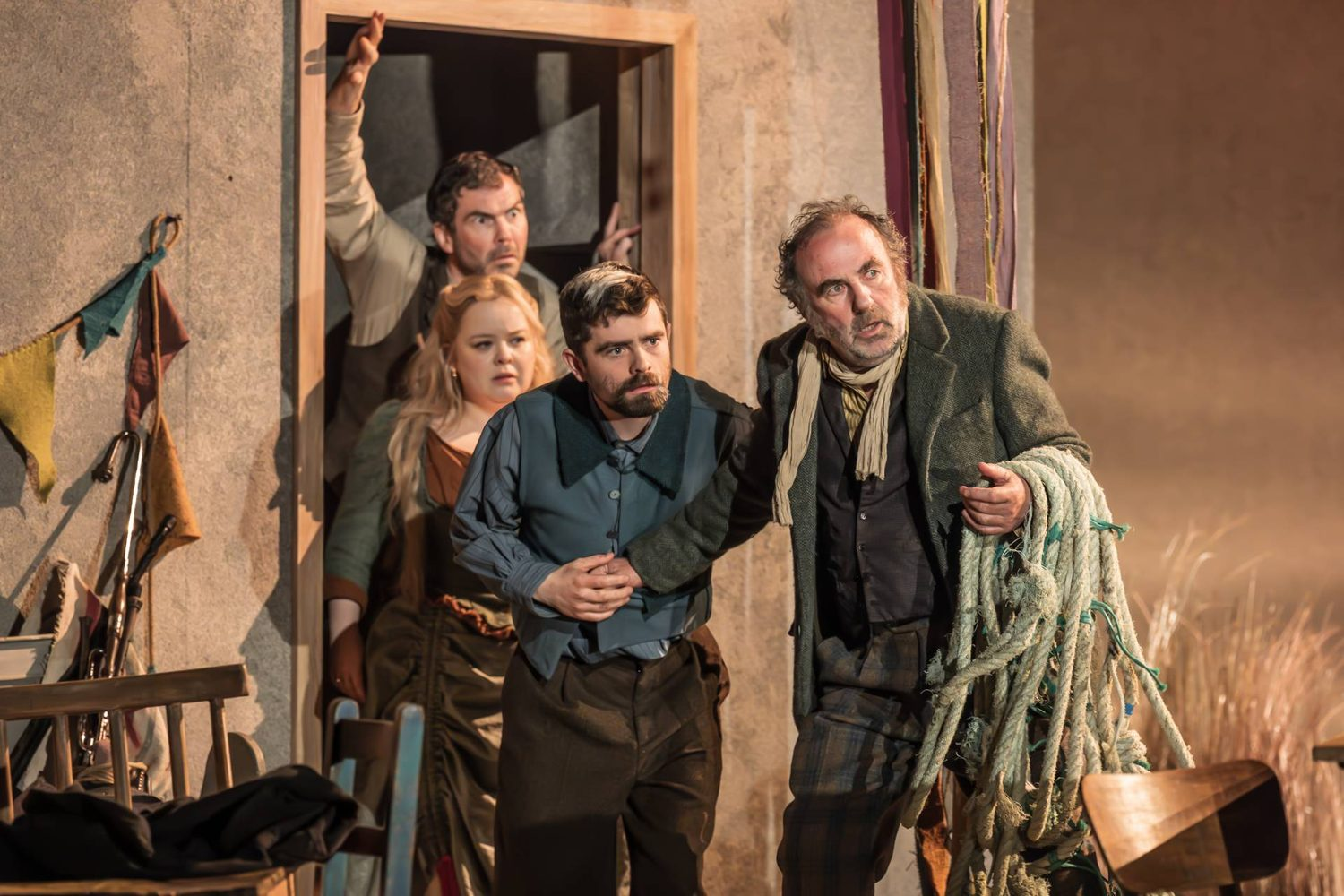
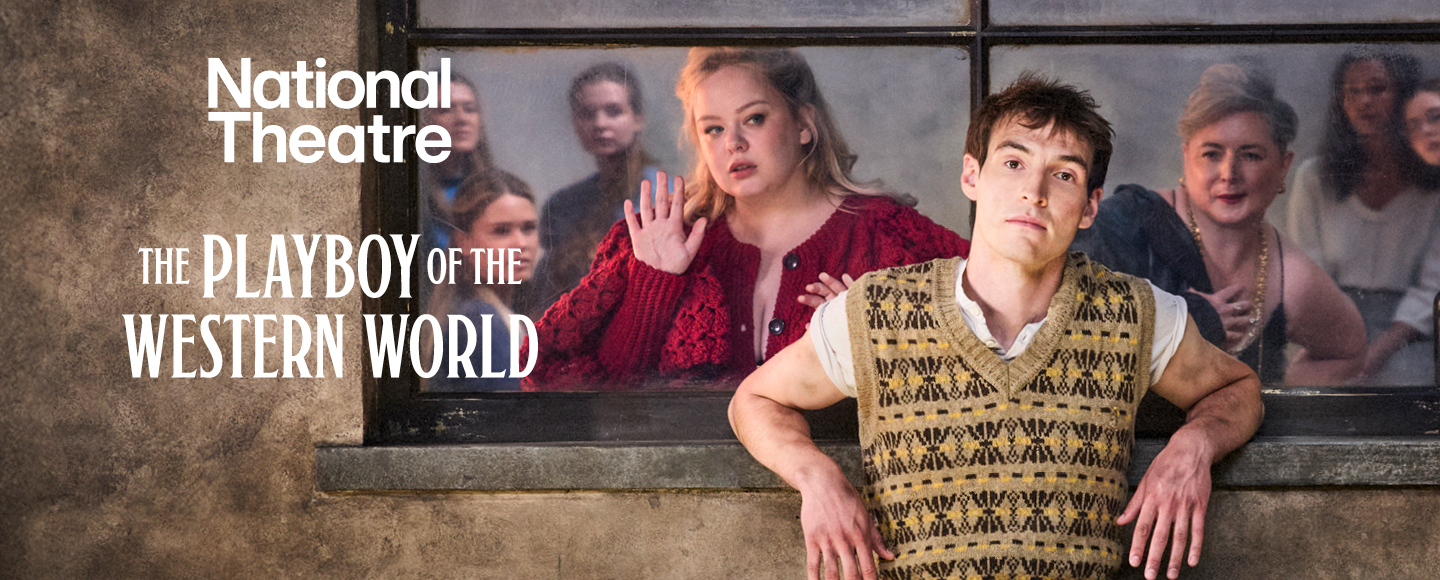
There is no denying the quality of the performances anchoring the evening, directed with ambition by McLaughlin (Abbey’s The Boy). Nicola Coughlan (“Bridgerton“) brings a lively, alert presence to Pegeen Flaherty, balancing romantic yearning with a brisk, sharp practicality and wit. Siobhán McSweeney (NT’s The Kitchen) as Widow Quin is similarly robust and deviously assured, her comic instincts pointed and her authority undeniable. Éanna Hardwicke (Donmar’s The Cherry Orchard) charts Christy Mahon’s transformation from timid outsider to puffed-up folk hero with commitment and sensitivity, while Declan Conlon (59E59’s My Eyes Went Dark) and Lorcan Cranitch (Abbey’s Ghosts) add solidity as the feuding fathers. Collectively, the cast work hard to navigate the dense Hiberno-English, crafted strong and true by Synge (The Aran Islands), though for most ears, much of the dialogue remains frustratingly elusive, with key lines lost to accent, pace, or staging.
Visually, the production, with set and costumes designed by Katie Davenport (Irish Arts’ What We Hold), is lavish and often beautiful. The wide, open set, heightened by the dramatic lighting of James Farncombe (NT/St Ann’s People Places & Things), and recurring images of death, grief, and processional movement, create an almost mythic landscape. Yet the abundance of symbolism, within the rainstorms, funereal imagery, and the recurring presence of straw-hatted, demon-like figures, rarely come together into a clear interpretive argument. Rather than illuminating Synge’s themes, these elements sometimes feel imposed upon them, leaving the audience somewhat lost in that same downpour of imagery, searching for meaning where emotional and narrative clarity might otherwise suffice.
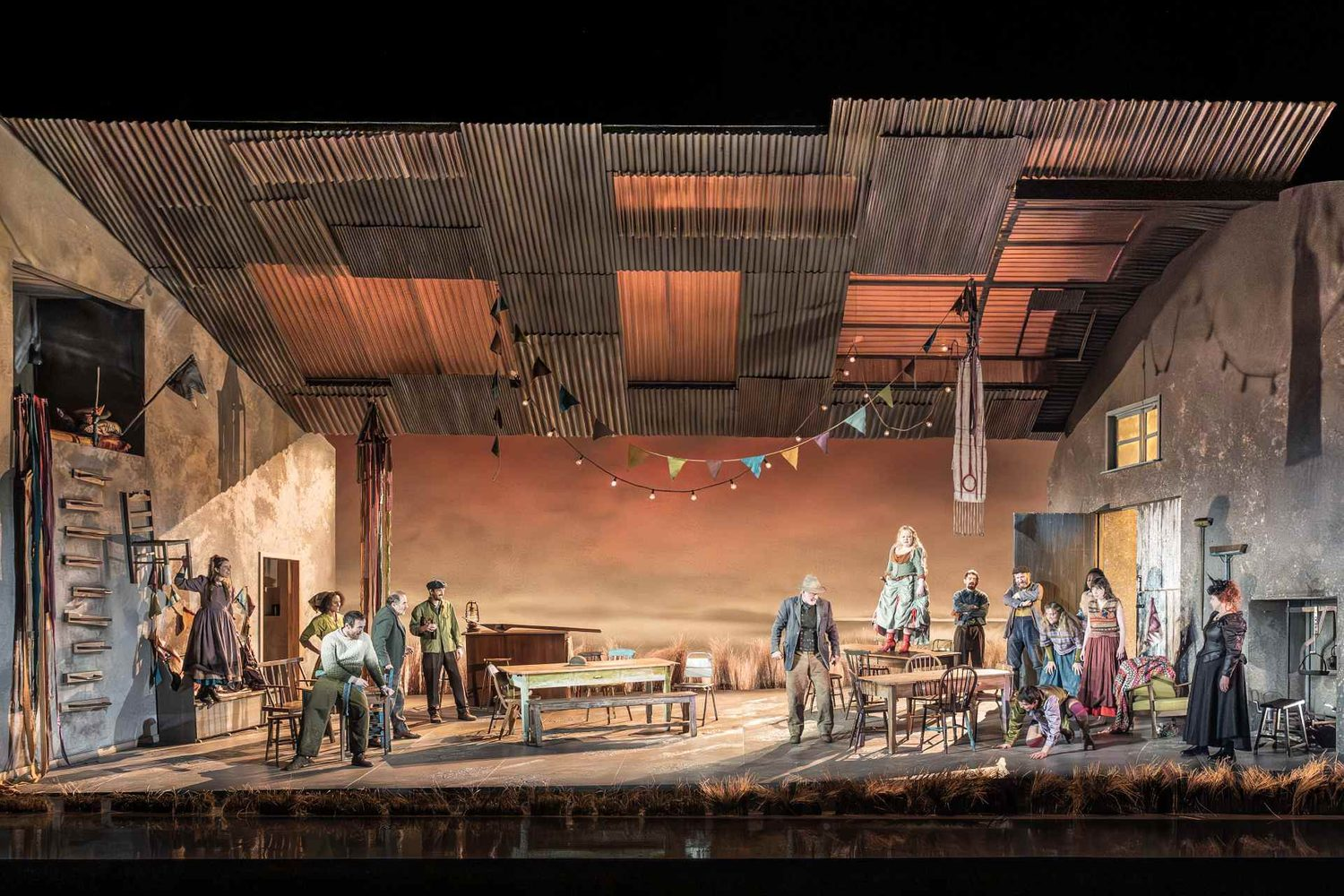
The scale of the staging also works against the play’s intimacy. The Playboy of the Western World thrives on claustrophobia, gossip, and the volatile chemistry of a small community contained within a single space. Here, the breadth of the stage and the emphasis on silhouetted vistas dilute that tight pressure, softening the play’s satirical and combative edge. Moments that should crackle with danger or dark humour instead drift into abstraction, and the production’s tone leans more toward solemnity than mischief for much of the evening.
Yet, by the final moments, when the rain returns and identities have been tested and reshaped, the production arrives at something closer to emotional cohesion. The overall effect is weighty, but one of admirable ambition rather than full satisfaction. This Playboy is thoughtfully cast, visually sumptuous, and clearly made with care, but it struggles to balance focused spectacle with substance, and poetry with punch. What remains is a production to admire in parts, even if it ultimately keeps Synge’s wild, unsettling comedy at a thoughtful, frustrating distance.
 front mezz junkies