
The Toronto Theatre Review: Hewitt’s chaotic, immersive fever dream transforms ancient myth into a night of karaoke, comedy, and consequence
By Ross
I tell you, with all honesty, I did not want to be handed a microphone, nor asked to help decide the fate of a mythological monster. And yet, within moments of stepping into that makeshift karaoke lounge at the Bathurst Street Arts Hub, that is exactly where I found myself.
A creature lies there, face down, unconscious, like a drunken frat boy whose buddies have all gone off and left him, maybe to bed or possibly another rave. The lights pulse, the music beats out a rhythm of wildness, and suddenly, as lyrics begin to flash, he wakes, and the distance between the performer and us collapses into something far more immediate, and far more ridiculously revealing.
It’s a strong swing, this Cyclops: A Satyr Play! arriving, pounding and poking at us like a great, bad hangover, Grecian style. This is not a polite revival of Cyclops (circa 5th century BC) by Euripides, but a full-bodied, wildly creative, massively disordered reimagining that embraces the original’s unruly spirit and then pushes it into something defiantly modern. Written, directed, and performed by the captivatingly clever Griffin Hewitt (TIFT’s The Frogs), this production treats Euripides’ fragmented, disorderly source text as an invitation to sing rather than a silencing constraint. The result is a “queer, techno-pop fever dream” that elevates and intoxicates the space around it. The one-person party feels as though someone attempted to retell The Odyssey after a long night out drinking, carousing, and deciding that accuracy was far less important or interesting than wild, wondrous energy. And boy, does Hewitt have energy.
His Cyclops, brought to life by Panic Theatre and Talk is Free Theatre, is deceptively simple. Hewitt wisely creates a Silenus who is equal parts host, instigator, and deliriously unreliable narrator, gathering us together inside his stupefied domain as he begins to spin the tale of Odysseus, the Cyclops, and the satyr who hovers somewhere between servant and accomplice. He asks the ever-so-important questions like, “What if a goat and a man had a child?” and “How did a goat and a man have a child?” But this is not a story that unfolds in a straight line. It loops, it fragments, it swerves into karaoke numbers and drunken confessions, thrusting and twisting the audience into the passenger seat with gleeful abandon. At any moment, you might be asked to sing, to choose, throw, or to step into the story itself, and the show thrives on that unpredictability.
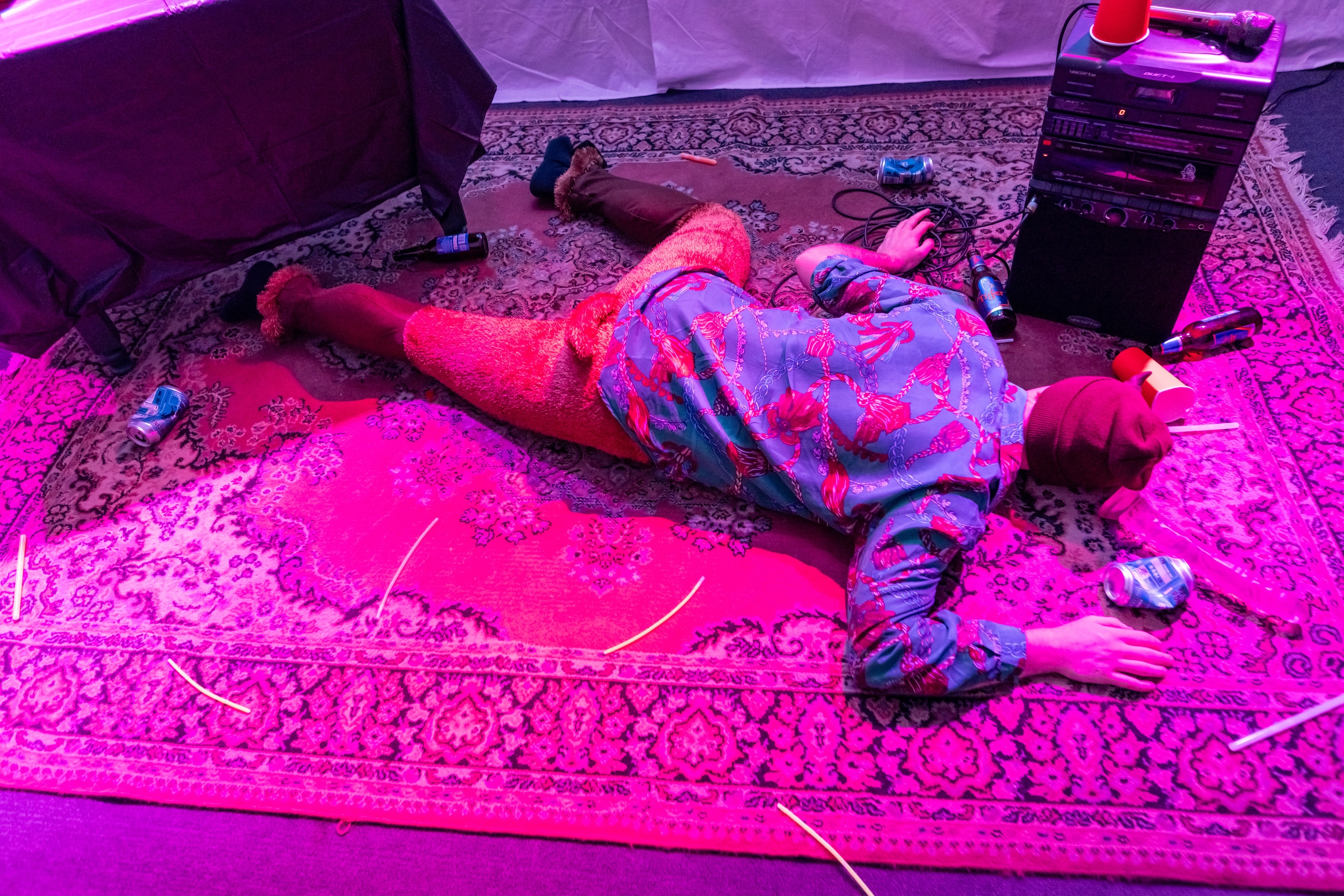
Hewitt’s performance is the engine that drives it all. He is fearless, mischievous, and completely in command of the room, moving effortlessly between narrative, song, and direct engagement with the audience. There is a tense looseness to his delivery that feels intentional, as though anything could happen, yet beneath that looseness is a precise understanding of rhythm and control. He knows exactly when to push the chaos further and when to pull it back just enough to keep us with him. I did want him to slow down for a moment, take a breath, and revel in our devotion to the cause, but he drives forward at warp speed almost from the first moment he wakes up, clasping his head like it’s going to explode. And maybe it will, we wonder, as he just keeps taking the stakes higher and higher with each thrust of his body and mind forward into a seemingly infinite universe of possibilities.
The production leans fully into its chosen aesthetic. The space has been transformed into a private room party lounge, where projections, pulsing sound, and shifting lights create a sensory-rich mythological playground that feels both disorienting and inviting. The lyrics projected on the walls become part of the storytelling, tugging at us through songs that range from absurd to strangely affecting. The soundscape, at times throbbing and relentless, reinforces the sense that we are not simply watching this world, but inside it.
We’ve all been in a room like this, or at least felt the aftermath of one, where the noise lingers and the energy refuses to settle. Yet inside this chaos, something surprisingly coherent begins to emerge. Euripides’ original Cyclops functioned as a satyr play, a bawdy release after the intensity of tragedy, filled with crude humour, song, and irreverence. Hewitt’s version honours that tradition while reframing its core question. Each night, the audience is asked to choose between feeding the monster or saving the stranger, a dilemma that sounds absurd until it begins to echo beyond the room. The joke lands, and then it lingers in the air.

The humour here is unapologetically broad, leaning into sexual innuendo, drunken antics, and frat-party absurdity with enthusiasm. Not every moment lands with equal clarity, and the sheer volume of chaos can occasionally blur the edges of the story. Yet the production never loses its sense of humour or its purpose. Beneath the jokes and the spectacle, there is a thread of connection that keeps pulling the evening toward something more grounded.
It doesn’t always make sense, which may frustrate those looking for a cleaner throughline, but what makes Cyclops: A Satyr Play! resonate is not its fidelity to the original text, but its willingness to ask what it might feel like now. It knowingly comprehends that the power of this story does not lie in its structure, but in its invitation to participate, to laugh, and to confront something unexpected in the process. Therefore, it is messy, loud, and often ridiculous, but it is also alive in a way that feels immediate, magnificent, and shared.
What at first felt like chaos begins to settle into something more deliberate. The singing, the choices, the absurdity all circle back to that central question, not as an answer, but as something we carry out with us. And somewhere between the laughter and the ludicrous, the line between feeding the monster and saving the stranger does not feel quite as simple as it did when the party first started. Now, if only Brad Pitt’s stranger Achilles had shown up to play along. That might have been the perfect finishing note to an already wild and wickedly fun evening.

 front mezz junkies