Frontmezzjunkies reports: A new chapter for musical theatre unfolds across streaming and cinema
By Ross
It wasn’t that long ago when I was sitting in that downtown NYTW theatre, aware that I was watching something people would be talking about for years, and quietly hoping I would get the chance to experience it again. At the time, I was only dreaming of a possible transfer uptown to Broadway. That did happen, even if I never made it into the Hudson Theatre to see it. But what I did not expect was that another version of that return would arrive in an entirely different form, opening the doors to more possible fans than I ever thought possible at the time.
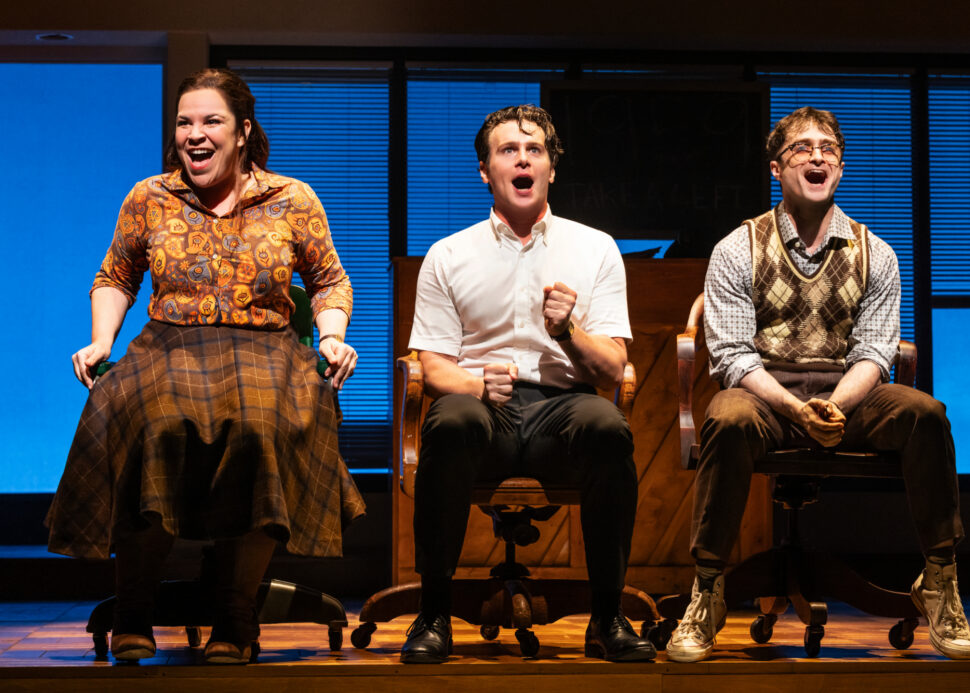
Beginning April 4, Netflix will release the filmed version of Merrily We Roll Along, directed by Maria Friedman and starring Jonathan Groff (Broadway’s Just In Time), Daniel Radcliffe (Broadway’s Every Brilliant Thing), and Lindsay Mendez (Broadway’s Carousel). Captured near the end of its Broadway run, and following a limited theatrical release, the production now finds its way into homes, extending the life of a revival that reshaped how this musical is understood and cared for.
When I first encountered Merrily, it felt like something had finally clicked into place. It was a musical that “throws it all in reverse, in an attempt to see what exists if we could stand and examine time differently,” and for once, that ambition landed. Under Friedman’s direction, the piece moved with a “wise assurance,” allowing each step backward to deepen what we thought we knew, until the story revealed itself in full.
At the centre of that unraveling were three performances that grounded everything. Groff’s Franklin Shepard, Mendez’s Mary, and Radcliffe’s Charley formed what I once called “an unthinkably strong and decisive” trio, giving the production its emotional core. Their work continues to resonate, now carried beyond the theatre and into a different kind of shared experience.
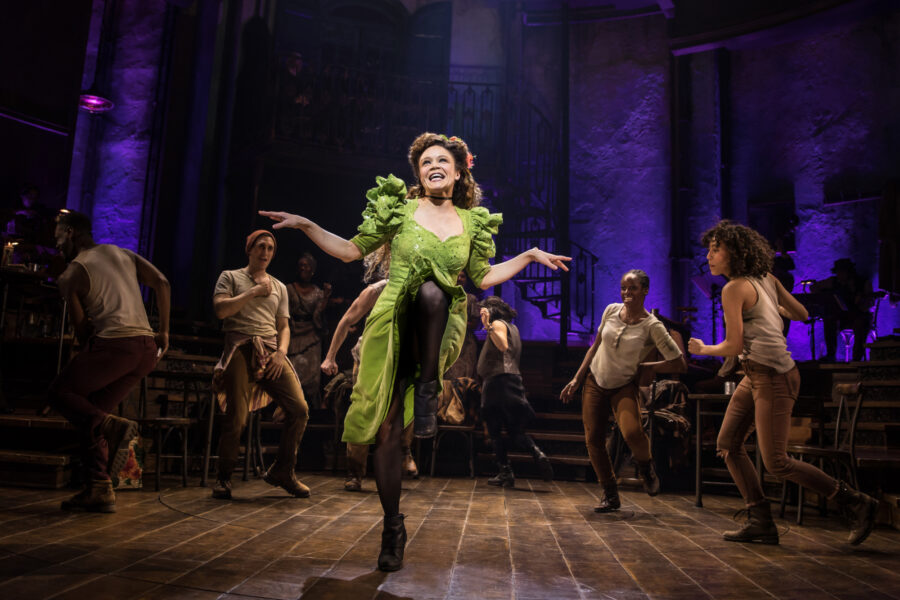
That journey does not stand alone. It now sits alongside the long-awaited release of Hadestown to cinema screens this summer, featuring its original Broadway leads. The musical has always moved with an “ancient and immediate” pull, where love and loss circle each other with a quiet inevitability. Its storytelling unfolds in loops and echoes, returning to its central questions again and again until they settle into something deeper. That rhythm, so essential to its life on stage, now extends outward, asking audiences to sit with it in a new way.
And then, arriving from another direction entirely, Six makes its own leap to the screen. Captured live at London’s Vaudeville Theatre and featuring the original West End Queens, the film brings a different kind of theatrical energy into cinemas this August. Where Merrily moves through memory and Hadestown through myth, Six thrives on historic immediacy, pop performance, and direct connection. Its structure is built on voice, identity, and reclamation, turning history into something loud, present, and defiantly alive. Seeing it preserved in this form offers another way for that energy to travel, reaching audiences who may never have stepped inside the theatre.
What has always made Six resonate so strongly is its refusal to sit quietly inside history. When I first saw it on Broadway, I was struck by how it “reclaims these women with ferocity and joy,” allowing each queen to step forward not as a footnote, but as a fully realized voice demanding to be heard. The concert structure, the direct address, and the electric pulse of the performances all work together to collapse distance between stage and audience. That energy translates naturally to film, perhaps more so than any traditional book musical. Where Merrily asks us to reflect, and Hadestown asks us to listen, Six demands that we respond. Its movement to the screen does not soften that urgency. It amplifies it.
Taken together, these releases point to something shifting in how theatre lives beyond the stage. This kind of theatrical extension has existed for years in other forms, most notably through the National Theatre’s Live program in the UK, but seeing it emerge so clearly around Broadway work feels like a shift. These works are not being replaced by their filmed versions. They are being extended. The intimacy of live Broadway and West End performances is being transformed, but something essential remains. The music, the language, and the emotional architecture of each piece continue to hold, even as the medium changes.
What is thrilling in all this is the possibility of returning to all three. Not in the same form, but with something unique and forever alive within them. Whether seated in a cinema or watching from home, the experience shifts along parallel lines, yet the connection does not disappear or disintegrate. Somewhere between what we remember and what we encounter again, something moves, just enough to reveal why we hold onto these stories in the first place.

 front mezz junkies