 The Oresteia
 Icke very cleverly unfolds the rest of the play as a series of flashbacks recounted by a highly traumatised Orestes (played with a passionate intermission by Luke Thompson), as his mental sanity is assessed by whom can only be assumed to be his psychiatric doctor (Lorna Brown) in a role that substitutes the entire chorus of the original tragedy. Orestes is also troubled by the ghostly image of his sister Electra (in the stage debut of Downtown Abbey’s ex-star Jessica Brown Findley) whom has persuaded him to avenge their father’s death by killing his mother (oblivious to the fact that Agamemnon himself is responsible for their sister’s death). Finally, the last section of the play centres on the trial of Orestes for his crime and provides an interesting insight (and turn of events from the Greek original) into the internal struggles he faces, as he tries to overcome the guilt of killing his own mother while embracing a feeling of righteousness for avenging his father.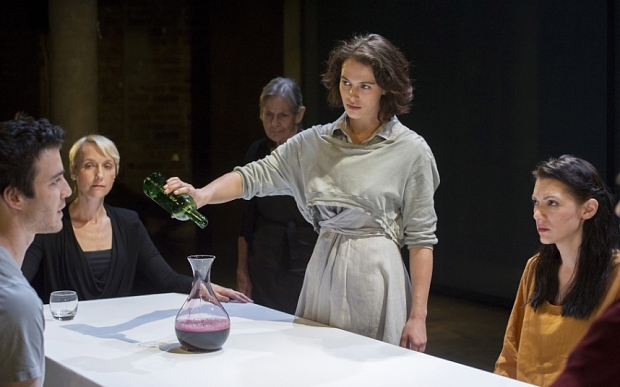
Luke Thompson Lia Williams Jessica Brown Findlay Hara Yannas
©Alastair Muir 06.06.15
Icke’s play is every bit clever and current. The set is very minimalistic and yet effective thank to the work of Hildegard Bechtlet who creates an environment that morphes through a set of screens that move along the length of the stage and that go from transparent, to translucent to black and provide a clever backdrop to the action occurring both in front and behind the actors. The use of small cameras and some small screens in the theatre also feel reminiscent of the director’s previous work in 1984, as a poignant way to comment on the power of address of the media and the political forces behind it. Undoubtedly, this adaptation clearly takes a more feminist stand, as it tries to distance itself from the usual condemnation of Clytemnestra as an irrational and vengeful character whose action are frowned upon by a clearly mysoginist society that sees no wrongdoing, ironically, in men’s murderous own actions. Women take centre stage in this adaptation that becomes a treaty on the power of address of the female figure when confronted by those same structures of power that have oppressed them since millennia.
 front mezz junkies
[…] Icke (Almeida Theatre’s Oresteia) has crafted something particularly intelligent and engaging. To say the least. It might be one of […]
LikeLike
[…] written and directed by Robert Icke (Almeida Theatre’s Oresteia), the conflict that reveals itself quickly is just the beginning of a cascade of constructs that […]
LikeLike
[…] written and directed by Robert Icke (Almeida Theatre’s Oresteia), the conflict that reveals itself quickly is just the beginning of a cascade of constructs that […]
LikeLike