The Best of 2023 Theatre Edition: Toronto, NYC, and London, UK.
By Ross
Oh, what a year it was. Running back and forth with a vengeance from Toronto to NYC, with stops in London, England, and London, Canada. Mostly for the sake of theatre and of course, family. It was quite the madcap adventure, with far too many miles up in the air, but there were just as many theatrical moments that made it all so very worth it. And I wouldn’t change a thing. (You can click on each and every title for a link to my frontmezzjunkies review if you so desire.) Here’s a list of the theatrical events I loved, in all of the cities and summer festivals that I attended.

One of the many highlights of the year (not of the theatrical season) was the near-perfect revival of NYTW’s Merrily We Roll Along, and like two of my other personal downtown favorites; Public’s Fat Ham and Here Lies Love, their not very surprising transfer to Broadway only elevated and expanded their miraculous uptown climb. Merrily We Roll Along was primed for this move. It was a legendary failure when it first arrived on Broadway back in 1981, shockingly closing after just 16 performances and 52 previews that first go-round, yet this revival skyrocketed itself way past that into the high-priced ticket wars of Broadway success. Maybe because of its stellar cast; Jonathan Groff (Broadway’s Hamilton; off-Broadway Little Shop of Horrors), Daniel Radcliffe (Broadway’s The Lifespan of a Fact; Old Vic’s Endgame), and Lindsay Mendez (Broadway’s Carousel; RTC’s Significant Others) putting it all together to engagingly, or maybe it was the choices made that solidified the experience, finding acute understanding in their backward momentum. It’s difficult to know, but it is true to say that much of the revival’s success squarely lies on the strong shoulders of director Maria Friedman (Old Vic’s High Society), who has resurrected her production, unleashing the same formula that elevated that Menier Chocolate Factory and Boston’s Huntington Theatre Company production to such grand heights. She somehow found that mysterious key to make this rewinding work, probably better than anyone has done before. Driving it backward down the road with a wise assurance.

Also rising up from the dead, in a matter of speaking, after playing to acclaim at The Public Theatre downtown, playwright James Ijames’s hilariously clever Fat Ham opened on Broadway and gave us all just cause for a glitter ball celebration. This smart and sly backyard BBQ reformation of Shakespeare’s Hamlet is not simple in any way, shape, or form. It’s breathtakingly brilliant and will forever be remembered for its ingeniousness. All of this Shakespearian drama rings true and clear, but what Ijames (Kill Move Paradise) has done with this brilliantly crafted play is to take those cornerstones of tragedy and angst, and elevate them up above the split-level Black man’s suburban experience, and infuse it all with the aroma of hilarity and wise wit. It’s a complex layering that unleashes so much flavor around being queer, Black, and soft in modern-day America that it’s almost too tasty to digest simply.
Much like the revival of Here Lies Love, created with a strong vision by the musicians David Byrne and Fatboy Slim, that rolled and revolved itself with its own fair share of glitter and glamour into Broadway history at the reconstructed Broadway Theatre. Destined to be idolized for its powerfully danceable and revelatory unwrapping, the pop musical takes us all for a delectable spin back to 1945 to investigate, and possibly try to understand, the notoriously criminal Imelda Marcos, played to perfection by Arielle Jacobs (off-Broadway’s Between the Lines) and those people that shared the spotlight with her during those infamous years.

A few other notable and spectacularly well-produced musicals took Broadway by storm this year. But sadly not a lot of original musical works on Broadway can be honored this calendar year. Yet there is one that stood out in the crowded (corn) fields. With a hilariously written book by Robert Horn (Disney’s Hercules; Tootsie) and rows of sharply grown music/lyrics by Brandy Clark (“Follow Your Arrow“) and Shane McAnally (NBC’s “Songland“), Shucked, the corn-fed musical, found what should have been an award-winning balance of smart and silly, sung strong, and delivered with confidence by a stellar cast that continues to astound. This amazing new musical is completely joyful and ridiculous, springing up from the stage with quite a different growth than most other offerings this season. It takes its place as my most loved new musical of the Broadway year.
It would be difficult to pass up talking about what was probably the most anticipated new musical to come to the stage this year; Stephen Sondheim’s last creation, Here We Are. “All will be revealed,” we are told midway through its delightfully delicious Act One in this new musical, or should I call it; the new sung and spoken word abstractionism that is Here We Are at The Shed‘s Griffin Theater. And in a way, it is exactly why we are all here, to pay homage to the man as we enter that beautiful theatre in Hudson Yards.
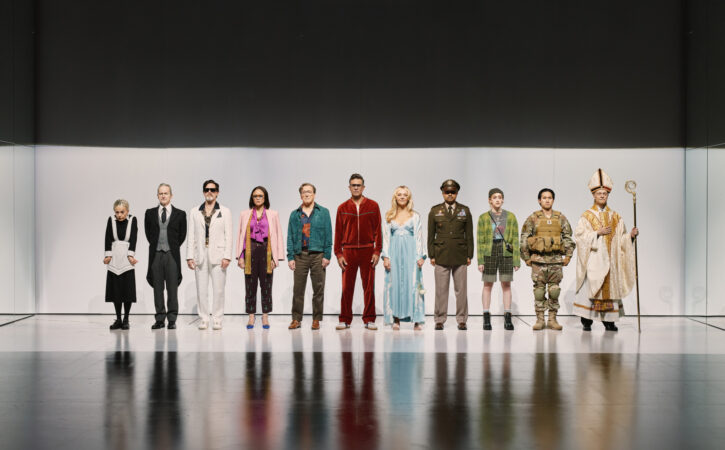
Here We Are, with a large unpacked and involving book by David Ives (Venus in Fur; The Liar) with music and lyrics by the late Sondheim (Into the Woods; Company), is in a realm all on its own. It gives us everything while also stripping away some of the draw. It’s abstract and wonderful, giving us inspection and deliverence, while leaving us somewhat befuddled, wondering where the music stopped in relationship to our invested interest.
Inspired most gloriously by the abstract and meaningful films of Luis Buñuel, Here We Are plants us exactly there, much to our confused chagrin and joyfulness, lost in a sea of squares of white light and circular neon, wondering when we are going to be fed the very thing we all turned up for. And then surprised, well at least some of us, with the feeling of being full on what appears to be something other than what we wanted or expected from this creation. Both sad and happy to have had that last Sondheim meal.
Of the other musical offerings that I loved this calendar year on Broadway (and beyond), there were three that were revivals, all produced in a different country, and all utterly spectacular; Donmar Warehouse‘s exciting and emotional Next to Normal, the Bridge Theatre‘s fantastically immersive Guys & Dolls, or the beautifully rendered Brigadoon at the Shaw Festival.
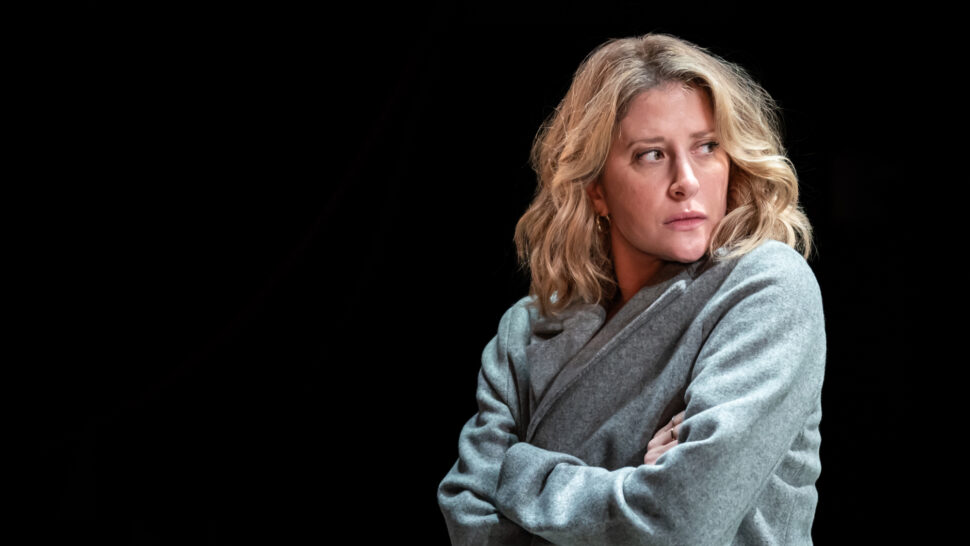
In London’s West End, one revival, in particular, pill-popped itself to the front, and from those first magical chords of Donmar‘s Next to Normal, created by Tom Kitt (Public’s The Visitor), that roll out hauntingly from music supervisor Nigel Lilley (NT’s Follies), the emotional cues are all found in their perfect place, ready to take us on this suburban journey drenched in tragedy, grief, depression and mania. The powerful rock musical digs deep, particularly with the director Michael Longhurst (Donmar’s Belleville; Chichester/RT’s Caroline, or Change) majestically at the helm, delivering us completely and emotionally into the complexities of mental illness and drug abuse, thanks to a wisely cast Caissie Levy (RTC’s Caroline, or Change) in the lead.
It’s a dangerous business, psychopharmacology, one that many a desperate patient can’t survive the twists and electric turns of the head. Yet, this Next to Normal is definitely one to be remembered, and I’ll be crossing my fingers that the show, with Levy and family in tow, after jumping into the West End this spring, will make that pond leap to Broadway, so I can have my heart ripped out and stomped on once again by the brilliance of their Next to Normal.
Also in London, Bridge Theatre’s revival of Guys & Dolls, made magnificent and immersive by director Nicholas Hytner (NT’s One Man, Two Guvnors) and set designer Bunny Christie (West End’s Best of Enemies), changed up that crap game to the highest level, delivering something that is truly beyond anything you could imagine for this classic musical. It’s the farthest thing from its standard rendering, bringing mountains of energy and excitement to a show that is already filled to the rim with gems and laughs. The immersive experience, much like Broadway’s Here Lies Love, brings the floor crowds within inches of the action, feeling as intimate up in our seating arena as it must have been down there for the likes of those who wanted to (and had the energy to) stand and be shuffled around. I must admit, that I felt blessed, not just because I got to see this stunningly great production but because we were given the always perfect view from just one flight up. And what a great vantage point it is to take in this immaculately well-written musical from start to finish, with pitch-perfect delivery of those magnificently well-crafted one-lines and songs sung by a crew of fantastic characters brought to life by a cast of amazing pros.

And then there was the surprise last-minute entry into my list of favorite musical revivals. It was the December holiday gift from the Shaw Festival and I couldn’t have been more thrilled after driving over from Toronto one Christmas weekend. Their impressive unwrapping of the Lerner and Loewe’s 1947 classic, Brigadoon is as superb and gorgeous production as one could ever hope for. Revived perfectly from their 2019 production, this musical is most definitely worthy of a road trip to the Shaw Festival in that sweet town of Niagara-on-the-Lake just to wallow in its wonderfulness. Brigadoon, with book and lyrics by Alan Jay Lerner (blessed with a revised book by Brian Hill), and music by Frederick Loewe, is as Scottish and sumptuously performed as you can get, from those first strongly crafted notes played most dynamically by the Shaw Festival orchestra, to the lovely romantic ending brought forth out of the fog and delivered most wonderfully into your holiday lap.
Back on Broadway, two other revivals rivaled each other for Tonys this past spring; Parade and Sweeney Todd. Both delivered powerful vocals and stories to a higher level this past year. The captivating and intense Parade, with a book by Alfred Uhry (Driving Miss Daisy), music and lyrics by Jason Robert Brown (Songs for a New World; The Last Five Years), and originally co-conceived by Harold Prince (West Side Story), stands undeniable strong up on a high sturdy box, taking on race, antisemitism, and prejudice in “The Old Red Hills of Home” South. It dutifully and dynamically does its duty, dramatizing the disturbing but true story of a 1913 trial of a Jewish factory manager who was wrongly accused and convicted of raping and murdering a thirteen-year-old young girl and employee of the factory. The musical revival was as timely and as brilliantly performed as can be, and as surefooted as one could have hope for. As directed carefully and artistically by Michael Arden (Broadway/Deaf West’s Spring Awakening), Parade delivered the goods on all fronts and came out winningly.

Played out big and strong on the Lunt-Fontanne Theatre stage, with that big and full orchestra sound under the command of music supervisor/conductor Alex LaCamoire (Broadway’s Dear Evan Hansen), Sweeney Todd, The Demon Barber of Fleet Street is as gorgeous as one could hope for. The show is basically unstoppable, especially with Josh Groban (Broadway’s Natasha, Pierre…) as the murderous Sweeney Todd, and his legendary sidekick, Mrs. Lovett, played hilariously by the astounding (if a bit over-the-top) Annaleigh Ashford (Broadway’s Sunday in the Park…). The musical is definitely one of Sondheim’s finest, and is most assuredly one of my favorite musicals of all, just below Sunday in the Park with George, and just above Company and Sweeney’s Tony Award for Best Revival competition, Into The Woods. I am curious about the new casting choices. Thinking and hoping that they will excel as strongly as Groban did – even though many of us (including me) didn’t think Groban was the right choice, dramatically (happily I was very wrong about that).
Play revivals also rose to prominence on the Broadway stage, but it was really the detailed pulled-apart revolutionary revival and return of Henrik Ibsen’s A Doll’s House that astounded me early in the year. As directed with the same magnificently detailed energy and flat-walled framework as the previously seen Betrayal on Broadway and the West End, Jamie Lloyd gave us A Doll’s House that will never be forgotten. The focus is oh-so deliberate, and the formulations are just so spectacularly strong, pushed forward in black and white, that we can’t look away, from the circular beginning to the jaw-dropping ending.

A Doll’s House’s celebrated star, Jessica Chastain (Broadway’s The Heiress; “The Eyes of Tammy Faye“) rotates the expanse of the bare stage before the others join her slowly and deliberately. She sits, arms crossed, staring, daring us to look away, while knowing full well we won’t. Or can’t. And without a word, it feels like she has us exactly where she wants us. Needs us to be. And all that transpires before the play even begins. She barely moves from her chair, as others, like the equally wonderful Arian Moayed (Broadway’s The Humans) as Torvald, are rotated in to sit beside her, conversing and delivering magnified lines that dig deep into the underbelly of the complicated interactions. The delicacies of this birdie trapped inside a cage, poisoned with lies and excuses, and beautifully brought forth by Chastain, register the reasonings for this revival to exist. It has found a new and deliberate place to sing, and for that, I am truly grateful.
In a slightly more singular and different framing, the same could be said of the amazingly gifted Andrew Scott (Veracity Digital’s Sea Wall the Film) and his one-man revitalized Vanya in London’s West End. Revived and reconstructed by co-creator, adaptor, and playwright Simon Stephens (Heisenberg), with director Sam Yates (Arts Theatre’s Murder Ballad) and designer Rosanna Vize (Royal Court’s Wordplay), they unleash something truly remarkable with Scott, one of the most loved and cherished actors from so many great things, like his impossibly good Fleabag role, took on the classic play all by his lonesome. Scott basically did the impossible. He held us completely captive, gently and thoughtfully, in his outstretched hands, as he bounced a tennis ball to start the doctor’s match off to its brilliant beginnings. Talking back and forth to himself, Scott magnificently and subtly embodied all of Vanya in the most stellar of played games imaginable, laying waste ingeniously to the high-concept idea presented before us.

Scott dives in, finding formulas and doorways for us to follow him through as he unpacks pages upon pages of Cheknovian themes with a craftsman-like precision. He’s a joy to behold, understanding each and every anglicized one in that room, all the way from Helena, the beautifully narcissistic wife of the elderly Alexander, now remodeled into an arrogant filmmaker, through his daughter, the love-struck Sonia, past the world-weary love-doctor, Michael, to the titular Uncle Vanya. Each one has their own quality or dishcloth to hold on to, shifting and turning from one to another with a thrilling adept velocity. Vanya is a masterclass of detailed deliverance, engaging in conversations with two or more of these complex characters with an off-kilter elegance all the while unpacking attachments and conflicts with a twirl of a wrist.
Three other play revivals also caught my attention and my adoration, and all of them were up in Toronto, Canada. One was That Theatre Company‘s emotional production of the epic Angels in America, probably my most beloved play ever written, for a much-too-short run at Buddies in Bad Times Theatre. This play, written so beautifully by Tony Kushner (A Bright Room Called Day; Caroline, or Change) and directed with such grace by Craig Pike (Buddies’ Body Politic), rises up as majestically and magnificently as one could have hoped for. The art of the play lies in the poetry of the words and the honoring of them all. And my belief is, that if we can believe in them wholeheartedly, the play will fly forward on strong wings. First-time director Pike does exactly that. It’s not revolutionary, his approach, and some say too preciously held, but for me, it does play a strong tribute to the words and how they are sent forth. In the end, this team delivers forth an Angels in America to be remembered and embraced.
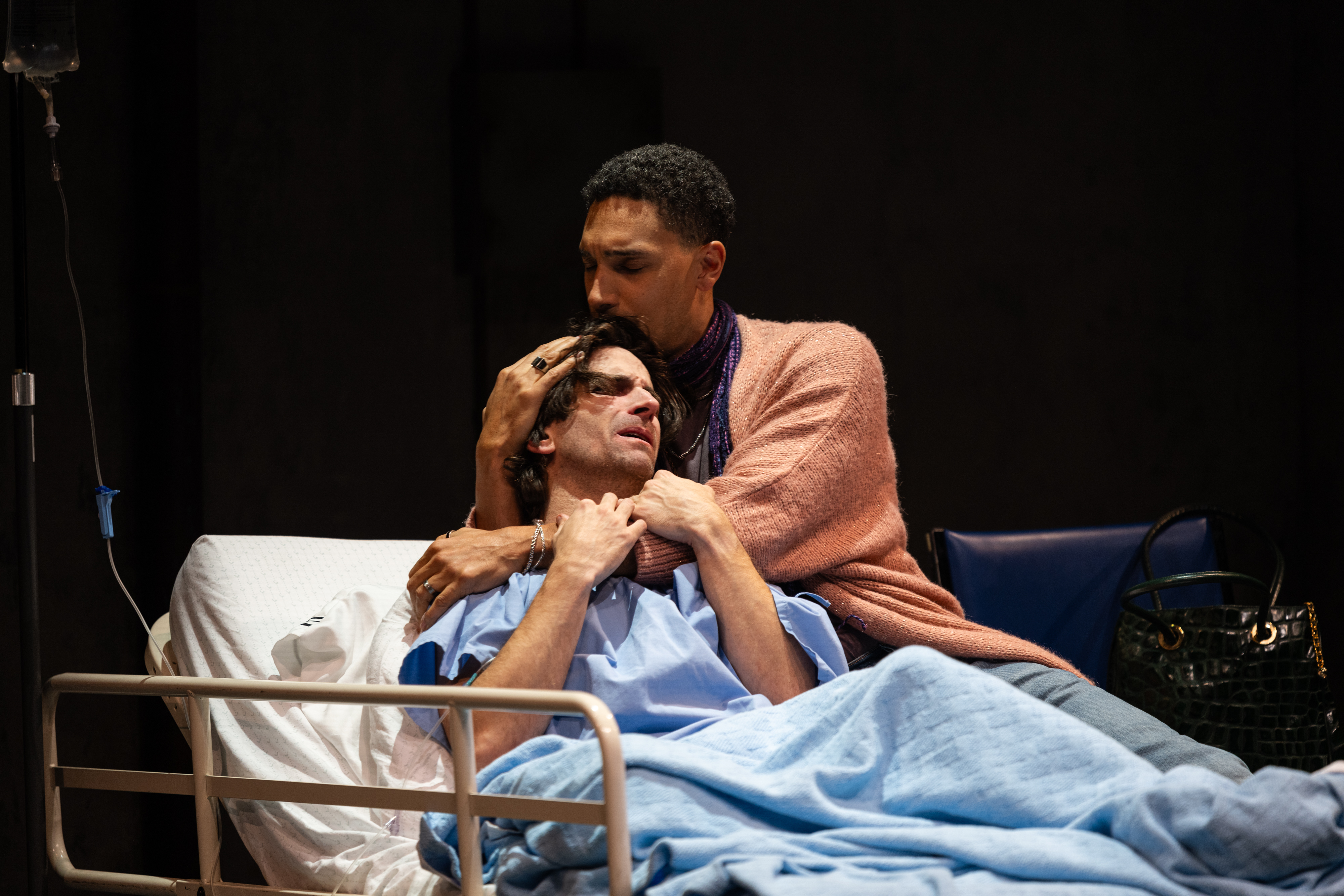
Another one of my favorites (and not just a Toronto favorite) was the surprising revitalization of the now phenomenally brilliant play, Appropriate, housed and unpacked so magnificently by Coal Mine Theatre. The captivatingly revealing production of Branden Jacobs-Jenkins’ brilliant play, Appropriate is both hilariously morbid and disturbing, while being gravely fascinating and meaningful. Using gothic horror as its framework, Appropriate delivers a distinct unraveling; intense and threatening in the darkness that initially takes over the space, destined to ensnare anyone who enters, with or without a flashlight. The play feels like a ghost story wrapped in the haunted memories of its vast connection to enslavement, and it plays with that notion that soon gets lodged in our heads, forcing us to squirm in the overpowering static darkness, waiting for what feels like forever before we can start making out the bones of the beginning.
But the haunting demons come from within, scattered about the space, seen and unseen, known and ignored, just waiting to be discovered. Not floating down the stairs or up from the basement, but they are as determined as ever to unsettle most, but not all, who open up that one particular chapter of Southern history, and really see what is there. It’s all right there in black and white; jarred and jarring, cataloged and presenting a disturbing time and formulation, even if we are determined to swim in the murky waters of denial. Appropriate is that moment. And what a moment it is, engaging every fiber of my being, and fueling an overwhelming excitement and interest to a higher degree in anticipation of seeing this spectacular play make its Broadway/Second Stage debut starring Sarah Paulson on December 18th at the Hayes Theater in New York City.

Also brought to life in the wonderful theatre town called Toronto, were five other plays, with the majority of them new and very original. And three others from summer festivals not far from Toronto. One of my all-time favorites of the year was Tarragon Theatre‘s The Hooves Belonged to the Deer, which delivered the same sort of sharp emotional jabs as when I saw Angels in America, and The Inheritance for the first time. Those two were epic explorations of queerness and HIV/AIDS in America that instantly became iconic in their unpacking. The Hooves… wasn’t exactly the same, but this deep dive into the heart of Alberta did unpack with clever insightfulness the confluence of religion, religious text, and the queer experience, particularly around shame, addiction, and identity in a way that could not be ignored. The play is dense and determined; sometimes overwhelmingly so, especially for those souls that were not raised with religion, let alone the ones presented here.
Entwined within that utterly engaging new play, The Hooves Belonged to the Deer, written with glory and inquisitiveness by its star, playwright Makram Ayache (The Green Line), is a layering of provocative themes that require unraveling and exploring, including the impacts of oppressive colonial Christian systems on our queer youth. The ideas come galloping forward with skill and an adventurous spirit. They are uncovered and kicked about, engulfing us all in their complexities and confrontations while forcing us to contemplate centuries of overt oppression and subtle hatred. “All that shame doesn’t belong to us,” we are told (one of my favorite lines and moments of many), and as the cast, guided by the magnificence of director Peter Hinton-Davis (Tarragon’s The Millennial Malcontent), with an assist by Michelle Mohammad (Coal Mine Theatre’s Yerma), wind their way through the complications and intensities of coming to terms with themselves and the damages done by the oppression of organized religion, the play unfolds the layers and chapters with determination and grace. It’s gigantic, smart, and intense, forcing strongly felt ideas forward, sometimes playfully, and sometimes with a strong grasp of their importance and deep emotional meaning.
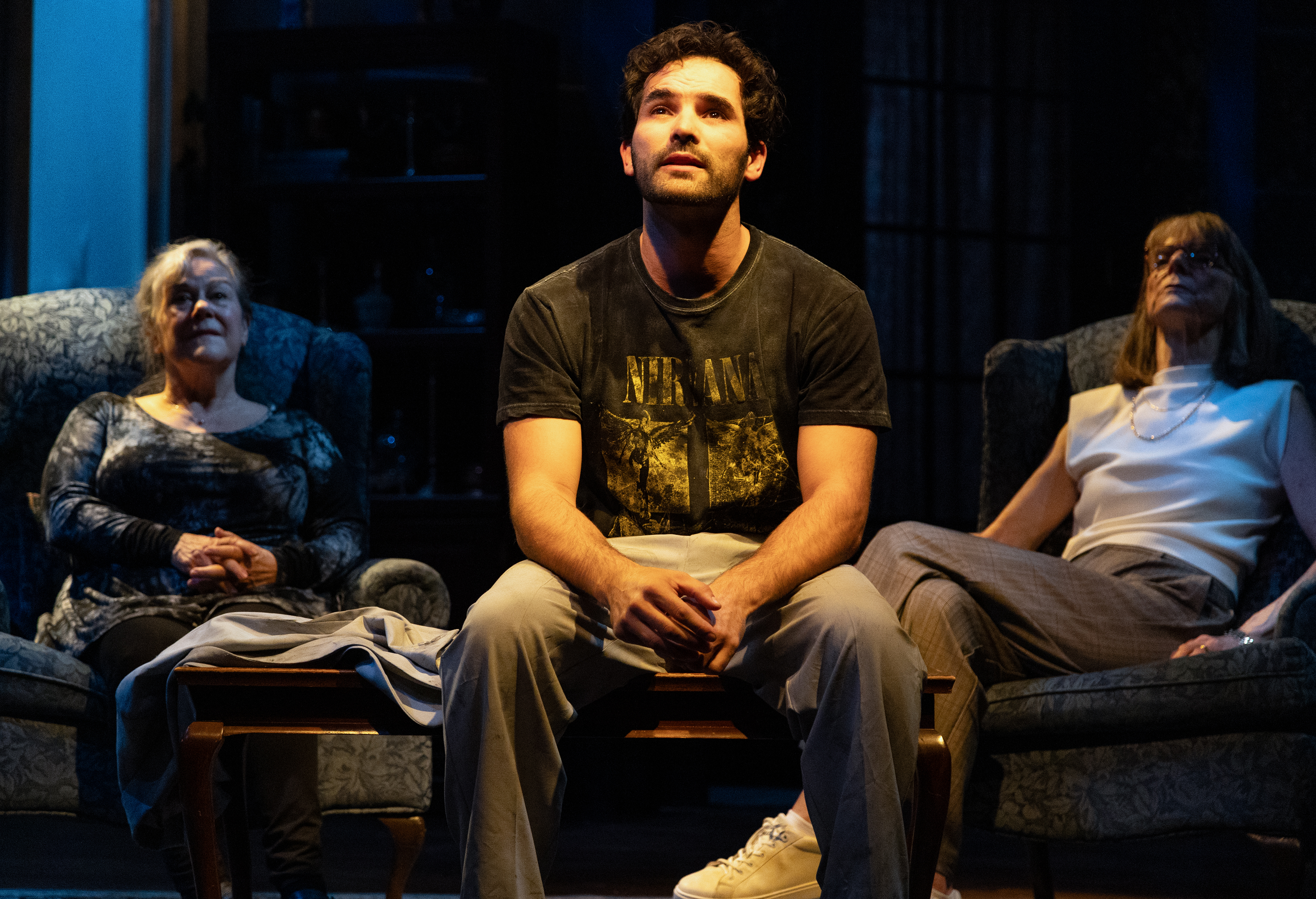
Some of the same accolades could be said of another play at Tarragon. Directed with pointed strength by Jackie Maxwell (Arena Stage’s Junk), Withrow Park is just that; utterly surprising and compellingly engaging from the first knock onwards, pulling us in completely to its tense but hilariously well-scripted scenario. It shivers with the uncomfortable feeling of being watched, even though the three that inhabit this tidy home, next door to Withrow Park, are the ones spying, beyond that one shadowy and scary moment of the outside peering in. “Time has found them, hiding in plain sight,” we are told, and in that brief moment of suspicion, we wonder what kind of mystery have we been invited into.
Listless and unwavering in this stale aroma, the three residents find communal despair in each other, filling the day with conspiracy talk of that wrinkled suited man staring back at them from the park. The dialogue is deeply funny, especially when they start going at each other as they look at the same things but see something completely different from their overworked binoculars. And then the handsome stranger comes inside, and everything shifts and turns like a pendulum lulling and hypnotizing us into another dimension.
Withrow Park keeps giving us more and more deliciousness to chew on, culminating with the dynamic ending of Act One and its smartly defined beginning of Act Two. There is poetry in their intellectual and emotional wanderings, as well as some hilariously well-crafted moments of sharpness mixed in with loneliness and a feeling of being lost in the rain without a map, or an umbrella. Withrow Park is hilarious, especially when it tosses out Buddhist recycling jokes, wild free-flying accusations, and deadly observations seen late at night in a park lit by car headlights. The writing is brilliant and intensely sharp, giving us binocular views into the subtle confusion and despair of some souls who need a push to make a change. “When you stop wanting something, you die,” a truth one of the trapped souls says of their situation, yet Withrow Park has some other brilliant plans in store for them. Hiding in the park’s bins, but it’s an engagement you will not forget. So try to remember this moment, because it’s hypnotizingly great. And utterly profound.

Over at Crow’s Theatre, the masterful Master Plan, unraveling itself brilliantly and hilariously, also delivers some brilliant truths inside of a dynamic new play, brought to magnificent life by playwright Michael Healey (The Drawer Boy; Generous, Courageous, and Proud). The fantastically fictionalized non-fiction story dives headfirst into some captivating city developmental processing that signifies all that is right and most wrong in Canadian politics and public office dynamics. In a way, it sounded sorta educational and possibly stiff going in, but as this new play unwinds before us by this most excellent team of theatre makers, it certainly made me lean in and listen, in a way that one of the characters, even though he claims to be “a listener” never actually seems to.
With director Abraham’s smashingly good cast unleashing their excellence all over those finely crafted and hilarious lines, the show revels in its comedy underpinning, rolling out sharply defined quips, like John Tory’s bad French, that, to be honest, flew over my head in their referential tone. But the quips and the jabs made me laugh even if I wasn’t tuned in to the factual landscape they were built upon. The play engulfs, creates, enlivens, and excites, mainly because of the clever delivery of the equally clever play. But at its core, it’s the tightness of its structural formulations that sold me on The Master Plan at Crow’s Theatre.
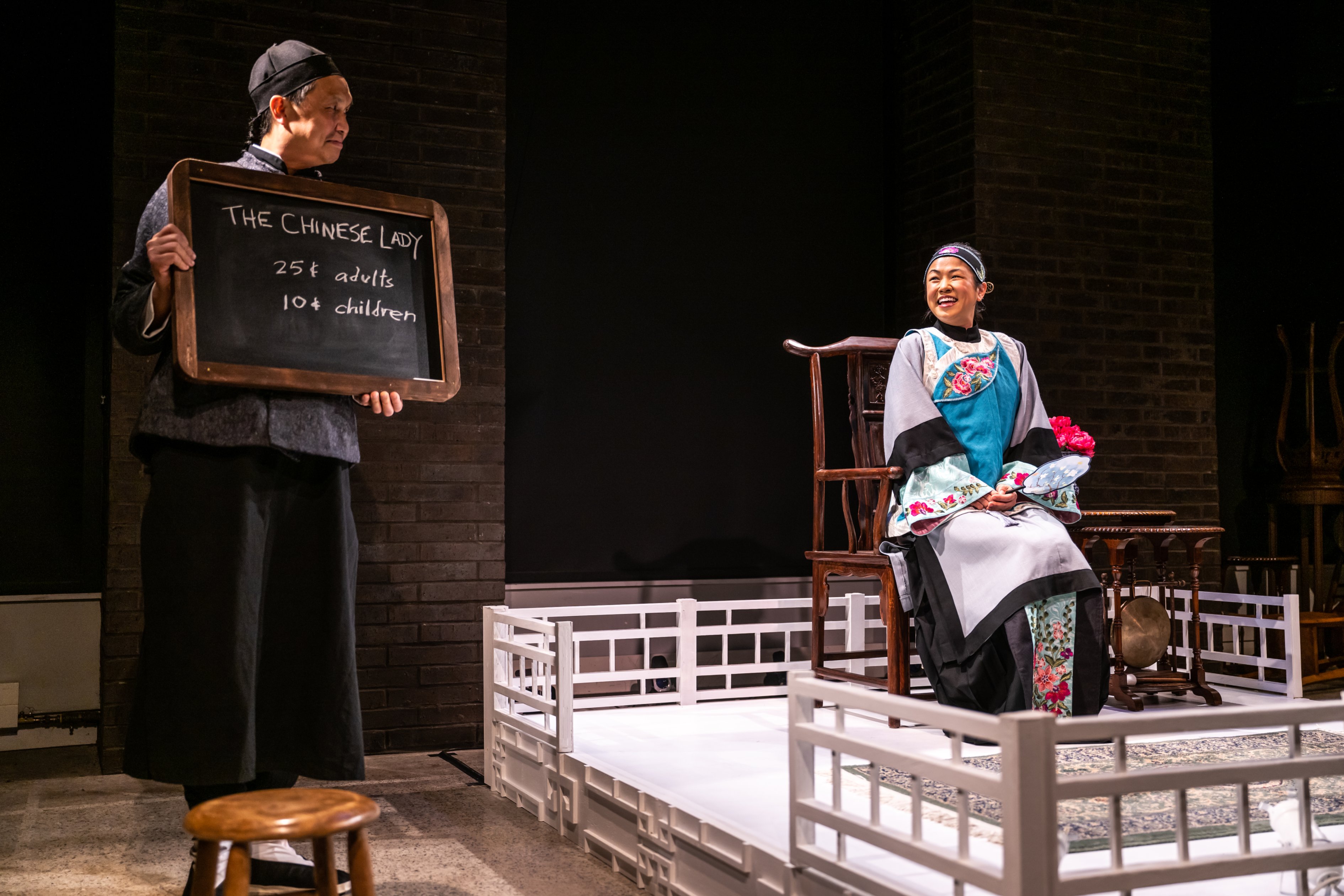
Also at the Crow’s Theatre, dynamically written with an expert force by Lloyd Suh (The Far Country), we were escorted into the world of The Chinese Lady by Studio 180 Theatre and fu-GEN Asian Canadian Theatre Company, which finds its power and force in the unraveling of this distinct form of scientific racism over years of confinement. The play engulfs that unraveling most delicately inside a sideshow format. It emphasizes the barbaric structure with precision with a framework that basically imprisoned the first Chinese woman to set foot on U.S. soil. And if that doesn’t bring forth discomfort, I’m not quite sure what would.
Afong Moy, dynamically portrayed by Rosie Simon (Factory Theatre/ fu-GeN’s acquiesce), is just 14 years old when we first are introduced to her with the help of her irrelevant manservant and guard, Atung, played with a deep sense of purpose by John Ng 伍健琪 (fu-GEN Theatre’s CHING CHONG CHINAMAN). She is alone and enslaved within this artifice, delivered from her now-faraway family in Guangzhou Province in 1834 and indebted to her ’employers’, although she is never paid nor is her debt ever fulfilled. She has been put on display within these four impenetrable, yet barless walls so that crowds of European Americans (a fine and brilliant distinction from Indigenous Americans) as “The Chinese Lady” to be gawked at and exploited for twenty-five cents per adult, ten cents per child.
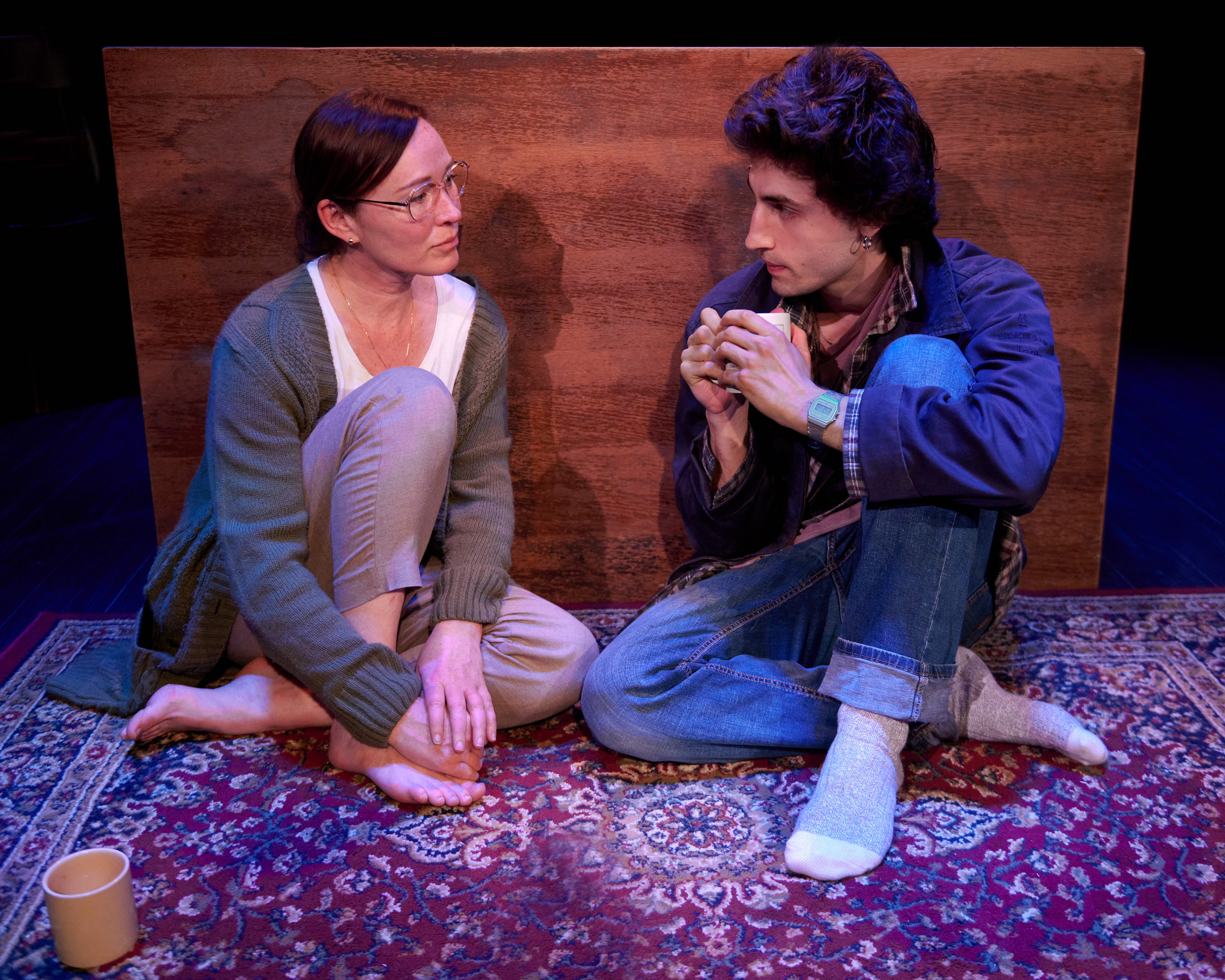
The play is a compellingly disturbing unpacking, and as directed with a simple sharp grace by Marjorie Chan 陳以珏 (Gateway Theatre’s China Doll), The Chinese Lady never lets us off the hook, pushing forth the horrors of what this country has down to women of color, whether Black, Asian, Indigenous, or otherwise. We can’t look away. We also couldn’t look away from Adam Rapp’s (Nocturne, Noble Gases) The Sound Inside which truly captivates at Toronto’s Coal Mine Theatre so simply and astonishingly, and as directed with sure-footed wisdom and expertise by Leora Morris (Coal Mine’s Knives in Hens), the piece expertly floats forward in segments, delicately ushering in the ideas of encapsulated loneliness and the acceptance of praise that resides within, ever so quietly.
Balancing on one of the most beautiful wrought entanglements, we navigate a thin line of understanding hidden in the layers that exist most definitively in and upon more layers. Is it all just creation, or a story of truth and confession? Are there footprints in the snow leading us somewhere? Suffice it to say that there is nothing clumsy about The Sound Inside, as the two come together in a way that will haunt your imagination as you try to make sense of the imagined and what’s written.

Just outside of Toronto, under the off-balanced arch of a tree, with the rotating moon hanging overhead lighting up the courtyard, Shakespearean magic is unleashed as perfectly as one could imagine and hope for at Ontario’s Stratford Festival with the deliciously produced Much Ado About Nothing. Filled with clever play, the festival and its cohorts dreamingly usher us forth into this expertly staged and performed comedy that Shakespeare wrote back in 1598. Revolving itself magically and hilariously around two romantic pairings, like sleeping doves looking for an open palm, this production, directed with a light sharp expert touch by Chris Abraham (Tarragon’s I, Claudia) is about as perfect as perfect can be. It delightfully plays a merry war with us all, delivering moving pots full of laughter with every ad-libbed aside taking to heart all that is glorious about the play and that glorious Shakespearean language.
Shaw Festival also created some revival magic with Tom Stoppard’s delightfully crafted 1981 play, On The Razzle which drinks in deliciously with its farcical wordplay and brilliantly realized madcap adventure. This is just the kind of play that the Shaw Festival does so so well, and it’s perfectly constructed and brought to life in that sweet town theatre. Giving you everything you could hope for. It flies and gives itself over to the malapropisms most magnificently at the festival’s lovely jewel box theatre, The Royal George in the quaint and charming Niagara-on-the-Lake, Ontario, and it’s one of those glorious pieces of farcical theatre too good to miss.

On the Razzle dazzles, running itself off into the wild when two young store clerks, played magnificently by Mike Nadajewski (RMTC’s Cabaret) as Weinberl and Kristi Frank (Grand Theatre’s Shrek) as the young apprentice Christopher, decide to run off for a night of adventure (a Razzle as they used it call it) in Vienna. On the Razzle is a delightfully fun, and not completely negative euphemism describing the actions of someone who has drunk, or is about to drink, a considerable amount of libations. It is often only used to describe someone who has decided to completely enjoy themselves on a night out. And this is exactly what these two sweet sympathetic souls are looking to do when their boss, Zangler, delightfully pompously portrayed by Ric Reid (Citadel/Canadian Stage’s The Humans), leaves them in charge so he can go away to meet his fiancee, shortly after employing a new servant Melchior, devilishly well played by the “classic” Jonathan Tan (Bad Hats’ Alice in Wonderland). And it is exactly what we experience with this wonderful staging of a hilariously well-written play that I had never even heard of before.
A very different kind of energy lights up the Stratford Festival‘s small Studio Theatre; the kind that is brave and loving. Those feelings hang in the air of Casey and Diana written with a truthful heart by Nick Green (Body Politic; Every Day She Rose), and it is a tearjerker-of-a-play, destined to play havoc with our emotions and our connective selves. It radiates from within, especially after we were formally introduced to resident Thomas, played to perfection by Sean Arbuckle (Canadian Stage’s London Road), as he prepares himself for a historical meeting with a Princess. It’s as monumental a moment for this man as it is for the world. Thomas is the Casey House’s longest-standing resident, and when he is told that Diana, Princess of Wales, portrayed most lovingly well in pink by Krystin Pellerin (Tarragon’s Orestes), is coming in one week’s time, the news shifts the light in the room in more ways than we can imagine. The prospect of spending even one moment with one of the world’s most famous women gives the place a royal burst of energy, fed and led by the trembling super-excited ultra-fan Thomas, and we can’t help but join in.

Poised to perfection, those initial moments, and the play in general, directed most impeccably by Andrew Kushnir (Tarragon/TMU’s The Divison), carry weight and dignity as easily as it does the compassion of its caretakers, their words, and their actions. “Hope has a sound,” we are told, and in this world premiére of Casey and Diana, commissioned by the Stratford Festival and soon to open at Soulpepper Theatre, the tilt of that iconic head and the shyness that is in every movement brings forth a tidal wave of emotion and connection. Supported and cared for by Nurse Vera, played beautifully strong by Sophia Walker (Soulpepper’s Blood Wedding), Arbuckle’s Thomas draws us in with his laughter, his nervousness, his honesty, his grass stains of deep shame, and his love of a gay breakfast. It’s an epic portrayal, fully embodied and distributed, even when thrown off by the difficult arrival of his complicated sister, Pauline, played solidly by Laura Condlln (Soulpepper’s Of Human Bondage), and their unresolved past.
Back in New York City, three downtown off-Broadway plays and one British import also played havoc with my heart, in all the best possible ways. The Almeida Theatre, London brought forth one of the best-written and constructed plays I’d seen in a long time, and even though I had seen it earlier, I was thrilled to have the opportunity to have another appointment with The Doctor, playing out powerfully at the Park Avenue Armory, NYC. Yet, when I heard a few days before my return to The Doctor that the lead, Juliet Stevenson, who has been involved in this production since 2019, was not going to be in attendance the night I was going, I was both disappointed (like many of those around me were verbalizing before the production began) and somewhat excited to get a chance to see another actor take on this magnificent part inside this meticulously constructed assault on our personal perceptions and unconscious biases.

At the center of this rotation is The Doctor, the key that turns the long table round and around all in the name of Professor Ruth Wolff, a part usually played by the magnificent Juliet Stevenson (Robert Icke’s West End adaptation of Mary Stuart) but this time around portrayed equally as strong by Dee Nelson (Broadway’s The Heiress) continues to engage. With the impressive Stevenson in the part, her portrayal of the doctor was the strong-armed glue that held this majestic puzzle together and kept it from spinning out of control. The same can be said of Nelson, who never falters or flinches from the task before her. She is, in her very being, a doctor, and secondary, the director of a leading medical institute where this play basically takes place. She doesn’t see herself as fitting into any other important groups, yet she does, at least in our eyes, which is, in essence, what this play is all about. What we see, and how we respond to it is the focal point, and it is done with precision.
As written and directed by Robert Icke (Almeida Theatre’s Oresteia), the conflict that reveals itself quickly is just the beginning of a cascade of constructs that never lets up, and never really shows its intricate ideals until it is ready. Icke, in all of his sharp reveals, has crafted something particularly intelligent and engaging. It takes its time, delivering forth characters with depth and complexities, one by one, and yet deliberately shifting our perception of them and finding a way for us to see them in a completely different light at a moment’s notice. Tense and abrasive, much like the doctor in question, the complete formulation is utterly astonishing and completely electric from beginning to end.

On a smaller scale, with as powerful an impact, two downtown plays pushed the emotional chord to the limit most expertly. As presented by Audible Theatre at the Minetta Lane, courtesy of the Goodman Theatre, Chicago, the new play, Swing State registers clear and dramatic in its unique and compelling posturing. Written with intent by Rebecca Gilman (A Woman of the World), the play tenderly and compassionately drives forward at a determined and reasonable speed, much like that faulty truck that the young man, Ryan, played to earnest perfection by Bubba Weiler (Broadway’s Harry Potter…; CSC’s Dead Poets Society), should have been able to go if it had been working correctly. But this play does it right, operating at just the right velocity, as so much else malfunctions and goes wrong for Ryan and the world around him as he tries to navigate forward through life.
Swing State radiates surefootedness, never getting lost or losing its way, staying solidly in its lane, and not ever going off the road. It moves with deliberation, unpacking the growth and the seeds of truth carefully and subtly. Mary Beth Fisher (“Sense8”; Goodman’s The Sound Inside), as Peg, the ultimate widowed caretaker of the troubled land that surrounds her (and this troubled lad), envelopes her character with a sharp edge that resonates authentically. It’s a beautiful earthy performance, breathing life and death inside that fine old face, yet it’s not enough to protect this young man from the world surrounding him. She brilliantly stays true, navigating the complexities of love and care inside a framework of grief and loneliness, giving growth to something powerful and raw while also being ever-so-determined.
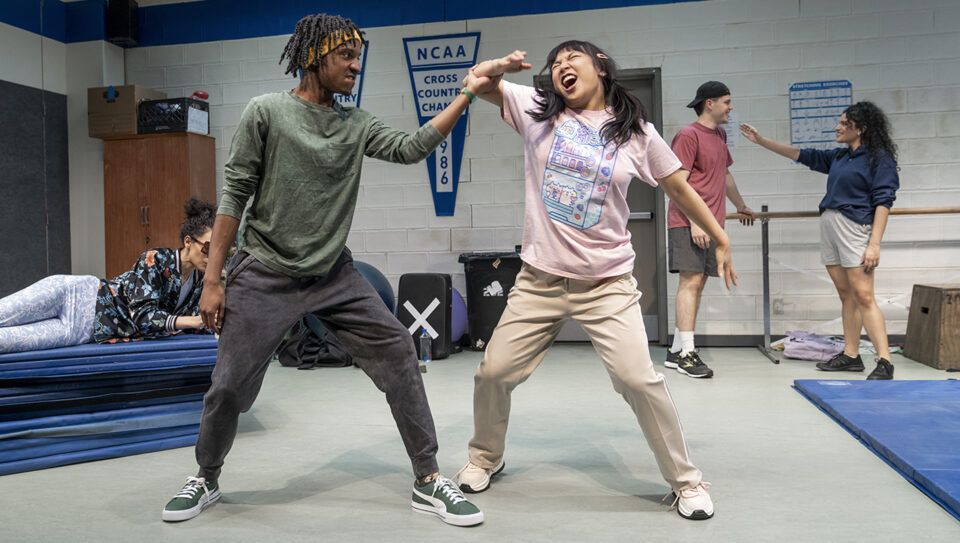
There was also the wildly engaging How To Defend Yourself that played out strong at the New York Theatre Workshop in the spring of 2023. Sex that is a surprise, and sex that is an assault. That is the key and one of the many fascinating paradoxes built in and intertwined within one well-crafted interaction. It gives forth a wealth of complex formulations by playwright Liliana Padilla (TWITCH) that jab-punches provocatively in the brilliantly captivating new play. The writing keeps revolving out nuggets of nuanced reactions slowly but surely, as we meet and engage with a bunch of college students trying to comprehend the terribly upsetting slice of violence that happened so very close to all of them. This isn’t one of those moments of reactions that come with a certain distance between, but something that each one of these characters is one handshake or smile away from a savage frathouse rape that landed one sorority girl in the hospital and two men in jail.
Even though we never actually meet the three students involved with the rape and assault, each one of Padilla’s characters knows all that were involved. The classroom where we find ourselves reverberates with the friction and the intensity of all that fury in all corners as these women (and two men) come together to try to navigate their response and their physical safety, while also trying to make personal choices about their bodies and souls that weave themselves in and out. How To Defend Yourself boldly digs in, punching forth ideas of conflictual engagement, attraction, and self-preservation, while offering up no clear nor concise conclusions. The ending feels a bit haphazard and without weight, not exactly the knockdown punch I was hoping for, but overall, the play and the performances find some solidarity in their strong voices. Even if the world at large is failing to listen all that well to what they are trying to say. So make sure your “No” is as loud and forceful as Padilla’s, cause maybe then they will be heard and things might find a way to change.
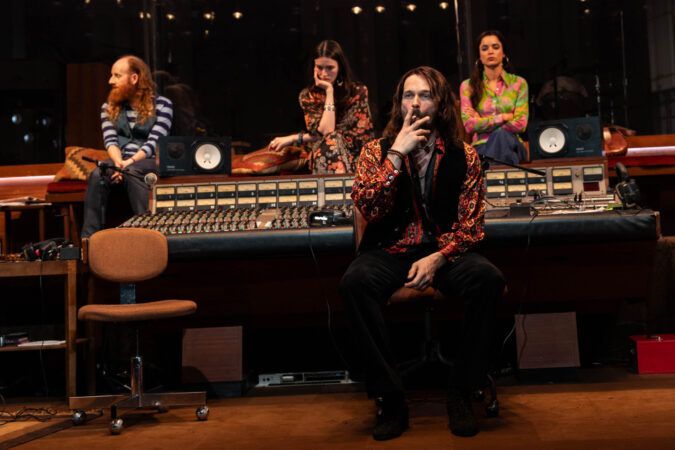
Inside Playwrights Horizons‘s magnificent new play, Stereophonic, written most delicately by David Adjmi (The Blind King Parts I and II), the timeframe is July 1976, and we find ourselves hanging like flies on the wall of a recording studio in Sausalito, CA. We have been silently invited into a space that only a select few get to visit, let alone witness. This is art in the making, pure and simple, with ego and love, getting mixed and faded in through the process most musically. The play is exceptionally well framed and constructed; both musical and meandering, in the best of all possible ways. Yet somewhere inside Adjmi’s engaging Stereophonic and its three-hour running time, a deeper level of contextual art formulation is unpacked quite beautifully. It saunters forward, with a complicated level of exhaustion, angst, and inspiration, unearthing something that almost defies expectations and compartmentalization.
The play is clearly and expertly modeled on the legendary Fleetwood Mac and their dynamic backstage friction, which leans into and plays with the problematic relationships that live within this unnamed band as they try to create magic behind a glass wall, while also trying to fulfill their emotional needs in the confines of the studio and real life. It’s all emotional breakups and reconciliations, with a layer of bored and sleep-deprived banter; around a broken coffee machine and the annoying reverberations of (not only) the drum. It’s electric and conflictual, playing havoc on these characters’ insecure hearts while offering no grand solutions or final product.
Stereophonic is all about the tiny details and the little frustrations that grow and become emotional cannonballs bent on destruction, leveled and defused out of an undercurrent of love and need for creation. It is incandescent in its artful construction, displaying and writing about a realm few of us can understand. It’s the agony and ecstasy that live and sing inside the magnificent creative process of musicians, arts, singers, and writers, who hear aspects that most of us can’t understand, let alone hear or comprehend. And we have been invited in, to bear witness to its creation, in all its meticulously dull and exhausting detail. Giving light to the darkness of the process, and how art can both create and destroy those involved in its coming to life.
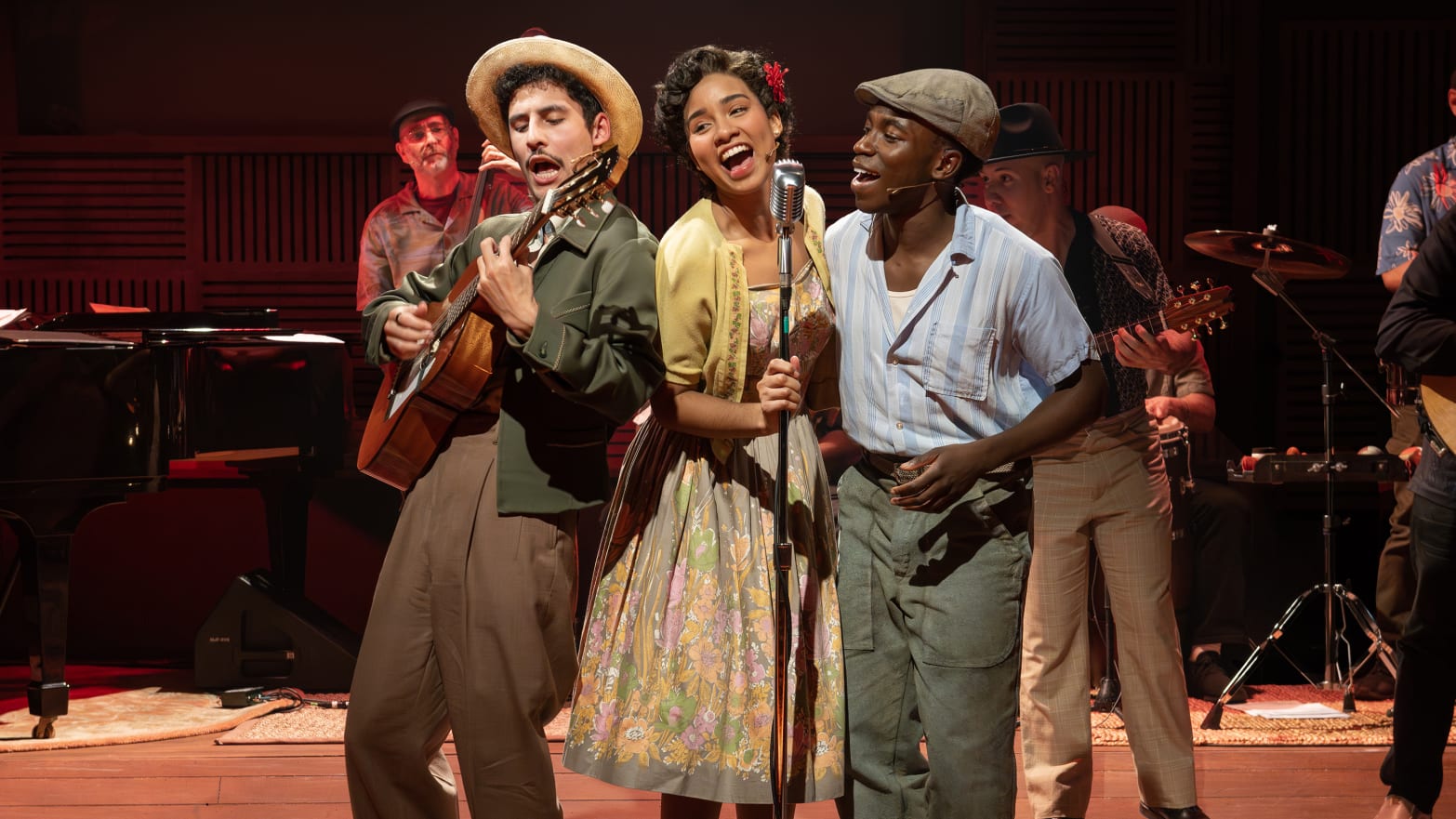
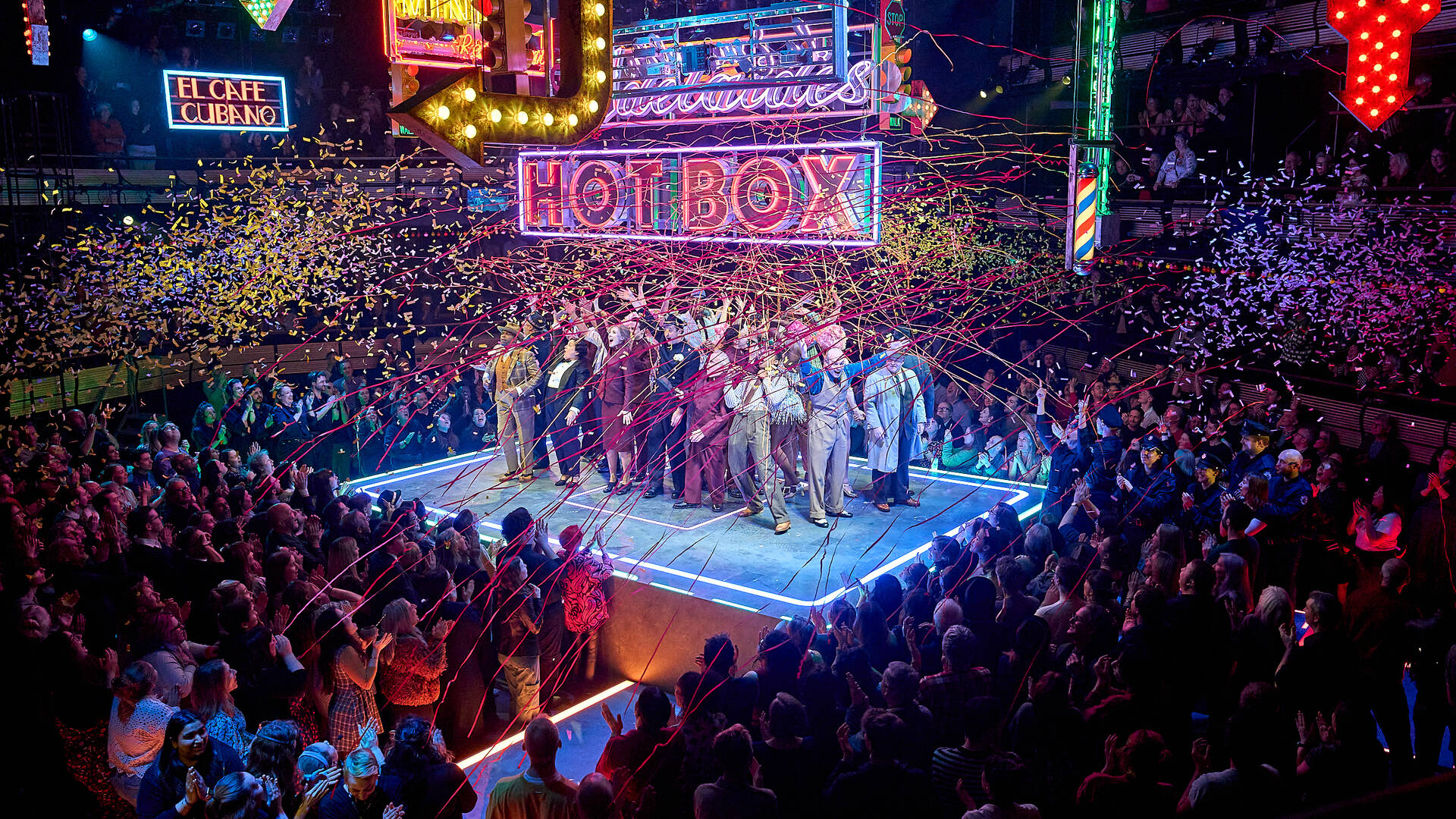
My final two, and I know I’ve gone on long past the idea of “Top Ten”, are both musicals that are not cut from the same cloth, and maybe shouldn’t even be talked about side by side, but I loved them both, for very different reasons. Atlantic Theater‘s Buena Vista Social Club is the grandest of musical parties that have come to the stage this year. From the first strum on that guitar, Buena Vista Social Club scores big and delivers an exceptional musical experience, overflowing with emotional and musical expertise shining down on us all as gorgeously as the sunset off the coast of Cuba. The music is completely unstoppable; rich, invigorating, and profoundly performed by a stellar band, led by music supervisor Dean Sharenow (Broadway’s Girl From the North Country) and music director/conductor (on the piano) Marco Paguia (Broadway’s Gutenberg! The Musical), that keeps giving and giving with a love and rhythm that is impossible not to devour.
Directed with a keen ear to its musicality by Saheem Ali (Broadway’s Fat Ham), Buena Vista Social Club is essentially a jukebox musical, done at a whole different level and dimension, taking inspiration from the musicians and stars of the Grammy Award-winning band of the same name, credited with the music that never gives up. Almost the same could be said of downtown’s smash hit, Titanique, which I finally saw last February. It’s also essentially a jukebox musical, done at a whole different level and dimension. But this show takes its inspiration from Canada’s legendary songstress, Céline “Fucking” Dion played by the magnificently funny and supremely gifted Marla Mindelle (Broadway’s Sister Act; Netflix’s “Special“) and floods us with humor and smart ridiculousness from beginning to end.

The show is an absolute blast and I can’t even begin to tell you how much fun I had downtown at the Daryl Roth Theatre the night I saw the hit musical comedy and parody. Created and co-written by Mindelle, along with the dreamy Constantine Rousouli (Off-Broadway’s Cruel Intentions; “This is the Night“), who is our hunky Jack Dawson on this voyage, and director Tye Blue, who, in his own words, has been “perfecting the Titanique pop-culture parody genre for several years in Los Angeles“, directing and co-creating [like he did here] musical adaptation of Mean Girls, The Devil Wears Prada” and so many more. Titanique is a high seas magnificently cheeky adventure, filled from bow to stern with hilarity and utterly brilliant parody. Overflowing with only Celine Dion songs, performed to perfection, this hilariously delicious musical plows forward through the kooky, wacky waters of the iceberg-laden North Sea, with Céline forever standing by your side (and sometimes awkwardly getting too close and in between) on a journey like no other. This ship is as right as ridiculously right can be, and should not be missed.
So much great theatre this past year that a list of the top ten was just too impossible to create. But all that I mentioned would be worthy of anyone’s list. Whether we are talking Toronto, New York, Stratford, or London, England, that is. Not the other one, the one in Ontario, where my mother lives. That town is lovely, but doesn’t offer the thing I love almost as much as her: live theatre. Regardless of the country of origin.