The Review: Babette’s Feast
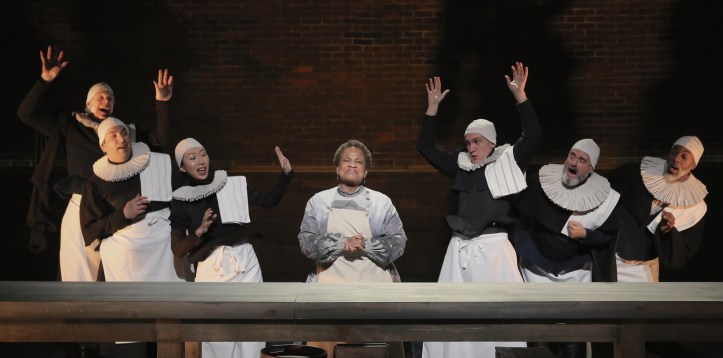
The film is spoken with enthusiastic love and adoration whenever discussed. Many of my friends spoke of the film, ‘Babette’s Feast‘, a film I never did see, as some wondrous and sumptuous creation that lovingly chronicles the preparation of food as beautifully as it does the characters, and from the trailer, it looks like a work of art; glorious, tidy, and elegant. This team of actors, featuring a cast of unique personas, Jo Mei (A.C.T.’s Fingersmith), Elliot Nye (Camden’s Romeo and Juliet), Steven Skybell (Broadway’s Fiddler on the Roof), Sorab Wadia (Berkely Rep’s Monsoon Wedding), Sturgis Warner (Tooth of Crime) and Jeorge Bennett Watson (Pioneer’s Fences), has managed to recreate that swift and clean old-fashioned flavor without recreating or simulating, but together, they expand the story into all the corners of the Theatre at St. Clement’s with an artistic flair of invention. Giving us a Babette’s Feast that is some kind of love affair, existing somewhere in between bodily and spiritual craving.
In the creation of the film, director Gabriel Axel (1989’s ‘Christian‘) had to stand up for his desire to create a narrator to lead the action, fighting with the producers, adamantly stating that it was not about being old-fashioned but only about the need: “If there is need for a narrator, then one uses one.” In Killeen’s creation, one becomes many, as the narrating task is being shared by all, in the same way this talented crew dons the physicality of a long list of characters played out brilliantly in a swirl of non-gender biased casting. The direction and the choreography of movement is precise and dramatic, keeping us forever engaged and aware of every shuffle and aroma that exists in the flavor of this small town.
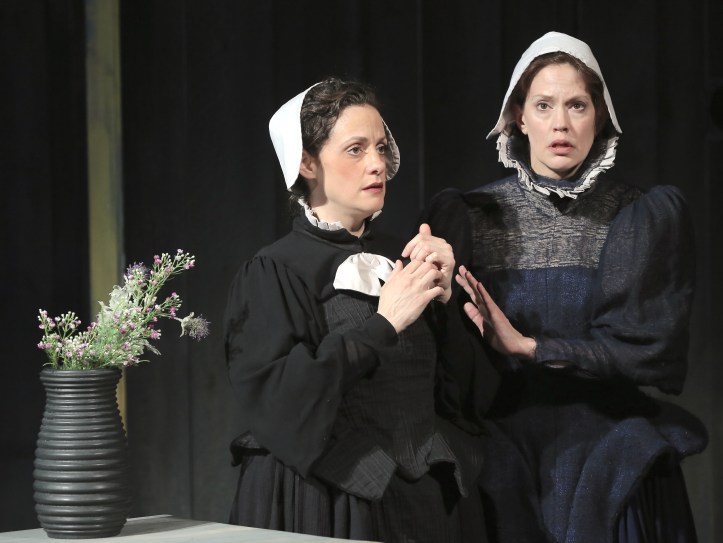
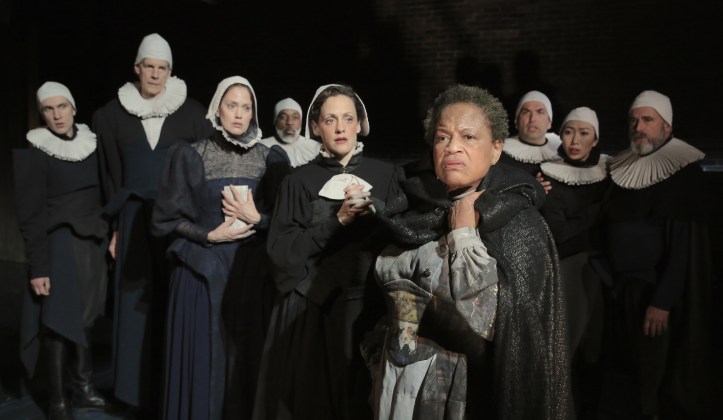
The elderly and pious Protestant sisters Martine and Philippa, played with a wonderfully restrained charm by Killeen (Portland Stage’s Brighton Beach Memoirs) and Juliana Francis Kelly (The Return of Tragedy), live in a small village in the most northern outpost of the continent of Europe. As young woman, these two sisters were once considered the most desired and beauteous creatures in the region, turning heads just as fast as their pastor father (Warner) rejected their proposals of marriage, deriding those offers and instilling puritan and simplistic needs and desires that were emphasized in their Lutheran movement. Each daughter has a moment of passionate courtship by suitors visiting their remote town, Martine by a charming young Swedish cavalry officer, Lorens Löwenhielm (Watson), and Philippa by an opera singer star, Achille Papin (Skybell) from the Paris opera, seeking a retreat from the madness of Paris and the world in the silence of the coastal town. Both sisters resist their advances, making the decision to stay with their father and spurn any life outside of their sect.
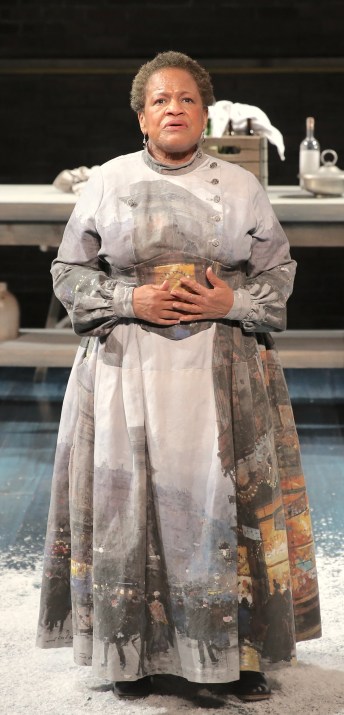
Then one evening, many years after their father had died, an enigmatic and mysterious Parisian woman by the name of Babette , played with an oddly cold and stoic solidness by Michelle Hurst (Netflix’s “Orange is the New Black“), appears at their door carrying a letter from the opera singer Papin, pleading with the sisters to give shelter to this woman fleeing the communard uprising of 1871. Naturally the sisters take Babette in, and Babette offers to serve as their cook and housekeeper, even when she is told that the two are far too poor to pay her. For the next 14 years, Babette, quietly takes care of the sisters, honoring their wishes of creating a dull and abstemious diet that relate to their religious devotion to simplicity in the eyes of God, holding down and hiding her own God-given talents in the kitchen. There, within the confines of this quiet town, she exists and thrives, gaining the respect of the sisters and their sect, while holding on to only one small connective tie to her former life in Paris in the form of a lottery ticket that a friend purchases for her every year.
To everyone’s surprise, one day she is informed that she has won the lottery, but instead of using the money, 10,000 francs, to return to Paris and her former life, she insists on creating a grand and delicious meal for the sisters and their small congregation in honor of the founding pastor’s hundredth birthday, but really this is a way for Babette to give thanks and gratitude to her savior sisters. The moment of pleading with the sisters to let her do this offering of thanks, is gentle and telling, beautifully encompassing the spiritual nature of this majestic small story. This is more than just a feast, it is an outpouring of Babette’s appreciation and love utilizing the gift of her culinary art that she has kept a secret for these many years. This is an act of self-sacrifice, epitomizing the story of denial and waste that is at work here, creating a debate that is stewing just below the surface; whether it is right for an artist to give their art freely to the world as a gift from God, as Babette decides to do, or forgo the God-given talents for some pious dedication of a spiritual structure. “I am afraid of my own joy” are the lyrics the young Philippa sings, quite gloriously I might add by the sublime Kelly, with her admirer, Achille, when they perform the romantic duet from “Don Giovanni“, before she locks her gift away deep in the back of her closet, possibly next to her sister’s love for her dashing young suitor. In some ways, it is one and the same, religious devotion, aestheticism, and sensuality, expressions of a similar impulse, to share love, honor, and generosity with those around you, one way or another.
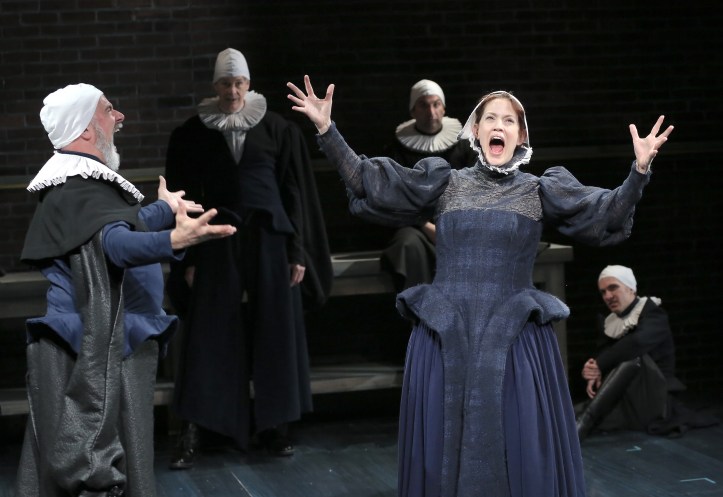
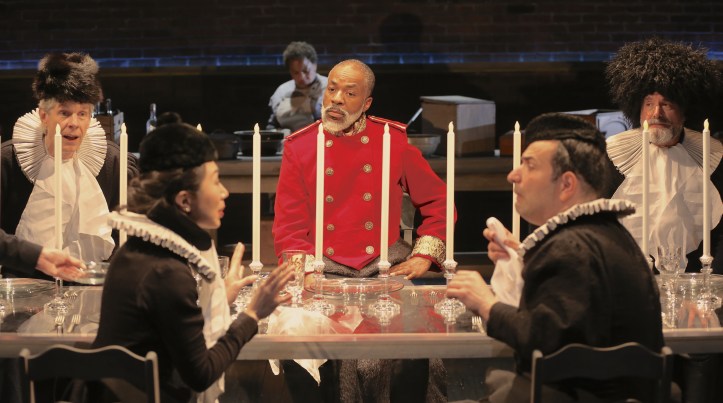
The ingredients for Babette’s Feast start to arrive, and they are plentiful, sumptuous and exotic. In the film version, much is made of the preparation and display of the luxurious ingredients and in the creation of the dishes, but here, in this pared-down bare production, not one item of food is seen, just the miming visual of their creation is on display. The expertise of the cast is akin to the gift of dance and movement subtly enfusing the air with their aroma and art. The sisters worry that the meal will become a sin of sensuality and devilry, but Babette’s gift is so glorious and comes from such a place of love and devotion, that even in their silence, their joy and pleasure begin, although quietly and without word, to break down their distrust and superstitions, elevating them physically and spiritually to place where all old wrongs are forgiven, lost and buried love and affection are renewed, and a mystical embrace of the human spirit rises up and overtakes the table.
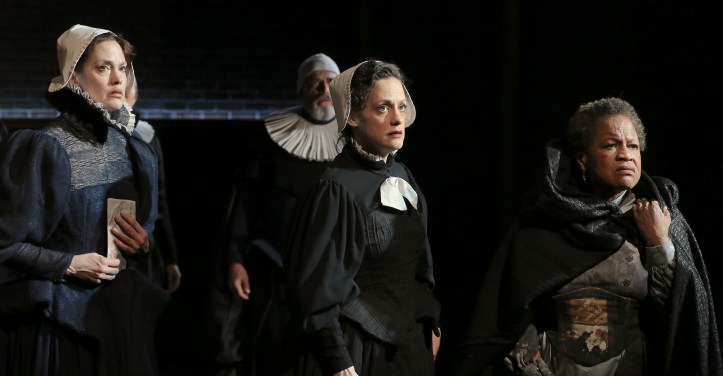
The sisters assume that Babette will now leave them and return to Paris. However, when she tells them that all of her money has been spent on this glorious meal, the sisters are stunned, saying “Now you will be poor the rest of your life“, to which Babette replies, “An artist is never poor.” They always have something to give to the world, for money, for love, for thanks, and beyond that, there is only joy to be had and given, here on our world and in the next.
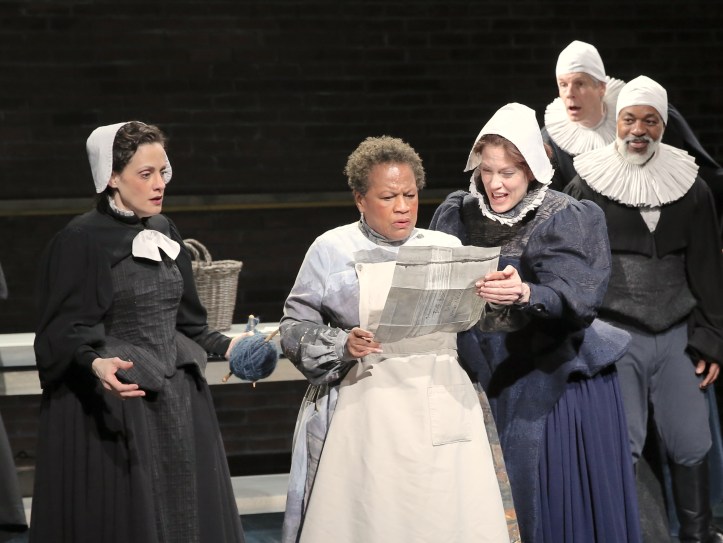
I don’t believe I have ever written so much about the plot of any play I have ever seen and reviewed, especially seeing that this tale is all about simplicity and subtle meaning. But I am compelled, as it is in those tiny simplistic details where the essence and magic exists, quietly and with so much restrain that it seems effortless but also with a sense of play that makes the piece charming. This play, although not for the linear thinker and the action-seeker, is a tour de force of stylistic intentions and performances as delicious and flavorful as the meal we imagine they are served. One just needs to sit back and take in the glorious aroma that one can imagine wafting through the air as the imaginary feast is mixed, blended, baked, and cooked over the non-existing open flame. This creation needs to be savored like the grand and gloriously compassionate meal that it is, served with love and care, sharing in the gift of theatre and performance, for all to take in. Although sometimes a bit slow and meandering, even in its whimsical nature, this meal shouldn’t be rushed and its servers should never be chastised for taking their time delivering it. We must bow our heads, for these wonders. Because for these precious few moments of simple pleasure, we should be eternally thankful.
 front mezz junkies
[…] Bright Colors and Bold Patterns Harry Clarke In & Of Itself Squeamish Who’s Holiday! Babette’s Feast Best Unique Theatrical Experience Babette’s Feast Ghost Light KPOP […]
LikeLike
[…] but with the beautifully nuanced performance of Steven Skybell (off-Broadway’s Babette’s Feast) as the father, Tevye, grappling with a changing world within his family, his community, and his […]
LikeLike
[…] Beans (LCT3’s Marys Seacole) as she pushes away the magnificent Jo Mei (Off-Broadway’s Babette’s Feast) who plays Jo (& Laura & Lola) with wordless replies. Her pain is less vocal but is by no […]
LikeLike