The Toronto Theatre Review: Factory Theatre’s Armadillos
By Ross
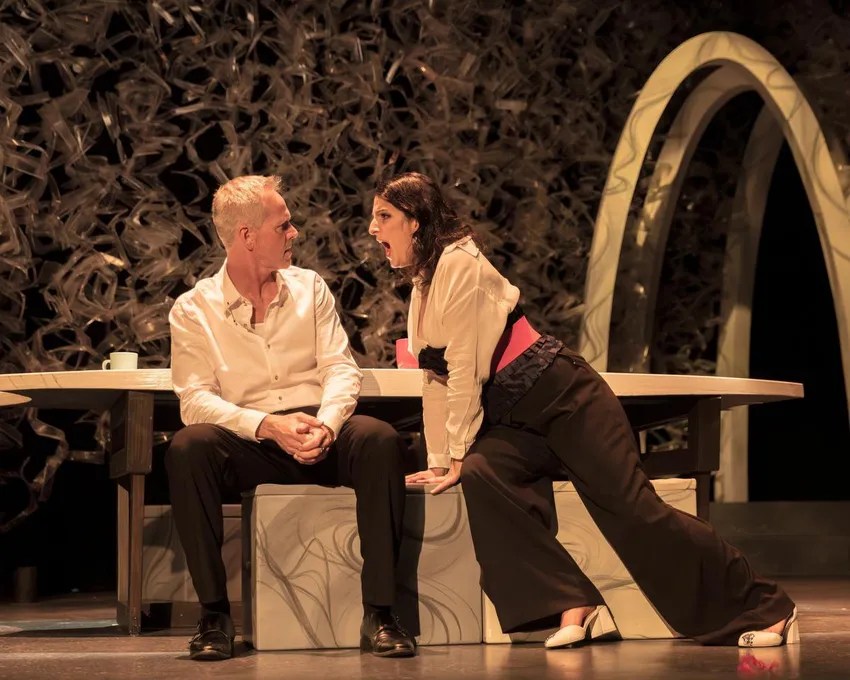
With a backdrop of archways surrounded by a sea of white curls, this thought-provoking play within a play, written with a smart, slow-burning underbelly by Colleen Wagner (The Living; Home), runs in with determination and confidence, much like the young woman at the center of this complex layering. Wagner is trying to unpack and shape (and reshape) our processing of these two often told stories centered on the marriage of Thetis and Peleus. A delicate yet fascinating conceptualization, reformulating a compelling Greek myth that carries with it two very different perceptions of the feminine principle and the power dynamic between people. On the one hand, it’s a story of domination and rape, while on the other, painted with some very different hues, it’s an exploratory tale of love, union, and ultimately consent. With snakes and love bites for everything. “The stories we tell shape our thinking,” we are told, and the honoring of that framework by Wagner rings true and cleverly in Factory Theatre‘s Armadillos multi-layered unpacking. Even when it takes it’s time getting there.
“Hurry up, get dressed!” is a telling command, thrown forward in those first few moments, backstage, at a less than illustrious touring production of that first formulation depicted in a 3rd-century BCE painting. It is centered around war and domination; deception and betrayal; trickery and rape. The cast of four playing a cast of four, preparing to go on, and the new young actress who just replaced an unseen other has finally arrived. It’s a short, almost too sharp set-up, giving us direction not to take in the next part too internally. But to watch Armadillos as something other than what it might have first appeared to be without being given the play within a play re-structuring at its core. It rings true, giving us the opportunity to feel the softness and humanity that lies hidden underneath the hard outer shell of the Greek tale. And realize the meaning of the two sides of one story and face.
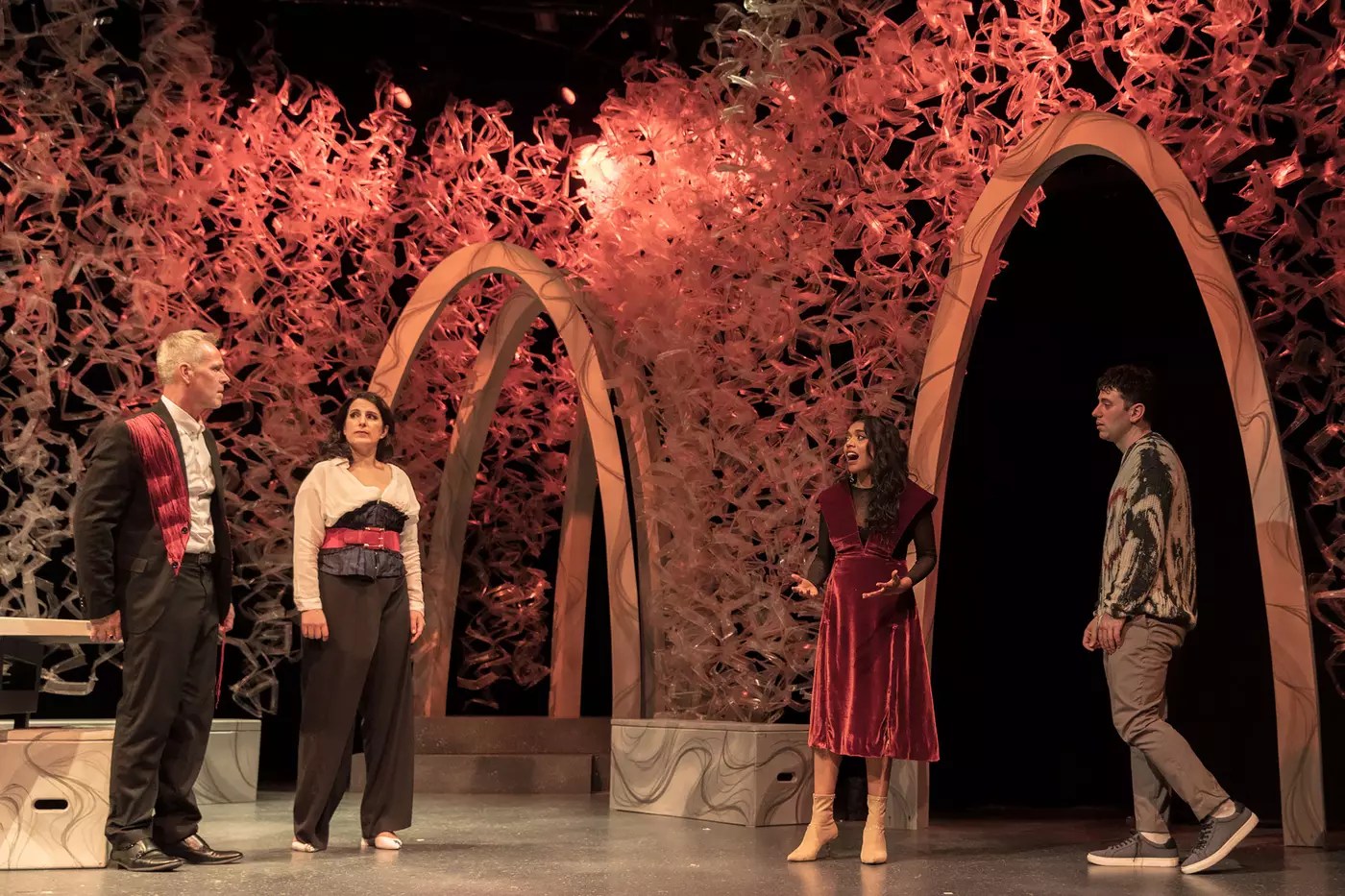
Directed intensely by Jani Lauzon (Soulpepper’s Where the Blood Mixes), with dramaturge duties taken on by Matt McGeachy (Factory’s acts of faith), the first act stomps forward with an uncomfortable stance and optics, giving us a Zeus, delivered with complexity by Ryan Hollyman (Tarragon’s The Hooves Belonged to the Deer), that signifies a Trump-like interior packed in a dangerously sharp CEO exterior, with a compelling blood red sash as part of his tailored black suit. It’s the perfect formulation, like most here, thanks to the interesting work by costume designer, Jawon Kang (Tarragon’s Redbone Coonhound), giving us insight without falling prey to its snakey sexual energy. The tale is laid out, delivered on the opaque landscape with all the uncomfortable formulations that come strongly and formally placed within, thanks to the fine work by set/props, and lighting designer Trevor Schwellnus (Factory’s We Keep Coming Back). “Take her by force if necessary,” Hera says, played delicately and deliberately by Zorana Sadiq (Factory’s Wildfire) as the scaled-down Goddess calls forth her trusted warrior, Peleus, portrayed expansively by Paolo Santalucia (Soulpepper’s The Seagull), to do his duty for her. She instructs him to abduct and usher the young goddess, Thetis, strong and intently performed by Mirabella Sundar Singh (Crow’s Fifteen Dogs), away from her husband/brother Zeus. To save whom is the question that hangs above her head, and for what end.
The tension and verbal sparring that occurs between Zeus, the supreme ruler that he intends to be (much like that American orange monster that the character emulates), and Thetis is what really is at the center of this complex picture that is painted. It, and he snakes his way forward, delivering a determined tale to shape our worldview, tearing down alters of worship to make his case. It’s a well-formulated contract, yet it leaves us feeling complicit and uncomfortable in its details. We watch allegiances and allegations fly and fall, with power and domination at the core. “Capitulate or die“, is the idea put forth, and we see the parallels to our own time and place. It’s fascinating and deliberate, even as the first act unpacks somewhat slowly, stiffly, and artificially. One wonders what Armadillos is plotting and pretending to be. “Don’t try to trick me,” Peleus says, as the act inches slowly to its violent end, and we join in with that hope that this unfolding is leading towards something more compelling than what we are left with in the interval.

“Too bad we can’t change the story,” the young actress, Karmyne (Singh), who plays Thetis, tells Sofia (Sadiq) who plays Hera, like an oracle as they gather themselves together after the show. Their energy is compelling, drawing us into a tension that enlists all that is part of the sexual intimate dance of being out there in this modern world. The constructs are laid out, and the stage is set, backstage, as these actors, playing actors, collide in this other dimension. Hollyman beautifully gives us deep and curious complexity as the older actor Jay, who plays Zeus, nervously encounters both Sofia, awkwardly, and Dyrk (Santalucia), who plays Peleus, conflictually, in our new world order of things. It gives us a reason to lean into these characters in a way that Act One wasn’t orchestrating, energizing Armadillos in the nick of time.
What spins forth in those late-night post-performance hours, as well as the following day’s deliverance, is worth the patience required to get there. The meta-theatrical messaging in the structure finally begins to pay off, sharply and fascinatingly unpacking ideas of change that find their footing in the second formulation of the tale. Santalucia and the rest of the cast start to shine in ways that we were secretly, and unknowingly wishing for, finding layers and layers of relational intersections to unravel, blurring the lines towards a different game. The two halves are unveiled as a better re-imagined story performed with a new-found determination. The play, Armadillos, doesn’t feel completely ready for prime-time quite yet, but it is a story that I can believe in, even if the monuments are destroyed by those scared of its power.
 front mezz junkies
[…] resonate. Utilizing some great costume changes, courtesy of designer Jawon Kang (Factory’s Armadillos), the show’s use of its other three actors, notably the wonderful and gifted Virgilia […]
LikeLike
[…] designed grandly by Jawon Kang (Factory’s Armadillos), (based on the original designs by Camella Koo) with well-formulated costuming by Ming Wong […]
LikeLike
[…] precisely by the fine work of set, props, and lighting designer Trevor Schwellnus (Factory’s Armadillos) with a dynamic sound designed cleverly by Thomas Ryder Payne (Crow’s Bad Roads). The distinct […]
LikeLike
[…] The strange “seduction” of the city, set upon first by Dion on the mother of Pentheus, Agave, beautifully embodied by the captivating Carly Street (Canadian Stage’s Heisenberg), has drenched the city streets with mayhem, violence, and drunken desire, in revenge against the hateful Pentheus for spreading blasphemous lies about Dion’s mother Semele, destroying her reputation after her death and Dion’s birth. It’s epic and delicious, as the two stand facing one another for battle on that long narrow stage, designed dynamically by set and costume designer Scott Penner (Off-Broadway’s JOB), with inventive insightful lighting by Bonnie Beecher (Shaw’s Shadow of a Doubt) and a clever sound design by Tim Lindsay (Eclipse’s Sunday in the Park…), assisted beautifully by technical director Sebastian Marziali (TO Fringe’s Lysistrata), stage manager Fiona Jones (Tarragon’s The Hooves Belonged…), production manager Erik Richards (ReadyGo’s Talk Treaty to Me), and supervising production manager Wesley Babcock (Factory’s Armadillos). […]
LikeLike
[…] playwright Anusree Roy (CBC’s “Allegiance“) as Alo; Zorana Sadiq (Factory’s Armadillos) as Sonali; and the one male in the cast, Mirza Sarhan (NTS’s Antigonick) as Lovely; make […]
LikeLike
[…] strong and jarring lighting design by the director of production, Wesley Babcock (Factory’s Armadillos), and the clever, intrusive sound design created miraculously by Michael Wanless (Coal […]
LikeLike
[…] almost immediately within Comfort Food, a new play by the lead star, Zorana Sadiq (Factory’s Armadillos). The title is also the name of Bette’s television cooking show, and although it is meant to […]
LikeLike
[…] Mirabella Sundar Singh‘s Cecily Cardew is a revelation, all wide-eyed innocence and razor-sharp cunning, while Kaylee Harwood’s Gwendolen Fairfax matches her beat for beat with a steely determination that disguises her questionable romantic exterior. And then there is Claire Jullien’s Lady Bracknell gifting the room with a perfectly calibrated performance that is extra sharp and pointed, as though Wilde himself might have penned the role with her in mind. Jullien finds every nuance in the character, from the imperious disdain of her famously funny handbag lines to the barely concealed delight she takes in her own absurdity. She may not be the traditional male actor in drag (like Stephen Fry in the National Theatre’s production of Earnest I saw in the West End a few months ago), but her portrayal is so rich, so layered, that it feels like a revelation rather than a departure. […]
LikeLike
[…] Bowden’s costumes offer a rich array of textures to complement each character, from Cecily’s (Mirabella Sundar Singh) light cottony dress as she flounces around the garden to Algernon’s self-indulgent green velvet […]
LikeLike