The Off-Broadway Theatre Review: The Great Gatsby – A New Musical
By Ross
There he is, dressed in a white suit, staring off into the horizon across the water. It’s just as we might have imagined the central mythical and titular soul that is at the center of this majestically sung new musical, The Great Gatsby, now filling seats at New Jersey’s Paper Mill Playhouse. “It’s New York City, folks,” we are informed, as if we didn’t know, and the “time is opportune“, especially for this musical extravaganza based on the 1925 F. Scott Fitzgerald novel that we (mostly) all know, and most probably love (even though, as history informs us, that this great American novel was not such a financial hit when it was first published).
With soaring music by Jason Howland and some sharp lyrics by Nathan Tysen, – the team that brought us the powerful but equally earnest Broadway musical, Paradise Square – the show is dressed in as much superficial gold as that unveiled ensembles that swing and shimmies themselves forward to a defined beat in the house where the party doesn’t stop. This writing team does know how to create some soaring songs made for adoration and wild applause, but, much like their last Broadway venture, the songs are not the problem. They usually feel epic in proportion, but it is the connective tissue that seems to be the issue in question, especially within the book written by Kait Kerrigan (West End’s The Time Traveller’s Wife – watch for my review coming soon). Inside that framework, there is a complication that only cements itself the further along we go, as we can’t quite figure out who is actually telling us their story. And through whose eyes we are seeing all that transpires.
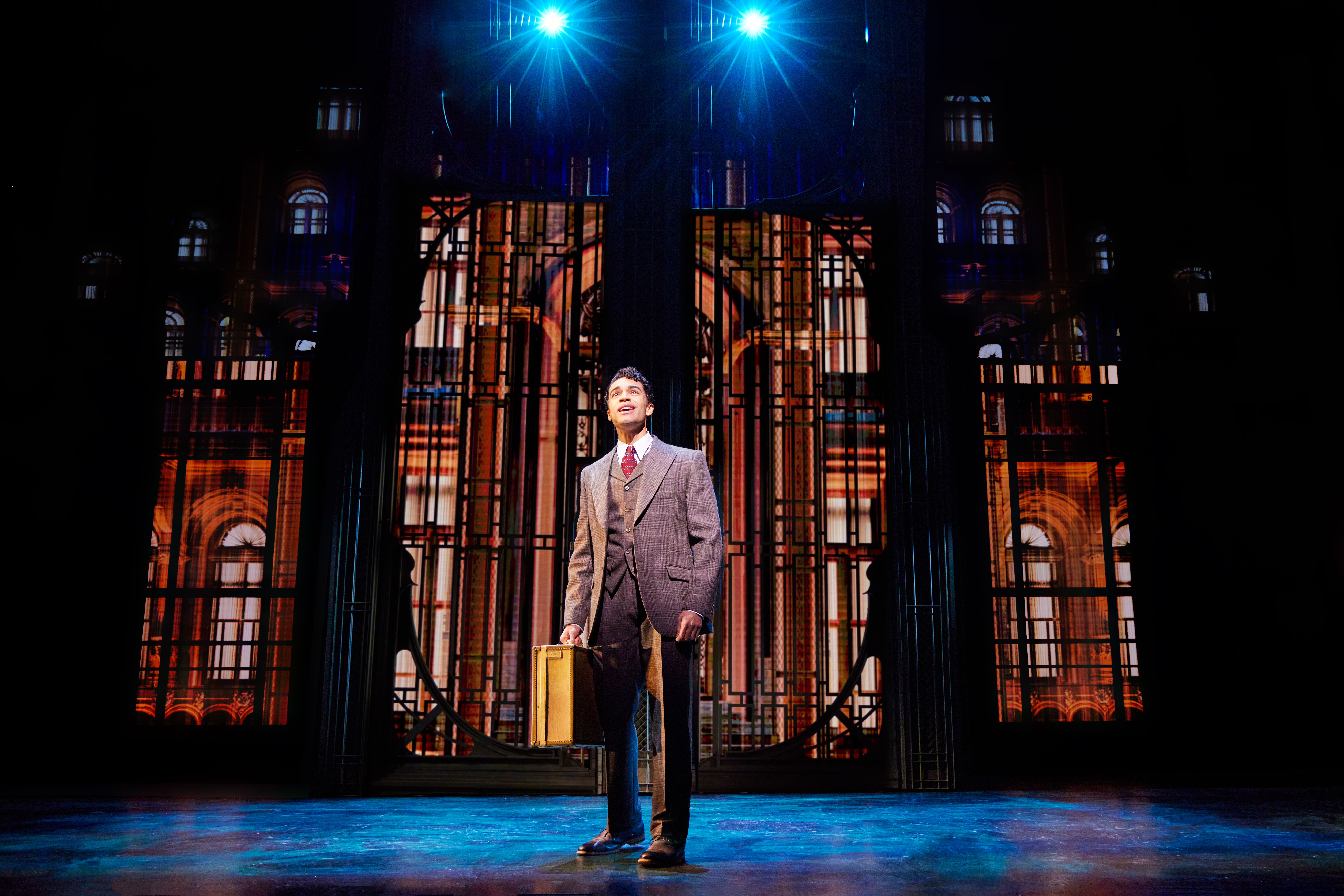
This tragic iconic tale of thwarted love and a cursed American Dream, like the Fitzgerald novel and the 2013 Baz Luhrmann movie that I couldn’t get out of my mind while watching this new stage version, should be unmasked through the wide observing eyes of its innocent narrator, Nick Carraway, played absolutely gloriously by the wonderful Noah J. Ricketts (Disney’s Frozen; 2ST’s To My Girls). He should be the epicenter for us all, and with him, we should feel his wide-eyed unpacking from that first moment he lays his eyes on all that surrounds him on the Sound. We must register what it means to him to come from such a uniquely different social class and discover the complications that Nick must inhabit in the deceit-filled lies of those he is connected. It’s his unwinding that we must experience, and when Ricketts’ Nick is given the space to expand his emotional and complex horizons, we feel in our bones the fading of that easy-going optimist that first arrives at that cottage door.
Unfortunately for this new musical stage adaptation, that wide Playhouse stage has a hard time keeping its attention focused on his collision with the decadence and indifference of the world that, at first, engulfs him. There are too many storytellers here, and in all those different vantage points, the story is essentially told efficiently, but not in an emotionally engaging manner as it could have been. What this production does have is its eyes fully aimed and refocused on the two star-crossed lovers that ultimately come and crash together leaving quite the mess discarded on the side of the road. It is Nick’s ultimate disappointment in those around him that plays the bigger part of the causality list. But no wonder that we aren’t as engaged with that emotive theme, as the music and the lyrics have been created to give this production’s two leads a tremendous number of opportunities to showcase their true undeniable talent. So how can we look the other way?

Jeremy Jordan (Broadway’s Newsies; American Son) as that captivating titular character, Jay Gatsby, steals the spotlight without a question in the house, and in a way, becomes the one who will lead us through this emotional upheaval. He is given, without a doubt, moment after moment to vocally shine as magnificent as the world he has created around him, courtesy of the very (almost too) geometric sets (and projections) that have been put together by designer Paul Tate DePoo III (Broadway’s The Cottage) with distinct lighting by Cory Pattak (Broadway Center Stage’s Next to Normal). The glittering visuals and the impressive vocals displayed by our star leads are rich and dynamic, with Eva Noblezada, fresh off the Broadway Hadestown stage, matching Jordan’s magnificent performance step by step. It’s the perfect pairing, finding clarity and distinctiveness in every Sophisticated nervous attempt for connection and renewal. But the question remains: does it work for the story being told?
Noblezada does find her shimmering soldier love story inside every song she sings, lifting herself up high and digging herself in and away from the enchanted life she has been trying to cultivate with her handsome, old-moneyed husband, Tom Buchanan, played perfectly by John Zdrojeski (Broadway’s Good Night, Oscar). The framework is all there, centered around the clash between new and old money, honesty and deception, and even some gender dynamics, most impressively embodied by the impressive Samantha Pauly (Broadway’s Six) as the wonderfully sharp, Queen-bee, lady golfer, Jordan Baker. That character magnificently rises above it all, almost stealing the whole crown away from everyone else. She swings that club and knocks those balls far and with force, forever finding fascination within her character and her voice. She is the main force to be reckoned with on that stage, bringing energy and excitement to every scene she inhabits.
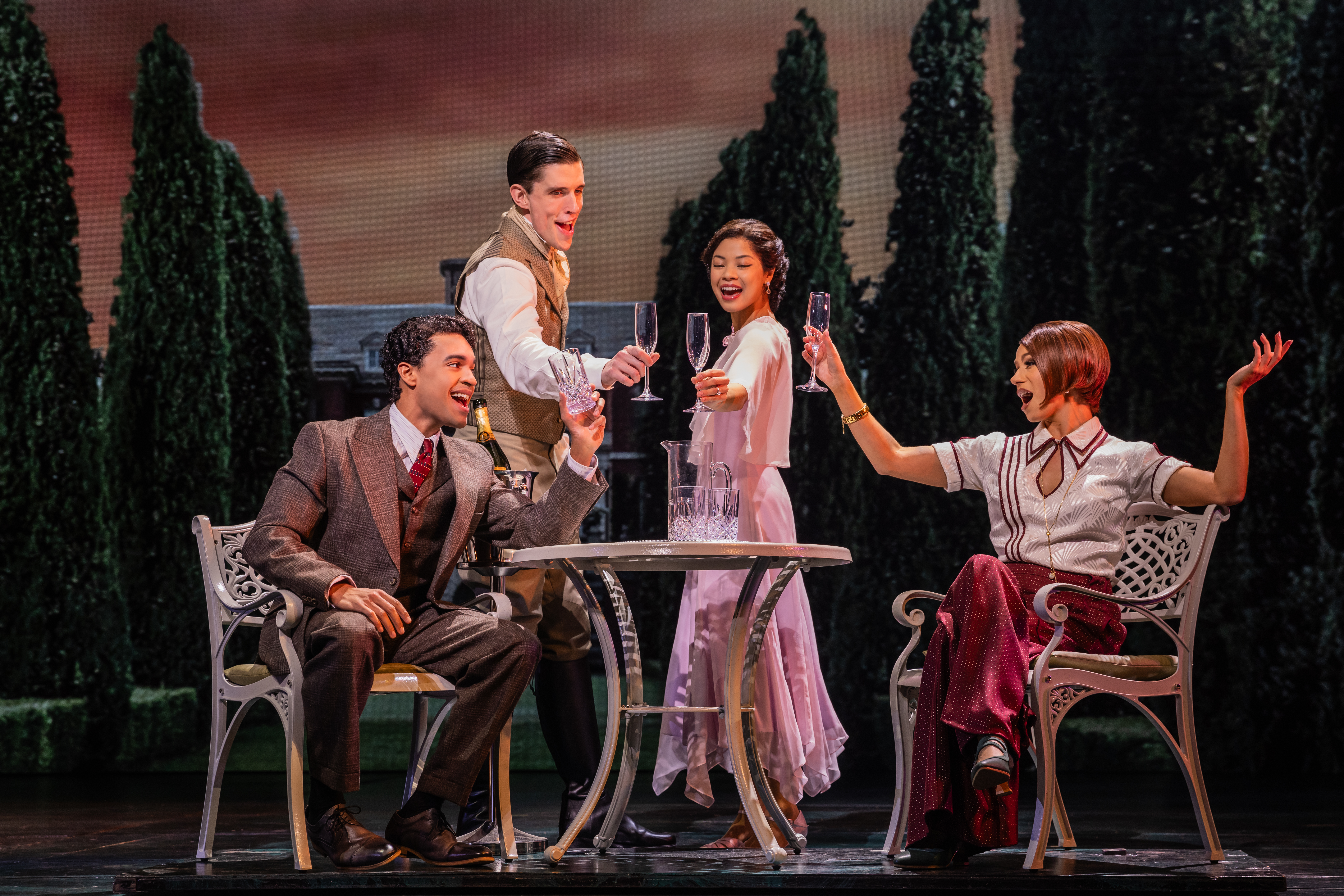
Even with the sometimes choppy dialogue she and the rest of the cast are given, and inside the minimal amount of handwringing that happens when Jay and Daisy meet up once again outside Nick’s cottage for a little bit of tea, the story drives forward at a neck-breaking speed. But somewhere along the road, these three super talents basically steal the show away from our narrator, pulling us quickly into Jordan’s non-stereotypical fascinating stance, and Jay and Daisy’s fantasy romance without even trying all that hard. That has a lot to do with Kerrigan’s book being the main culprit in driving us away from Nick.
It’s a bit of a frustrating recentering, that works well for the roaring love party of the show’s two stars sparkling brightly in the center. But not so well for the overall melodrama. The two bedazzled us with their magnificent, vocally perfect romance, thanks to the fine work done by music director Daniel Edmonds (Broadway’s Shucked) and sound designer Brian Ronan (Broadway’s Some Like It Hot). Yet, it pushes the humanistic themes of disillusionment somewhat to the side of the road, leaving the spectacled poster eyes staring out into the audience with a look that seems to be saying, “Where did this all go so wrong?”
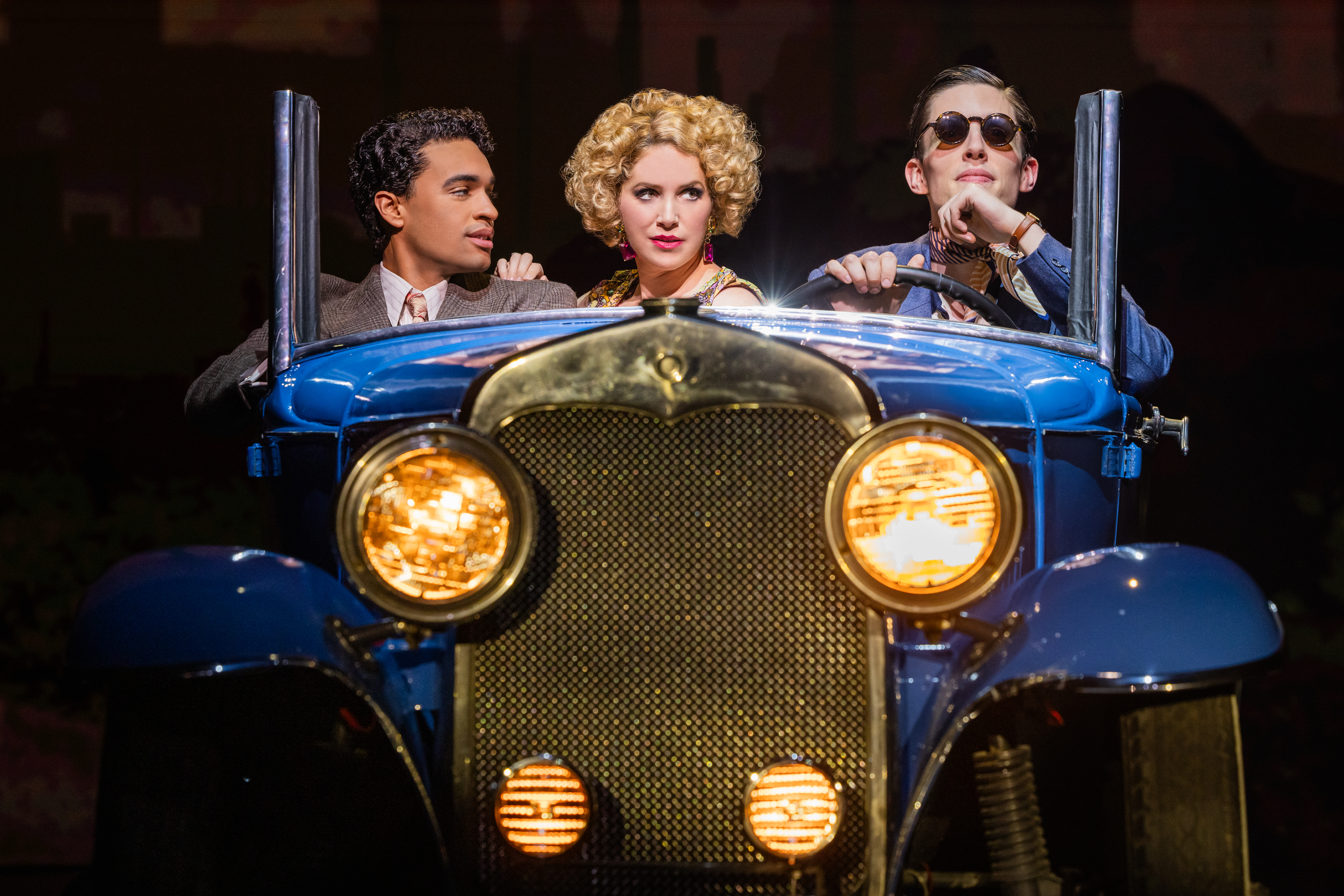
The same could be said of that other couple that gets caught in the spectacled gaze of that ominous sign on the road to the city. That eyeglass symbol and metaphor are infinitely better addressed and unpacked in the novel, but here, in the show’s scattered storytelling, those eyes just hang there staring back at us, almost distracting us from the fine work done by Paul Whitty (Broadway’s Come From Away) as gas pump owner George Wilson, alongside his cheating wife, Myrtle, played deliciously wild and wicked by Sara Chase (Netflix’s “Unbreakable Kimmy Schmidt“). These two are given some pretty amazing moments of vocal shining and emotional unburdening, but once again, whose story is this really? And do we really need a big powerful ballad from Myrtle, regardless of how well she sings it, about her pregnancy just before that somewhat clumsy climax that we know is coming around the corner?
As directed by Marc Bruni (Broadway Center Stage’s The Music Man), The Great Gatsby musical is ushered forward in a pretty standard approach. Bruni seems to always want to bring everyone down centerstage for their big musical moments, singing loud, strong, and true most magnificently in a spotlight, framed in squares by everything behind them. There are no angles or off-balanced lines to speak of, even in the fine, but sometimes overly done costuming by Linda Cho (Broadway’s Summer, 1976) and jazz choreography by Dominique Kelley (Ebony Rep’s Ain’t Misbehavin’). It’s all so geometrical and straightforward in the way this rendering has been staged. It felt a bit dull and too direct, that I almost wanted a more experiential telling from the maestro who brought us Moulin Rouge! the Musical on Broadway. It needed that level of imbalance and involvement that a director like Alex Timbers could bring. And speaking of Moulin Rouge!, I also craved that intense and frenetic energy that Luhrmann brought to his cinematic retelling of this great American tale. The fascinating thing about that comparison is that regardless of how spectacular the music is in this Paper Mill Playhouse version of The Great Gatsby, the pop music score of Luhrmann’s version almost feels more in tune with the period than this original score. Especially in the party scenes at that grand house. Something in this musical’s pop-jazz fusion felt more modern and out of touch than the jukebox score of Luhrmann’s film. It’s ironic actually, that his film delivered a party that I didn’t want to leave. Unless Pauly’s Jordan was my companion. If that was the case, I’d go to any party that character invited me to. Without a doubt.

 front mezz junkies
[…] with the spot-on, absolutely perfect projections, with solid lighting by Cory Pattak (PMP’s The Great Gatsby), dynamic and glittery costuming by Jen Caprio (Broadway’s Falsettos), and exacting sound by […]
LikeLike