The Off-Broadway Theatre Review: Playwrights Horizons’s Stereophonic
By Ross
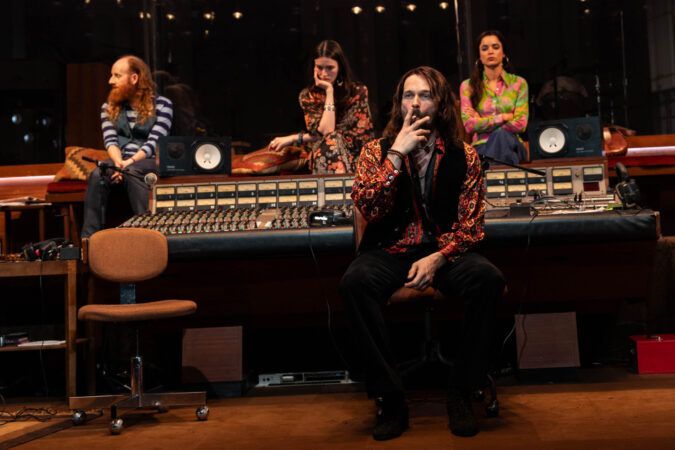
It’s July 1976, in a recording studio in Sausalito, CA and we are being invited into a space that only a select few get to visit, let alone witness. This is art in the making, pure and simple, with ego and love, getting mixed and faded in through the process most musically. In Playwrights Horizons‘s magnificent new play, Stereophonic, written most delicately by David Adjmi (The Blind King Parts I and II), a band on the cusp of greatness has assembled, and they are tasked, casually and with great intent, to something magnificent and meaningful, a lasting piece of musical art, to follow up their last album that has become, over the timeframe, a breakout hit.
The play is exceptionally well framed and constructed; both musical and meandering, in the best of all possible ways, yet somewhere inside Adjmi’s engaging Stereophonic and its three-hour running time, a deeper level of contextual art formulation is unpacked quite beautifully. It saunters forward, with a complicated level of exhaustion, angst, and inspiration, unearthing something that almost defies expectations and compartmentalization. It’s a 1970s rock saga, clearly modeled on the legendary Fleetwood Mac and their dynamic backstage friction, that leans into and plays with the problematic relationships within this unnamed band as they try to create magic behind a glass wall, while also trying to fulfill their emotional needs in the confines of the studio and real life.
It’s all emotional breakups and reconciliations, with a layer of bored and sleep-deprived banter; around a broken coffee machine and the annoying reverberations of (not only) the drum. It’s electric and conflictual, playing havoc on every one of these characters’ insecure hearts, while offering up no grand solutions or final product. Stereophonic is all about the tiny details and the little frustrations that grow and become emotional cannonballs bent on destruction, leveled and defused out of an undercurrent of love and need for creation. It is incandescent in its artful construction, displaying and writing about a realm few of us can understand. It’s the agony and ecstasy that lives and sings inside the magnificent creative process of musicians, arts, singers, and writers, who hear aspects that most of us can’t understand, let alone hear or comprehend. And we have been invited in, to bear witness to its creation, in all its meticulously dull and exhausting detail. Giving light to the darkness of the process, and how art can both create and destroy those involved in its coming to life.
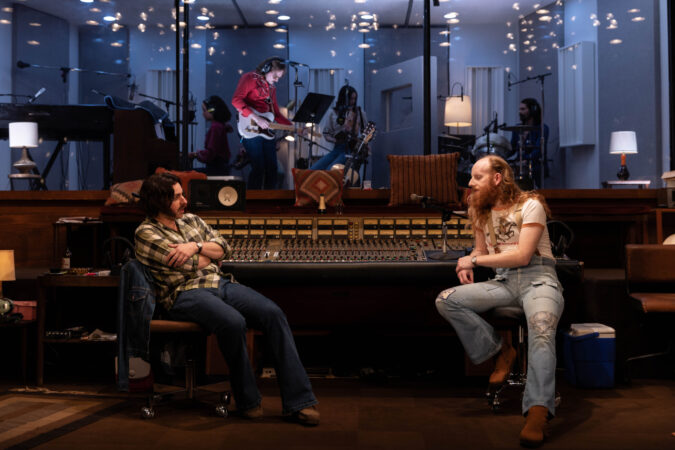
Stereophonic, as directed solidly by Daniel Aukin (LCT’s Admissions), is relentless, casual, and wonderfully detailed, giving us the band experience of trying to organically create music, supplied by the immensely talented musician and composer, Will Butler (Arcade Fire’s The Suburbs). It all plays out over a long period of time, driving each other mad with their internal and external struggles and ego manipulations. The set, miraculously well designed by David Zinn (Broadway’s Kimberly Akimbo), with the solid help of sound designer Ryan Rumery (PH’s Placebo) and lighting designer Jiyoun Chang (Broadway’s The Cottage), delivers the dichotomy of the control room in the foreground and the soundproof recording space in the back, separated by a wall of glass, where different elements unfold with deliberation. It’s a fantastic formulation, that resembles and plays with the making of ‘Rumours‘ whole also paying tribute, (I am told – this detail flew over my head), to albums by Todd Rundgren, Talking Heads, Pink Floyd, and Elton John.
The unnamed Stereophonic band before us seemingly has a hit album that is climbing the charts as they start recording, and their record label is becoming more and more generous as they become more and more famous. All the actors find their fantastically unique space within that iconic construct, with the two couples taking center stage, along with nods to those around them. It’s a compelling narrative, with their body language giving off the boredom and exhaustion that comes with all the late-night partying and endless recording and re-recording. Dominated by an American guitarist and singer, the aggressive Peter, played strongly by Tom Pecinka (TFANA’s He Brought Her Heart Back..), and his insecure songwriting girlfriend, Diana, beautifully portrayed by Sarah Pidgeon (Hulu’s “Tiny Beautiful Things“), they act out a dynamic that is as raw and rocky as one would imagine when two artists collide, both with faltering egos and needs. The cling to one another in desperate need, while also mistreating and hurting one another endlessly. It’s electric and disturbing, while being entirely believable and dynamic.
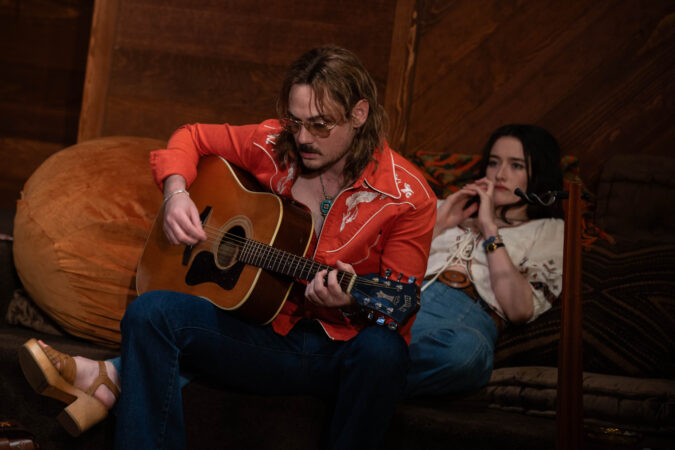
There is also, almost more fascinating, a trio of Brits, two of which are struggling to connect within their explosive marriage; namely Holly, magnificently embodied by Juliana Canfield (ATC’s Sunday), who sings and plays the piano, and Reg, brilliantly portrayed by Will Brill (Off-Broadway’s Uncle Vanya), who plays the bass and drinks and snorts so much that he can barely walk, at least at the beginning of this play. There is also the captivatingly complicated Simon, played well by Chris Stack (ATC’s Blue Ridge), who plays the drums while trying hard to manage the mess that slowly and almost lazily unravels around him.
Staying firmly on the control side of the glass, we are also given a peek inside those who live in the background; the young sound engineer Grover, meticulously unpacked by Eli Gelb (RTC’s Skintight), and his hilariously well-constructed assistant, Charlie, wonderfully played by Andrew R. Butler (Ars Nova’s Rags Parkland Sings…). Their drive and infatuation with the band and their creative power play strong and true, especially at the beginning, but as the mystique of the band’s unity begins to unravel and explode into chaos and compulsion, their determined connection to the musicians shifts from worship to irritation as the weeks turn into months and years. Or does it, in the end?
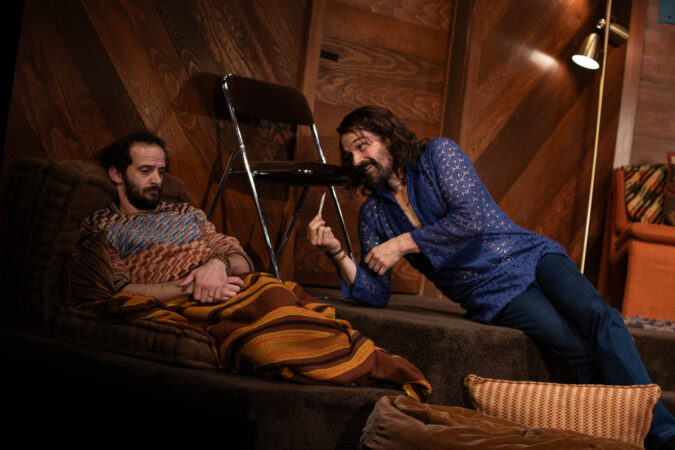
The creative energy and compounded exhaustion that live inside every brilliantly performed song cause Stereophonic to sing, most magnetically and is clearly as real and authentic as one could hope for, drenched in authentic swagger, courtesy of the costuming by Enver Chakartash (Broadway’s A Doll’s House). Even as the clock ticks forward, for them and for us, the pitfalls of collaboration and the art of creation mingle and mix like only musicians can, hurting one another while also elevating their craft in order to create that piece of art that makes all of us sit back in wonderment. They riff and talk rough to one another, accessing imagery of the hotness of Donald Sutherland and the bonding of artists, regardless of gender. The music in the background soars, thanks to the beautiful songwriting work done by Arcade Fire’s Butler, but it’s more in the magical interpersonal dynamics that elevate this experience into something special, powerful, and utterly unique. Aggressiveness and control hit hard against love, creation, and connection, playing with loyalties and solo careers in a way that unlocks chaotic relationship complications that echo far beyond the room. Sudden fame does wonders to the energy within, and in Stereophonic, we are gifted with the fly-on-the-wall syndrome, watching magic develop out of thin air and focused minds, even when clouded by love, pain, and that big bag of white powder.
 front mezz junkies
[…] & In Old Age), the simplistic but meaningful costume design by Enver Chakartash (PH’s Stereophonic), and the solid expanding sound design by Mikhail Fiksel (NYTW’s How To Defend Yourself). I […]
LikeLike
[…] Naturally, some of the funniest lines are delivered by the conflicted Ryan, until he exposes his internalized homophobic self to be as equally misogynistic, sharply overstepping the consent boundaries with shocking ease. Using Dawn, without really considering the consequences and meaning of his action beyond himself. And when that bloodied amputated appendage is held high like a symbolic battle cry to the gods and those waiting Promise Keeper gals, the inferno war has begun, dressed to perfection by costume designer Enver Chakartash (PH’s Stereophonic). […]
LikeLike
[…] Playwrights Horizons and MCC Theater, has the most nominations with 8; followed by Playwrights’ Stereophonic and Atlantic Theater’s Buena Vista Social Club with 7 – the latter being the most nominated […]
LikeLike
[…] Best New Musical Buena Vista Social Club Dead OutlawLizard Boy The ConnectorThe Gardens of Anuncia Best New PlayDracula: A Comedy of Terrors Infinite LifeJob Oh, Mary!Stereophonic […]
LikeLike