The Toronto Theatre Review: Factory Theatre’s Monster & Here Lies Henry
By Ross
“Is this what you expected?” asks Henry. “Is this what I’m supposed to do?”
I had no idea what I was walking into, nor did I understand the historical aspects of this double bill of one-person shows that were being staged so magnetically on the two Factory Theatre stages. The significance lies in the contrasting unity and the way the two solo shows changed theatre when they first came into being so many years ago. Daniel MacIvor, a playwright, performer, and filmmaker, fills these two contemporary classics with sparks of phenetic energy, exuding tension and emotional complexities that resonate far beyond the single spotlight, and now, brought to life here at Factory, the gift is full-blown, exacting, and utterly enthralling.
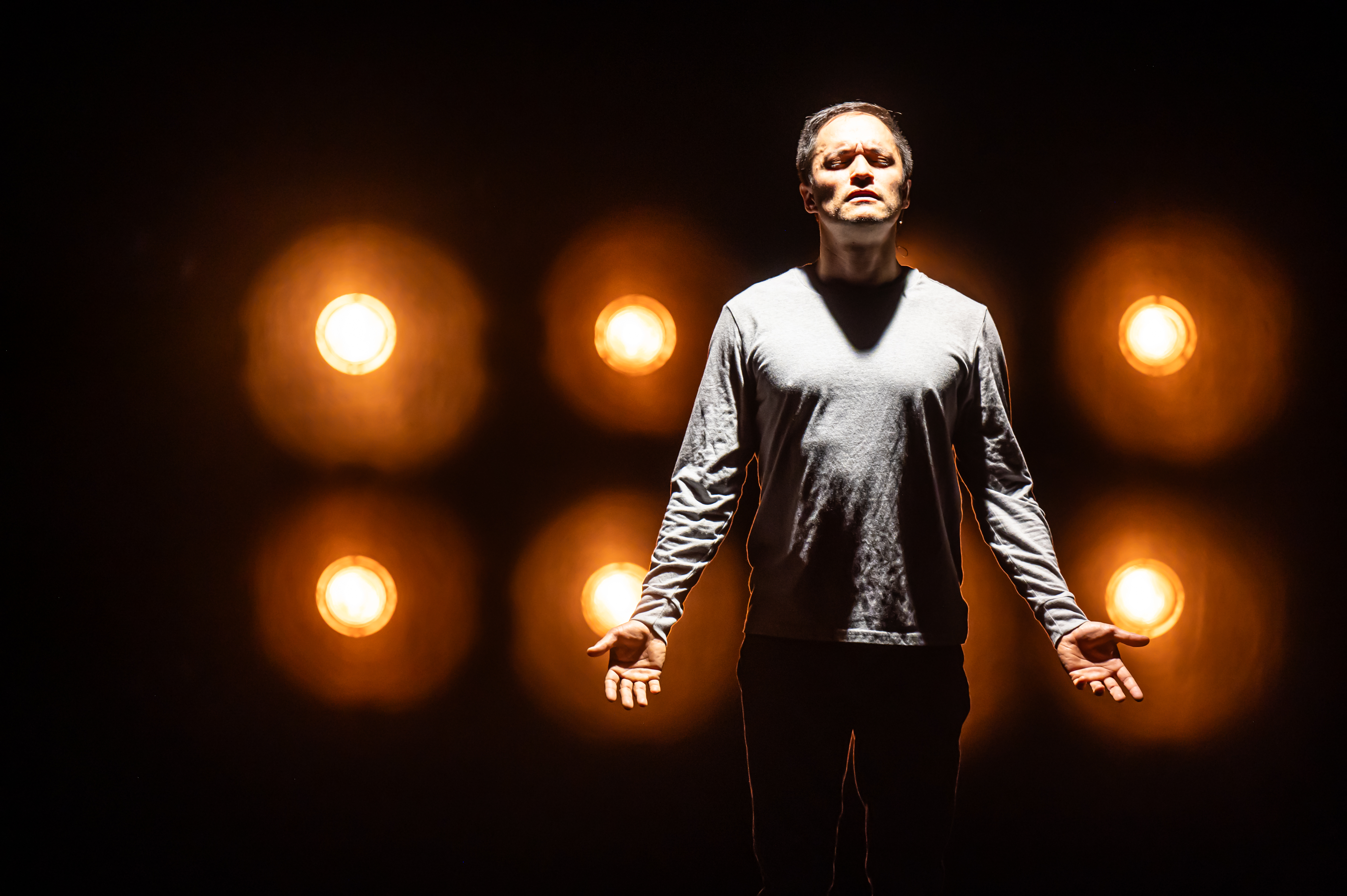
With the 75-minute Monster, the one-man tense wonderment casts us deep into an electric darkness. Its first movement abandons us, forcing us to sink into the tension that bows down before us in the pitch-black void. We sit, wondering, feeling the electric discomfort well up inside, before a voice cuts through the blackness with a “Shhhhh,” “Has it started yet?” It’s a captivating bit of theatrical engagement, forcing a squirm to come compulsively over us, long before the lights come up on the magnificent Karl Ang (Tarragon’s Cockroach) giving us a master class of chaotic exacting intensity.
As directed with a fine eye to precise moments of dark intensity by Soheil Parsa (Factory’s Wildfire), Monster takes us through, around, and about a tale of tension, anger, and obsession where the ending is as fascinatingly unclear as its beginning. It seeps in from the edges with Ang transporting us through a series of characters and formulations that jump in and out of time and its ever-fluid construct. We are invited into a tense quarreling heterosexual couple’s scenario, filled to the electric frayed edges with passive-aggressive violence. It shifts around before us, led by the exacting and determined Ang, forcing us to lean and pay attention from an angle of curiosity and tension.
There is a young boy, meticulously well-embodied, as Ang does with every one of these complex characters, who is at first, fascinated, then obsessed with an impossibly vicious murder that was committed by the weird next-door neighbours down in the darkness of their basement. Ang takes us through the details, as only a young boy would, unflinching in his compulsive engagement with what happened and horrified/entranced with the act itself. We are also thoroughly obsessed, with him and the whole unraveling, wondering where this is all heading, and what it all means.
As written with an exacting purpose by the masterful MacIvor, the narrator of these stories is a wide-open Adam, who speaks directly to the audience. He draws us in, while keeping us nervous and unsure, giving off the impression of impartiality but not completely convincing us that there isn’t something dangerous lurking in the background. His calculated energy is mirrored and enhanced within the theatrical dynamic, brought forth precisely by the fine work of set, props, and lighting designer Trevor Schwellnus (Factory’s Armadillos) with a dynamic sound designed cleverly by Thomas Ryder Payne (Crow’s Bad Roads). The distinct and sharp reverberations are amplified and muffled, shouted in and whispered out. That sonic energy creates a chaotic realm of interactive intensity, with the movements of the expert Ang unleashing a menacing air of tight, muscular, thrilling proportions, never giving us a moment to relax before the ending pushes itself forward.
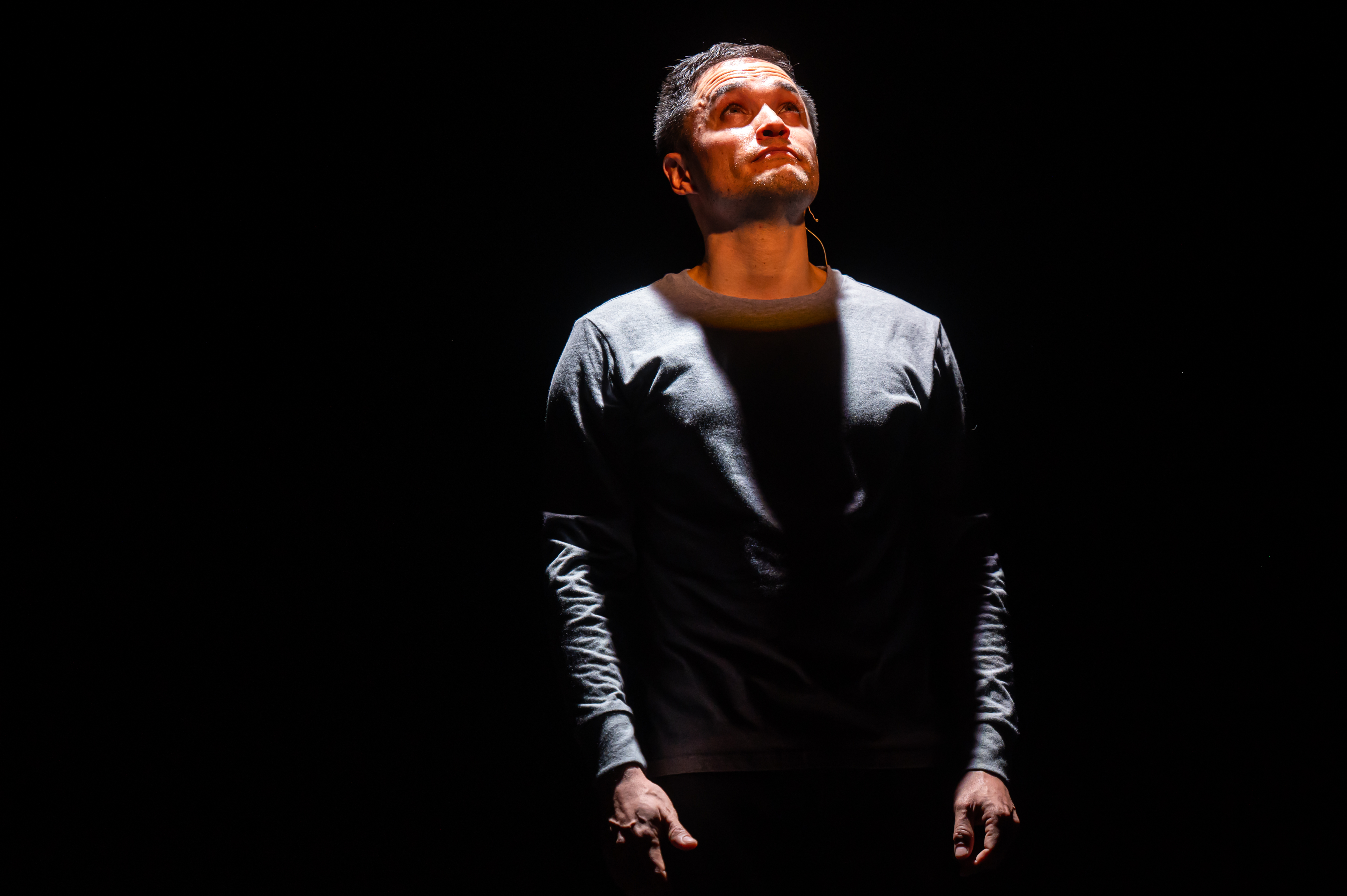
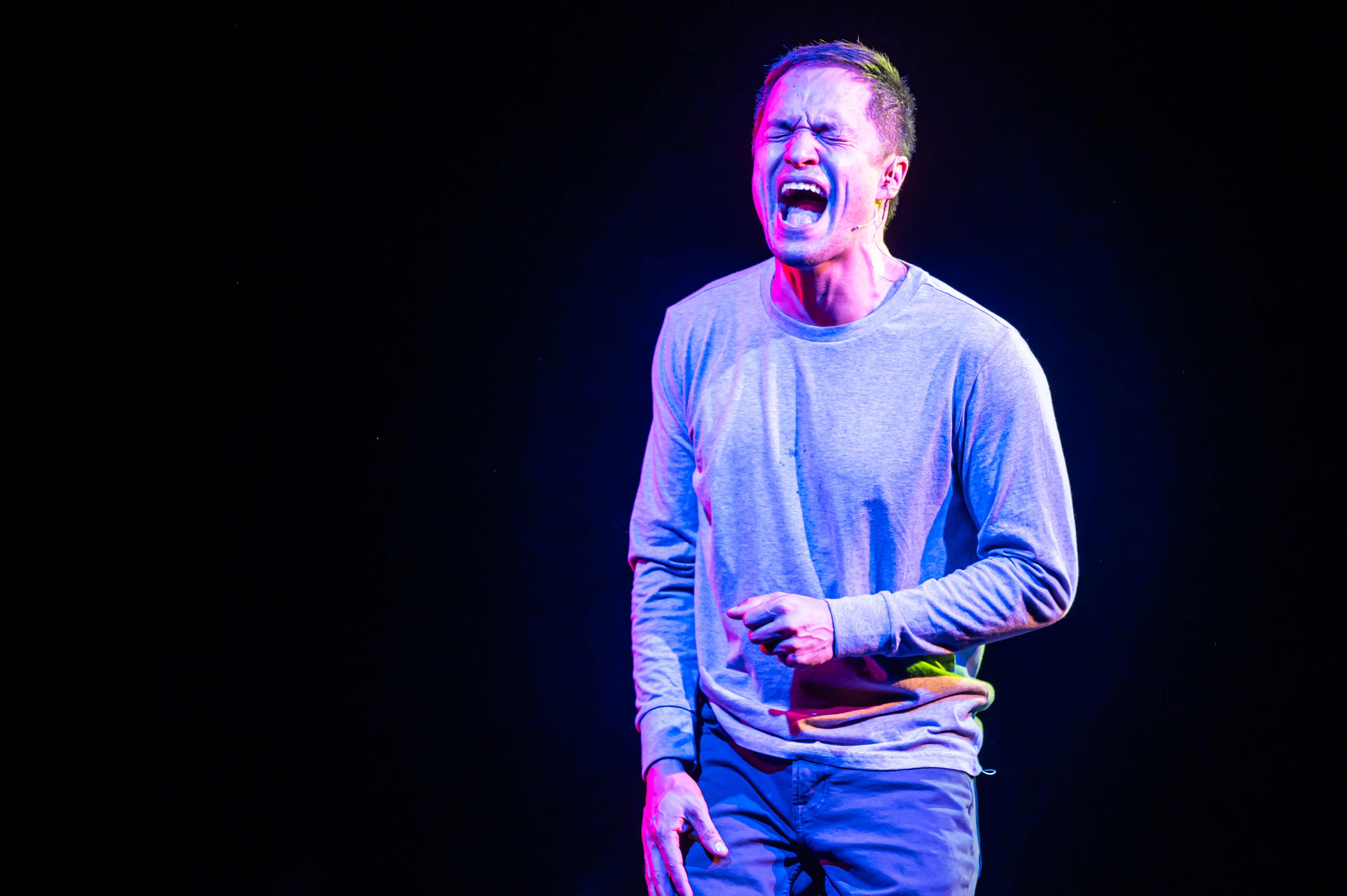
Karl Ang is detailed and spectacular in this intense unraveling, giving us exacting constructions of various characters, as he stays solidly center-stage in that sharp pool of light. The neon colors and tightness of the pool of light illuminate the darkness with intent, with Ang transforming himself with cutting definition, emphasized even more by the simplistic costuming by Allie Marshall (Factory’s My Granny the Goldfish). The outcome is razor-edged and distinct, elevating the topography effortlessly with a shift of his head, and a look in the eyes. His performance, with the gift of Parsa’s direction, pushes Monster into a completely entrancing and electric realm, exciting our senses and leading us out of the theatre mesmerized.
The overall effect is honed and powerful, and as fresh as I imagine it would have been back in 1998 when it was first performed at the duMaurier World Stage in Toronto. It faulted and stumbled a bit near the end, somehow missing the connective tissues by only a hair, here and there, but the monstrosity of humanity as a whole lingers within, seeping into our senses, and staying with us, deep under our skin, as we make our way out and up to the next MacIvor master class one flight up (and 45-minutes later).
“Cause I’m free, nothing is worrying me.“

“I’ll take two, if that’s my choice,” he tells us. Noting that Here Lies Henry is as spectacular as the Monster we just left, but quite the different beast, cut from a similar cloth but a very different fabric. Interestingly, it’s layered with another classic old song. In Monster, MacIvor played with the menacing sweet tendencies of “Raindrops Keep Falling on My Head” but in this other one-person beam of captive energy, Damien Atkins (Soulpepper’s King Lear), the central bright white light of Here Lies Henry, uncomfortably delivers to us the happy “…Sunny Side of the Street” as he moves around the broad main stage of Factory Theatre thrilling us with a very different kind of tense complication.
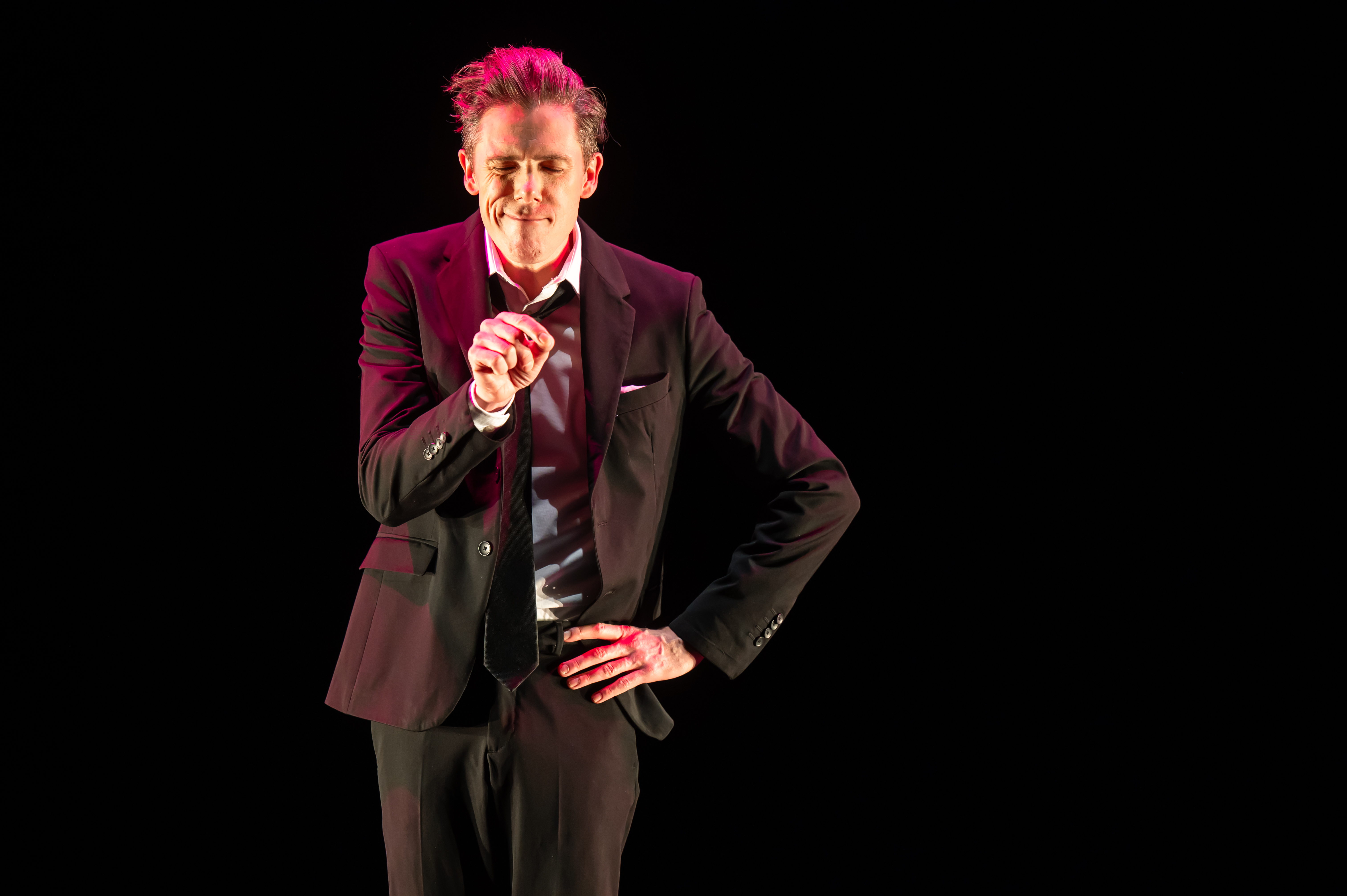
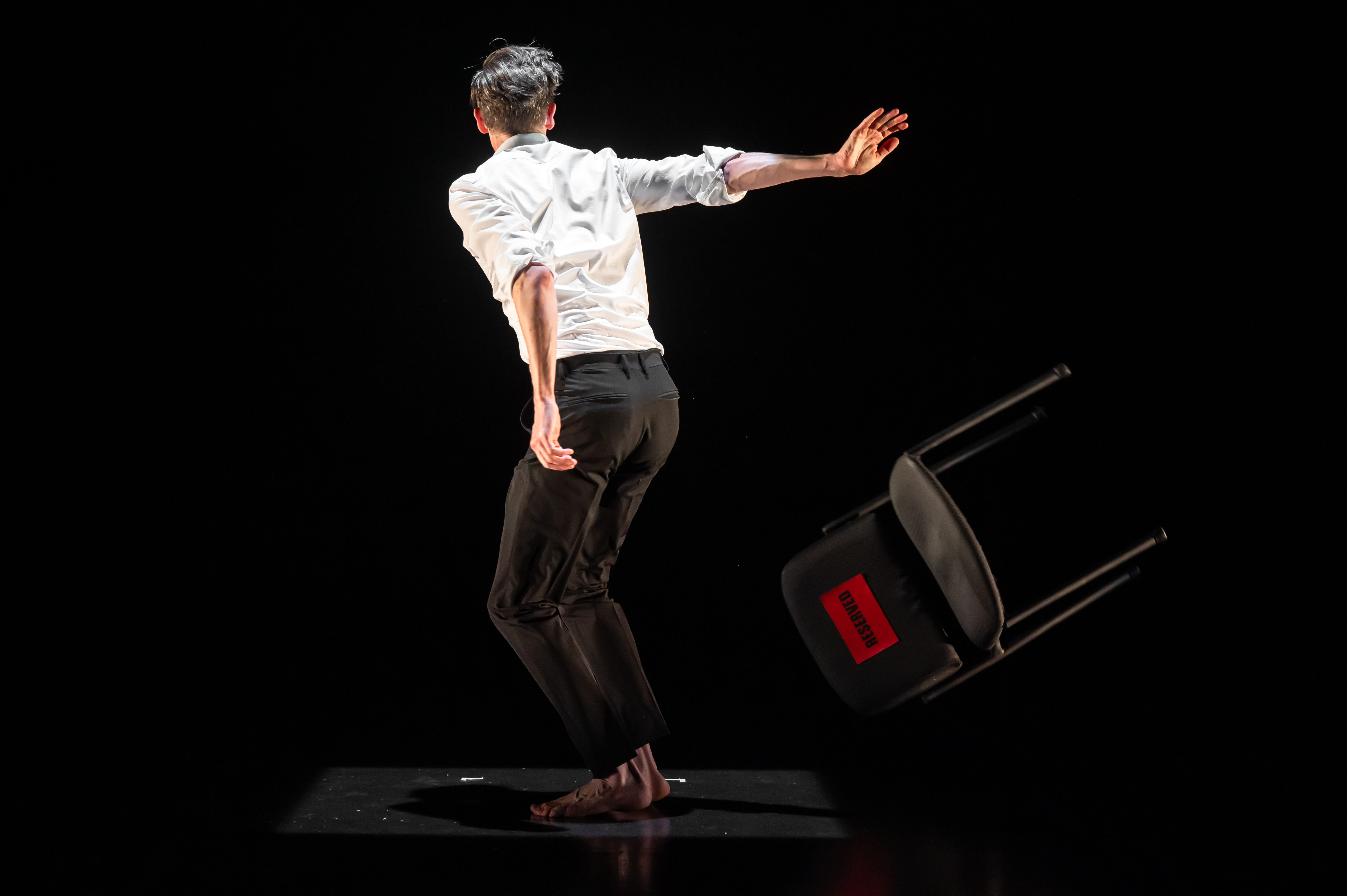
Timed to perfection, a slice of white light and dramatic cueing delivers a hurried Atkins to us. We feel his vibrating discomfort in every pore of that wide nervous face and expressive body and eyes. Atkins unpacks his character with a very different electricity, created from a place of anxious engagement and discombobulation. He has an overwhelming sense of theatrical flourish, singing and trying with all his might to engage, with hand puppet gesturing and scattered, stilted jokes that fail to find the punchline, as if he is completely desperate to get us on his side, for some unknown reason.
“I am the Monster,” he states, yet, he’s that guy that we all feel for but dislike being corralled by at a party. His intense need to connect fills us with a pushing-away discomfort and anxiety, even as we are drawn into his circular thinking and repetitive entertainments. He tries to tell funny stories, with a setup centered around a salad bar at a vegan convention, but then, his anxiety gets the best of him, unnerved by the idea that he might have offended any vegans in the audience.
“Is this what you expected?” he asks. “Is this what I’m supposed to do?”
He’s an optimist he tells us, and as we internally question that description, he also unpacks another item, that any optimist is also a liar, as there is no way to be one and not the other. He also teases out the idea of a dead body in the other room. He doesn’t tell us who, but we begin to put some of the pieces together. Is the title a reference to his compulsive act of lying or is it a reference to the body that is doing exactly that in the other room? Or maybe it is a bit of both, or a lot of both. He is, in fact, dressed like a corpse caught trying to escape his own funeral and coffin, thanks to some fine work done by wardrobe stylist Allie Marshall. Atkins completely hypnotizes us with his skill, his unwavering talent, and his taxonomy list of lies, one through seven, starting with the clever “just kidding” quip to the highly problematic pathological lie, and ending with the universal one, which is the concept of time, a dynamic framing that gives people hope, something he has little of.
The unmistakable brilliance of the piece is revealed inside Atkins’ skilled portrayal of this desperate man, as he unravels his possible truths before us, pulling at us to enter his domain while keeping us vibrating at arm’s length with his projected anxiety. His mother is a fried egg sandwich, he tells us, and his father is a cigarette pack of specificity. He distracts his vulnerability with some wild dance moves, something that Atkins revels in, and as directed with clarity and comedic brilliance by Tiwiah M’Carthy (Obsidian/Canadian Stage’s Fairview), the personality portrayal is delivered almost perfectly, energized with a nervous self-exposing cycle of existential destructive self-preservation.
Together the two pieces find energy and excitement in their tense unfolding. It’s a master class of one-person acting, directing, and writing, that must be seen and felt to fully understand the power that a one-person show can bring. Don’t miss this electric gift and exciting opportunity, courtesy of Factory Theatre, Toronto. MacIvor’s magnificent Monster and the equally profound Here Lies Henry are just too delicious and disturbing to ignore.


 front mezz junkies
[…] to wild perfection by the intricate and meticulously well-defined Damien Atkins (Factory’s Here Lies Henry), dives right into the specific meanderings of his sharp-witted mind and angry hurt […]
LikeLike
[…] (Factory’s acts of faith) with clear straightforward lighting by Andre du Toit (Factory’s Here Lies Henry) and detailed sound by John Gzowski (Buddies/That Theatre Company’s Angels in America), bows […]
LikeLike
[…] of Guillermo Vedecchia’s Feast. Directed by Dora Award-winner, Soheil Parsa (Wildfire and Monster, Factory Theatre), Feast is a charged look at the globalized world in which some are movers and […]
LikeLike
[…] Theatre in association with paul watson productions and Obsidian Theatre CompanyDamien Atkins in Here Lies Henry, Factory TheatreDaniel MacIvor in The Inheritance Part 1, Canadian StageMike Shara in The Master […]
LikeLike
[…] Kong Kie (TPM’s The Year of the Cello), and sound designer Olivia Wheller (Factory’s Here Lies Henry). It feels as powerfully big and dense as its source, legendary and mystically, while unpacking […]
LikeLike
[…] season, which included a memorable performance in The Inheritance, and the revivals of his plays Monster and Here Lies Henry, both produced by Factory […]
LikeLike
[…] Theatre in association with paul watson productions and Obsidian Theatre CompanyDamien Atkins in Here Lies Henry, Factory TheatreDaniel MacIvor in The Inheritance Part 1, Canadian StageMike Shara in The Master […]
LikeLike
[…] and in his trying to regain his power, he falters quite famously. Damien Atkins (Factory’s Here Lies Henry) does a fine job with the forgettable small role of Rev. Lexy Mill, but the part never finds its […]
LikeLike
[…] (Fine China), Never Walk Alone, as directed with clarity by Tawiah M’Carthy (Factory’s Here Lies Henry) and choreographed cleverly by Nate Gerber, bends and blends in a whole different kind of pole […]
LikeLike
[…] then there is the ever-so-talented and always reliable Damien Atkins (Factory’s Here Lies Henry), giving what might be one of the funniest villain turns Toronto has seen since Panto arrived on […]
LikeLike
[…] of Affection), with a strong helping hand by lighting designer André Du Toit (Factory’s Here Lies Henry), create a multimedia distortion field that mirrors his disorientation, especially when the lawyer […]
LikeLike
[…] the consequences of living truthfully in a world that resists it. With its original cast members, Damien Atkins, Jonathan Corkal-Astorga, and Colton Curtis, it sits alongside a new stage adaptation of […]
LikeLike