
The Off-Broadway Theatre Review: Public Theater’s Hell’s Kitchen
By Ross
Charging its way from off-Broadway’s The Public Theater to Broadway as fast as can be, we have been gifted with the latest jukebox musical pulled from the playlist of Alicia Keys, Hell’s Kitchen. The musical is solidly energetic, and electric, rising up strong and true to the highest of floors with an excitement that runs in from the side as soon as the lights dim and the music begins. Feeling as fortunate as can be, I was lucky enough to be there, in attendance of the newest endeavor, ten years in the making, from the Grammy-winning and classically trained Keys that elevates itself high above the standard fare of jukebox musicals with its multi-layered approach to song and movement. With a tailor-made book by Kristoffer Diaz (Public’s Hercules), Hell’s Kitchen lights up the Public with its drive and approach, and as directed with vision by Michael Greif (Broadway’s Dear Evan Hansen), the music and lyrics by Keys pumps out big and loud, with a pulsating heart and soul that is hard not to be drawn in and held tight.
“She’s 17 and her brain doesn’t work,” is the key phrase that forms the foundations of this musical’s high levelled floor, and it’s repeated with authenticity by the magnificent Shoshana Bean (Broadway’s Mr. Saturday Night) as the mother trying to hold her small Hell’s Kitchen family together as she works herself down to the ground. It’s no surprise that Bean kills it (in the best way possible) with every number she gets to sink that powerhouse voice and teeth into, but in many ways the musical lies majestically at the feet of the Keys stand-in, the vibrant and gifted Maleah Joi Moon (“Mystic Christmas“) who plays Ali, the 17-year-old that drives her mother mad with love and concern, but finds purpose and meaning playing the piano. This is basically the story of Keys and her Manhattan upbringing, being played out in Ali’s Hell’s Kitchen, living loud and rebellious inside the Manhattan Plaza Tower for artists, with a father, portrayed compellingly by Brandon Victor Dixon (Broadway’s Shuffle Along), who has a difficult time sticking around long enough to really be of use, an overly busy and controlling mother (Bean), and a life-changing run-in with a piano teacher, played to beautiful perfection by Kecia Lewis (Broadway’s The Drowsy Chaperone), in the Tower’s Ellington Room who brings Ali’s anger into musical focus.
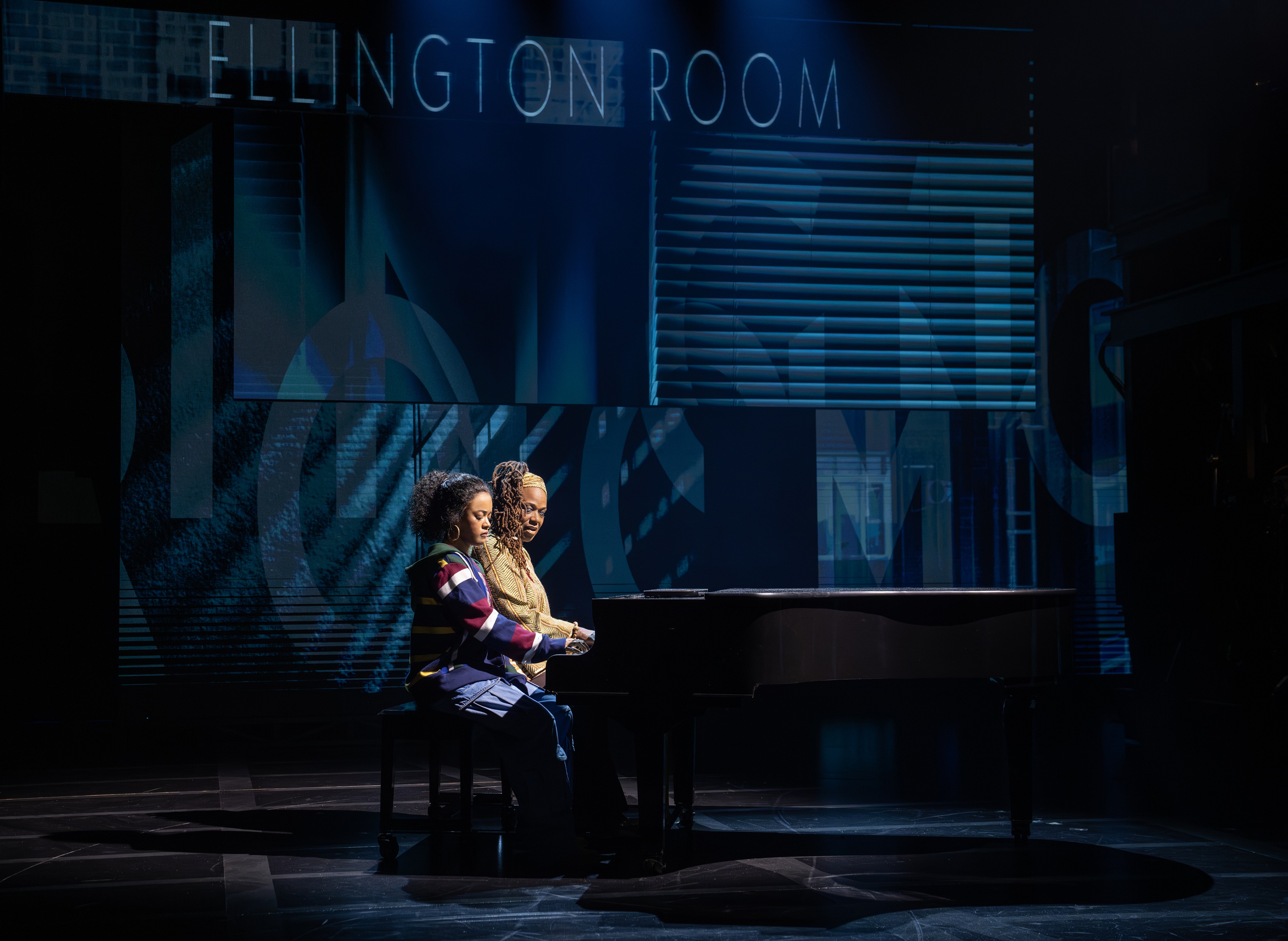
Unlike the more complicated and unfocused Jagged Little Pill and its overdone roadmap of complications and far-too-many characters, the jukebox component in Hell’s Kitchen lives strong, rarely getting in the way of the central story. Keys keeps it simple and straightforward, for the most part, unpacking the autobiographical edge with a clarity and decisiveness that delivers it up far above the others in that crowded genre. There was only one moment, the clumsy audition scene, that felt forced in and outside the requirements, but it did give Bean her moment to out-sing everyone on that stage, powering herself and her song to relevance and the highest of heights, even as we withstood the inauthenticity of the framework and staging.
But under the watchful eye of Keys, who had her talented hand in almost every aspect of the show, Hell’s Kitchen is on fire, like the teenage girl at its center (and the song that gives the show one of its best pops of color, sound, and light). I especially appreciated the jumping in of the problematic boy-centric structuring by Ali’s friend. That insert made it feel all the more thoughtful and smart, beyond anything I could have imagined when that famous song energetically brought Act One to its closing. The number, like most, feels refreshingly deliberate and required, filled to the brim with the complicated clarity of life, a big dash of angst, and plenty of emotional chaos that teenage life and hormones can illicit and ignite.

Moon delivers the piece forward with an unexpected balance of emotionality and anger, paired with a beautifully powerful and precise voice. It radiates a determination and love for music and, of course, desire for that slightly older, well-bicep-armed man who plays the plastic bucket on the corner with his buddies. Embodied by the very handsome and extremely gifted Chris Lee (Chicago’s Hamilton), Knuck is both everything her mother is worried about and her daughter desires, while never falling completely into the stereotypical role that the world wants to handcuff him to. It’s a sharply defined and complicated structuring that balances itself well in the world this show has created for us. It’s clear, complex, and smart, even when it gets passed by too quickly and with little ultimate fanfare.
The music surges and sings vibrantly, as brought forth by music supervisor Adam Blackstone (NBC’s “That’s My Jam“) and music director Dominic Fallacaro (Broadway’s & Juliet), with orchestrations by Blackstone and Tom Kitt (Donmar’s Next to Normal), pulsating forward with a pop and an emotional feel. The choreography by Camille A. Brown (Broadway’s for colored girls…) is powerful and true, emulating everything this musical needs and more. Although, sometimes, the intrusive nature of those dance moments overwhelms and distracts our eyes from the main characters, their voices, and the dynamic interactions that should have been the focus. I wish there had been more faith that the singers could hold those dynamic moments, and expand the framework on their own without the need to always add more, tasking us to take in both, when it isn’t and wasn’t required.
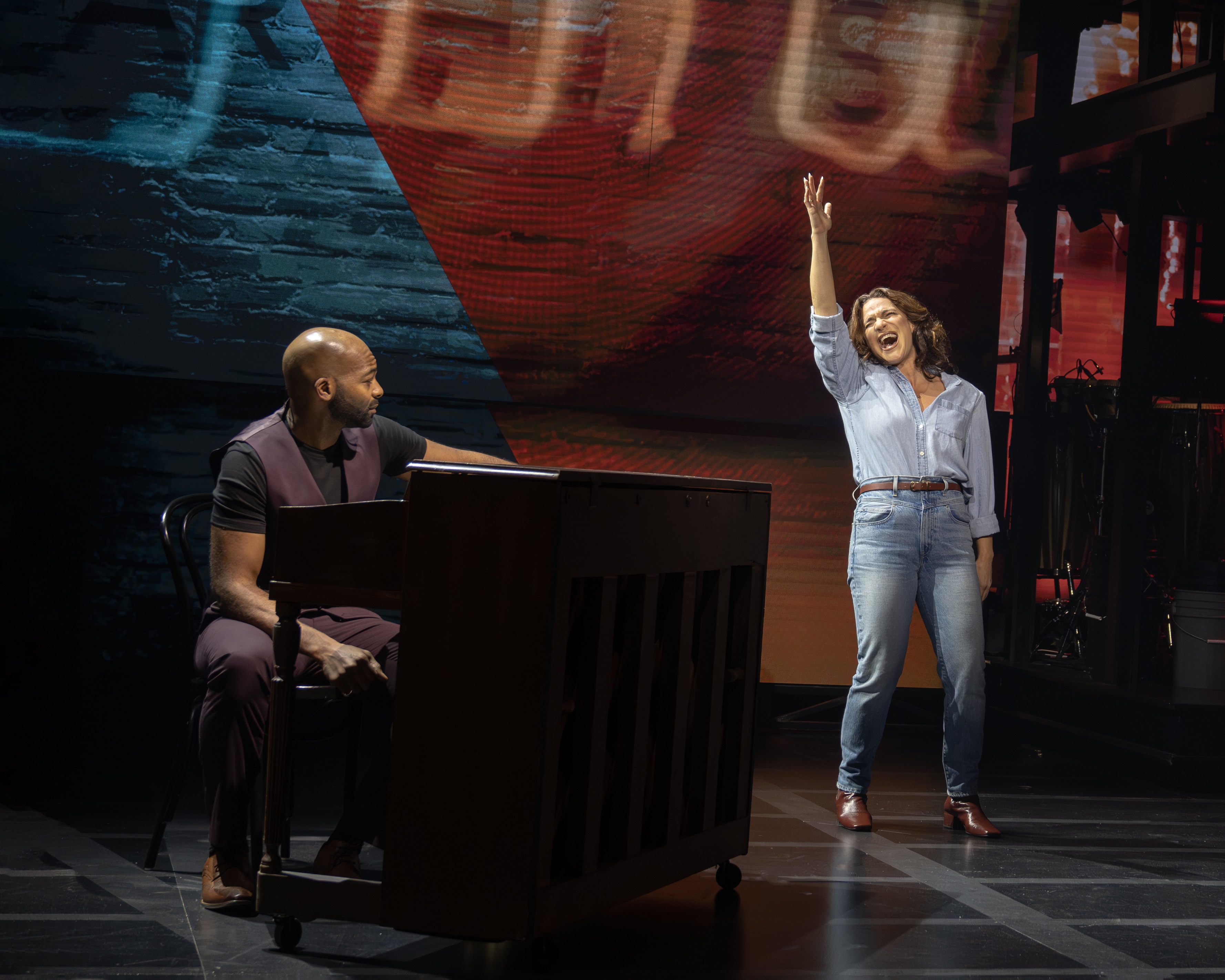
Yet, Hell’s Kitchen lives and breathes in the standard New York of the 90s, from the baggy pants and Timberland boots, courtesy of costume designer Dede Ayite (Broadway’s Topdog/Underdog), to the sound and feel of the Manhattan Plaza, the subsidized apartment complex that still stands strong in the middle of, what once was the less-family friendly midtown neighborhood of Hell’s Kitchen. Designed with energy and a vibrant life of its own by Robert Brill (Broadway’s How To Dance in Ohio), with sharp lighting by Natasha Katz (Broadway’s Some Like it Hot), exacting sound design by Gareth Owen (Broadway’s & Juliet), and a strong projection design by Peter Nigrini (Broadway’s Here Lies Love), Hell’s Kitchen unleashes artistic dreams and the complications of life at close range. As stated by Oskar Eustis, the artistic director of the Public Theater, this musical is “a story about how a girl both separates from and embraces her family, how she enters the world with fear and faith and courage, how she discovers art, herself, and herself in art.” It’s a mouthful, but as brought forth by the Public, Hell’s Kitchen succeeds and flourishes in that struggle with those contradictions and components. It’s no surprise that this musical has already announced its Broadway transfer. It seemed destined to fly fast from the East Village to Broadway, right next to its namesake, Hell’s Kitchen. Finding a home exactly where it belongs.

 front mezz junkies
[…] Arnulfo Maldonado (Broadway’s A Strange Loop), costume designer Dede Ayite (Public’s Hell’s Kitchen), lighting designer Tyler Micoleau (Broadway’s Into the Woods), and sound designer Jonathan […]
LikeLike
[…] Keys earned a Lortel Award nomination for her semi-autobiographical new musical, Hell’s Kitchen, which recently transferred to Broadway. David Adjmi’s Stereophonic – nominated for 7 Lortel […]
LikeLike
[…] Production of a MusicalBuena Vista Social ClubDead OutlawHarmonyThe Heart of Rock and RollHell’s KitchenIllinoiseLempickaThe NotebookThe OutsidersSuffsTeethWater for […]
LikeLike
[…] Once Upon a One More TimeLeslie Rodriguez Kritzer, Monty Python’s SpamalotKecia Lewis, Hell’s KitchenBebe Neuwirth, […]
LikeLike
[…] Hell’s Kitchen […]
LikeLike
[…] 🏆 Hell’s Kitchen […]
LikeLike
[…] Arnulfo Maldonado (Broadway’s A Strange Loop), costume designer Dede Ayite (Public’s Hell’s Kitchen), hair, wig, & makeup by J. Jared Janas (Broadway’s Purlie Victorious), lighting designer […]
LikeLike