The Off-Broadway Theatre Review: The New Group’s The Seven Year Disappear
By Ross
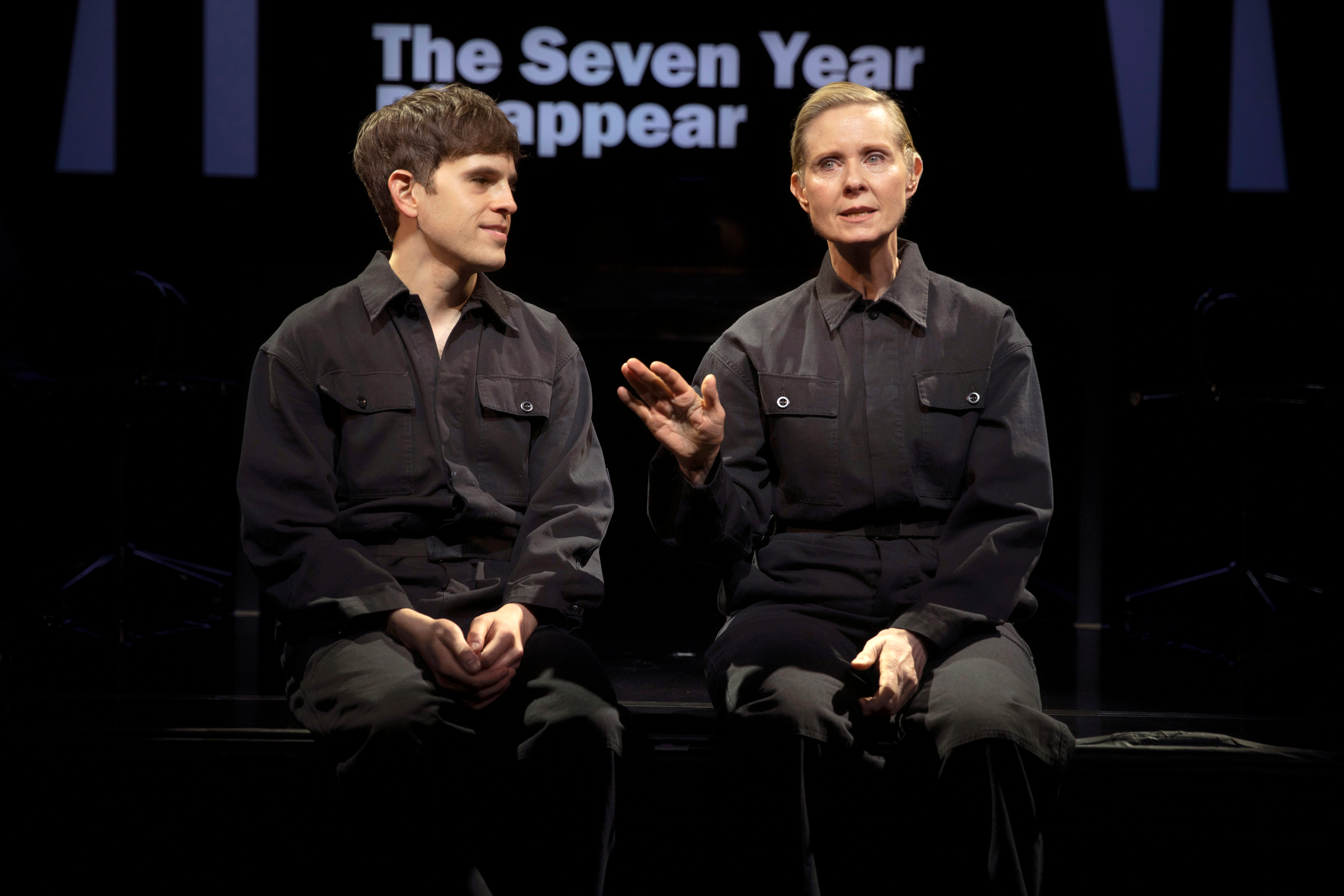
“Have I got the complicated guy for you?” And with that commentary from one friend to another, The New Group‘s fantastically layered cocktail of whisky and sadness dives in. It’s a deliciously adept remark, related somewhere in the midst of this time-jumping fascination that revels in art and protest; personal and political. Or so The Seven Year Disappear, written with forceful intent and intelligence by Jordan Seavey (Homos, or Everyone in America), tells us. The complication and attraction are stated by one of the many wild and wonderful interactions had by the son and manager of the world-famous performance artist, played to detailed length by the wonderful Cynthia Nixon (“The Gilded Age“; MTC’s The Little Foxes). He, Naphtali, dynamically portrayed by Taylor Trensch (LCT’s Camelot; Broadway’s Hello, Dolly!), is that guy. He’s part of the art, but this time, he has been left out of the loop, abandoned by his mother after vanishing into thin air, as he stood, introducing her to a roomful of donors at an event organized by him to announce a new creation that she has been commissioned for by MoMA.
But, she was gone, yet also, as this play spins forward and back most savagely, she is everywhere. As the timeline zips up and down in the background, giving titles to framed artworks of time, Naphtali tries in his own way to cope with the sudden disappearance and move forward, playing the game, but not aware of the rules. The play, directed with preciseness by Scott Elliott (TNG’s The Seagull/Woodstock, NY), is a masterclass of performance and creation, taught by the incomparable Nixon. She presents herself as both the artist and the art, taking on all the faces of those Trensch’s desperate son engages with during those years; friends, lovers, coworkers, lovers, and flirtations. Nixon digs in with all her might, taking on accents and postures that resonate and reveal both their harshness and their care. It’s clever and fascinating in its construct, especially as it bounces around, unleashing all the responses one could have with such a mother as this.
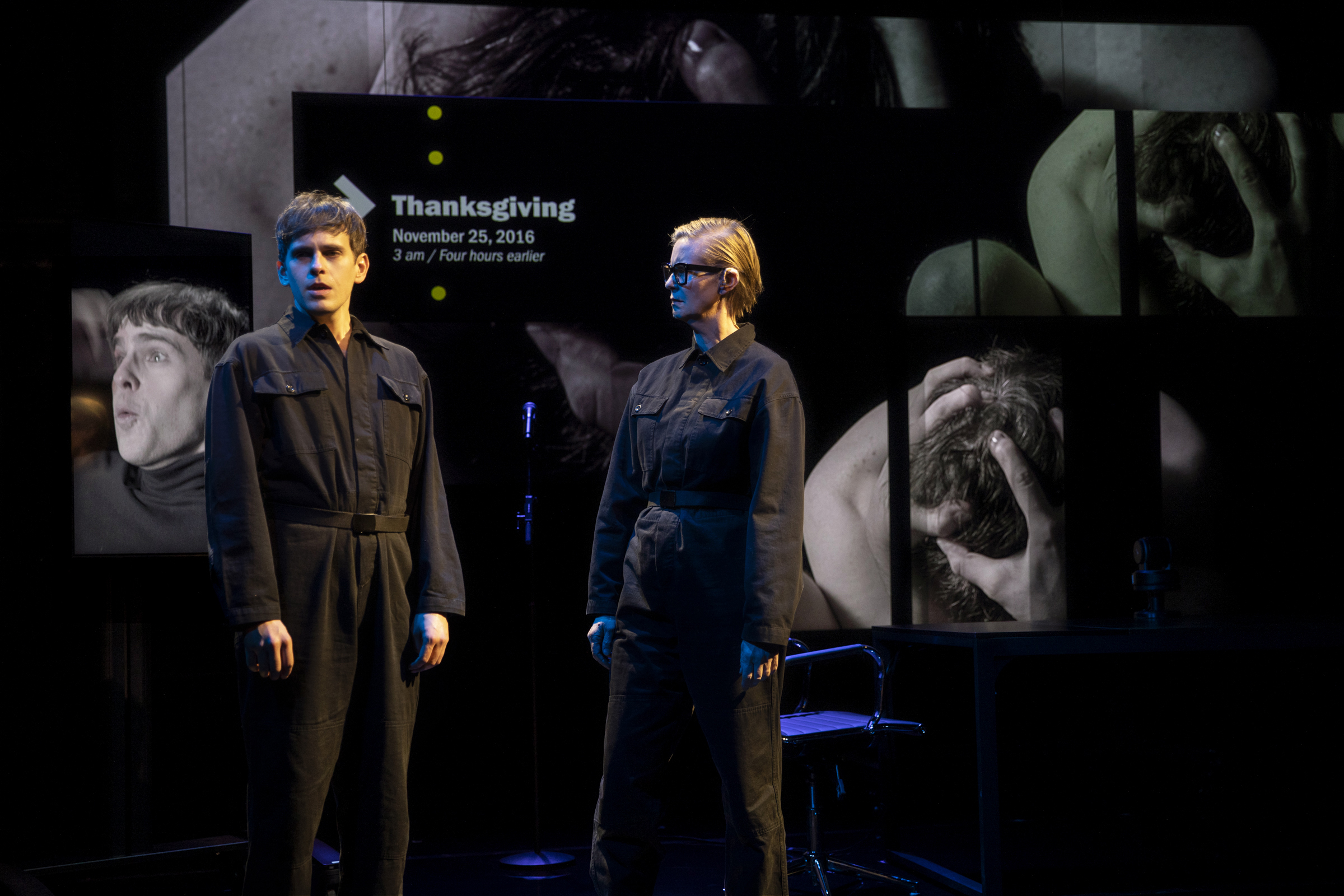
And then she returns, suddenly from her disappearance act of art, taking a seat casually, requesting cooperation and involvement, when she has given him neither. Naphtali must confront her absence and neglect, something that has been painted on him from the day he was born, like a canvas. But it all comes to a centerpiece head with a request that baffles him, yet explains so much, without her answering the questions and inquires he has for her. It’s a compelling setup, that delicately transforms itself before us on that meticulously cold-formed stage, courtesy of scenic designer Derek McLane (Broadway’s Moulin Rouge!), with simple yet effective costuming by Qween Jean (TNG’s Black No More), complex and determined lighting by Jeff Croiter (MTC’s Cost of Living), solid and electric sound by Rob Milburn & Michael Bodeen (Broadway’s Sweat), and the meticulously well scrolled out projection design by John Narun (Life Jacket’s Gorey…).
It’s all “part of the art“, we are told by The New Group‘s The Seven Year Disappear, and part of the game, and it works, this sweet lollipop of art and attachment, reconstructing its own brilliantly crafted formula as a way to wrap up the discontent and connection. It’s captivating and fascinating, watching the attachment and anger flourish and recede into the performance art that is at its core. The two relish the wonderfully created interactions, finding layers of complication and attraction to interact with inside an installation of reconciliation and art. The range of ideas unspooled is relentless and ravishing in its determined approach to a mother and a son, and their complicated dance of love and misuse. And I was enthralled.

 front mezz junkies
[…] JaneLindsay Mendez, Merrily We Roll AlongTobias Menzies, The HuntCynthia Nixon, The Seven Year DisappearEva Noblezada, The Great GatsbyKelli O’Hara, Days of Wine and RosesLeslie Odom, […]
LikeLike
[…] The Memory Of was presented as part of The Lipstick Project’s Fresh Fruit Festival at The Wild Project in the East Village. Schulte says the idea for the play was born out of a “vivid dream.” She developed the idea of keeping a dreamlike aspect to the work by frequently shifting from past to present using more than a dozen scenes of varying length each separated by a blackout. They are supposed to offer a fluidity of time but this surreal shift from past to present leaves the audience bewildered. The script doesn’t provide enough information for the audience to follow the timeline. The author provides a list of the dates in the program but it is useless once the house lights go down and everyone is sitting in the dark. The shifting storyline zig-zags, jumping ahead then jumping back, with a vague roadmap of the author’s vision often leaving the audience in the dark. [The concept was better handled in The New Group’s The Seven Year Disappear.] […]
LikeLike
[…] JaneLindsay Mendez, Merrily We Roll AlongTobias Menzies, The HuntCynthia Nixon, The Seven Year DisappearEva Noblezada, The Great GatsbyKelli O’Hara, Days of Wine and RosesLeslie Odom, […]
LikeLike
[…] TheatreFirst Preview: February 4, 2025Opening: February 25, 2025Playwright: Sam ShepardDirector: Scott ElliottCast: David Anzuelo, Kyle Beltran, Calista Flockhart, Cooper Hoffman, Jeb Kreager, Stella Marcus, […]
LikeLike
[…] play, as directed by Scott Elliott (TNG’s The Seven Year Disappear), tries its best to live and breathe in the squaller and ignorance of the Tate family home, […]
LikeLike
[…] after the naive young reporter, Skeets Miller, magnificently embodied by Taylor Trensch (TNG’s The Seven Year Disappear), writes a simple, yet sensational story that he soon regrets ever […]
LikeLike
[…] starred in Safety Not Guaranteed at BAM (Outer Critics Circle nomination) and in The Seven Year Disappear opposite Cynthia Nixon. Additional Broadway credits include Camelot, To Kill a […]
LikeLike
[…] with The Adding Machine by Elmer L. Rice with revisions by Thomas Bradshaw, directed by Scott Elliott; followed by Bocking by Preston Crowder, directed by Stevie Walker-Webb; and Jackals by Adam […]
LikeLike