
The Toronto Theatre Review: Tarragon/lemonTree’s 3 Fingers Back & Soulpepper/Obsidian’s Three Sisters
By Ross
Two plays take to the Toronto stage in two nights courtesy of a few wonderfully inventive theatre companies, delivering some deeply moving and ultimately compelling theatre that sets its eyes on Africa, to explore some pretty compelling constructs. They each demand our attention, even when the pieces feel a bit stuck in the bloody mud of Africa slogging their way through with slow heavy steps. The plays, Tarragon/lemonTree‘s 3 Fingers Back & Soulpepper/Obsidian‘s Three Sisters, both centered and placed around the continent of Africa, pull us in with force, trapping us in their war-torn violence, while unwinding in fascinatingly different ways, the complex intersections of conflict, colonialism, violence, misogyny, oppression, and regret, to name only a few of the severely important topics that unwind within these two very different but oddly connected plays, written with elegance and passion by two compellingly different playwrights.

In Donna-Michelle St. Bernard’s complex double bill, 3 Fingers Back, presented by Tarragon Theatre and lemonTree creations, the pairing feels almost more like a fully constructed undertaking in two proper pinholed parts; “Give It Up” and “The Smell of Horses“. The panoramic plays fold themselves in together like a jab and a punch, delivering its form as a powerful unit unpacking “rife with deceptive binaries.” They walk forward with a tonal poetic tension and a deep breath, both revealing themselves with clarity to be conjoined pieces of a greater, more elaborate puzzle, namely the 54ology series, with these two slices inspired by events in Angola and Guinea-Conakry, “but the realities that the soldiers in both pieces face resonate here on Turtle Island.”
St. Bernard (The First Stone) and her dialogued words don’t melt doors and bars, but they do ripple through the cell walls with force, starting with an unhooded laugh that quickly shifts to a loss of power and autonomy that has been yanked away violently. Pushing us into the cell with the others, 3 Fingers Back asks us, once we get our eyes focused and adjusted to what is in front of us, to not look away from the violence that comes from warring sides living together on a common land. The tension within these connected plays finds off-stage power in their adept construction, and as directed, somewhat casually, by Yvette Nolan (Imago’s The Flood) and Cole Alvis (Theatre Aquarius’s Salt Baby), we find ourselves forced to come face to pained face with the big questions around power, resistance, and the way we humans can and do treat one another when lines are drawn in the sand (but really in the air).
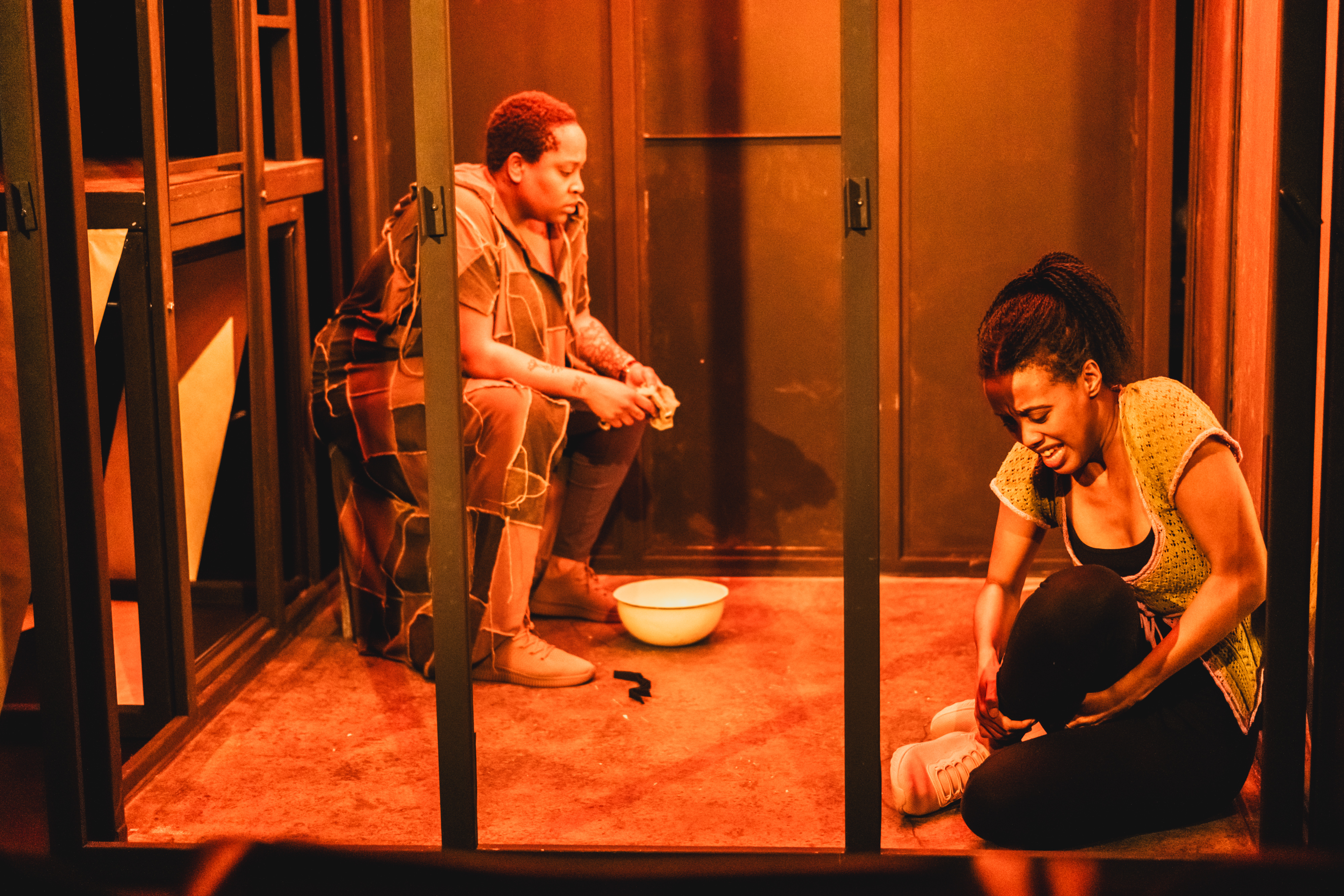
On one side of the coin, in “Give It Up“, two women are caged without any questions answered, and in that cage, set off too much on the side of Tarragon’s Extra Space, designed a bit awkwardly by César El Hayeck (CS’s Nowhen), faith and earned trust seem to unravel and tie themselves up in a combative consolidation of two strong but very different spirits, both trying to survive and understand. The movements of caged thought and defensiveness are played out with force by Uche Ama (Cahoots Theatre’s Sweeter) as the seemingly older and more experienced Yol, and Megan Legesse (Buddies/GCTC’s The First Stone) as the younger, more uncentered Ada. They engage in a friend/foe dynamic that is both compelling and tense, even when all we want them to do is find comfort and trust in one another.
Our desire for that is humanistic, but maybe not wise inside the Cariguna Outpost where the two try to contemplate the day-to-day harrowing existence at the hands of a few, almost faceless, soldiers who are doing unseen and unknowing damage to one, but not both, of these two women warriors. Ama’s Yol is repeatedly taken away, time after time, by a young warrior soldier (Tsholo Khalema) who radiates a complex underlying that lingers in the stale air around him. We can’t quite figure him out, nor does it seem he can either. Yet, inside those complex dynamics, the play feels timeless, albeit current, and filled with unseen violence against the ‘other’, more specifically, the females who are rebelling against the unknown domination of the male soldiers in power. This transaction could be almost anywhere, but this moment in time for these two women is more specific. It is filled to overflowing with complex engagement, as they fight a fractured battle with each other that is defensive and filled with longing, compassion, fear, and pain all jumbled together into a mix that is both raw and heartbreaking.

The energy and fantastical elements of mental escapism and camaraderie step forward compelling, thanks to some strong lighting gestures by Michelle Ramsay (Factory’s The Waltz), detailed costuming by Des’ree Gray (Coal Mine’s Appropriate), and an exacting sound design by composer Janice Jo Lee (TPM’s Suitcase). Even as the play meanders far too long than what is really needed, we float with it, in and out of our attachment to these two, as the repetition fails to keep us completely tuned in from beginning to end. It’s possible that a tighter formulation or a deepening of understanding could have created a stronger sense of anxious attachment to these two scared women, hitting and bruising our senses with their understandable fear and suspiciousness, rather than being left with the gradual numbing we start to experience alongside Yol’s ever-increasing battle scars being presented to us and her cellmate.
The same could be said of the second play, which is entwined and layered on top of the first. It’s all clean to them, we are told, as we are led through the same time frame and locale, but from a differing perspective and angle, with shadows of what we already bore witness to being played out behind scrims. We are presented with the previously unseen vantage point; the male-centric warring view on the other side of those bars, as we watch them grapple with ideas of rank, power, and control. The three soldiers that exist up above on a staging platform (at a level I wish the cell was also on for the purpose of cleaner sight lines) that sometimes invigorate the action, but also get in their rotating way, play an interactive game of soldiering that feels wisely inauthentically scripted as if they are being fed their soldier lines from some obscure misogynistic video game about domination and violence.

It’s a strong edition and formulation, watching lines feed themselves down the food chain almost comically. It makes us realize that these boys are just playing the roles of fearless warring soldiers, while never really understanding why they are there, what kind of person they truly are, and what kind of person they would like to ultimately be. Each soldier attempts to embrace their ranking with a different energy, stance, and level of power, yet struggling within their own cells for some kind of validation and advancement without really connecting to it on any level externally. It’s very macho and inhumane, what we take in from these three, as we watch them unearth animalistic mentalities and actions to extract information from the caged women who they have in their possession.
The writing is fascinating, but unyielding, unpacking formulations but not really giving us enough to find connection within these souls, especially the top-ranked Adam, played with a riveting sense of abstract destiny by a very game Christopher Bautista (Grand Theatre’s Fences), and his trusted/not trusted second in command, Beech, played with determination by a forceful Indrit Kasapi (MSM [Men Seeking Men]; Mutual Friends Co-op’s Other People). Their paralleling speaks volumes about their internal dialogue and mentoring, but they also are both given some confusing masturbatory dance moments that don’t really add up to much beyond the already obvious machismo posing and conflictual non-self-awareness.

At least an hour or so, in my humble opinion, could be edited out, but what does make the two plays worth the 3+ hour double bill commitment lies most fascinatingly in the unraveling near the end, brought forth by the more compelling, yet confusingly embodied creation of the young and lowest ranking soldier, Saad, played compassionately (and a bit awkwardly) by Tsholo Khalema (TPM/New Harlem’s Cake). The twisting of the pillars of power on that stage, an act that initially felt overly symbolic in “Give It Up“, starts to find its central pin and main function. As the ping-pong tables are turned and the ultimate function is released from its trappings, the writing and the plays finally pull it all together, wrapping it up and finalizing a production that has a lot to say, but has also been made wobbly by some long-winded conversing and awkward staging. 3 Fingers Back steps itself up, finally, in the end, becoming a fully formed thesis on power dynamics between captors and their captives, and those who bear witness to the pain and torture we can somehow enact on one another all in the name of orders and commands.
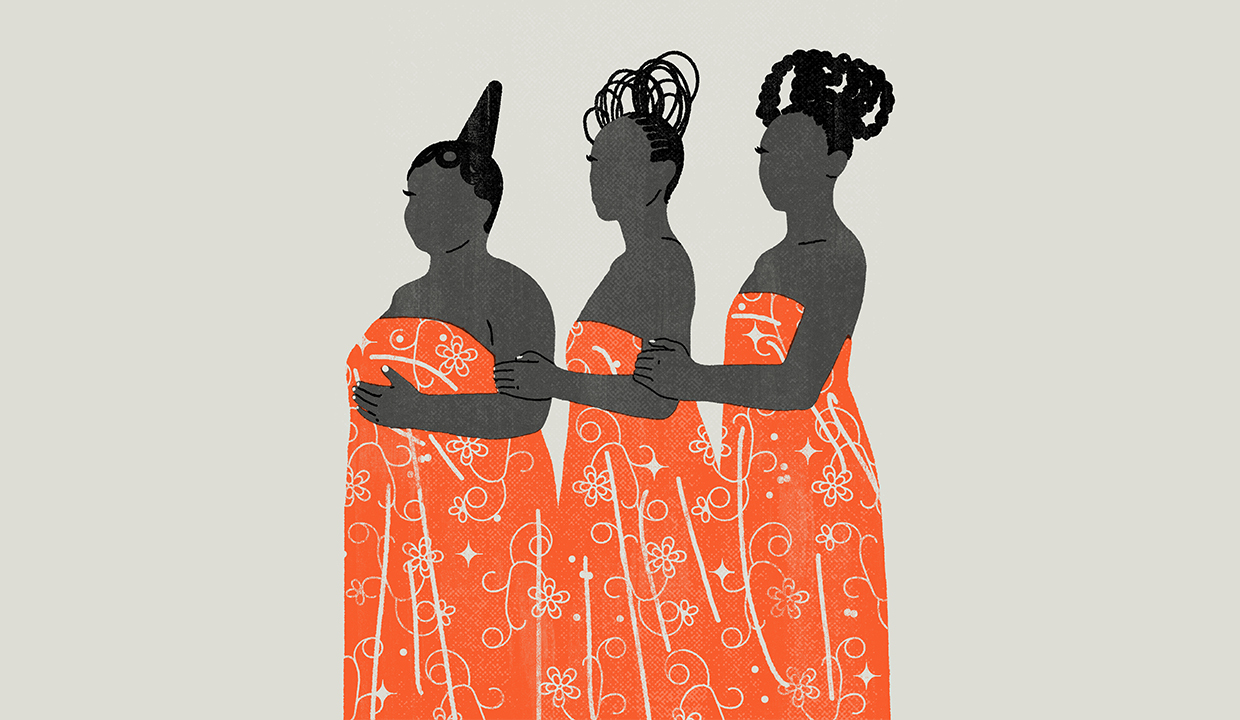
Over in the distillery district of Toronto, the music of a different African country leads us into a similarly complex undertaking. Soulpepper and Obsidian Theatre Company have delivered a beautifully rendered production of Inua Ellams’ Three Sisters, a personally inspired reformulation of Chekov’s classic story to wrap our heads around colonialism and war. Stitched elegantly together from her own family’s immigration story, Ellams (The Half-God of Rainfall) sets out to examine the effects of neo-colonialism and the Nigerian Civil War, that is, as he states, “part of British History, and by extension, part of Canadian history.“
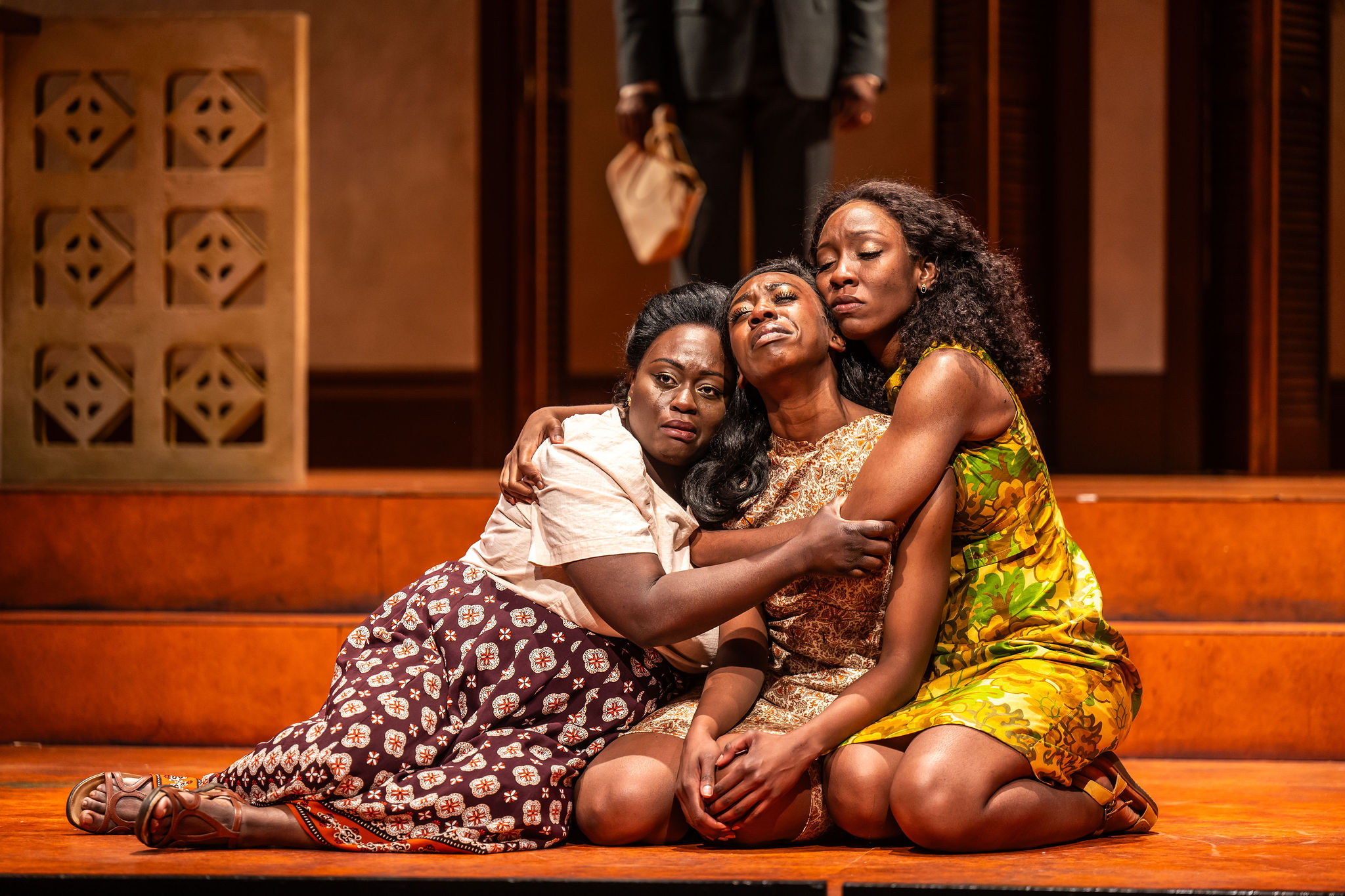
Melting skillfully together two exacting worlds; Chekhov’s structural landscape with Nigerian heritage and culture, with a strong level of confidence, Three Sisters follows closely the structural walls of the classic play but expands on ideas put forth concerning the unnerving aspects of civil war and the manipulating effects of colonialism in Africa (and beyond). The historical context of Ellams’ engaging Three Sisters takes us to the year 1967 in Owerri, Nigeria, where the unfolding dynamics take place over the next three years of the Nigerian Civil War. In their thoughtful formulation and solid recreation, the heart of the piece beats strong and true, especially in the performances of the three women at the center of this play; Akosua Amo-Adem (Stratford’s Les Belles Soeurs) as the eldest sister, Lolo; Virgilia Griffith (Soulpepper’s Queen Goneril; King Lear) as the middle sister Nne Chukwu, and Makambe K. Simamba (Buddies’ The First Stone) as the youngest, Udo. Their dynamic attachment holds this meandering piece together as it winds itself around the longing and frustration that lives inside a typical Chekhovian play, but adding elements of status, colonial culture, and political manipulations that lead to widespread massacres and an aftermath where there was “no victor, no vanquished.”

The play adeptly chronicles the survival of these three Igbo sisters through the Nigeria-Biafra war, telling the story of how their lives, filled with regret and longing, are transformed and held captive, with their dreams displaced and their hopes thwarted, much like all those thousands of Igbos who were killed and fled to the southern and eastern regions of the country at war within its own borders, fueled by greed from England and beyond. And similar to those two abducted women in 3 Fingers Back. The framework is solidly distinct, with those who colonized standing outside, watching and waiting for the dust to settle, yet knowing full well that they would control the financials (and oil) regardless of who is able to come out as the so-called victorious.
As directed with purpose and finesse by Mumbi Tindyebwa Otu (Tarragon’s Post-Democracy), this version of Chekhov’s Three Sisters moves itself forward slowly and with a sense of dignified purpose, laying the parallel plot points on this vantage point with precision. It’s almost too clever for its own good, elongating the tale somewhat with too much honor and prestige. It feels, just like the other production reviewed here, that a tightening of the reins and a stronger focus on the key points would have created a more compelling and engaging journey through war, but as it stands, this Three Sisters, on a strongly designed set by Joanna Yu (Factory’s acts of faith) with clear straightforward lighting by Andre du Toit (Factory’s Here Lies Henry) and detailed sound by John Gzowski (Buddies/That Theatre Company’s Angels in America), bows regally to the compelling themes of both Chekhov and the dismantling of the colonial narrative that is etched, most inaccurately, in the history books. A formulation that is most slyly embedded in the curriculum of the town’s school system, forever frustrating and angering the eldest sister who has to teach it against her wishes and desire for truth.

With a strong cast that holds the piece together, even when it feels like it is losing its way through the blood-red landscape, this co-production from Soulpepper and Obsidian Theatre Company relishes itself in the details, particularly in the developing formulation of the disturbingly funny secondary character, Abosede, played to bodily perfection by Oyin Oladejo (CS/Obsidian/Necessary Angel’s Is God Is) in wonderfully designed costumes by Ming Wong (Crow’s The Master Plan), and her interactions with the elderly Nma, played lovingly by Ordena Stephens-Thompson (Grand’s Fences). The others; Daren A. Herbert (Soulpepper’s Jesus Hopped the ‘A’ Train) as Ikemba; Sterling Jarvis (Mirvish’s The Lion King) as Eze; JD Leslie (Factory’s Vierge) as Oyiridiya; Tawiah M’Carthy (Canadian Stage’s Topdog/Underdog; director) as Onyinyechukwu; Ngabo Nabea (Factory’s Twisted) as Nmeri Ora; Tony Ofori (Soulpepper’s Pipeline) as Abosede; and Amaka Umeh (Stratford’s Hamlet) as Igwe; find moments of engagement and emotional connection throughout, even in the muddy terrain, giving the play a deep sense of family and understanding.
“You will be mothers of the nation,” they are told, and these Three Sisters dutifully carry the flag of regret and longing much like their Russian counterparts. They also engage in service in ways those Chekhovian sisters never did. War is not in the vast background as it is here in Ellams’ well-tuned adaptation, with bombings being the acts of destruction that bring to a boiling point the pathos of the sisters’ loneliness and desperation. They talk of Lagos longingly, like those other adapted sisters, written spectacularly by playwright Halley Feiffer, who talk of Moscow Moscow Moscow Moscow Moscow Moscow to the point of abstractionism, where hopes, aspirations, and dreams go up in flames and gunshot wounds. This Three Sisters play is dutiful to the text, expanding the classic form with its clever and wise observations centered on power, colonialization, and the manipulations of foreign bodies in civil wars in Africa. It held me, even when I was fading from its slow march forward, delivering an adaptation worthy of its fine form and structure.

The borderline of War is made of air, not of the earth, and it is controlled and played with by forces outside of those who actually feel its pain and the soldiers who inflict it. The heaviness and disturbances that these two productions unpack make for two dynamic nights at the theatre, even with both of them being a bit overblown in their theatrical interactions and dialogue. The key elements within the historical timeline and context of these two nations of Africa unfurl the ramifications of replacing one flag for another, and the brutality that may follow. So hold your sisters close, you Saras of dissension, and find your way to Tarragon/lemonTree‘s double bill of 3 Fingers Back and Soulpepper/Obsidian‘s adaptation of Three Sisters. Maybe spread the viewing of them out a bit more than I did, as both run around 3 hours each. I guess 3 is the number to embrace here, although 3 stars sounds like a too-low rating, unless it is 3 out of 4, and not out of 5.
 front mezz junkies
[…] Crow’s TheatreThe Master Plan, Crow’s TheatreSizwe Banzi is Dead, Soulpepper Theatre CompanyThree Sisters, Soulpepper Theatre Company and Obsidian Theatre […]
LikeLike
[…] the Studio 180 Theatre production of Four Minutes, Twelve Seconds, and Oyin Oladejo for her turn in Three Sisters, co-produced by Soulpepper and Obsidian Theatre […]
LikeLike
[…] Theatre: Three Sisters, Soulpepper Theatre Company and Obsidian Theatre […]
LikeLike
[…] the look the neighbor, Eunice, played to perfection by Ordena Stephens-Thompson (Soulpepper’s Three Sisters), gives as she leaves Blanche to her requested privacy and her secret consumption of Stan’s […]
LikeLike
[…] The Inheritance), Kwaku Okyere (CS’s Choir Boy), and Oyin Oladejo (Soulpepper/Obsidian’s Three Sisters), never disappoints, drawing out authentic, yet stereotypical cardboard-cutouts of characters that […]
LikeLike
[…] Kill a Mockingbird) with determined lighting by André du Toit (Soulpepper’s Three Sisters) and a solid sound design by Lyon Smith (Factory’s The Waltz), that unpacks the random voices […]
LikeLike
[…] Otu (Obsidian/CanStage/NecAngel’s Is God Is), who helmed the Dora Award-winning Three Sisters last year at Soulpepper. Following four artists in San Francisco wrestling with […]
LikeLike
[…] creation, Chukuemeka, played with michevious charm by Tawiah M’Carthy (Soulpepper/Obsidian’s Three Sisters). With this guide, Mark’s off-balanced need to feed his helplessness swoops in, drawing our […]
LikeLike
[…] Andrew Reid (Stratford’s La Cage aux Folles) as Thought 4; and Amaka Umeh (Soulpepper’s Three Sisters) as Thought 2; with each giving us a tightly nuanced slice of their particular corner of the […]
LikeLike
[…] gowns, and jackets, heroically designed by the astounding Joanna Yu (Soulpepper/Obsidian’s Three Sisters) as they unknowingly seek to learn about the repercussions of hasty judgments that come from […]
LikeLike
[…] delightfully portrayed by the very game and able Makambe K. Simamba (Soulpepper/Obsidian’s Three Sisters). Magnificently portrayed, the two have a bond that runs as deep as if they were loving sisters, […]
LikeLike
[…] (Soulpepper’s Jesus Hopped the ‘A’ Train) as Timothy, Tony Ofori (Soulpepper/Obsidian’s Three Sisters) as Lyle, danjelani ellis (Buddies’s speaking of sneaking) as Vincy, and Jamie Robinson […]
LikeLike
[…] the Witch, glittering and gloriously determined like a snow squall. Amaka Umeh (Soulpepper’s Three Sisters) is spectacular, sharp, charismatic, and fully in command of the room. Where Shaw’s production […]
LikeLike
[…] Hopped the ‘A’ Train) and Ordena Stephens-Thompson (Soulpepper/Obsidian’s Three Sisters), recount the horror that unfolded in their neighbourhood one morning, while simultaneously […]
LikeLike
[…] centre, portrayed with a calm and spiritual gravity by Sterling Jarvis (Soulpepper’s Three Sisters). If Clyde governs through fear, Montrellous offers something closer to poetry and belief. His […]
LikeLike