A Frontezzjunkies Interview with the Directors, Playwright, and one of the Actors of Pencil Kit Production’s “White Muscle Daddy” at Buddies in Bad Times Theatre
By Ross
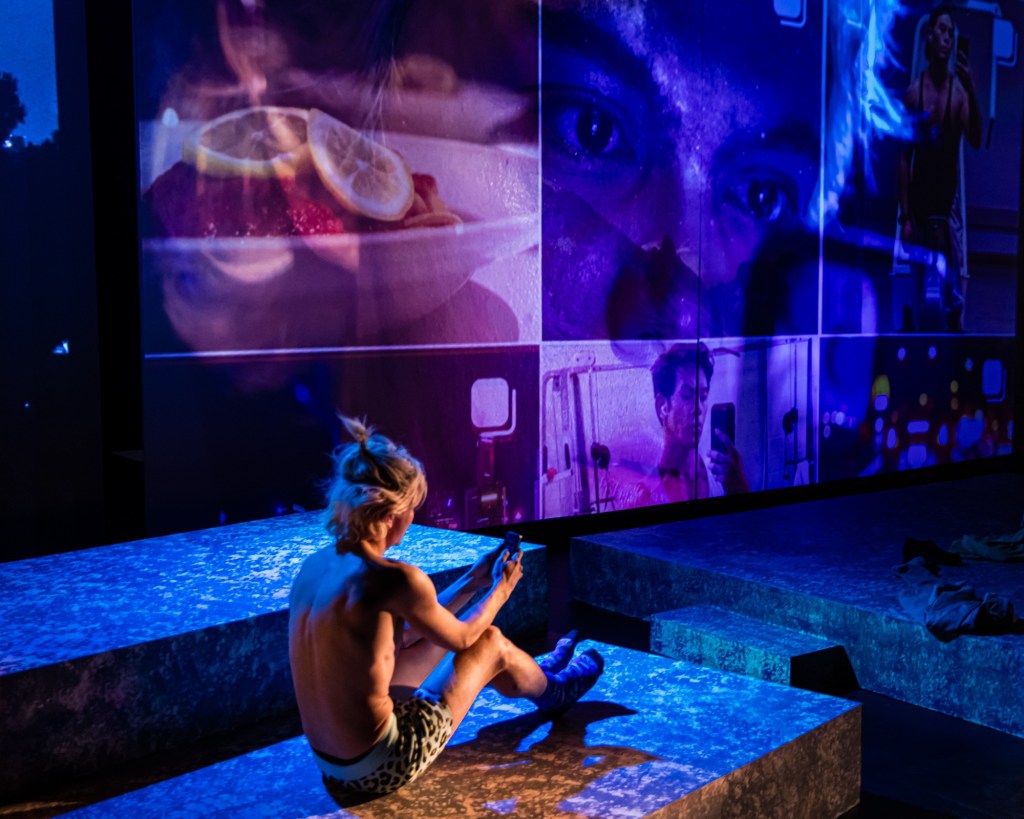
The provocative title of Pencil Kit Production’s new play opening up at and in conjunction with Buddies in Bad Times Theatre, has an energy all to itself, daring us to look in at our own reaction and response. It definitely elicits a response, on many levels, and draws on our curiosity through sexual tension. This gritty new play by Raf Antonio (Rope Running Out, Salvador: A Latin-Canadian Fantasia) is a horror/thriller piece that blends theatre and film–using projection art, live camera feed, and shadow play to create the compelling and enticing White Muscle Daddy. The new play will attempt to explore the pervasive effects of white supremacy on the politics of desire in queer communities, an examination that is very much needed and whose time has finally come. With a QTBIPOC-led team, White Muscle Daddy will strive to weave a chilling yet campy tale of lust, power, and predators, and I can not wait to see it.
“Horror can be a really malleable genre and also feels rarely performed in live theatre,” says playwright and co-director Raf Antonio. “We’ve taken its tropes and mashed them into a hybrid of cinema and theatre. Our goal is to subvert expectations of the genre itself, of what theatre can be, and of what film can be, creating an experience that will leave audiences chuckling, a little spooked, a little provoked, and maybe even a little bit horny.”
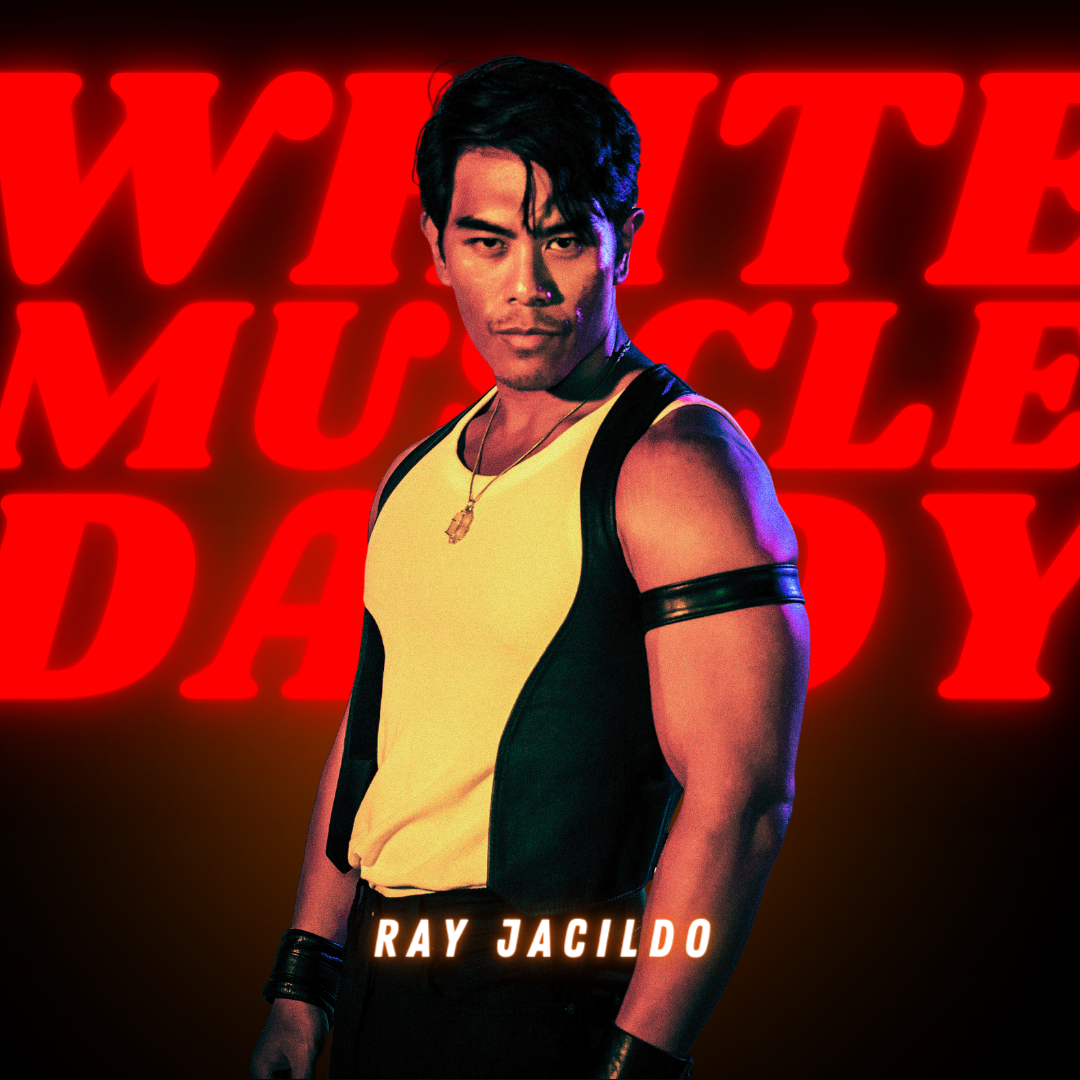
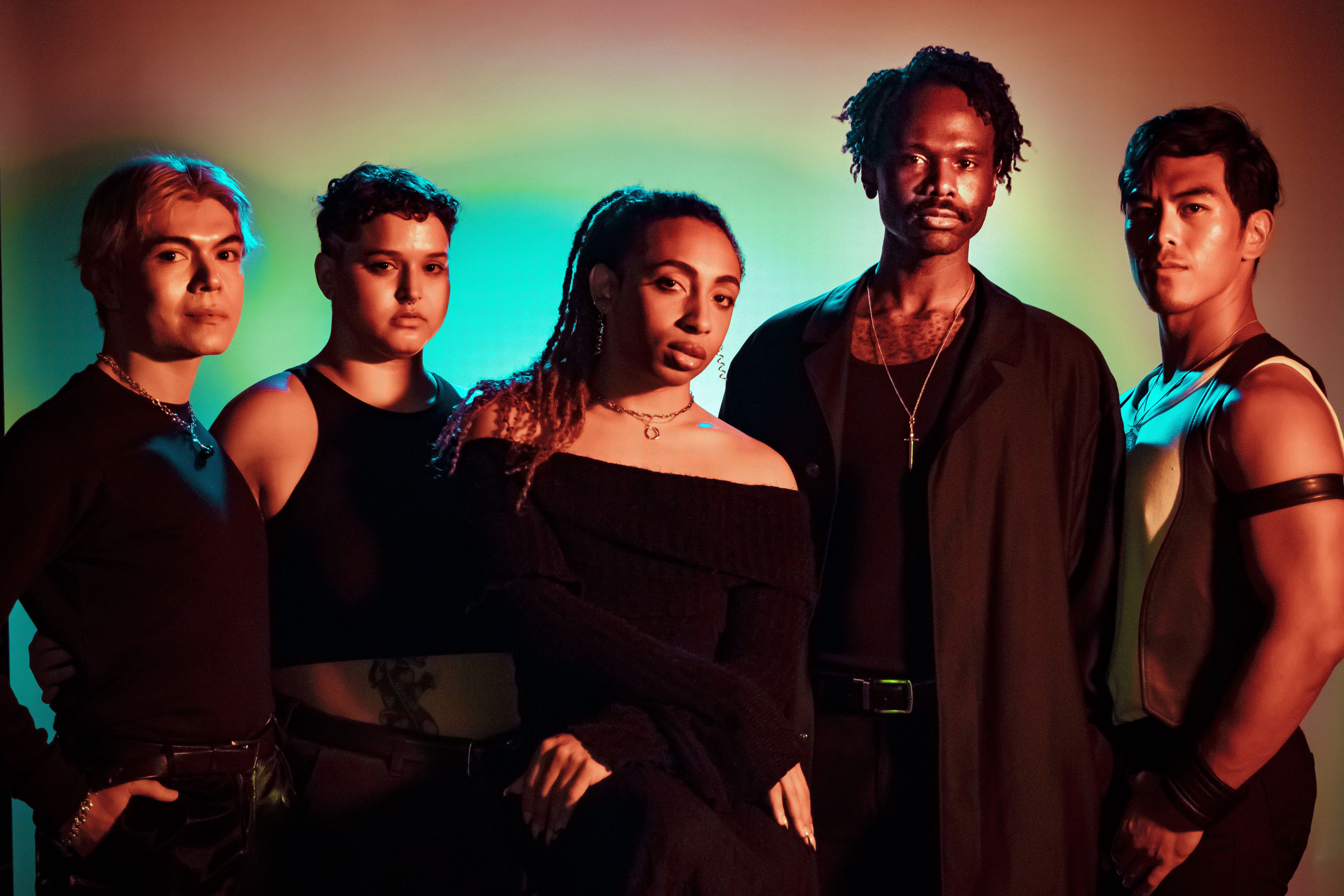
Developed through the Buddies Residency Program, the psycho-sexual thriller White Muscle Daddy is the final mainstage production in the company’s historic 45th anniversary season. Co-directed by Antonio and Tricia Hagoriles (Lola’s Wake [film], Boiband the Boyband), White Muscle Daddy is brought to life by an ensemble cast featuring Ray Jacildo, Jaime Lujan, Frankie Bayley, Chel Carmichael, and Shaquille Pottinger.
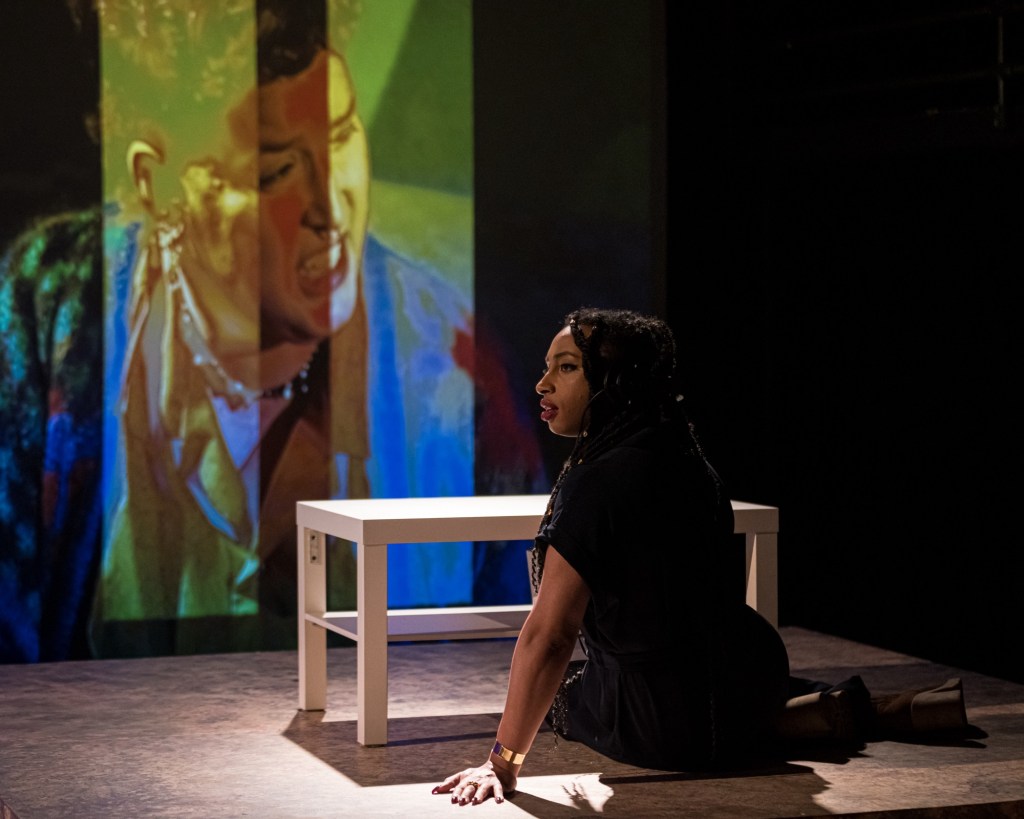
This cinematic-theatre piece features a blend of live and pre-recorded footage, working with director of photography Khanh Tudo (Insomniac Film Festival) and projection designer Nicole Eun-Ju Bell (Ga Ting 家庭). The design team also features set designer Echo Zhou (Between a Wok and a Hot Pot, The Chinese Lady, The Year of the Cello), costume designer Cat Calica (stylist for Buddies’ 2022-23 season promo), lighting design Alia Stephen, and frequent Pearle Harbour-collaborator Stella Conway on Sound Design (Agit-Pop!)
Frontmezzjunkies was lucky to have the opportunity to (virtually) sit down (via email) with co-director Tricia Hagoriles, co-director/playwright Raf Antonio, and one of the actors, Ray Jacildo from Buddies in Bad Times/Pencil Kit Production of White Muscle Daddy, to discuss the production in greater detail. Here’s what we explored:
Q: Director Tricia Hagoriles, when thinking about directing this play for Buddies in Bad Times Theatre, what was the process like for you? And what enticed you to the project?
Tricia Hagoriles (co-director): Reading an earlier draft, what initially enticed me to White Muscle Daddy was the visceral imagery that Raf’s writing evoked. That version hadn’t evolved into the Film/Theatre Hybrid that it is now, but it certainly felt cinematic. My work as a filmmaker lives in the realms of genre and surrealism and so the idea of tackling that in theatre was very appealing.
For this version, where it firmly became a film-theatre hybrid, the process for me started with collaborating with Raf; getting on the same page as them, discovering the story they were trying to tell, and figuring out how best to use my voice and experience to exploit both mediums.
Q: Playwright and director Raf Antonio, the title of this play is very provocative. What does it all mean to you and why is it important to bring a horror/thriller to the stage?
Raf Antonio (co-director/playwright): Our show most pointedly critiques gay cis men, the culture that surrounds them, and how that culture affects the wider community, so the title represents some of the qualities that would most likely be attractive to the majority: whiteness, masculinity, and patriarchy. It’s representative of societal structures which have been and continue to be really damaging, not just to the queer community, but to everyone, including those who benefit. A fun layer: the initialism “WMD” is used as shorthand for “weapon of mass destruction” which I think applies really well to these structures and the damage they can cause. As for horror/thriller… what’s exciting is that it’s not very commonly done on stage. It’s one of my favourite genres because it can metaphorically reflect the worst parts of our society and let us work through the relevant emotions in a space that we can temporarily exist within and then, in theory, leave behind. Of course, everyone has different tolerances but there are also many different subgenres/eras to horror and while WMD has spooky, unsettling moments, there’s also a lot of camp and humour mixed in.
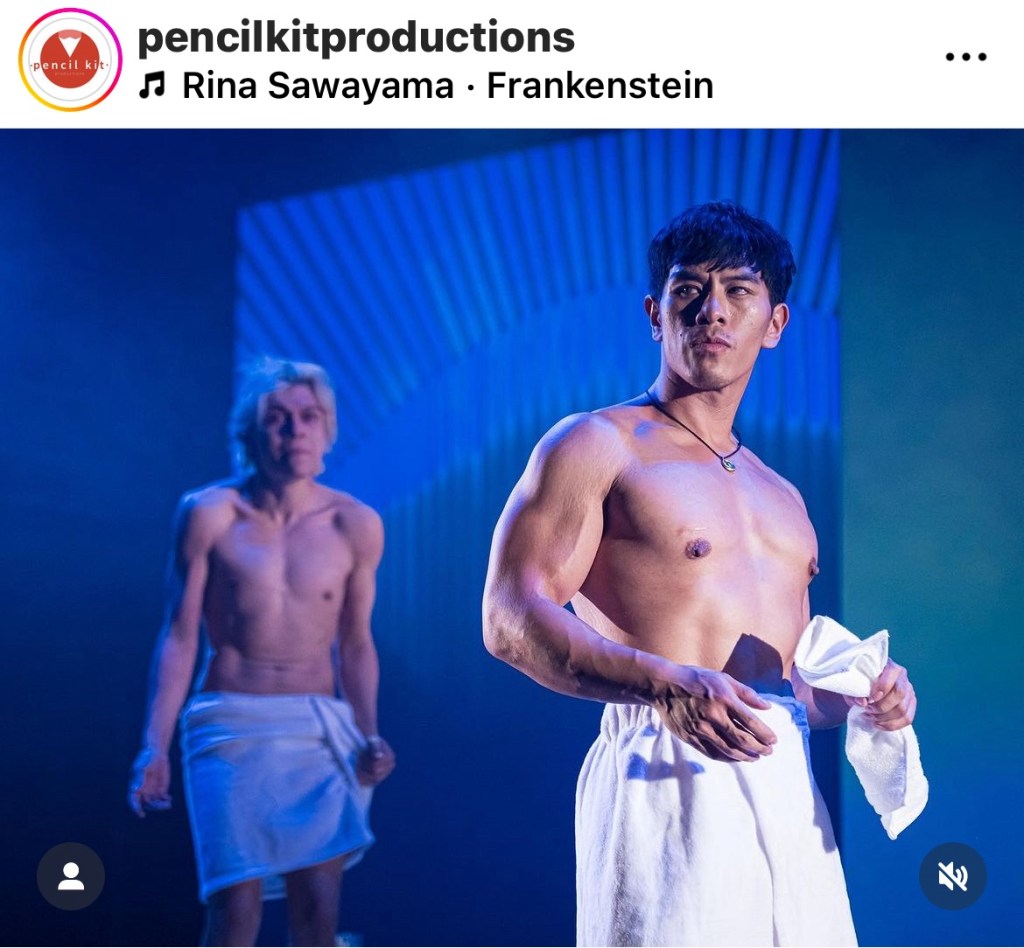
Q: As one of the actors in White Muscle Daddy, Ray Jacildo, who plays the part of Eugene – the anti-hero fitness influencer who in a way is the catalyst, tell us about your role in WMD, and what it was like for you to unpack a play that critiques gay cis men? What has been your experience with this? And how does that framework feel to you? Your reaction to the material?
Ray Jacildo (actor): To Jeremy, Eugene is seen as the apex, the A-gay, the idolized version of what he is attracted to, or wants to become. My experience with the play is very similar to how we walk through our community today. Whiteness and fitness are still in some parts the ‘ideal’. But seeing it from the other side, our community also perpetuates this ideal. In our media, in our friends, in our unconscious attraction to the power structures that have been put in place in our society. I’ve realized it is not enough to just put a lens on those who get put on a pedestal, but also on those who put them there. At the end of the day, it is very rare for me to see roles putting an Asian body at the forefront of the ideal. I was ecstatic to be able to represent that complicated intersection of our community.
Q: Tricia, tell me a bit about how you unpacked this play? In your vision and in your imagination? And the mashing together of cinema and theatre?
Tricia: I first unpacked the play by reflecting on my own experiences of desire, being desired, and violence as a Filipinx person that is read as a woman in the varying queer communities. Then I considered whether I could lend anything to the script.
Approaching the play in a cinematic language played a huge role in that.
Once the creative ideation was underway, we quickly learned how technical the show was going to be. Working with our cast began as a more traditional theatrical process in rehearsal, but as soon as we introduced cameras into the process, not only would our actors have to adjust their performances, but the entire team had to change how they were used to working.
Q: So Ray, what was that process like for you, an actor in this creative adventure?
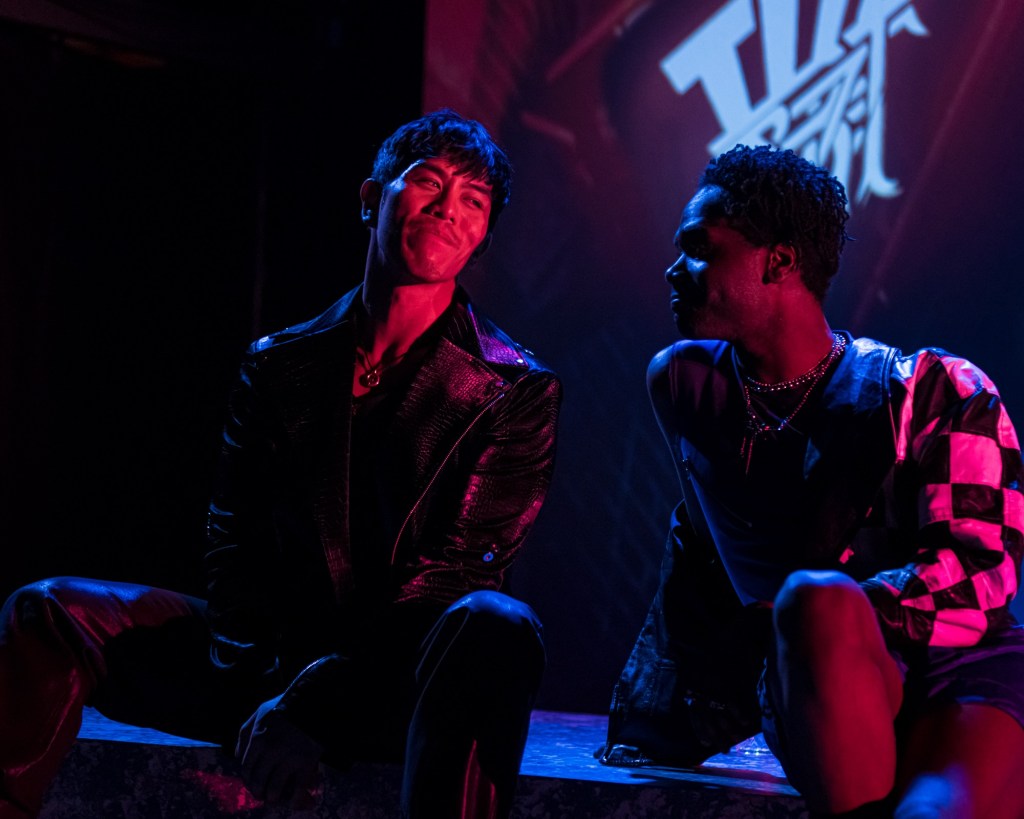
Ray: It started off as a typical rehearsal process, but as we delved more into the play it became a lot more complicated. Both technically and personally. To act for a theatre and, at the same time, for a camera lens takes some getting used to! And our awesome camera ops, Khanh and Kat became our partners, and our audience’s view into that. In addition, as my physical look started to change for the role, I started seeing how idolatry of the physical body is still very much a part of our community. It’s a combination of flattering and dangerous, because it can reduce a fully fleshed person to just a sexual object.
Q: The idea of “the pervasive effects of white supremacy on the politics of desire in queer communities” is a huge topic for discussion and understanding. How can this play be a part of that much-needed conversation?
Raf: We feel pretty strongly that no piece of art can ever provide definitive answers to such big questions or be everything to every person so our hope is that the show will function as a conversation starter or the beginning of a reflection on how each individual experiences those effects. Whether folks feel we achieved what we hoped to achieve is much more interesting as an after-show debate amongst friends over drinks (maybe even at the Buddies bar if it’s open!) than as a neatly laid out explainer from the artists.
Q: Very true, and Ray, do you have anything to add?
Ray: My job is to portray my character to the best of my abilities. To help raise those questions. Eugene is in part trying to rise above that white supremacy, but ultimately is still very much inside of it and continually damaged by it.
Q: Tricia, tell me about the team that you have compiled? The actors you have gathered, the creative team you have brought in, and what was it like to develop this project?
Tricia: Our team is made up of some young, bright, talented designers that come from strictly theatre, strictly film, and a few that have a foot in both.
Alia Stephen, Nicole Eunju Bell, Echo Zhou and Sabrina Pye, Taylor Zalik-Young, respectively make up our lighting, projection, production design, and stage management departments.
On our film side: Khanh Tudo, Katerina Zoumboulakis, and Hayden Salter make up our camera department.
Our pre-production chats were very conceptual and we felt confident that we could pull off these ideas, but as soon as production started, we had to break and create our own processes.
Q: What is the process of taking and combining those features and spaces? And the act of bringing them all to the stage? How would you like us to take it in?
Raf: It was a fun layering process. Our first week was with the actors only. We did table work and blocking. Then the following week we brought in the camera operators and folded in their blocking. That continued for week three. On the last day of week three, we moved to Buddies in Bad Times where our very first day in the space was all filming for pre-recorded sections of the show. Then we continued on into a not-so-traditional cue to cue. It’s been really collaborative, exciting, and a bit chaotic to bring it all together. We do hope the audience will feel more like they’re in a movie theatre than a traditional theatre space. Meaning mostly that you can sneak out to use the washroom at any point and come right back in. Other than that there’s no prescribed way to view the show. Well, except for phones. Those should be turned off or silenced. Oh, and no photography whatsoever, please :).
Q: How difficult has it been to navigate the play onto the stage? The best moments? The largest challenge?
Raf: There are the tech issues that we expected, but what we didn’t completely anticipate was that in addition to the live broadcasting, we’d also be live editing. I always thought light cues were the theatre version of that, but it’s completely different when you mix in pre-filmed elements and cut to live moments. Which for thematic and budget reasons, we had to do. Those were the most challenging and best moments for me.
Q: What about you, Ray, as one of the actors?
Ray: The most difficult was the repetition. Some scenes have Eugene as the object of desire and as a result: leered and ogled at. Some days it was difficult to separate his objectified body from my own. But our intimacy coordinator Burcu Emeç was a huge part of how I approached personal self-care. The best was working with so many creatives of colour! Especially our incredible costume designer Cat Calica. We found subtle ways to weave our Filipino culture into Eugene’s costuming and that was a huge part in grounding me.
Q: What is the power or main construct you want us all to understand in this play, to walk away with?
Ray: Haha, I’ll defer to Raf and Tricia for that.
Raf: We’d actually rather not explicitly underline any one thematic takeaway for the audience to come prepared with. That can too easily sway the viewing experience in one direction or another and there’s a deliberate ambiguity to many of the characters’ actions and many of the images we’ve chosen to stage. This isn’t a show that exists within a tidy morality and so it’s much more exciting to turn that question back on the audience: what was the main construct you, dear viewer, walked away with? How did it make you feel? Did you see yourself in these often messy characters and if so, what does that ask you to consider? Hope to see you there!
For tickets and more information: visit buddiesinbadtimes.com/show/white-muscle-daddy/
 front mezz junkies
[…] way. Created by Rene and embodied by the compelling Augusto Bitter (Buddies in Bad Times’ White Muscle Daddy), the secret is thrust forward after hiding in the background, already heard, but not yet seen. He […]
LikeLike
[…] inspection. As presented and performed by the engaging charmer that is Jaime Lujan (Buddies’ White Muscle Daddy), Reina walks big and wild into the hypnotic space, dressed in a flowing white costume reminiscent […]
LikeLike