The Toronto Theatre Review: Coal Mine Theatre’s Hedda Gabler
By Ross
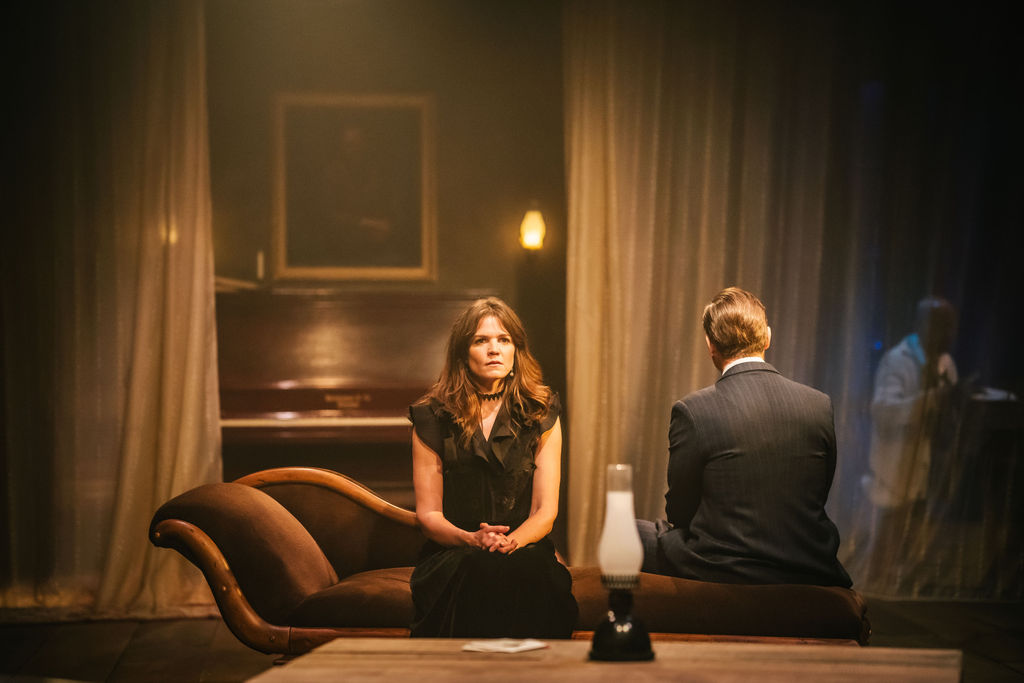
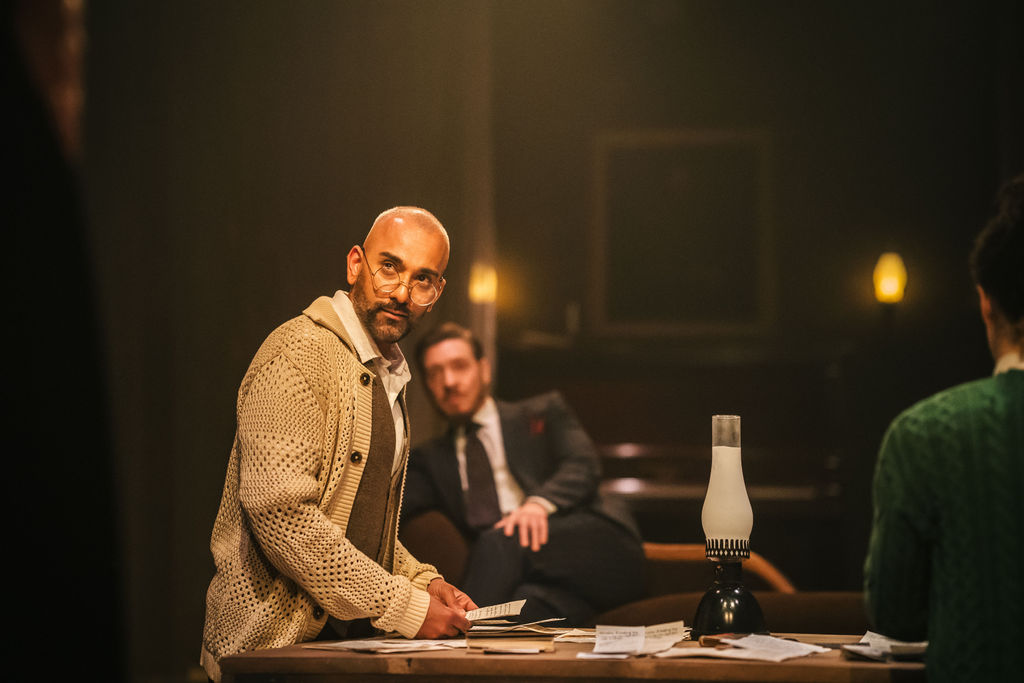
With homecoming flowers and the sound of strings, Coal Mine Theatre‘s revival of the classic Hedda Gabler gets underway. It’s a captivating runway set-up, giving intimacy to the struggles of Henrick Ibsen’s anti-hero and namesake by placing the audience on three sides of its wood-planked rectangle. Played with wild abandonment by Diana Bentley (Coal Mine’s Detroit), her Hedda finds herself sitting in the moonlight at the piano, hunched over in some complicated state of anguish, trapped and caged in a backless gown. It’s clear, from that first image and the music that comes, that this production, adapted with tinges of modernity by Liiisa Repo-Martelli (Crow’s Uncle Vanya), is aiming itself directly at the naked soul of Hedda Gabler, now Hedda Tesman, the married woman who had once enchanted the men of this town with her beauty and cool exterior. But in what time frame does she come from and live within? That is a complex question that doesn’t actually have to be answered because as directed by Moya O’Connell (Actor: Coal Mine’s The Sound Inside) with a fierce passion that sometimes overflows the sparsely-used space created by set and costume designer Joshua Quinlan (Crow’s Theatre’s The Master Plan), this Hedda is from no distinct era, floating and fighting against her position and place in the world that never fits her frame.
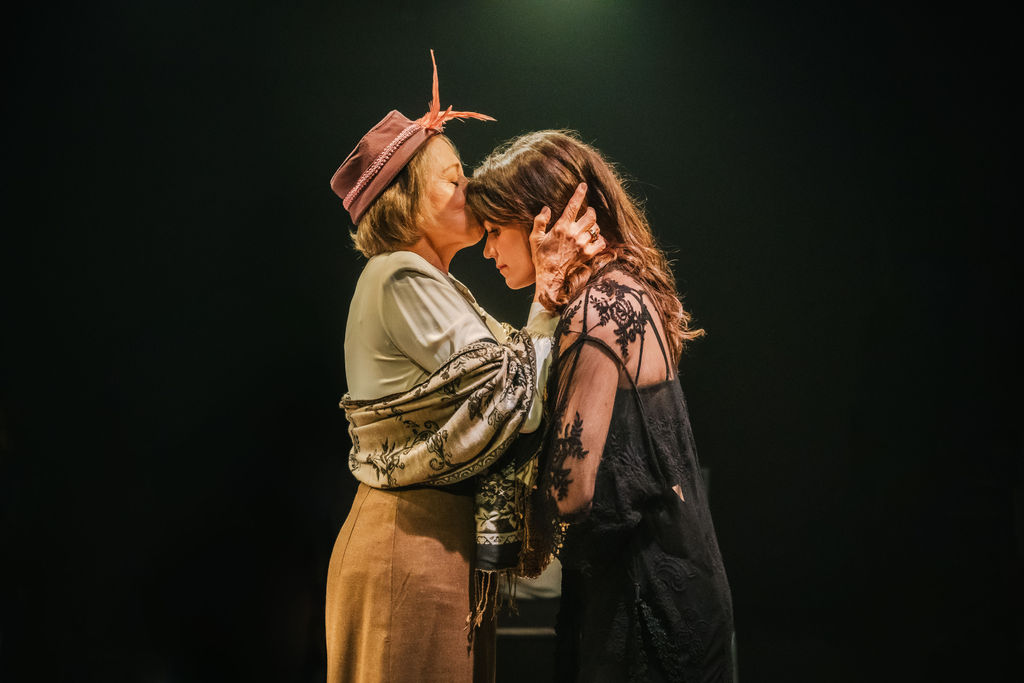
When the sweet Auntie Julia, played lovingly by Fiona Reid (Shaw’s Dance of Death), is ushered into the living room by an overwhelmed nervous Berta, played quietly by Nancy Beatty (“The Shipping News“), it is clear that there is tension in this newly acquired home of Hedda and her newlywed husband, Jorgen Tesman, played a bit too obviously by Qasim Khan (Canadian Stage’s The Inheritance). Jorgen is forever oblivious, even when prompted by the sweet maternalness of Auntie Julia. He doesn’t seem to see much beyond his books and personal interests, even when addressing the woman he has married and is completely spellbound by. Khan’s Tesman is a bit dense about marriage and what comes next, sailing in worlds that are oceans apart from his wife, especially when it comes to sensuality and seduction. It all flies over his head, but not ours.
Trapped in a marriage and a house that she does not want, Bentley’s Hedda is a heap of contradictions, struggling with her new life and the timeframe she must live in. Devoid of any excitement or enchantment, she battles with an inner demon that only comes out when she finds herself alone on that stage. Her fighting spirit erupts in those moments, making it clear that when she is in the room with others, she is mostly insincere and putting on whatever face is required. This is especially true when it comes to her interactions with the timeframed women who float in and out of the room in a more traditional tone. She belittles them, slyly, for no other reason than knowing how. Playing nice, when she needs security or information, but shifting gears the moment she is no longer in need. Hedda’s tragic flaw, as we all know, is her willful narcissism that latches itself on to a destructive force within. Her only focus is getting whatever she wants at any given moment, even if it comes at the expense of another person’s feelings.
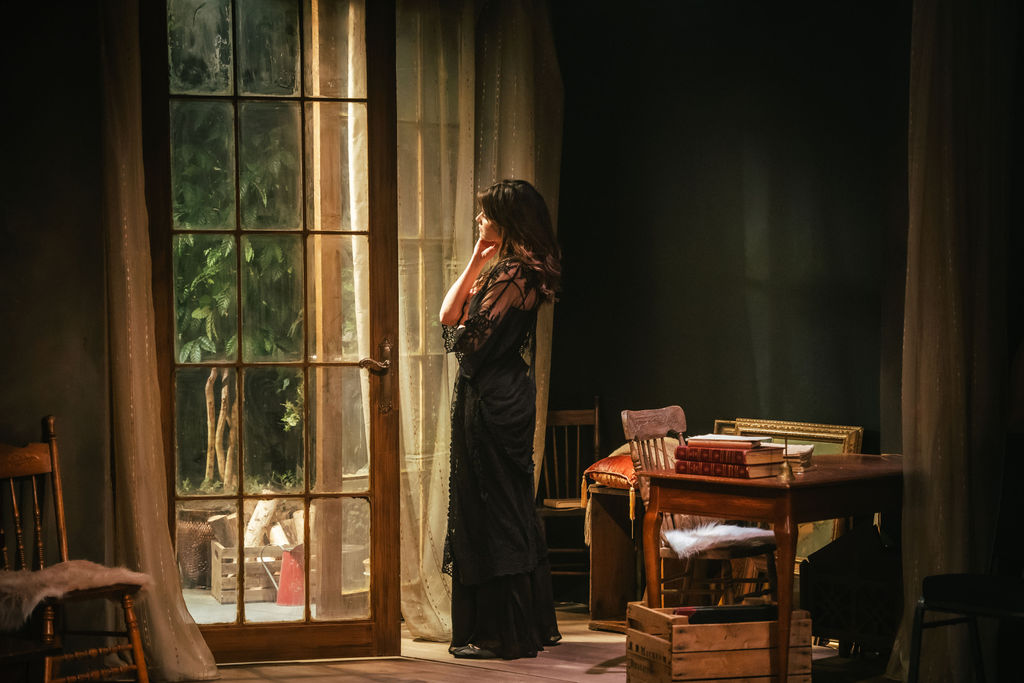
This Hedda, passionately portrayed by Bentley, needs to manipulate others as an undercurrent form of power and control, forcing those frameworks forward, most likely, because of societal expectations and norms. Ideals Hedda can’t abide by. Bently does a fascinating job at flinging herself into the role, flipping back and forth from insincere politeness and care to manipulative and suggestive power dynamics, usually involving one particular way of sitting on that lounge chair. Unfortunately, those two aspects get used repeatedly without much variance or subtlety added. Where is the steady climb to destruction? And where is the fall from grace? She is supposed to be a woman born into a higher class than the one she finds herself in; more her regal father’s daughter than her intellectual husband’s wife. Thus the play’s focus on her maiden name. But rather than class consciousness, she simply comes off as a hungry smooth sociopath, with no empathy and an impulsive streak that stings all that get too close. This Hedda sometimes falls into the form of a one-page, two-sided narcissist without a soul, and with nowhere to go, she doesn’t hold our interest as sharply as she is supposed to.
A sense of subtlety seems to be the key that is missing in much of this production of Hedda Gabler. Everyone is hitting their marks, doing what is required of them at any given moment, raising their voice when they are told to, but the deeper depiction of the manipulative nature feels a bit hurried, as we watch the characters move with urgency around the space. Within this patriarchal society, Hedda pushes a bit too hard and obviously, trying to gain some agency or control over her existence. It’s clear that she is forever disturbed by her marriage to the boring Tesman, now that she has found herself caged in a new house that, while being more extravagant than they can really afford, “smells like old lady” and death. And it will never bring her any contentment unless she seizes control.
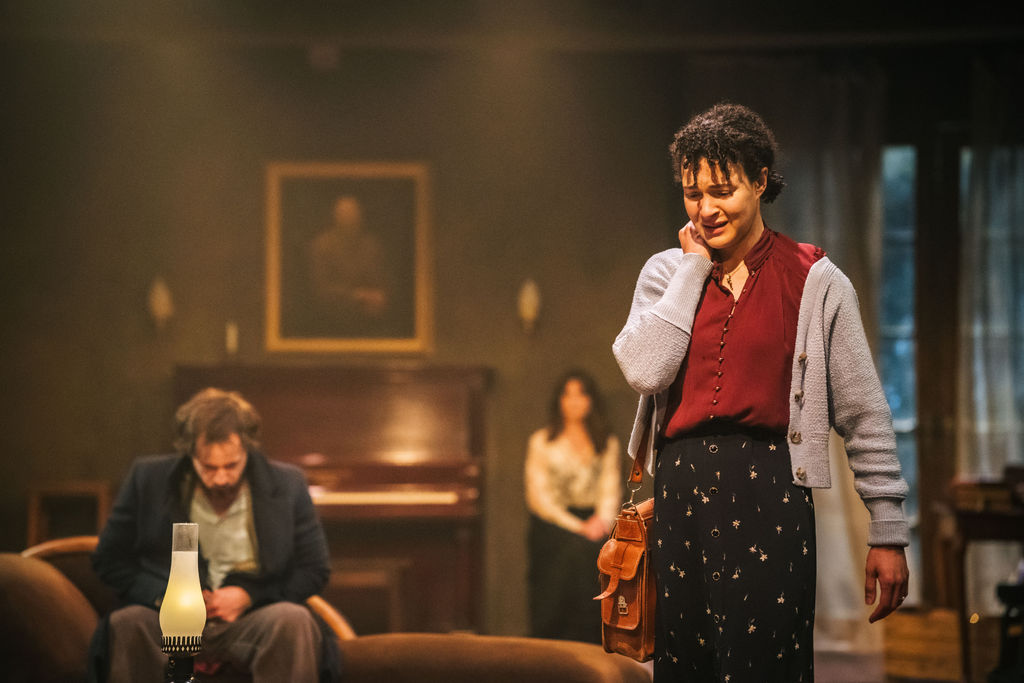
So when she hears from a former classmate Thea Elvsted, portrayed tense and uncomfortable by Leah Doz (Coal Mine’s The Effect), that a former lover, Eilert Lovborg, handsomely portrayed by Andrew Chown (Crow’s Bad Roads) has resurfaced, her focus shifts. “He’s nothing to me“, Hedda delivers, but a shaking, dynamic need has been awakened. A spark has been lit inside this trapped animal, and this spark leads all to chaos and a sea of drunken madness and despair. “No one trusts a tea toddler,” Hedda says, tempting and creating her own manifesto for the future, one of manipulation, deviance, and a roaring fire of pages destroyed. Why, we may ask? Because something must happen in this woman’s new world order, and she must find a way to take control. “This night will be the making of him,” she says, for someone, or herself.
Hedda is smug and cruel, out of boredom and shallow emotional connection to others. She moves through the space like a caged lioness, under captivating lighting by Kaitlin Hickey (Factory’s Wildfire) with a strong sound design by Michael Wanless (Coal Mine’s Appropriate). Hedda initially only finds excitement in the eyes of their family friend and helper, Judge Brack, played suggestively and a bit overtly by Shawn Doyle (Canstage’s A Number). But that triangle only works with one rooster in it, the Judge tells the woman he wants to control, and once he sees the glint in Hedda’s eyes for the firebrand that is Lovborg, a different tension climbs up and out of its box. And like any caged animal unleashed, destruction must come for all those who get too close and demand too much.

The ending is legendary, complicated and raw. A different fuse has been lit, as we witness what happens when Hedda discovers that the intended destruction did not go how she had conceptualized it. She must take control of something, but unfortunately, after such a solid buildup, the end disappears into the depths in a far too quick undynamic fashion with an inauthentic mayhem following soon after the firing. The symbolic bodily unleashing is fascinating, but doesn’t actually carry the emotional weight and magnitude that is intended. It’s overwrought and disconnected from the heart, even with the thought-provoking physicality thrown out with wild abandonment. The tragedy doesn’t connect to the desperation that is underneath in Coal Mine‘s Hedda Gabler. It’s distinct and electric, but doesn’t manage to shoot itself deep into the soul.
 front mezz junkies
[…] Dalmatian), Sarah Murphy-Dyson (Off-Kilter), Fiona Reid (Harry Potter and the Cursed Child, Hedda Gabler), and Kaleb […]
LikeLike
[…] follows the young man, played with solid intent by a strong Qasim Khan (Coal Mine’s Hedda Gabler) as he grapples with existential questions of life, death, and revenge. But here, the play and the […]
LikeLike
[…] Louise Lambert, Oliver Dennis, Farhang Ghajar, Matthew Gouveia, Sam Grist, Sarah Murphy-Dyson, Fiona Reid, and Kaleb TekestePlaywright: Duncan MacmillanDirector: Diana BentleyAbout: “I don’t think […]
LikeLike
[…] rest of the company; the extraordinary Fiona Reid (Coal Mine’s Hedda Gabler) as her doctor, her therapist, and her mum; along with the subtle yet engaging Matthew Gouveia […]
LikeLike
[…] lives, specifically the epic John Willoughby, dashingly portrayed by Andrew Chown (Coal Mine’s Hedda Gabler), and the one that always warms my own sensible heart, Edward Ferrars, boldly portrayed by the […]
LikeLike