
The Toronto Theatre Review: Tarragon Theatre’s Come Home: The Legend of Daddy Hall
By Ross
The “sweet, sweet boy” lies in a spotlight, shrowded in Spanish moss and mystic lighting. He’s drowning in the mystic feeling of death with ghostly faces of ancestorial connection shimmering forward to engage and recount. This memory play, written with purpose and desire by Audrey Dwyer (Calpurnia), spans time and place, layering in the histories of both Black and Indigenous teachings that float out the realities of the cultural framing. Spanning generations and one man’s ever-so-long lifeline, Come Home: The Legend of Daddy Hall plays tribute to John “Daddy” Hall. It’s his extraordinarily complex journey layered with a poetic rewinded breath that rises to the surface looking for understanding and a framing that feels mostly clever but sometimes forced. With a life that began in Amherstburg, Ontario in the 1780s, and ended, approximately 117, or 118 years later in Owen Sound, Daddy Hall is as epic in its scope as can be, distinct and smart in its construct, and sometimes lacking in focus, leading us to lean in and tune out with some regularity.
The beginning, as staged by Tarragon artistic director Mike Payette (Tarragon’s Cockroach), floats into our system like the smell of ghostly swamp air, hidden behind layers of mist and secrecy. Giving abstract vantage points to breathe in the complexities of this man’s trauma, the play spirits out souls from his epic life for us all to engage with, as well as a future generation stumbling forward while trying to unpack a past, all so he, Billie, played by Troy Adams (TIFT’s The Other Place), a descendant, can understand the present condition and navigate life forward from a wiser perspective. The framing is unique and contextual, letting Hall’s mixed heritage of Mowak and Black Jamaican ancestry find equal footing on that somewhat overstuffed stage, designed by Jawon Kang (Tarragon’s A Poem for Rabia), while giving layers of space to try to understand personal trauma and confusion.

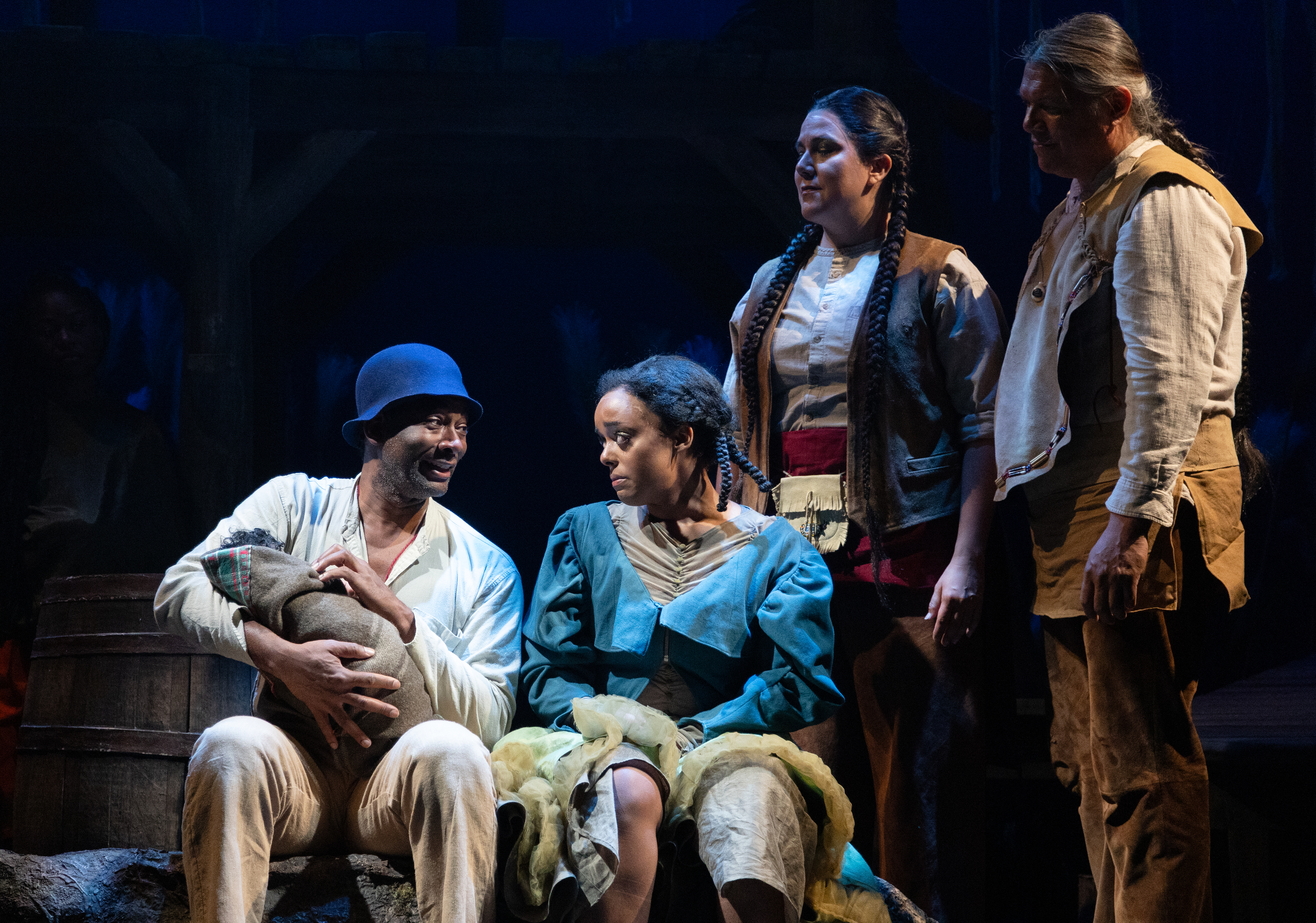
Hall, played forcibly by Daren A. Herbert (Soulpepper’s Jesus Hopped the ‘A’ Train), finds clarity in his rewinding, looking back over his timeline with curiosity. He fought as a Black loyalist in the War of 1812. He survived capture by American forces and was systematically enslaved in Virginia and Kentucky. He escaped, with his wife, using a threaded map of rice and beans braided into his hair that helped lead him back home to safety in Canada. Throughout his journey, he held true to his yearnings for home, family, and love, marrying, we are told, up to six wives and was father, or should I say “Daddy Hall” to somewhere around 21 children. It’s a lot to cover in this one-act wonder of a play, and even when it falters in its complicated unpacking, muddling the journey with an overly fussy rearrangement of wood pieces and somewhat jarring blocking and movement, the journey has marked moments of wonder that are highlighted and expanded by the gentle fantastical music delivered out from the depths by Unsettled Scores (Spy Dénommé-Welch & Catherine Magowan), the production’s sound designers and composers.
The notes float in, elevating the dialogue with background poetic illusions of ancestorial and cultural undercurrents that consistently save the framing from sinking down underneath the crackling ice. They trigger tragedy and loss, even when the interconnectivity feels jagged and forced. Lit from a place of historic warmth and engagement, designed by Michelle Ramsay (Factory’s The Waltz) with simple yet clever costuming by Christine Ting-Huan 挺歡 Urquhart (Tarragon’s Cockroach), Come Home: The Legend of Daddy Hall works hard to relive all those key moments in this man’s complex life, particularly around the ideas of home, safety, and attachment. The cast, that includes Indigenous actors Nicole Joy-Fraser (Tarragon’s My Sister’s Rage) and Brandon Oakes (CBC’s Diggstown), and Black actors Helen Belay (Soulpepper’s Queen Goneril & King Lear) and Emerjade Simms (Cahoots Theatre’s Sweeter), engages with intent in the non-linear mystical unpacking, allowing us to consider and engage with Hall’s ancestral lineage and all the trauma that has been layered on this man throughout his journey.

The play spirits forth the dynamic from this misty ancestral plane, sometimes finding complete visual and poetic illusions, like in the crackling watery descent of his wife, Mary, played lovingly by Belay. At the same time, other moments feel disconnected from the emotional journey and its overarching themes. The modern stance in Tarragon‘s Come Home: The Legend of Daddy Hall never really finds its connective tissue throughout and feels put upon and not completely organic to the main Hall stance. There’s wonder in their search for bigger pictured themes and answers to complex historical and connective questions, sometimes feeling grounded in emotional truth, and sometimes masked behind layers of Spanish moss. The energy shifts, floating in and out of the murky cold waters of memory and ancestral history, and when it hits its mark, there is clarity, but other times, we swim in cold waters looking for the light and air of understanding.
 front mezz junkies
[…] (Odysseus); Poole’s Clythemnestra, Iphegenia (Agamemnon); Helen Belay (Tarragon’s Come Home: The Legend of Daddy Hall) as Electra, Chryses, Thrasymedes; Sarah Dodd (Stratford’s Twelfth Night) as Galax, Anax, […]
LikeLike
[…] design mirrors that poetical shit-talking complexity. Jawon Kang’s set is a textured, multi-layered space that holds shadows of desire, intimacy, isolation, and […]
LikeLike
[…] design mirrors that poetical shit-talking complexity. Jawon Kang’s set is a textured, multi-layered space that holds shadows of desire, intimacy, isolation, and […]
LikeLike