
The Stratford Theatre Review: Shakespeare’s Twelfth Night
By Ross
Two siblings stand tall, side by side, in the beautiful warm light of connection at the Stratford Festival‘s premiere opening night. There’s a crack of light and sound, ushering forth a storm, a shipwreck, and a forced disconnect, all to the glorious emotional sound of a slide trombone played to strong effect in the first few moments of Shakespeare’s Twelfth Night. Written somewhere around 1601–1602, this favored romantic comedy, as directed lovingly by Seana McKenna (New Globe’s Valley Song; Stratford’s Les Belles Soeurs), has been shifted to the mid-1960s and given a mid-modern Miro-hanging edge that feels sweet and engaging, that doesn’t overwhelm the text, yet doesn’t really play much of a part within the structuring either. Delivered with an expert vocal edge by the engaging cast, this Twelfth Night is a charmer. It finds flavor and meaning in those captivating words, even if it fails to dig too deep into some of the major players’ motivations and impulses.
Like a few other Shakespearian plot devices utilized in other tragic comedies like The Tempest, this clever play centers around two lost twins; Viola, deliciously portrayed by Jessica B. Hill (Tarragon’s Paint Me This House of Love), and her twin brother, Sebastian, handsomely played by Austin Eckert (Stratford’s Much Ado About Nothing). Separated by that initial shipwreck, orchestrated somewhat casually by set and costume designer Christina Poddubluk (Shaw’s On The Razzle) with compelling lighting by Bonnie Beecher (Coal Mine’s Dion: A Rock Opera), a dynamic sound design by Verne Good (Grand’s Art), and strong musical compositions by Paul Shilton (Stratford’s An Ideal Husband), the storm is merely referenced to in those first few captivating moments. Each twin must find their own way through the land of Illyria, in a sorry state of grief and without hope of reconciliation with their other. The two are exceedingly charming and endearing, giving us ample reason to gather behind them in love, even if their grief only resonates for a quick seaside moment, leaving us hoping, sweetly, that they find the engagements and reconnection they can only dream about.
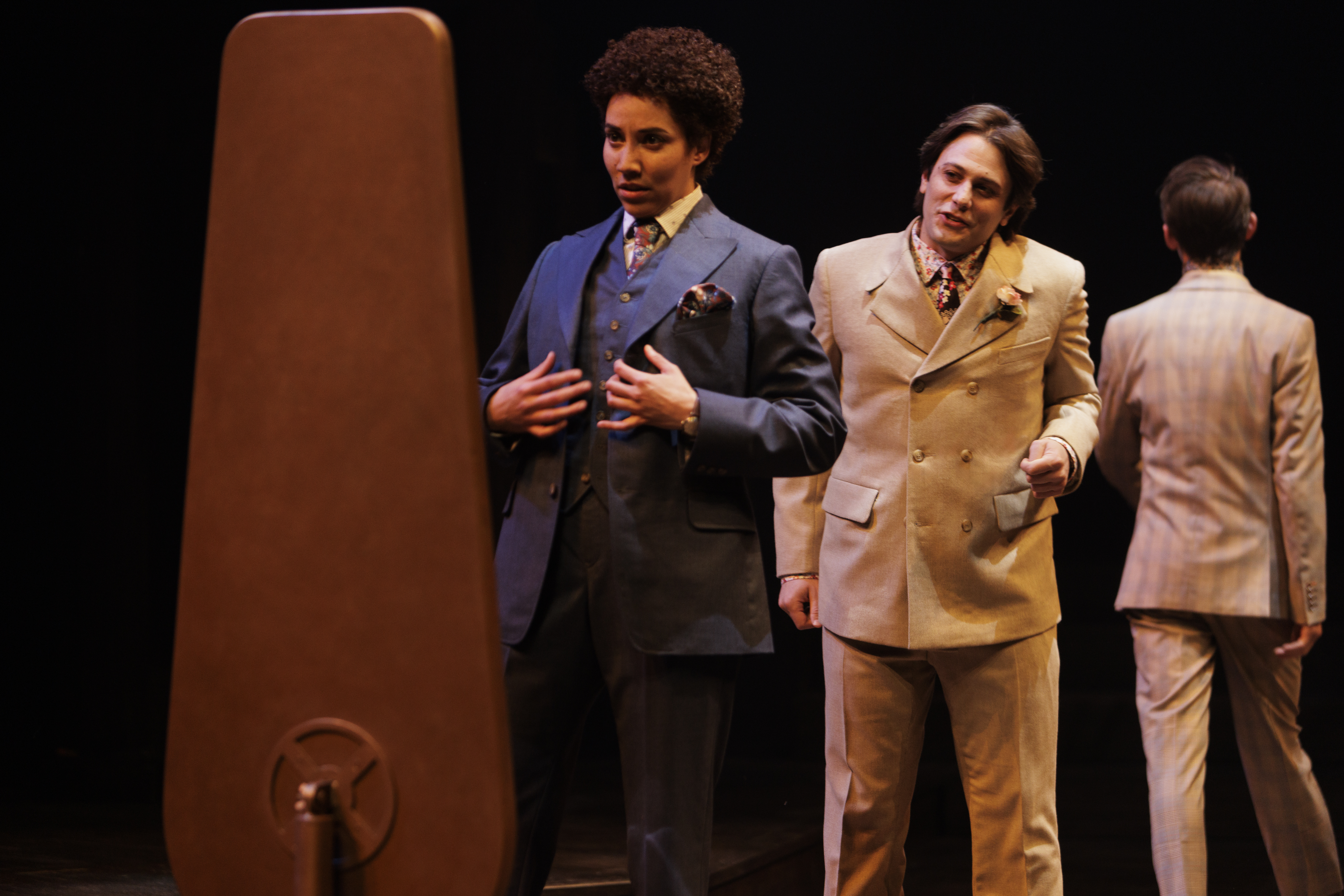
Viola, disguised as the young gentleman, Cesario, seeks safety and security in the court of the Duke of Illyria, Orsino, played big and glorious by André Sills (Stratford’s King Lear), yet all the while serving him, Viola, as Cesario, falls hopelessly in love with the Duke. Beyond the fact that Viola is pretending to be a very elegant, well-spoken young gentle-boy, a complication played up well and with great subtle humor (without being homophobic), the other obstacle is that Orsino thinks he is in love with the grieving Countess Olivia, with the Duke continually sending his faithful Cesario to woo her for him. Another jaunty hurdle, played well and sweetly, is that upon meeting Cesario with their task in hand, Countess Viola, played clear and coyly by Vanessa Sears (CS/Obsidian/Necessary Angel’s Is God Is), falls hard and ever so quickly for this ‘young man’ and continually orchestrates ways to keep their meetings ongoing, even as she dismissed the Duke’s pleadings of love.
Even with the somewhat inauthentic, instantaneous fallings in love, it all plays out warm and true. With two meandering tourists wandering without purpose through the streets of this quaint town, the recognizing of the twin confusion and mistaken identities is beautifully and sharply orchestrated with love and care, adding a tenderness to this Twelfth Night that remains charming yet somewhat lost in time and place. Underneath the clanking of the Miro mobile, the romance remains engagingly fun, even with the imprecise locale not really getting utilized in any meaningful manner. The precise body gesturing and verbal interactions create more and more deliciousness at every turn in the romantic chapters of this text.
Yet the true humor lies in the background mischief, played out cleverly by a crew of pros; led by Scott Wentworth (Stratford’s Fiddler on the Roof) as the drunkard Sir Toby Belch, Rylan Wilkie (Stratford’s To Kill a Mockingbird) as the ridiculously vacant Sir Andrew Aguecheek, and Sarah Dodd (Coal Mine’s Marjorie Prime) as the connivingly sharp Maria, Olivia’s gentlewoman. The three, with the wide-eyed hippy help of Feste, the ‘court’ jester, played melodically and thoughtfully by Deborah Hay (Grand’s Mary Poppins), devise a device. Led by Sir Toby and Maria, they attempt to orchestrate a shaming of the stiff and unsmiling Malvolio, played to perfection by Laura Condlln (Startford’s Frankenstein Revived). And we all happily join into Malvolio’s pulling down, even when it becomes harsher than need be.
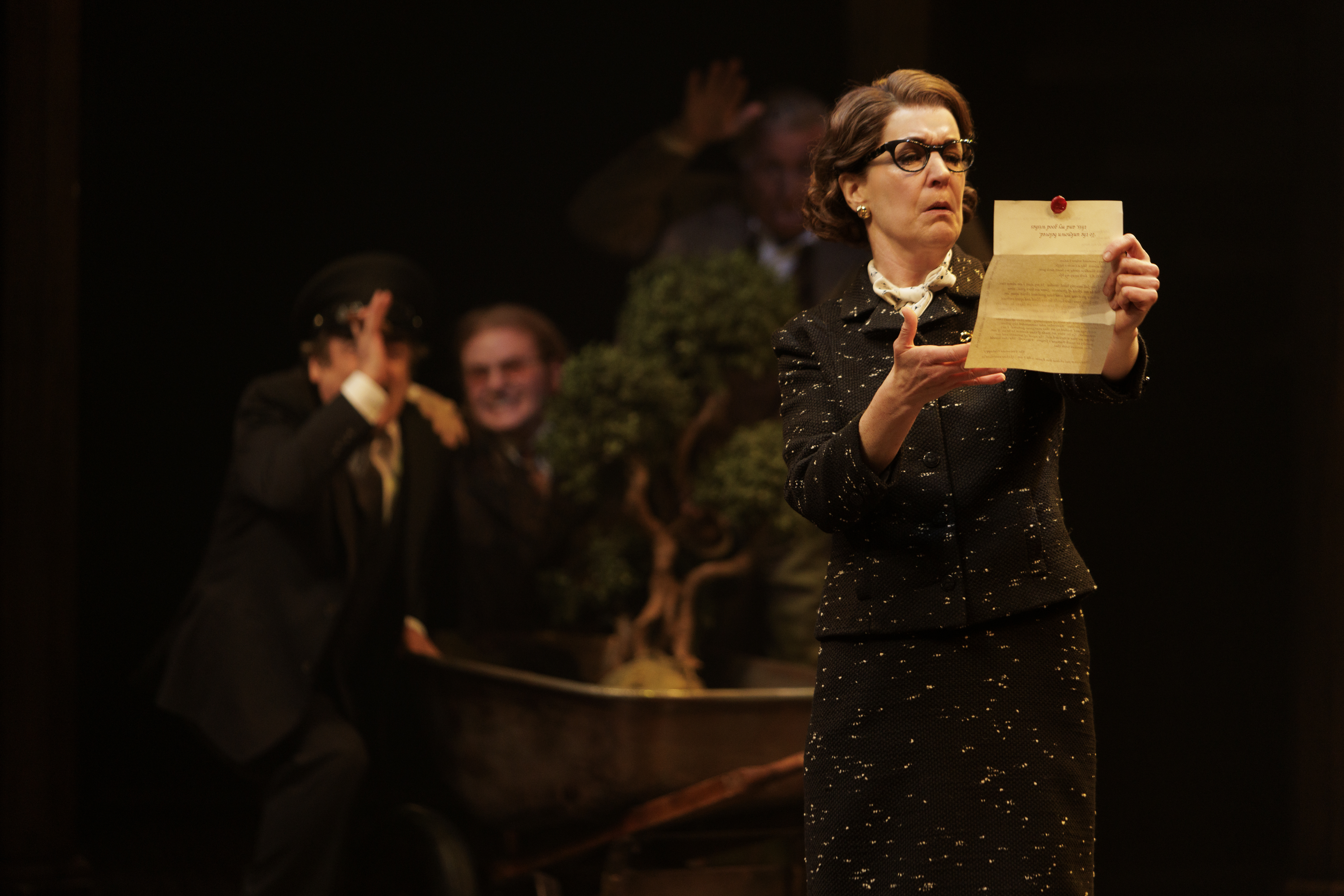
This is where the words of Shakespeare truly find their rascalling in the ridiculing of the tightly wound Malvolio and the mistaken threat of the young Cesario to the dimwitted Sir Andrew Aguecheek. Wilkie’s Aguecheek is delightfully dim, but his intentions with the Countess lack clarity and are far removed, vaguely hanging around in the distance. The same could be said of Wentworth’s Toby and his assistance that Aguecheek stay the course with the Count. Condlln, on the other hand, as the cantankerous Malvolio is the jewel in this Shakespearian Twelfth Night crown, finding all sorts of flavors in this character’s demeanor. Normally the part is a wickedly fun representation of rules and formality, played by a tightly wound male, but not always (check out England’s National Theater production of Twelfth Night starring the incredible Tamsin Greig as Molvolio). In this breathtakingly good reconfiguration, the shift exposes all the silliness and wit within this classic comedy of errors and misrepresentations while adding another more ingenious layer, disguised under a magnificently constructed modern take as rich in subtext as it is well-spoken and performed.
Condlln plays it deliciously tight, giving off the impeccable appearance of a severe, flavorless disciplinarian played hilariously, and seriously, during that perfectly crafted letter-reading scene. Contempt jabs out of her tight lips continuously. It’s brilliantly savage, clearly laying the beautifully orchestrated groundwork of the besotted employee, sick in love with her feminine boss. Her yellow cross-gartered transformation is delightfully wicked, quickly shifting our focus to the over-the-top punishment of the tightly wound steward. Condlln, along with the musically endearing Hay as the meandering fool, wins continually throughout the piece, digging deep inside their characters for their sense of purpose and pointed behavior. Malvolio’s treatment is left hanging in the air somewhat, with Olivia quickly discarding the punishing behavior of her crew and moving on to her superficial love of a twin she barely knows beyond his resemblance to the female version of him.
But these two actors, Hay and Condlln, know how to engage with the text and with the audience, finding all sorts of subtleties to unpack for our delight. The others tend to land in the more shallow versions of this formula, clearly connecting the text with precise understanding and naturalisms, yet somehow not uncovering deeper justification or motivation for their actions and emotional interactions. But that slight undercurrent never really gets in the way of our enjoyment of the text, the play, and those deliciously delivered words of love and foolishness. We lean into this production of Twelfth Night, even when the time and place have no real relation to the unpacking of the text. I wish the setting was as magically colorful and interlinked as the embodiment before us. Two lost and wandering hippy tourists doesn’t really do the trick, nor does the random costuming. Yet, most charmingly, Stratford‘s production finds endless humor and effervescent flavor throughout, and we can’t help but fall in endearing love with their Twelfth Night.

 front mezz junkies
[…] (Stratford’s Richard II), with superb lighting by Bonnie Beecher (Stratford’s Twelfth Night) and a solid sound design by Haley Parcher (Kennedy Center’s Sunset Boulevard), these two […]
LikeLike
[…] Juliet, played wide-eyed and giggly by the lovely and captivating Vanessa Sears (Stratford’s Twelfth Night). Following the straightforward path to love and marriage, these two come together as if following […]
LikeLike
[…] show will be choreographed by Stephanie Graham, who did the choreography for this season’s Twelfth Night. She has worked as a director and choreographer across Canada and won the 2015 Dora Award for […]
LikeLike
[…] liar in London“, Cool, played to tight perfection by Rylan Wilkie (Stratford’s Twelfth Night), the performance that Davies gives is delightfully silly and ridiculous, in a way that we […]
LikeLike
[…] Next to Normal) and choreographed energetically by Stephanie Graham (Stratford’s Twelfth Night), these Dirty Rotten Scoundrels do the job most convincingly by continually reinventing the game to […]
LikeLike
[…] keeper, the deplorable Miss Hannigan, deliciously embodied by Laura Condlln (Stratford’s Twelfth Night). “It’s medicine,” she flatly and hilariously states as she guzzles down some […]
LikeLike
[…] Belles-Soeurs) beautifully embodying the effervescent Perdita; and Austin Eckert (Stratford’s Twelfth Night) as the lovestruck son of Polixenes, Prince Florizel, who, all together, must bring this lopsided […]
LikeLike
[…] heart, Edward Ferrars, boldly portrayed by the wonderful Thomas Duplessie (Stratford’s Twelfth Night). Oh, and let’s not forget the quiet and gentle Colonel Brandon, embodied solidly by Shane […]
LikeLike
[…] (Stratford’s As You Like It) as Le Vicomte de Valmont, Jessica B. Hill (Stratford’s Twelfth Night) as La Marquise de Merteuil, I expect to be utterly captivated as these characters scheme and fall, […]
LikeLike
[…] Home: The Legend of Daddy Hall) as Electra, Chryses, Thrasymedes; Sarah Dodd (Stratford’s Twelfth Night) as Galax, Anax, Andromache, Hector, Old Woman, Greater Ajax; Ijeoma Emesowum (Stratford’s […]
LikeLike
[…] Borden (Tarragon’s The Last Epistle of Tightrope Time) and Scott Wentworth (Stratford’s Twelfth Night) carry the weight of that history with the kind of simplicity only actors of great depth can […]
LikeLike