
The Toronto Theatre Review: Soulpepper’s A Streetcar Named Desire
By Ross
It’s the quintessential sound of New Orleans that draws us in. Starting with the iconic rattle of that Streetcar Named Desire, clanging and banging its way through the streets, the unraveling, beautifully unpacked here at Soulpepper, brings a clearly out-of-place, white-clad sister to the door of a home filled with a rough and tumble energy that is as red as she is white. It’s a classic beginning, seeing her stand there, out-of-place and out-of-sync with a subtle modernist flair courtesy of director Weyni Mengesha (Soulpepper’s The Guide to Being Fabulous). It is that visual that delivers Tennesse Williams’ iconic damsel to the door of sister Stella, and we see it in her contemporary touch that this is an undoing worthy of our watch.
The big easy New Orlean chaos is rolled out and unmasked, here and there from time to time (with an energy that I wished I got to see a bit more), as the clashing of types overpowers and fills the stage and down the aisle. Meat is thrown from outside in, by a wife-beater-wearing Stanley, played with blue-collar deliverance by Mac Fyfe (Howland C0./Crow’s Heroes of the Fourth Turning), and caught by the love-struck Stella, played with a straightforward deliberation by a very game Skakura Dickson (Mirvish’s Dear Evan Hansen). Their engagement is effortlessly of that space, etched in the way they look and touch one another before she runs off to watch him bowl. And then she comes, dragging a hard-cased rollie bag down the aisle, banging the floor at each step as if to signal her approach. Or maybe an alarm. Possibly to her own self as much as to the others. It almost screams out, I don’t belong here. That I am a visitor, from another time and place, and this arrangement is a distinct contradiction to the word ‘easy’.
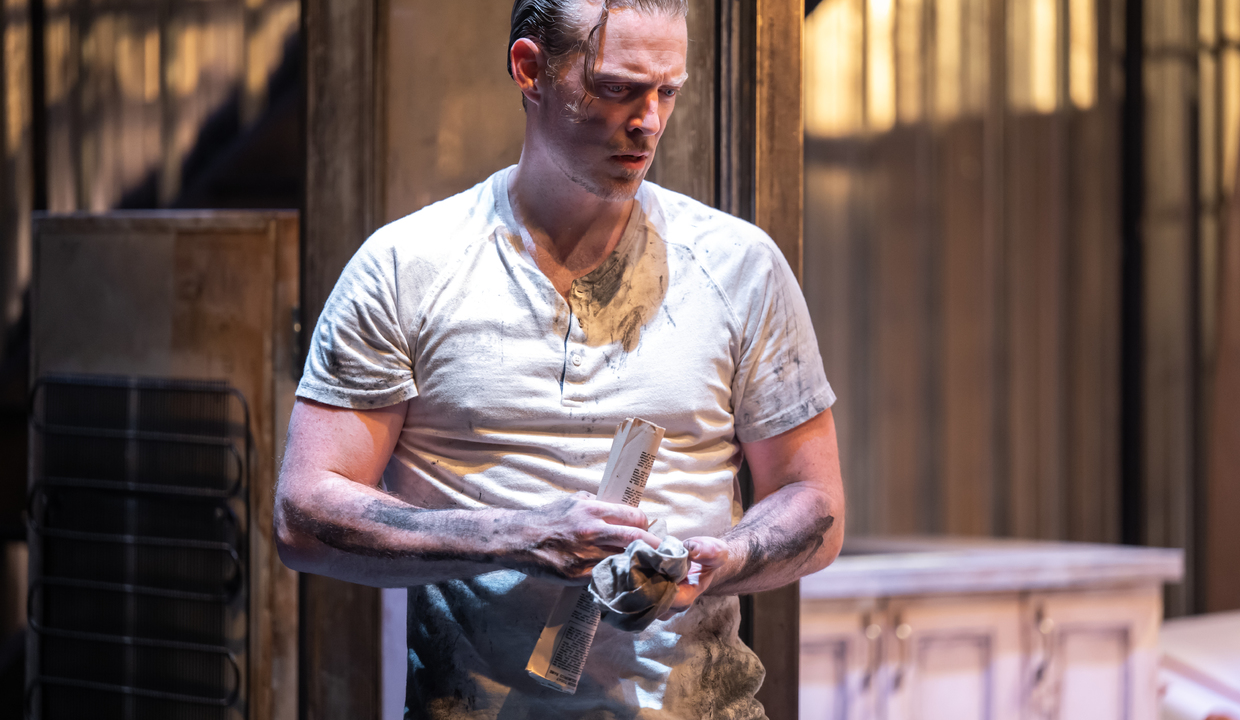
This Soulpepper Blanche, played timelessly as if a relic from some other world by the captivating Amy Rutherford (Segal Centre’s Fifteen Dogs), is worthy of the look the neighbor, Eunice, played to perfection by Ordena Stephens-Thompson (Soulpepper’s Three Sisters), gives as she leaves Blanche to her requested privacy and her secret consumption of Stan’s liquor. Rutherford’s Blanche is vibrant in her false framing, modulating her drawl for full manipulating effect, moment to moment. She gives us a magnificent creation based on nervous intention and supreme denial, pivoting this way or that, depending on the requirement that hangs in the thick air. It’s the smoothest of simulated posturing, that conveys a deft and disturbing downfall waiting in the wings, just behind another type of curtain drawn to protect and hinder inspection under a harsh unforgiving light.
Her statuesque framing is in harsh objection to all that runs around it, swinging and engaging in the smooth wildness of modern New Orleans. The sounds rise up from the edges and behind closed walls, singing and laughing in their jazz-infused joy, but they find no home in Rutherford’s Blanche. Here is the hot-blooded underlying surrounded by hard metal that reveals smokey sexuality when required, that breathes extra life and fire into the roughness of the room, designed to deliver by Lorenzo Savoini (Soulpepper’s De Profundis), with captivating lighting by Kimberly Purtell (Tarragon’s Withrow Park) and a strong sound by Debashis Sinha (Stratford/Soulpepper’s Casey and Diana). This hot musical energy is what I was waiting for as Soulpepper revisits A Streetcar Named Desire, which comes clanging back to their main stage (after a very successful 2019 production). Blanche’s downfall is clear and predetermined, mapped out from the moment Fyfe’s Stanley first sees her, and from the faulty flirtation she throws his way. Blanche is out of her dimmed-light element, and even though Dickson’s Stella tries her best to serve her in the way she likes to be cared for, the escalations of love, lust, and fury will have their way with this damsel in self-created distress. And she won’t have the strength to see her way through the smoke into the reality of the modern world that swirls around them.
Clinging to her distorted past that we hear glimpses of, playing in the background until the shot ends the fantasy, A Streetcar Named Desire delivers magic and the cruelty of realism balanced in abundance. The visuals and the musical energy, courtesy of both Mike Ross (Soulpepper’s Of Human Bondage), the original music director, and Kaled Horn (Shakespeare Bash’d’s As You Like It), the music director of this remount, emphasize the clash, excluding the delusional Blanche from the rest, even as she entices, for a moment, the kindly Mitch, played engagingly by Gregory Prest (Can Stage’s The Inheritance). The costumes by Rachel Forbes (Can. Stage’s Topdog Underdog), push forth the same cultural and societal clash. Stanley and his buddies, played well and true by Sebastian Marziali (“Dark Side of Comedy”) as Pablo, and Lindsay Owen Pierre (“Jack Reacher”) as Steve, are outfitted in your standardized blue-collar constructs, that feel curated from a different era then Blanche, although I never really understood the collection of coats and jackets these guys carry around with them on these hot humid nights. Stella finds herself straddling the timeframes in short shorts that bridge the gap that Blanche’s ensembles don’t. They engage with both, to different effects, igniting Stanley’s passion while also cementing a subtle connection to Blanche and her past life.
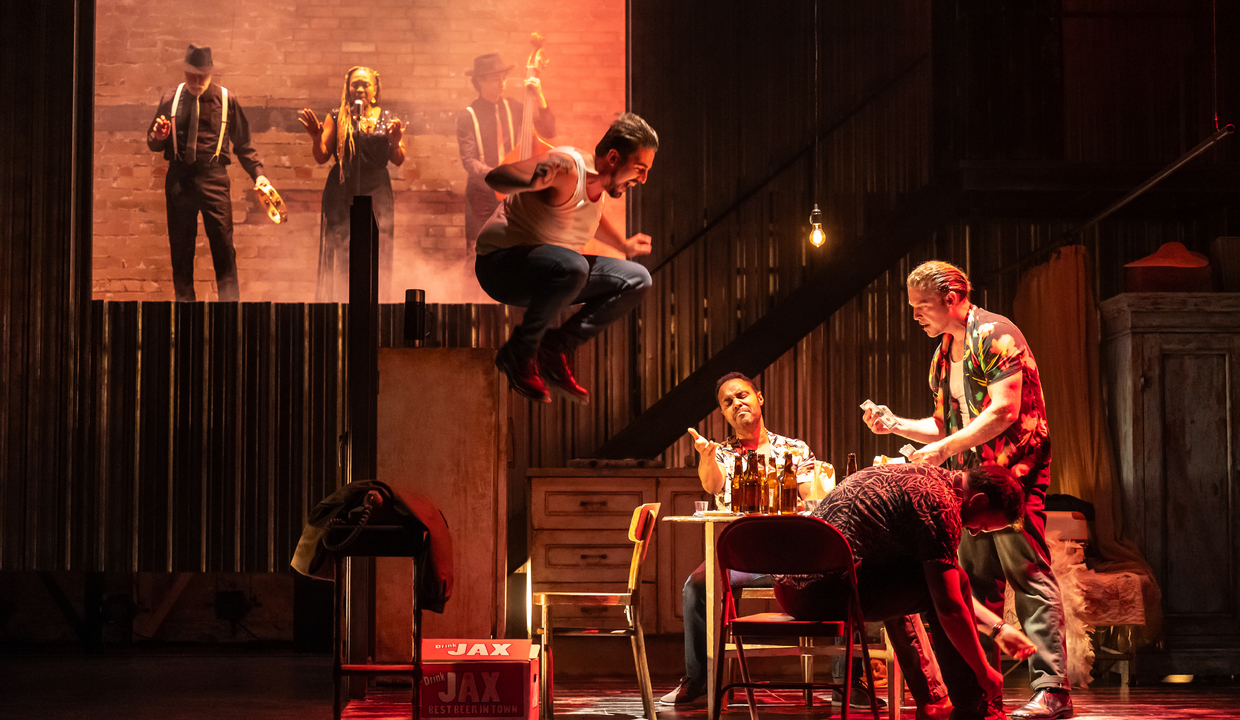
But it’s Rutherford who our eyes are glued to, and she is a marvel inside her performative Blanche, weaving lies upon lies in hopes of escaping the trap she has created or found herself in. She tries her best to hold it all together, taking hot baths on steamy hot days to calm her nerves, and weaving tales of Southern elitist privilege often in comparison to Stanley’s less refined heritage. It makes her hard to feel much for, on the surface, as she lies and throws attitude, but Rutherford finds her way through the text pretty brilliantly, delivering a woman who is perplexed, anxious, and confused. It’s all wrapped up in one intense performance by one amazing actress. Dickson’s Stella doesn’t stand a chance in that rosy dim spotlight.
It’s no wonder this part is coveted by so many performers, and I’ve seen a few, including Cate Blanchette at BAM, Jessica Lange on Broadway, and Gillian Anderson at St. Ann’s Warehouse. It’s an emotional and deeply complex role that gives an actress such a deviating journey to move through from entrance to heart-breaking exit. Rutherford’s Blanche finds her way into the room inside a unique framing, taking us through an emotional journey that is epic, devastating, and deeply affecting. It’s an extremely complex and modern take on the role, weaving in layers of addictive energy and validating anxiety that feels so deeply integral to Blanche, especially during the incredibly uncomfortable interaction with the young newspaper collection boy, played captivatingly cute by musical director Horn.

The time flies by as we watch Rutherford’s wounded, flailing, and righteous-sounding bird struggle to save herself, but Fyfe’s Stanley is too brutal of an animal force to be caught in Blanche’s desperation. He’s also difficult to ignore. He plays it more subtle than loud, unpacking unknown layers that intrigue, even when they don’t add the required heat. The same could be said of Dickson’s Stella who finds her space, but not always the right amount of heat.
At times we are drawn into Blanche’s flawed pain, especially the dramatic sad story of the love that seemed to break her apart. That famous monologue, as it should, destroys, but she’s also too difficult to love and to take. During many of those tense moments, we feel for her sister, Stella, who has no idea how to take care of her or even deal with Blanche’s grandiose facade. The only one who can actually save Blanche from Blanche and her situation is Mitch who attempts to balance the sweet suitor with the desperately defeated man. Prest’s Mitch is far more gentle than most I’ve seen tackle the part, bringing his own dreaminess to the role, but it doesn’t actually mesh well with the resulting pivotal provocative scene that erupts from inside him brought to the surface because of her lies and deceit.
The tension and the rise to violence does float in the air over and within, matched by the music that erupts from behind that wall. And with the loud crash of bed posts against the same, the loud collision elevates the heat and the heaviness, sometimes too fast and furious, changing direction and speed as if the anxiety and the alcohol levels fuel the fire and the fury, without enough underlying formulations. This idea includes the final inevitable collapse of Rutherford’s Blanche, and her disconnect from reality. It’s a jarring, majestic, and heart-wrenching full-speed crash, and one not to be missed, but somehow it doesn’t hold the framing together as well as I expected.
I wanted more of a build-up; a long fuse leading from one room to another, lit by claustrophobia and an insulting fantasy world. But this one, pushed forward by Fyfe’s Stanley is short, popping up hard and violent into the hot humidity. Yet, as expected, we watch her walk out on the arm of the stranger; a gentleman doctor who is to commit her to a mental asylum, with compassion and sorrow. Her disintegration into shattered collapse is complete, but the mystery and deluded fantasy of her grand self still holds even if it’s as wobbly as the legs that carry her forward into the night, and up the aisle before our very eyes.

 front mezz junkies
[…] Schreck, the playwright, portrayed cleverly and carefully by actor Amy Rutherford (Soulpepper’s A Streetcar Named Desire), greets us at the casual sweet beginning, I struggled a bit to want to take on the collective role […]
LikeLike
[…] TorontoFirst Preview: January 18, 2025Opening: January 23, 2025Starring: Paul Gross, Martha Burns, Mac Fyfe, Hailey GillisPlaywright: Edward AlbeeDirector: Brendan […]
LikeLike
[…] final season for outgoing Artistic Director Weyni Mengesha (Soulpepper’s A Streetcar Named Desire), Soulpepper’s 2025/26 programming offers a signature mix of four World Premieres from […]
LikeLike
[…] also awarded outgoing Soulpepper Theatre artistic director Weyni Mengesha (Soulpepper’s A Streetcar Named Desire) a special citation for her outstanding tenure as artistic director of Soulpepper […]
LikeLike
[…] Sinha, Mike Ross, Kaleb Horn, SATE, Divine Brown for A Streetcar Named Desire (Soulpepper Theatre Company)Dasha Plett for Roberto Zucco (Buddies in Bad Times Theatre)John […]
LikeLike
[…] MacDonald (Citadel’s The Penelopiad) as Michael Coren, Sebastian Marziali (Soulpepper’s A Streetcar Named Desire) as Sk8r Boi, and writer Johnnie McNamara Walker, give it their unvarnished all, ripping away, in […]
LikeLike
[…] both theirs and ours. As directed with exciting pounding energy by Weyni Mengesha (Soulpepper’s A Streetcar Named Desire), the play has us hooked in, curious, and enticed within seconds. And with the next revealed […]
LikeLike
[…] freedom Alma struggles to imagine in two very different embodiments. Kaleb Horn (Soulpepper’s A Streetcar Named Desire) moves between the melancholy, love-struck young poet and an equally struck wandering salesman […]
LikeLike
[…] Beau Dixon, Barbara Gordon, Christo Graham, Lucy Hill, Ryan Hollyman, Eric Peterson, Rick Roberts, Amy Rutherford, and Richard Waugh, the production represents one of the largest casts Coal Mine has ever assembled […]
LikeLike