

The Shaw Festival Theatre Review: Part Two: “Snow in Midsummer” and “Sherlock Holmes and the Mystery of the Human Heart“
By Ross
Returning to the Shaw Festival last week, ‘mystery’ is the theme that greeted me in the three plays I saw this round more than secrets (see Part One), yet it wasn’t exactly where you thought it would be. I expected the dark business, unhappy coincidences, and suspicious circumstances that revolve around Reginald Candy’s Sherlock Holmes and the Mystery of the Human Heart to be the mystery play of the season, but that play, based on the characters created by Sir Arthur Conan Doyle, and its overly talky fumbling left us much too distracted and far less intrigued than Frances Ya-Chu Cowhig’s compelling play, Snow in Midsummer. That play, based on the classical Chinese drama “The Injustice to Dou E that Moved Heaven and Earth” by Guan Hanqing (c. 1241–1320), is the one that truly hypnotized the overheated August audience. It was the one that intrigued, and with its captivating layerings and complex ghostly engagements, the expertly crafted contemporary reimagining, first staged in 2017 by the Royal Shakespeare Company, kept us all leaning completely in with amazement, curious to uncover what actually happened on that deadly day, the day that brought a curse onto a small Chinese town by the play’s wrongly accused central figure, and how the curse could be reversed.
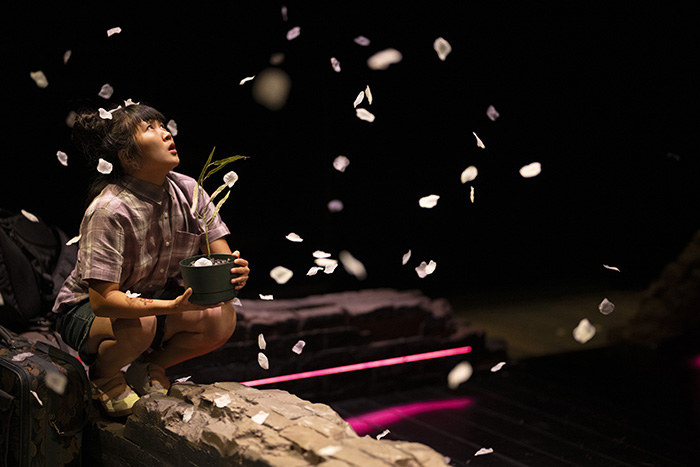
Frances Ya-Chu Cowhig, the internationally produced playwright known for The China Plays: Three Parables of Global Capital trilogy; The World of Extreme Happiness, The King of Hell’s Palace, and Snow in Midsummer, has captivatingly weaved together a story of double happiness ripped away in a moment of care for one over another. And how a stranger by the name of Dou Yi, played with a compelling edge by Courtney Ch’ng Lancaster (Soulpepper’s Of Human Bondage), ripped the heart out of a town long after she was executed. Directed with a clever creative dragon flow by Nina Lee Aquino (Factory’s The Waltz), Snow in Midsummer magically finds its way to the heart of the tale, commandeering the whole Jackie Maxwell Studio Theatre space at the Shaw Festival for its compelling unearthing. In an unflinching exploration of extreme familial devotion over the care of others, wrapped in secrets and the traumatic consequences of those emotionally dishonest humans, Snow in Midsummer brings forth a pounding, contemporary Chinese framing that feels both culturally ancient and deliciously current as it winds itself around its historic tale soaked with modern functions and blood red interactions.
It’s part ghost story and murder mystery, framed in a post-apocalyptic landscape splattered in colorful magic and supernatural underpinnings that seek justice and hope for a possible future in the small town of New Harmony. The town’s factories have fallen into abandoned neglect until a clever single Chinese woman, Tianyun Lin, strongly embodied by Donna Soares (Shaw’s Blithe Spirit) arrives ready to invest. Along with her adopted young daughter, Fei-Fei, portrayed captivatingly by Eponine Lee (Stratford’s R+J), they come into town in an act of insured salvation.
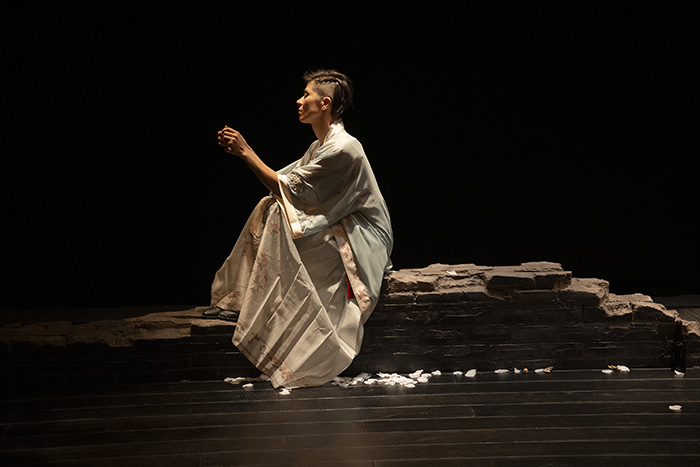
Years earlier, a curse had been placed on this town by a desperate young widow, Dou Yi who was wrongfully executed for committing the murder of a high-ranking officer, Master Huang, ferociously well played by John Ng (Studio 180/fu-GEN’s The Chinese Lady). Before those deadly fired shots left the soldiers’ rifles, Dou Yi proclaimed her innocence, and that her blood would not fall to the earth but rise up and turn a white flag red, that snow would fall in the middle of the summer covering her dead body in white, and finally, that a devastating drought would bring the townsfolk to their knees until her innocence is uncovered and her name has been cleared.
The drought continues years later, devastating the town and its industry, but hope has found its way back in the form of the rich young business woman, Tianyun Lin. But when her young daughter Fei-Fei tries unsuccessfully to stop another superstition being ignored by the Master’s son, Handsome Zhang, solidly portrayed by Michael Man (fu-GEN Theatre’s MH370), the spiritual boundary is broken, giving way to the possibility for the dead to speak truth to power. Handsome, against Fei-Fei’s protest, proposes marriage to his love, Rocket Wu, played with dynamic care by Jonathan Tan (Shaw’s On The Razzle) during what Fei-Fei states is “a dangerous month” for proposals, and the ghost of the executed woman returns, gorgeously and captivatingly down the stairs, demanding justice and the return of honor to her name.
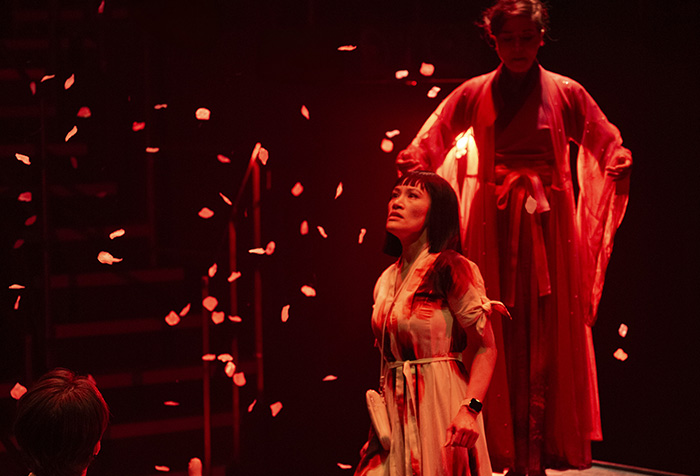
A sleepwalker’s snowy dream of necklaces and love, swearing and swallowing suffering in her superstition, is played out to perfection on the simple structural set, designed cleverly by Camellia Koo (Shaw’s Man and Superman) with stellar costumes by Joanna Yu (Factory’s among men), a subtle yet emotional lighting design by Michelle Ramsay (Theatre Rusticle’s The Tempest), and captivating original music composed by sound design by John Gzowski (Stratford’s The Front Page). The dreamy play of lies, accusations, and death, whether it be from a highway accident or an execution, finds its magical force and power in the unpacking of the mystery at hand.
Enriched with a strong and focused cast, including Kelly Wong (Shaw’s Brigadoon) as the complex Doctor Lu; the detailed Manami Hara (Firefhall Arts’s Courage Now) as both Nurse Wong and Mother Cai; and the other workers and officers of the town: Cosette Derome (Glasswater’s The Queens), Richard Lee (Soulpepper’s Kim’s Convenience), Travis Seetoo (Shaw’s Brigadoon), and Lindsay Wu (Shaw’s On the Razzle), the play majestically sweeps us up in its deeply symbolic, intricate, and engaging tale of redemption and ghostly apparitions. It plays beautifully with our senses, creating energy and suspense all around us as we bear witness to a fascinating funeral procession attended by ghosts and mourners alike, unloading stacks of offerings layered with guilt and sorrow.
Cowhig’s Snow in Midsummer is the shockingly engaging theatrical prize of the season, drawing us in with its magical unveiling and culturally compelling storytelling style that illuminates honor and compassion. It unravels a dynamic mystery before our eyes, and I almost fell off my seat as I leaned in with such intentional interest to the story of the snow maiden and her ghostly demand for justice.

The same, unfortunately, can not be said of the other murder mystery currently getting its world premiere at the Shaw Festival‘s main stage. In what should have been the masterful mystery of the season, Sherlock Holmes and the Mystery of the Human Heart, overly written by Reginald Candy, arrives feeling old and weathered from the start, with an unfortunate monologued beginning that failed to elicit excitement, to the drawn-out ending that is meant to be more electric than it actually is. Candy, a playwright unknown on these shores and credited with a few obscure plays including another Holmes mystery, Sherlock Holmes and the Great Australian Bite, seems to be as much (or maybe more) of a mystery than his clumsy play.
The mystery revolves around a series of murders where only a severed “harvested” human heart has been found, left on display for Sherlock’s inspection. And even though the hearts look as plastic as a dog chew toy, the mystery of who is at the center of this murderous web is what causes the legendary crime-solving detective, portrayed by Damien Atkins (Soulpepper’s De Profundis…), his trusted confidant and friend, Dr. Watson, played charmingly by Ric Reid (Shaw’s The Hound of the Baskervilles), and the formidable Mrs Hudson, the landlady of 221B Baker Street, played to perfection by Claire Jullien (Shaw’s The Shadow of a Doubt), to spring forward, dashing into the streets of London with a sense of purpose and force. If only we felt the same.
Whether wanted or not, Sherlock comes to the assistance of Inspector Lestrade, played admirably by Sanjay Talwar (Stratford’s Macbeth). Yet, Holmes seems to be more focused on the intellectual web than the personal tragedy that is laid out before him. No surprise here, as his emotional disconnection has been made infamous by more actors than one can count on one’s hands. Most recently, the phenomenally good Benedict Cumberbatch (partnered with the equally brilliant Martin Freeman as his Dr. Watson) has made those personal emotives legendary and psychologically nuanced in the excellent 2010 TV series, “Sherlock“. Elementary and quite logically, it’s no surprise that Atkins, who is both a very talented and somewhat similarly framed young actor, was wisely drafted to play the iconic part hoping to create the same exciting electricity that the television series brought to the iconic character. And he does his best, trying to find the right balance of off-putting indifference, his surprised internal amazement around emotional attachments, and later understanding of his hidden emotionality toward his two most cared-for cohorts. It comes across, this complex contradiction, as much as the play allows, thanks to Atkins, but it’s not quite enough to make us feel any which way about the legendary detective and this tale, even though we try our best to channel that connection from elsewhere.

The framing is definitely not enough to save this over-stuffed, overly-long mystery, that is less about the murders than about the clash between a spider and its prey. And, just to be clear, the prey isn’t the humans who are being murdered, but the master detective himself. And the spider, as played by Johnathan Sousa (Tarragon’s Withrow Park), doing his best Andrew Scott impersonation (admirably), is equally legendary, with a strong surprising assist by Sophia Walker (Soulpepper’s The Heidi Chronicles) as his Miss Vespertine Hunter. “This is the endgame, Watson. Night falls, and the spider reveals himself.”
Played out on a handsome, but overly complicated and far too literal set, designed by Ken MacKenzie (Crow’s The Wrong Bashir), with well-mannered lighting by Bonnie Beecher (Stratford’s Something Rotten!), and distractingly unbalanced moody music and sound design by John Gzowski (Canadian Stage’s The Flood), the cat and mouse game that takes a while to get going, finally arrives in Act Two. And surprisingly, it’s a long-winded seated tea talk that fails to keep us engaged or interested. “There has to be a meaning?” they ask of one another. But “does there?“, “humans are not predictable“, we are told, but does the play have to be so equally meaningless and slow? And does that sword fight need to feel so unthreatening? (I only hope it gets better and more exciting in time.)
Act Three, we hope, shows signs that some action might be in store for us, mainly because of the shifting of location and the threat of a fight to the death, but alas, we are mistaken. The play continues to “chip away” at our patience, creating overly wordy moments over tea breaks between characters that only distance us from the drama. A few fascinatingly new characters and frameworks were created for our pleasure with the play’s female characters being given a stronger positioning in the logical mind games presented. This is particularly true in Jullien’s more feisty and sharp Mrs. Hudson and Walker’s surprising Miss Vespertine Hunter. Rais Clarke-Mendes (Outside The March/Factory’s Trojan Girls…) as the Inspector’s observing sister Amelia, as well as Nehassaiu deGannes (Shaw’s The House That Will Not Stand) as the fascinatingly focused coroner, Mrs. Allstrüd, deliver a brainy, driven female-empowerment commentary that is fresh and engaging. Their back story of how each of them came into these positions of respect suggests an exciting future for these women, matching the usually male-centric formula that typically lives and breathes inside a Sherlock Holmes mystery. These female actors are all quite fantastically interesting and deserve to be at the center of their own detective story, rather than assisting these stuffy men who stand in the spotlight of their own intense psychology. Enola Holmes would have been thrilled.

But back to The Mystery of the Human Heart, Atkins, looking the part in predictable and suitable costumes by Hanne Loosen (Shaw’s Flush), is as wonderful in the role as one could be inside this intricate, but overly fussy mystery web overwhelmed with far too many “words, words, words“. The excitement and energy sadly vanish quite quickly as the set reforms itself over and over again, stalling the action and the actors regardless of how much music and busy work is thrown at us by director Craig Hall (Theatre Calgary’s The Mousetrap). The whole thing feels like a missed opportunity, mainly because of the production’s slow pacing, poorly orchestrated staging, and stoggy writing; flaws that the wise Sherlock Holmes could easily detect and solve if given the chance. The cast of pros do their darnedest to make it compelling, but logging in at almost three hours, this Sherlock play needs a reformation of the highest degree, refocusing itself on the true heart of the mystery and the man. Much like what Reid’s Dr. Watson keeps poking at Holmes to do. And what playwright Cowhig has unearthed beating solidly in the chest of her thrilling adaptation, Snow in Midsummer. This is a murder mystery we were completely engrossed by, feeling its blood pounding intensely through the play’s ghostly veins. The other true mystery of the Shaw Festival is why no one saw the lack of blood in the problematic Sherlock play and did something to stop its murder.

 front mezz junkies
[…] old-fashioned and formidable father, Mr. Burgess, played forcibly by Ric Reid (Shaw’s Sherlock Holmes and the Mystery of the Human Heart)). Their combative nature finds numerous dynamic flavors to engage with in that rectory setting […]
LikeLike
[…] The Shaw Festival Part Two – More Amazing Mystery in Midsummer than in Sherlock: “Snow i… Emily Anne Corcoran and Anthony Goncharov in Icarus Theatre’s Constellations. Photo by Desmond Lazar. […]
LikeLike
[…] captivatingly portrayed by Sochi Fried (Shaw’s Candida) and Richard Lee (NAC/Shaw’s Snow in Midsummer), in hopes that they will aggressively point out any problems and inconsistencies in the speech she […]
LikeLike
[…] and compassion by Howland’s Courtney Ch’ng Lancaster (Crow’s The Wolves; Shaw’s Snow in Midsummer), the gendered response to pregnancy is only the beginning of this thoughtfully written exploration […]
LikeLike
[…] by Ming Wong (Crow’s Rosmersholm), dynamic sharp lighting by Michelle Ramsay (Shaw’s Snow in Midsummer) and a somewhat difficult sound design by Brian Kenny (The Musical Stage Co’s Kelly V. Kelly) […]
LikeLike
[…] within those years and those conflicts. This is particularly true for Michael Man (Shaw’s Snow in Midsummer) in his loving full portrayal of Mitsue’s love interest and future husband, Hideo, as well as […]
LikeLike
[…] the great and powerful lion, Aslan, portrayed by the game and steady Kelly Wong (Shaw’s Snow in Midsummer). He stands proudly before us, determined to roar, but the poorly concocted costume fails the […]
LikeLike
[…] as created and hosted by the incredibly charming and gifted impresario, Travis Seetoo (Shaw’s Snow in Midsummer), with a strong assist by the equally appealing Cosette Derome (Globus Theatre’s Halfway […]
LikeLike
[…] Sarah Undershaft (who also plays Jenny Hill), portrayed cleverly by Lindsay Wu (Shaw’s Snow in Midsummer). Like Barbara, Sarah is engaged to Charles Lomas (who also portrays Bill Walker), played […]
LikeLike
[…] namely Kristopher Bowman (Shaw’s Witness for the Prosecution); Cosette Derome (Shaw’s Snow in Midsummer); Sochi Fried (Crow’s Wights); Virgilia Griffith (Crow’s Rosmersholm); Martin Happer […]
LikeLike
[…] namely 郝邦宇 Steven Hao as Snug, Aaron Krohn as Francis Flute, Sara-Jeanne Hosie as Snout, and Michael Man as Robin Starveling, finds plenty of laughs in their preparation of “Pyramus and […]
LikeLike
[…] The character is ridiculous in ways that the play is happy to expose, yet Man (Shaw/NAC’s Snow in Midsummer) also allows us to see the vulnerability underneath the pretension. I must admit I fell in love […]
LikeLike