The Stratford Theatre Review: The Diviners
By Ross
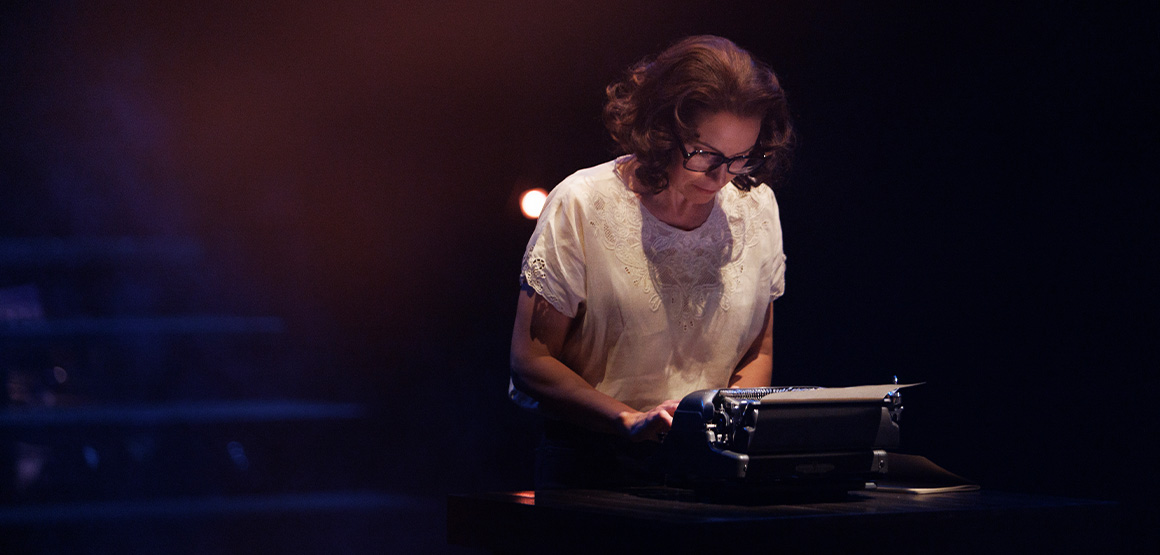
On that long, elegant thrust at Stratford Festival‘s Tom Patterson Theatre, a fiddle parade of characters moves into place, setting up the stompingly good formula for this tender, emotional unpacking. Within the fluidity of time and place, The Diviners, a new play based on the epic novel by Margaret Laurence, tries to find all kinds of ways to divine in this river that flows both ways. We are transported magically by the tapping on the wooden bleachers and the typing that takes place center stage, drawing us beautifully into the focal point of this complex tale.
Written poetically with force by playwrights Vern Thiessen (Of Human Bondage) and Yvette Nolan (The Unplugging), The Diviners seeks to find salvation and epic connectivity in Laurence’s captivating and epic story that shifts and reforms itself in a moment’s notice. As directed with an inventive energy by Krista Jackson (Shaw’s Dancing at Laghnasa) with Geneviève Pelletier, and assisted in their formulation by choreographer Cameron Carver (Stratford’s La Cage Aux Folles), the piece speeds into the text, sometimes shifting in ways that distant and distract us from the core emotional language that emanates from the source material. But also finds moments of pure emotional connectivity.

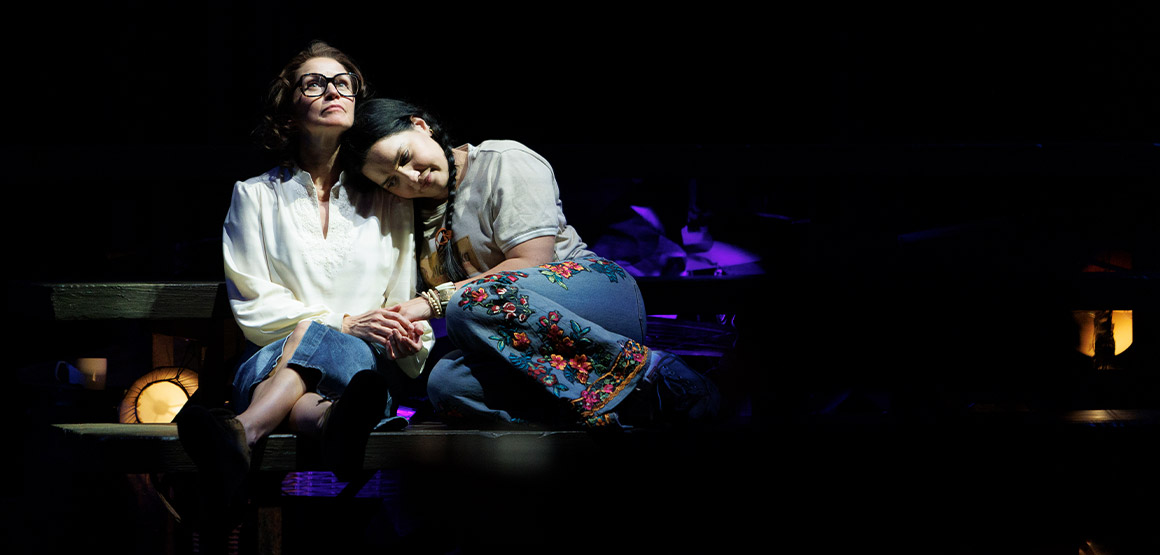
Margaret Laurence’s heroine, Morag, portrayed clearly and forcibly by Irene Poole (Stratford’s Les Belles-Soeurs), shifts time and place with a change in posture and voice. It’s sharply defined but, at least within the first half of the play, feels somewhat stilted and inauthentic. The whole first act is a tad muddied, with dialogue between her and the others falling flat and difficult to take in. There’s also an Indigenous woman in red who wanders in and around the action, playing with our curiosity. Who is she? And where will she be leading us? This piece of the puzzle takes too long for us to figure out, and when we do, it doesn’t have the power we were expecting or hoping for.
But the engagement created between Poole’s Morag and her caretaker, the rough-around-the-edges Manawaka native, Christie, played beautifully by Jonathan Goad (Stratford’s Spamalot), is the one cornerstone that holds us in. It feels as honest as can be, especially as he tries his best to be her adoptive father figure in a town that shuns him for being the garbage collector. Our connection to this man is one of the strongest, and we feel his desire to take care of the orphaned Morag as best as he can, knowing he doesn’t really have the skill set required. We feel his anxious desire to be a good parent, and we connect to him almost instantly.

Within his storytelling and caretaking, The Diviners finds its emotional core and connection to Morag’s historical roots. Along with her deeply felt friendship with the modern-day well diviner, Royland, played engagingly by Anthony Santiago (Stratford’s King Lear), Morag’s network of friends feels inspiring and emotionally true. It’s when it flies out and around her wandering and rebellious daughter, Pique, played by Julie Lumsden (Shaw’s Gypsy), where The Diviners loses its way and trips over its own attempt to be profound.
It’s an ambitious task, this translation from page to stage, and even in its Act One unevenness, the heart stays solidly beating underneath that typewriter. It’s sharply jagged and fascinatingly non-linear, delivering an emotional pull equal to the need of novelist Morag Gunn to confront and unpack her past as she attempts to pen her latest novel. There’s a side shot of an activated publisher who is pushing for Morag to complete her new novel, and although it adds tension, it does feel a bit simplistic in tone, like many of the formulations presented that linger around the main task at hand.
Maybe it’s too much to ask, to take all of the novel and bring it fully to the stage. I wanted to be swept up and down the river of this memory mix, but it fumbles on that path. Especially in Act One. That is the trouble with using such an iconic masterpiece as the source material. Anything left out will be noticed, but the sea of memories is enough to draw us in. Yet, thanks to the fine creative team; consisting of set and lighting designer Bretta Gerecke (NYTW’s american (tele)visions), costume designer Jeff Chief (Vertigo’s Gaslight), composer Andrina Turenne (NAC’s Wild West Show), and music director and arranger MJ Dandeneau (PTE’s Space Girl), the river of Morag’s life flow basically smoothly, bouncing around some rocky terrain that gets in the way, but eventually finding the pool of care and emotional truth at the end.

In Act Two, the play finally finds its emotional center and narrative, confronting the past and her complications with the men in her life. First, there is her childhood sweetheart, Jules, played true and captivating by Jesse Gervais (Native Earth Performing Arts‘ Women of the Fur Trade), who finds his form more as an adult than as a teenager. That’s true of Poole’s Morag as well. Then there is her condescending first husband Brooke, played by Dan Chameroy (Stratford’s Something Rotten!), who has to deal with some pretty hard-to-form lines that are met with shock (and a few groans). His character is unjustly weighed down by some heavy-handed writing with little to no shades of grey. Therefore, their marriage never really gels, forming too quickly and unraveling almost instantaneously in somewhat of a stereotypical, surface-leveling manner. It doesn’t feel as honest as many of the other attachments in Morag’s life, leaving that snippet feeling typed in, rather than lived.
Inside Thiessen and Nolan’s complex narrative, the adaptation mostly captivates us, especially in the stronger second act. In that framing, the original story starts to come together, gracefully and emotionally. There’s a touching connection to the Métis heritage that lives inside Jules’ family, fleshed out by his father and sister, touchingly well played by Josue Laboucane (Stratford’s Much Ado About Nothing) and Caleigh Crow (Stratford’s Cymbeline). There are also some well-choreographed dance sequences that feature dream-like sequences to the sounds of fiddle player Darla Daniels. Dancing us through and bouncing us back and forth from past to present, and sometimes to fables and campfire origin stories, The Diviners lives in the tangled construct that doesn’t feel so split in the end. It discovers the well full of peace and connectivity that it has been seeking throughout.
 front mezz junkies
[…] by the wonderful musician/singer Amiens, beautifully played by Gabriel Antonacci (Stratford’s The Diviners). Through truth, loyalty, and song, the masterful cast transform their harsh reality into new […]
LikeLike
[…] with the debonair Lawrence Jameson, portrayed charmingly by Jonathan Goad (Stratford’s The Diviners), as he swindles and charms his way to riches, making it up (gloriously) as he goes along. He uses […]
LikeLike
[…] Swinging herself out, headached hungover, and all, is their orphanage keeper, the deplorable Miss Hannigan, deliciously embodied by Laura Condlln (Stratford’s Twelfth Night). “It’s medicine,” she flatly and hilariously states as she guzzles down some hair of the dog, spoken unconvincingly to a room full of her orphaned “brats”, with the “Little Girls” responding, perfect in pitch and edge, “you must be very sick, Miss Hannigan!” And a smile comes over our face (if it wasn’t there already), steadfastly remaining until the final scene. We couldn’t be more happily content in the unmistakable, unmissable production of Annie, especially when the gorgeous Grace Farrell, played glowingly by Jennifer Rider-Shaw (Stratford’s Spamalot), twists the frustrated Miss Hannigan into knots, like an expert balloon artist. She fantastically forces her hand in ‘allowing’ her to rescue the wide-eyed Annie and rush her away from the orphanage into the surprised hands of Oliver Warbucks, lovingly played by an excellent non-bald Dan Chameroy (Stratford’s The Diviners). […]
LikeLike
[…] by Joe Perry (Stratford’s As You Like It) and Gabriel Antonacci (Stratford’s The Diviners). As young men, they show us the ignorance of racism, before throwing them into a certain type of […]
LikeLike
[…] something akin to a Greek chorus, the gossips (Christopher Allen, Jenna-Lee Hyde, Celia Aloma, Jesse Gervais, and Julie Lumsden) fill in the gaps and societal commentary with glee, although the costumes, […]
LikeLike
[…] happily with the debonair Lawrence Jameson, portrayed charmingly by Jonathan Goad (Stratford’s The Diviners), as he swindles and charms his way to riches, making it up (gloriously) as he goes along.” […]
LikeLike
[…] Beaty (Stratford’s Much Ado About Nothing) as Penelope and Irene Poole (Stratford’s The Diviners) as multiple Greek gods and heroines, will bring to life under the visionary direction of Jackie […]
LikeLike
[…] fully be able to convey that level of truth in destruction?‘ asks playwright Yvette Nolan (The Diviners). Or does a medium like film carry that burden in a more focused, real-time way? “It needs to […]
LikeLike
[…] by Irene Poole. Starring Maev Beaty, Tabitha Campbell, Ijeoma Emesowum, Gordon Miller, and Benedict […]
LikeLike
[…] director, Krista Jackson (Stratford’s The Diviners) is known to Grand audiences for a fast-paced and deliciously dark laugh. This London-made […]
LikeLike