The Toronto Theatre Review: Tarragon Theatre/Modern Times Stage Company’s Craze
By Ross
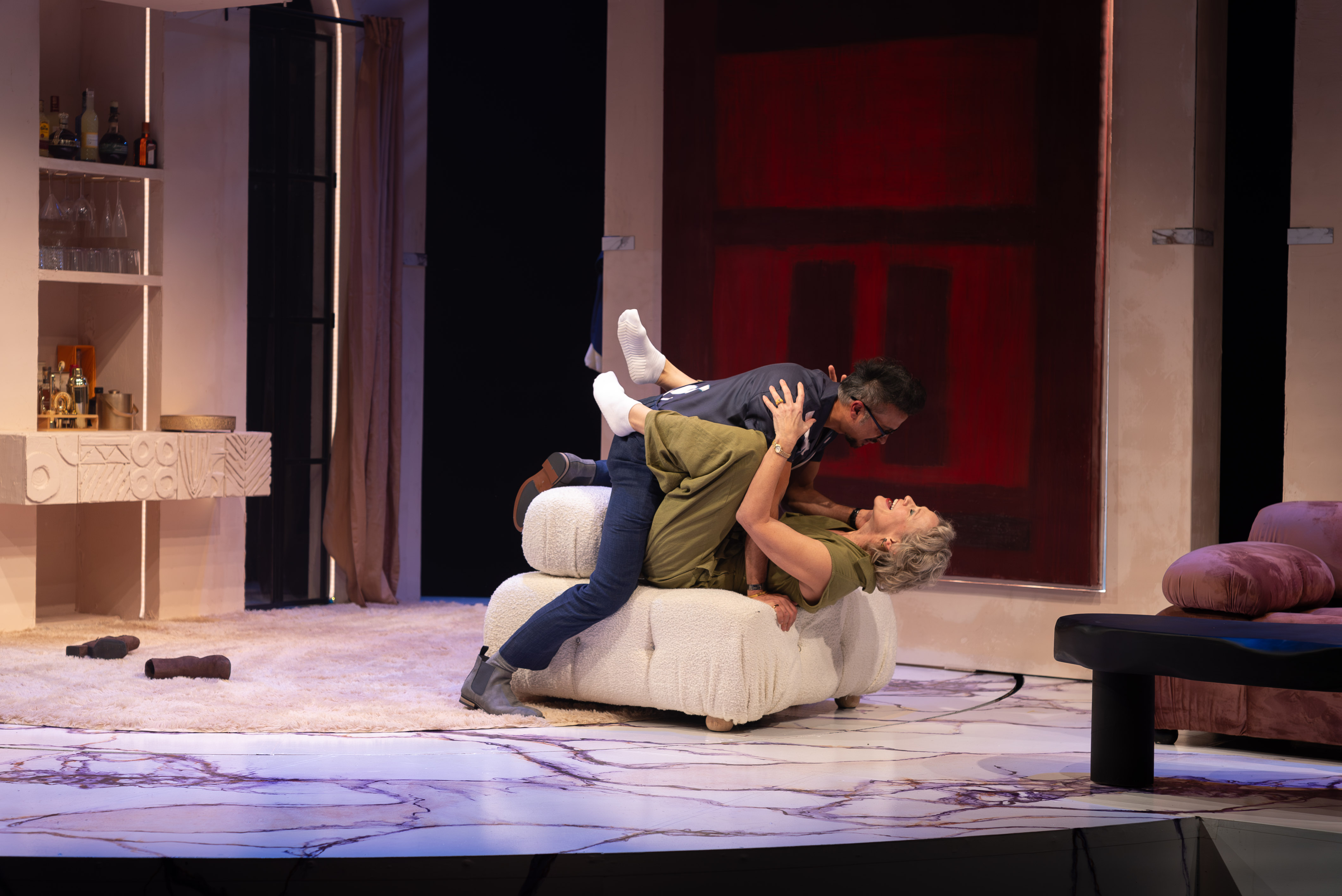
A deliciously dark mock Rothko hangs ominously on the back wall of the sometime-in-the-future livingroom, designed dynamically by Christine Ting-Huan 挺歡 Urquhart (Shaw Festival’s The Orphan of Chao). It hangs with intent, giving us everything we need to know and understand about Tarragon Theatre and Modern Times Stage Company’s co-production of Craze, a new play by Rouvan Silogix and Rafeh Mahmud (The Caged Bird Sings) that lives and breathes in the profound and abstract. The painting, like the play, is beautifully created, dynamic in its contrasting colours, with complexities that would make it difficult to digest, and filled with metaphoric meaning that doesn’t jump out at you or lead you by the hand through its desert scenes and fractured thought process. And in that swivel red and black framing, we are captivatingly embraced as we are driven a bit mad by its abstractionism and its stunning but conceptualized approach to art and its creation.
In association with Theatre ARTaud, Craze digs into the Inferno that is at its abstract framed and marbleized core. Battered from the inside out as directed with a clever tight nudging by Mike Payette (Tarragon’s Cockroach), a well-off couple scratches at each other with mad intent after a torrential hurricane tornado storm cuts a rooftop agency party short. They are ordered home by the storm, where husband Renee, distinctly portrayed by the appealing Ali Kazmi (Tarragon’s Behind the Moon), and his power-wife June, fascinatingly portrayed by an electric Lisa Ryder (Bald Ego/Nightwood’s A Blow In The Face), fling themselves with a tense drunk passion into their secured mansion in a safe Toronto neighborhood. June sings an aggressively playful (or playfully aggressive) song about gentle raindrops falling on her head, only because the two feel protected from the outside world behind gates and a computer system named Buddy designed to keep them fully informed and safe from the storm blowing furiously outside.
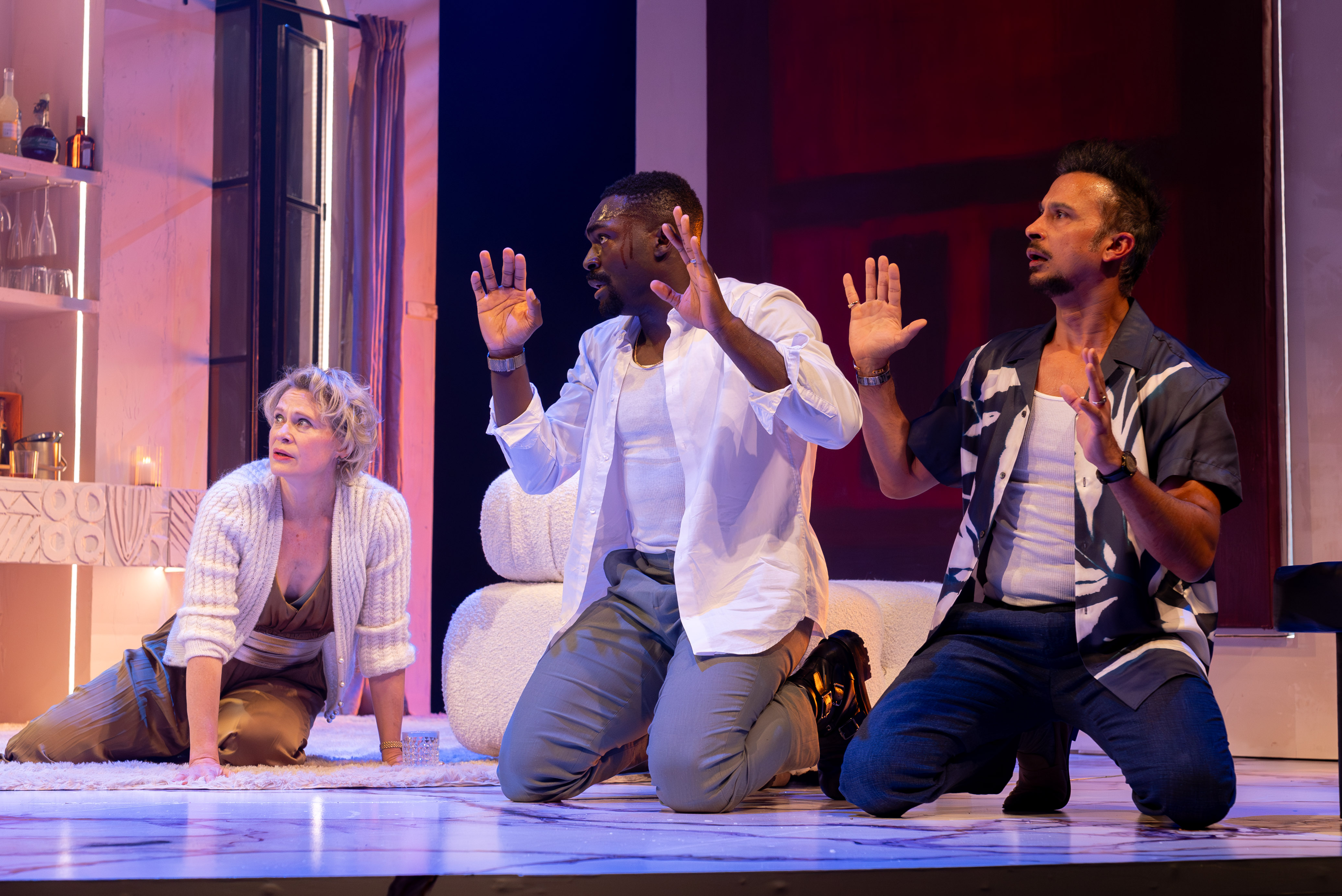
But a different kind of out-of-control storm is brewing, one that is possibly more dangerous, disturbing, or violent than what is keeping them locked within. We watch the two fling themselves at and away from one another late into the night. Stiff drinks or pancakes, Renee wonders out loud. This is the question proposed by the “no-fun brown guy“, who is either “sweet or irritated” depending on the function and the framing. The dialogue doesn’t flow as freely as one would expect from this type of setting and set-up, but the electricity that lights up the space from the storm outside, made alive and threatening by the superb lighting design by Arun Srinivasan (Stratford’s Much Ado About Nothing) and combative sound design by composer Maddie Bautista (Stratford’s Les Belles-Soeurs), is matched in forceful sexualized terms from within and between these compelling creations.
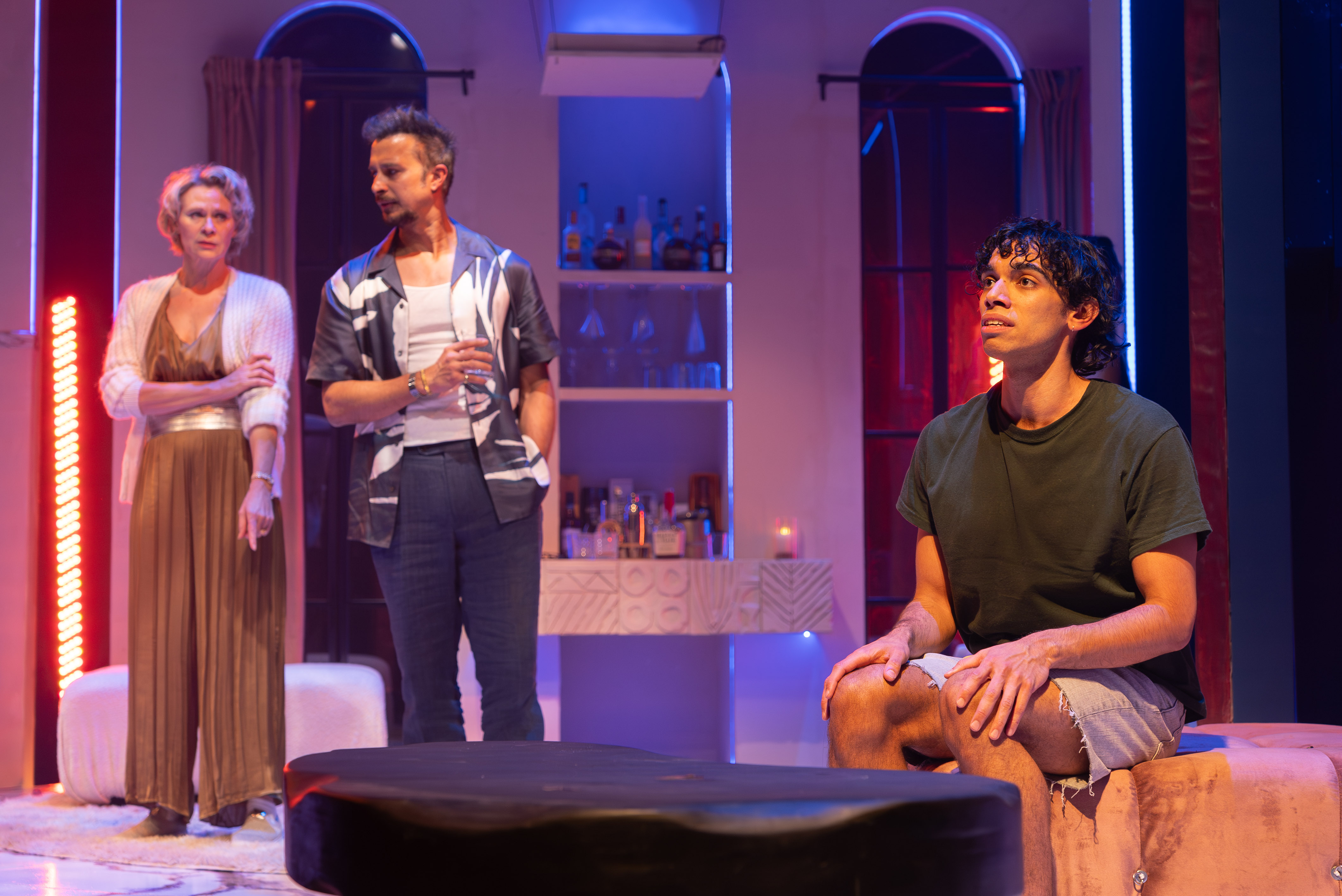
A couple has been invited over, much to Rene’s surprise and dismay, giving echoes and parallels to the soon-to-be-presented Who’s Afraid of Virginia Woolf? (at Canadian Stage in January – I can not wait!). The imbalanced power dynamic is all there, as is the sexual tension, just like Albee’s Wolff in the form of a new employee at June’s advertising firm, Selina, played in divine detail by the waiting warrior Louisa Zhu (CanStage’s Dream in High Park), and her handsome doctor husband, Richie, embodied powerfully by Kwaku Okyere (Buddies in Bad Times’ Roberto Zucco). June, with an AI assist from Buddy (Augusto Bitter), pokes hard at her young husband as their arrival time approaches, stating that on a scale from one to ten, Richie is an 18. It feels perfectly aligned to the construct, playing with all the dark tender wounds that reside between partners and lovers, polyamorous or not, young and old, but just like the iconic George and Martha in Albee’s iconic play, the jabbing feels completely harsh and utterly disturbing, as if each is out to win in a war with no rules.
It’s a formula that served that Albee play so well, especially when the final thrust is revealed, and that main secret feature also storms this Craze castle midway through, although in its own uniquely painted way. Created by Rene and embodied by the compelling Augusto Bitter (Buddies in Bad Times’ White Muscle Daddy), the secret is thrust forward after hiding in the background, already heard, but not yet seen. He jumps out armed and ready for engagement, in a manner that Albee could have only fantasized about in the abstract. And none of us, including these characters are ready for the rewinding that follows.
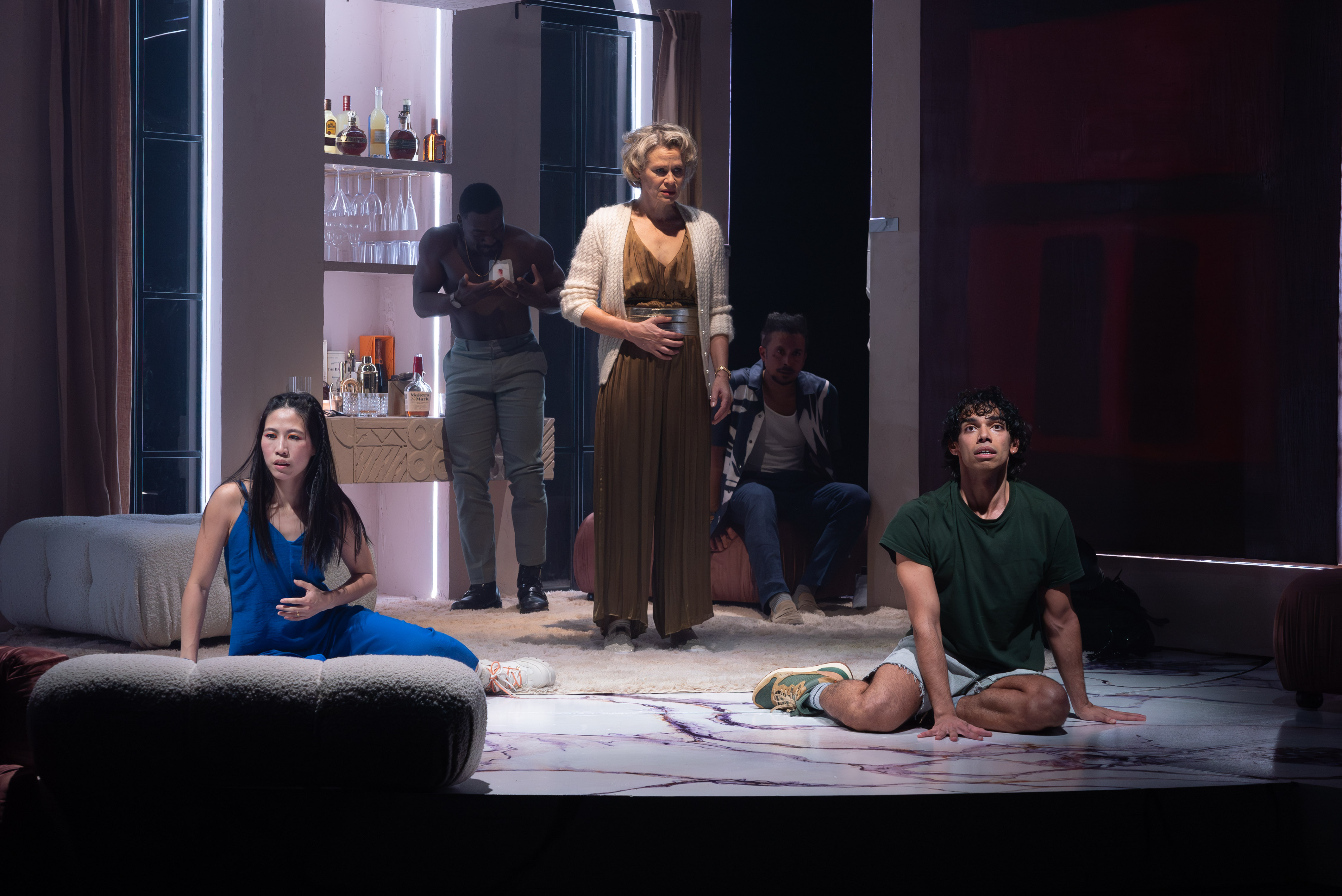
The tweaks to the formula and the unraveling are processed like a divine comedy played out on a VCR tape with the playwrights holding the remote. It turns us back and forward in time, wrapping itself up in AI contemplations, and unraveling the ideas of emotional trauma and loss in slow-motion sitdowns in this space and across the globe. Much like Albee’s George and Martha, and their vindictive dynamics and attacks at anyone who tries to comfort, the play beats at us with a “BOOM, POP, BOOM,” from the ninth circle of hell, brought into focus by a power surge and some ridiculous banter interrupted by alarming banging at the door late at night. The storm wants to come in, it seems, unannounced and unwilling to be ignored, in the same way this play is equally unwilling.
Pistols go off in jest, while the results of alcohol and meddling with AI play havoc with the room and its inhabitants. Craze is a maddening adventure into dynamic reframing and impulsive abstractionisms, played out in forced incohesive and sharp shards of heartbreak and anger. It storms hard and forward, ceaselessly engaging with frameworks that don’t follow form and a sense of realism. AI makes its presence known with the voice of Buddy and the body of Alex, hovering dangerously around the room like drones looking to drop explosive truths on unsuspected civilians. The play seems out of control, and hard to comprehend, even with this cast giving it their all,. But somewhere in the chaos is a fragmented metaphor that, like the painting, will give individualistic meaning to some, while others may look at Craze in the same way one might look at a modern piece of art in a museum, giving it a confused shrug before moving on to a possibly more symbolically respected piece of art, like a Picasso or an Albee. I dare you to stay put and attempt to see what Craze means to you, as crazy as that may seem.
 front mezz junkies
“Craze” is blatant plagiarism. From the opening scene of a married couple, somewhat drunk, coming home from a social event. She has invited guests over (it’s 1am). The dialogue….the set-ups….for god’s sake, the rifle that shoots a small flag. Her father is wealthy. The husband is weak and basically a failure. Line after line, word for word, whoever ‘wrote’ this monstrosity has stolen from Edward Albee and presented it as their own. This is not an homage…this is flat out theft. The dialogue is so turgid that the audience often tittered at just how ludicrous it was. And poor Ali Kazmi. A truly gifted actor forced to scream for 90 min and say lines that even a high school writing class would reject. I hate anyone talking during a performance, but literally within 10 min those around me were whispering their dismay….and possibly their disgust….at what they were witnessing. The woman in front of me actually tried to leave but her friend insisted that would not be acceptable, so she suffered through…..and let it be know just how much she was suffering. I have never once walked out during a performance….but I certainly felt her pain. I thought “The Thanksgiving Play” would be the worse thing I’ve seen this year. Not so….this is even worse than that horror show. I’ve seen many dozens of shows over the years at Tarragon. This is the first time I have ever been both embarrassed for them, and ashamed of them. Unprofessional and unethical. And just plain bad theatre.
LikeLike
[…] Sarah Murphy-Dyson (Low Rise’s Her Inside Life), Kwaku Okyere (Tarragon’s Craze), and Kaleb Tekeste (Vertigo’s Clue) as fellows and emotional mirrors; find power in their […]
LikeLike
[…] Mahmud, and Ahad Lakhani, and directed by Rafeh Mahmud (Tarragon/Modern Times Stage’s Craze), The Caged Bird Sings comes to light on June 9.Tarragon is pleased to partner with two […]
LikeLike
[…] Salesman in China), and a clever sound designer/composer Maddie Bautista (Tarragon’s CRAZE), The whole cast dons numerous hats, dressing gowns, and jackets, heroically designed by the […]
LikeLike
[…] Wrinkle in Time) complemented by careful lighting by Arun Srinivasan (MTSC/Tarragon’s Craze) and a solid sound design composed by Richard Feren (CS’s The Inheritance), Dangerous Liaisons […]
LikeLike
[…] played with magnetic intensity by the always magnificent Kwaku Okyere (Tarragon/Modern Times’s Craze), to his lover Dustin, portrayed with fragile, fascinating restraint by Justin Eddy […]
LikeLike
[…] at Tarragon Theatre. Directed with quiet intensity by Mike Payette (Tarragon/Modern Times’s Craze), the play moves like a shifting fever dream between myth and reality, asking whether the woman […]
LikeLike
[…] in the fall with the world premiere of Prophetess, written by Ho Ka Kei (Jeff Ho) and directed by Payette. Inspired by Shakespeare’s history plays, the production promises a striking and imaginative […]
LikeLike
[…] and flashes of vulnerability that cut through her bravado. Augusto Bitter (Tarragon’s Craze) brings a gentle, searching quality to Rafael, whose desire to connect, particularly with Letitia, […]
LikeLike