
The Toronto Theatre Review: Canadian Stage’s Winter Solstice
By Ross
It’s Christmas Eve in this tight, taunt, twisted comedy of manners, brought to the Berkeley Street Theatre stage at the perfectly attuned time in history by Necessary Angel Theatre Company. What is at the core of Winter Solstice, audaciously written by one of Germany’s most frequently produced playwrights, Roland Schimmelpfennig (Arabian Nights), is something a whole lot more compelling than just that framing. Written in response to the rise of the new political Right in Europe, the play is a dynamic commentary on complicitness and blind acceptance when coupled with charm and personality, and there’s no way to view this complicated and sometimes distancing play without layering in what is happening south of the Canadian border. And hopefully not coming here this year.
It’s impossible to ignore the comparison as I write this review on the day after the Inauguration of that horrific man as the first felon to lead the United States, a misnomer for a country if there ever was one, especially at this moment in time. The tension that vibrates in the theatre connects quite directly to the feeling that overwhelmingly exists in the world today as we watch a man who seemingly embraces fascism rise to this powerful office. It is palpable and intense watching this play with that knowledge sitting in the back of our minds.

In this solid translation by David Tushingham (Mr. Kolpert), we are ushered through, gently, by a narrator, carefully portrayed by Frank Cox-O’Connell (Coal Mine’s Hand To God), who eventually becomes an active artistic participant. And as we watch the unraveling begin, there is an uncomfortable, tense conflictual engagement of a couple; Bettina and her husband, Albert, played forcibly by Kira Guloien (Stratford’s Tommy) and Cyrus Lane (Stratford’s Much Ado About Nothing), bickering with middle-class passive aggressiveness. They throw blame and accusations at each other in an attempt to break a stalemate that seems to be made of the same hard cold material that set and lighting designer Lorenzo Savoini (Stratford’s London Assurance) has used to create this modern arena for this battle to be played out within. They mainly throw finely tuned barbs at one another with growing frustration and contempt, all centered around the recent arrival of Bettina’s problematic mother, played to perfection by Nancy Palk (Tarragon’s Withrow Park). It’s authentic resentment played out in detailed form, mainly about how Bettina escaped the moment by pretending to be involved with an important phone call about her film work. The scene is powerfully uncomfortable, painted with dexterity and clarity by the narrating soul who stands nearby. It’s effective, while also somehow slowing down the proceedings and making us sit back and wait for the ultimate conflict that we feel is quickly approaching.
A crash is heard, off stage but nearby, but no one seems to want to take responsibility for it, at least in those first slowly unwinding scenes. The shattering feels appropriate and ominous, much like the brutal way these two converse around complicated interpersonal interactions, and it only heats its way upward when a gentleman stranger by the name of Rudolph, played dynamically by Diego Matamoros (Crow’s Bad Roads), turns up at their door and strides forward out of the escalating darkness into the light of the hallway. He has been invited, surprisingly by Bettina’s mother, Corinna, to join them for Christmas Eve after the two casually met on the stalled train that was bringing the mother to Bettina’s for the holidays. Corinna, knowing that she is not exactly welcome in her daughter’s home, was completely charmed by the gentleman’s chivalrous, sharing compassion and elegance. Overwhelmingly impressed by him, she dove right in, not wanting to think about him being left all alone on Christmas Eve. So even though she knew it would rattle her tightly wound and controlling daughter and her husband to the bone, she invited him into the fold, unannounced with a casual air of entitlement and obliviousness.
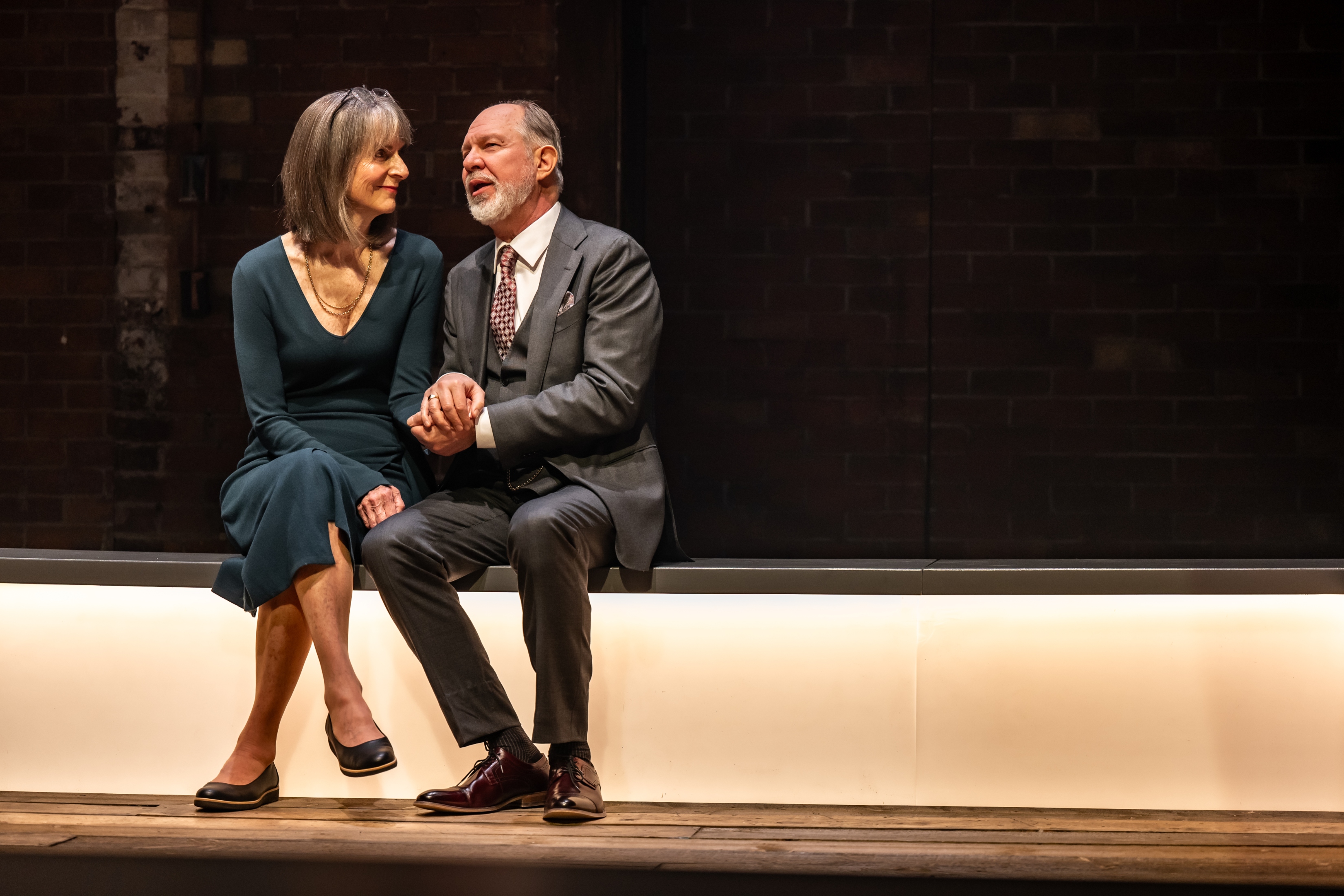
Rudolph isn’t exactly welcomed into the home either. Yet he remains, out of the forced politeness of Albert, charming the crowd with his intelligence, gentility, and his musical talent on the mimed piano. We can completely understand why he would be so embraced in that tense environment, winning over most of those in attendance, and gathering up the hearts of the majority. Yet we also feel the impending bad energy and dread that slowly ignites in Albert. But there is a complication. We can’t quite make out if this paranoia is due to some medicinal machination created by a casual and greedy ingestion of numerous pills aimed at helping Albert ‘feel’ better. Yet, Albert registers something no one else sees in the character of Rudolph. We also sense it, and also question it. Is it real or a hallucination brought on by his ever-worsening physical state? Is Rudolph the monster Albert sees? Or is he loosing his ability to comprehend reality?
This tension spins in, out, and around itself, as we make our way through a Christmas Eve of tree-decorating and sitting down for a polite meal, all within the framed modern rectangle that represents their modern home space that has been invaded by a stranger whose rhetoric is slowly becoming more ferocious and fascist-sounding with every tensely wired moment. Directed with intent by Alan Dilworth (Soulpepper’s Mother’s Daughter), the historian-centered Albert is either spinning inside his delusional brain an idea that sits in opposition to everyone else, or he has picked up on a narrative that charm and musical talent has masked from the others. The framing, as escalated within that elongated room, dynamically registers as something very similar to what happened in America, and in that symbolic context, no one can ignore the racist, rapist conman.
But I wouldn’t call the orange monster man charming like Rudolph, but I would call him strange, and like Albert, a large part of the population of the world sees through the thin-skinned reality star act that somehow has hypnotized millions of others, leading them to accept all that hate he spews while simultaneously ignoring all the horrific things he says and does as something that isn’t all that significant. Like Albert, we don’t understand how others can’t see who this man truly is. This insidious encounter on Christmas Eve hangs heavy on our hearts, even with the slow-paced maneuverings that this production embraces.

Winter Solstice is stealthy and subtle in its unraveling, asking us to pay close attention and look past the polished veneer of a gentleman stranger. Schimmelpfennig has said of Winter Solstice, that his “focus was always on the method of the ‘fascist’ seduction.” That this play, in a way, is not about rising up in action against this doctor’s seductive mannerisms; one that loves to play Bach on the piano and is good with children, but of seeing past his “chivalry” into the fascist framings that slowly, and easily start to leak out. The play treats the transition like an easy slow bluffing hand of poker, almost too much so, but it’s also exacting and deliberate. Matamoros embodies the stranger with a graceful perfection, slowly revealing his lethal sincerity and reverence in a winding up fashion of ferociousness. Palk’s older female character, the first to fall under his spell, finds captivating and engaging nervousness in her vulnerable carelessness, shifting her precarious connection to her daughter around her body like the new dress she changed into, courtesy of the strong costuming by Ming Wong (Crow’s Rosmersholm). The other three also present with deliberate and detailed unwindings, filling in the blanks of connectivity with dexterity and clever conviction.
My only real complaint is the subtle disconnection from the carefully crafted momentum, each and every time the narrator speaks directly to us, trying to find drama in the verbal presentation of stage directions and personal character descriptions. It beats us down and makes us sit back, taking us away from the tension that the metaphoric Winter Solstice is trying to establish. Nevertheless, our collective brains are awash with captivating symbolic integration, while also challenging us to stay tuned in to the precise processing that connects this framing with this moment in American (and world) history. The play, courtesy of Necessary Angel in association with Canadian Stage and Birdland Theatre, arrives in a starkly lit rectangle of light that vibrates with a cool sharp appeal, signaling a modern dilemma of epic meaning at precisely the appropriate historic moment as we watch a slimy white supremacist rapist become Felon-President of the United States.

Winter Solstice. A Necessary Angel Theatre Company production in association with Canadian Stage and Birdland Theatre. Jan 14-Feb 2, 2025 at Canadian Stage‘s Berkeley Street Theatre. For information and tickets, click here.
 front mezz junkies
[…] longtime company member Frank Cox-O’Connell (Necessary Angel Theatre Company’s Winter Solstice) directs the Toronto Premiere of Pulitzer Prize-nominated and Tony Award-winning […]
LikeLike
[…] On a very immersive and triangular sharply defined theatrical space, a psychological standoff is what immediately snaps us deep into the emotionally volatile and captivatingly dangerous world of JOB, the thrilling and critically acclaimed play by Max Wolf Friedlich (SleepOver) that is getting a first class, not-to-be-missed production at Toronto’s Coal Mine Theatre. Working this through in real-time, after many blinks and flashes of possible chaotic interactions of various degrees of anxiety-producing standoffs, the play dives in brilliantly to its tense, tight, and tumultuous zooming in on mental health and the workplace, when one young tech worker, played to frayed perfection by Charlotte Dennis (Soulpepper’s The Walk-up) is mandated to seek the services of a crisis therapist, hypnotically well-played by Diego Matamoros (Canadian Stage’s Winter Solstice). […]
LikeLike
[…] James Smith (Coal Mine’s The Effect), and sound designer Debashis Sinha (Canadian Stage’s Winter Solstice), this telling of Anne of Green Gables is exactly the kind of connective engagement that makes […]
LikeLike
[…] (Purpose) about old friends, unfinished business, and the inevitability of reckoning. Directed by Frank Cox-O’Connell, this Canadian premiere takes the playwright’s sharp social wit and turns it toward something […]
LikeLike