The Dublin Theatre Festival Review: The Boy at Abbey Theatre
By Ross
There’s something ever so Greek and tragic in the air lately, as I wrote just yesterday, and I’m not (this time) talking American politics. There seems to be a resurgence of Oedipus, that ancient, deadly wanderer of destiny and blindness, reimagined through wildly different theatrical lenses all over the globe. This year alone, I’ve encountered three versions: the gripping Oedipus on London’s West End (soon to transfer to Broadway), the mischievous, thought-provoking Goblin: Oedipus by Spontaneous Theatre CA at the Stratford Festival, where chaos itself became revelation, and now, The Boy at the Abbey Theatre, presented as part of the Dublin Theatre Festival. Each one grapples with the same impossible question: how do we retell a myth that already knows its own ending? And how do we make it something that beats soundly in our collective hearts?
Written with captivating intent by Marina Carr (Marble), The Boy, as directed forcibly by Caitríona McLaughlin (West End’s The Playboy of the Western World), is only the first of a two-play cycle (paired with The God and His Daughter, which sadly I will not have the opportunity to see) that delves into Sophocles’ Theban trilogy — Oedipus Rex, Oedipus at Colonus, and Antigone. Even as a standalone work, it’s clear that Carr is durifully expanding her long-standing captivation with Greek tragedy and the epic questions they ask. She gives her well-defined characters the wide-open space to step beyond their ancient sources and refract them through a contemporary Irish lens. The result is a heady exploration of morality, punishment, and the lingering belief in powers, divine or otherwise, that still move among us, or play with our lives for their entertainment.
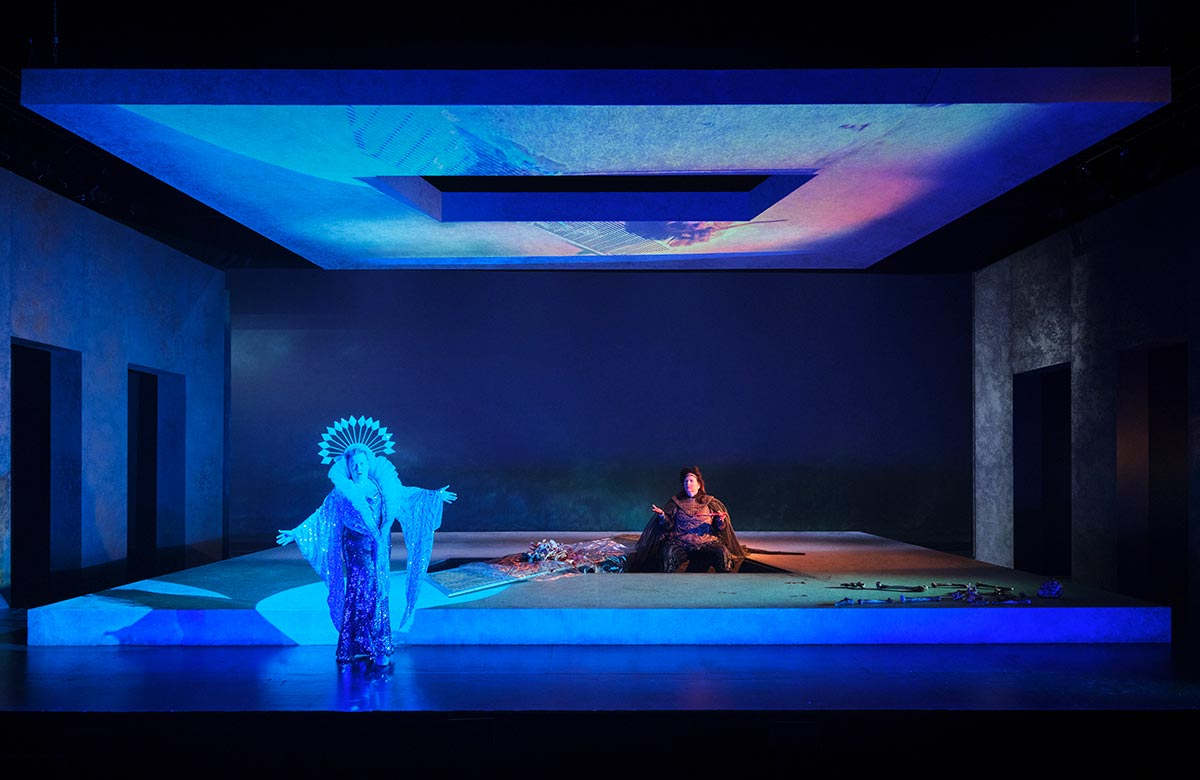
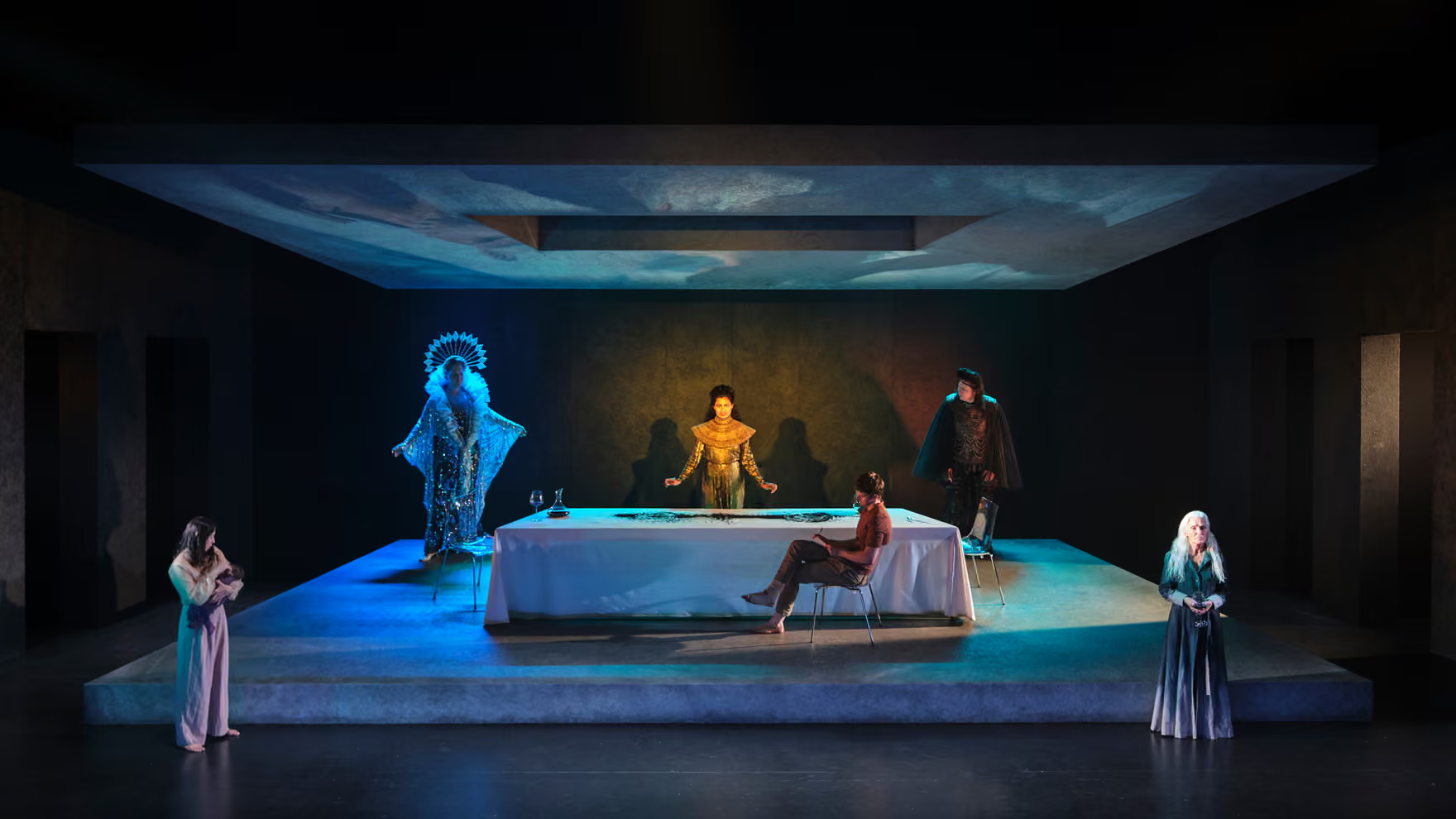
There’s no doubt that The Boy dazzles. Elaborately produced, the staging matches Carr’s ambition, delivering something both wildly epic and sensually charged. Shimmering silver curtains glide across the stage repeatedly, revealing Cordelia Chisholm’s monumental and classical design, a raised stone slab standing solidly below a suspended ceiling, orchestrating the boundaries between both Thebes’ palace and the gods’ elevated otherworldly realm. Hanging bodies, mirrored projections, and Jane Cox’s sharp lighting create a haunting duality, heightened by Dick Straker’s projected video design and the ethereal vocals supplied by Carl Kennedy’s thrumming soundscape pulse that slices through the air with tense, historical resonance. The production’s scale alone feels worthy of Mount Olympus and the Abbey Theatre.
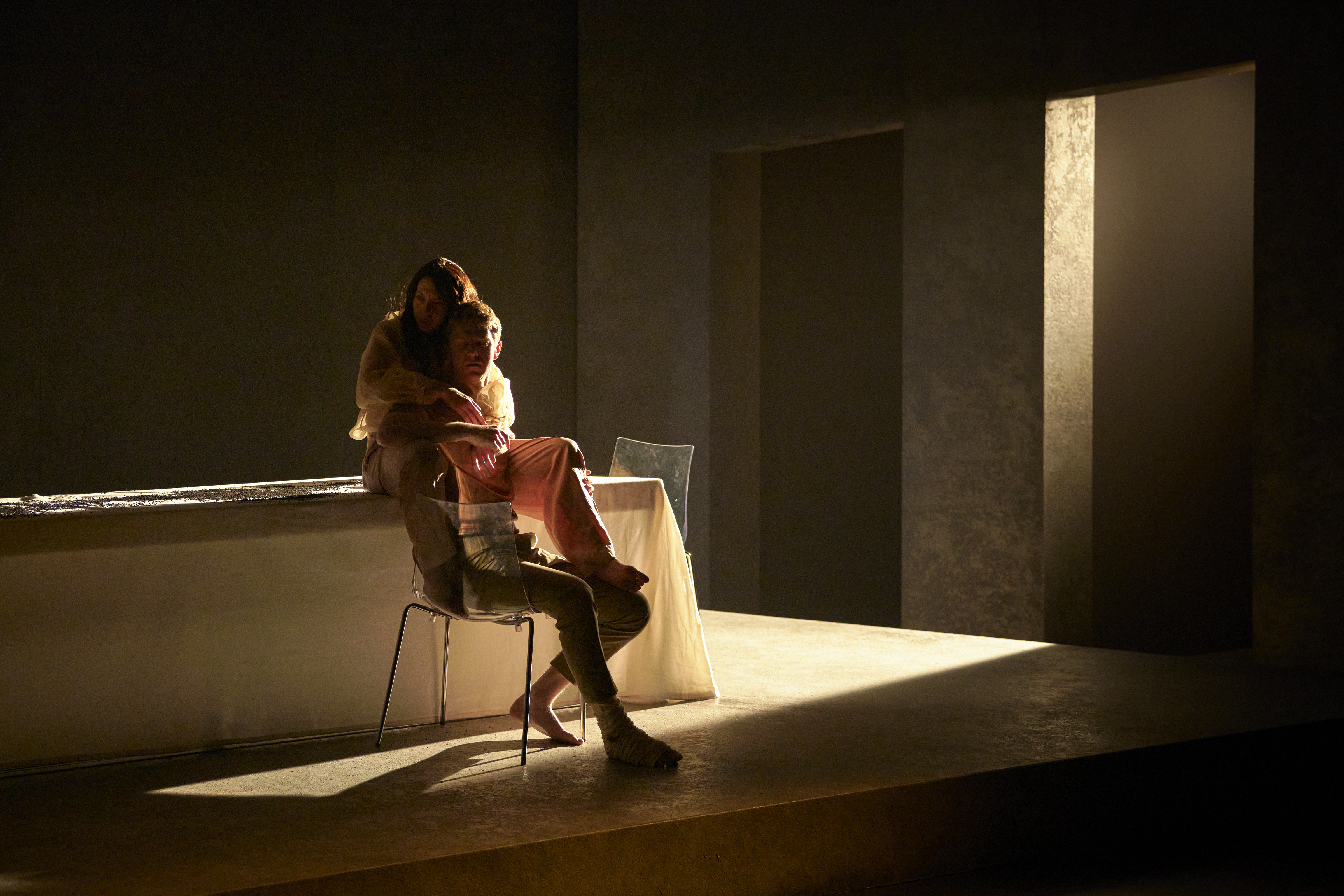
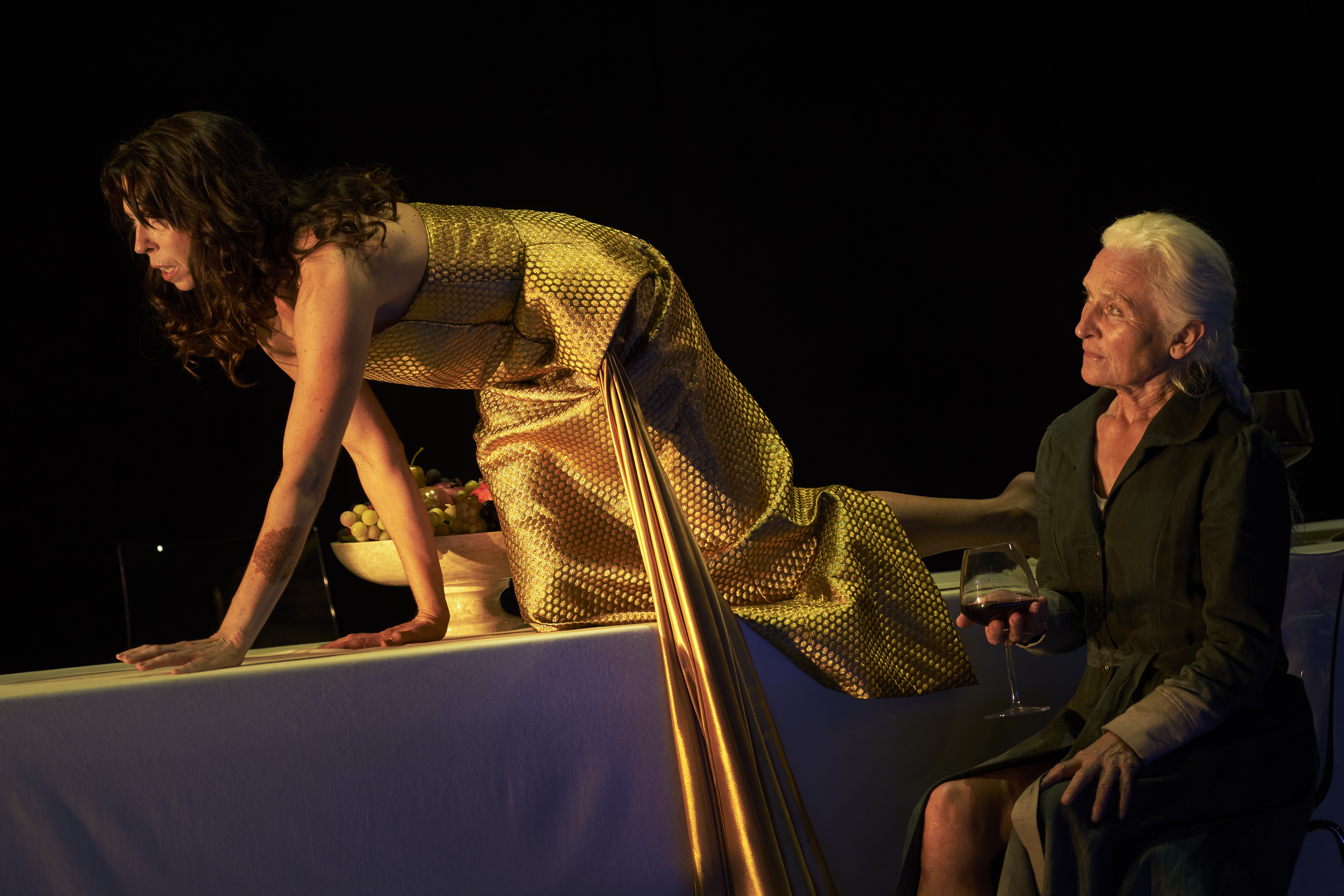
Beneath the production’s grandeur, it’s the writing that holds the real battle between fate and free will, and Carr’s text is at its most compelling when filtered through the play’s human heart. The Boy wants to reconcile ancient fate with modern Irish identity, a story of family, shame, and cyclical denial. “I feel like I’m living the wrong life,” laments Oedipus, powerfully portrayed by a phenomenal Frank Blake (Gate’s The Glass Menagerie), and we lean in eagerly for the anxious unraveling. Standing firm, entwined in her physicality, Eileen Walsh’s sensual Jocasta gives the piece its true aching centre. She’s tender. sharp, and tragic all at once, layered on top of all the grief and disappointment that lived inside her earlier marriage. Their dynamic entanglement grounds the sprawling, surreal structure in palpable human pain. Together, they find an aching emotional truth inside Carr’s verbal fireworks, while around them, a cast of sixteen fills the world of Thebes with conviction and clarity, even as the language spirals into poetic excess.
That language is both Carr’s gift and her trap. Her writing is lush, rhythmic, and full of incantatory power, but at times it grows overwrought and obvious, circling its own themes until they lose sharpness. The emotional focus occasionally drowns under the weight of the language. Where Sophocles found inevitability in simplicity, Carr seeks transcendence in density. Her myth swells, sings, and sometimes stumbles. Still, in its best moments, the play achieves a strange and striking grace. The final act gathers its energy into a resonant conclusion, a recognition that blindness, literal and emotional, remains one of our most enduring human conditions.
Seen on its own terms, The Boy is an ambitious and often arresting achievement, the kind of large-scale mythic theatre that feels at home on the Abbey Theatre stage. But in a wider context, it also sits solidly among a growing wave of Oedipal reimaginings. Earlier this year, I saw Oedipus on London’s West End (soon to open on Broadway), a modern, psychologically taut interpretation that found its power in its political construct, with superb, tense foreshadowing of dark secrets that will upturn tables and lives. Where that production sliced cleanly to the bone, Carr’s The Boy, by contrast, revels in its operatic explosion, its lushness, its language. What it lacks in coherence, it compensates for in being utterly daring, and perhaps that’s precisely the point in a theatre culture steeped in rhythm, rhetoric, and myth-making. Both approaches illuminate different truths: one through pinpointed tension, the other through operatic opulence.
Interestingly, Goblin: Oedipus at the Stratford Festival, told by three goblins trying to understand humanity, and theatre itself, reached a more profound emotional clarity with far less adornment (beyond the large phallus that sits center stage as we enter the Studio Theatre). It reminded me that myth lives best not as divine ravishment but as an act of collective empathy. The Boy comes close, but never quite finds that same heartbeat beneath its shimmering surface.
If Goblin: Oedipus found humanity through wise laughter, The Boy searches for it in lyric tragedy. It doesn’t need to answer the riddle of Oedipus so much as to ask it anew. It’s sometimes messy, but mostly magnificent, occasionally maddening theatre, the kind that reaches for transcendence even as it tumbles toward chaos. At times, Carr’s foreshadowing undercuts the tension, playing its hand too visibly. Yet, what Carr and McLaughlin achieve here is culturally unique, less a retelling than an act of resurrection. The gods glitter above, the mortals crawl below, and somewhere in between, the eternal question still echoes: how do we live with what we refuse to see? And how, even after the curtain falls, do we learn to find unity in our collective beating heart?

 front mezz junkies
[…] – watch for the Broadway review next month), to Marina Carr’s glittering and god-touched The Boy at Dublin’s Abbey Theatre (review posting tomorrow), the tragic wanderer of Thebes has been […]
LikeLike
[…] wickedly sharp Goblin:Oedipus and the Abbey Theatre Dublin’s haunting and majestic adaptation, The Boy. With those themes swirling together in this abundance, unpacking different attitudes and postures […]
LikeLike
[…] of the performances anchoring the evening, directed with ambition by McLaughlin (Abbey’s The Boy). Nicola Coughlan (“Bridgerton“) brings a lively, alert presence to Pegeen Flaherty, […]
LikeLike