The Tiff Film Review: Farnoosh Samadi’s “Between Dreams and Hope” / “Miane Roya Va Omid“
By Ross
Some films move us by their beauty, and others by their bravery. “Between Dreams and Hope” / “Miane Roya Va Omid“, the quietly astonishing and deeply moving new feature by Iranian filmmaker Farnoosh Samadi, manages both. It is a work of immense tenderness and heart-racing courage, both lyrical and romantic without ever softening the difficult truths at its core. What Samadi achieves here is nothing short of radical: she tells a story about trans experience in a country where such lives are rarely seen, and even more rarely granted their full human complexity. And drives us deep into the terrifying tension of standing up for unlimited love and authentic connection.
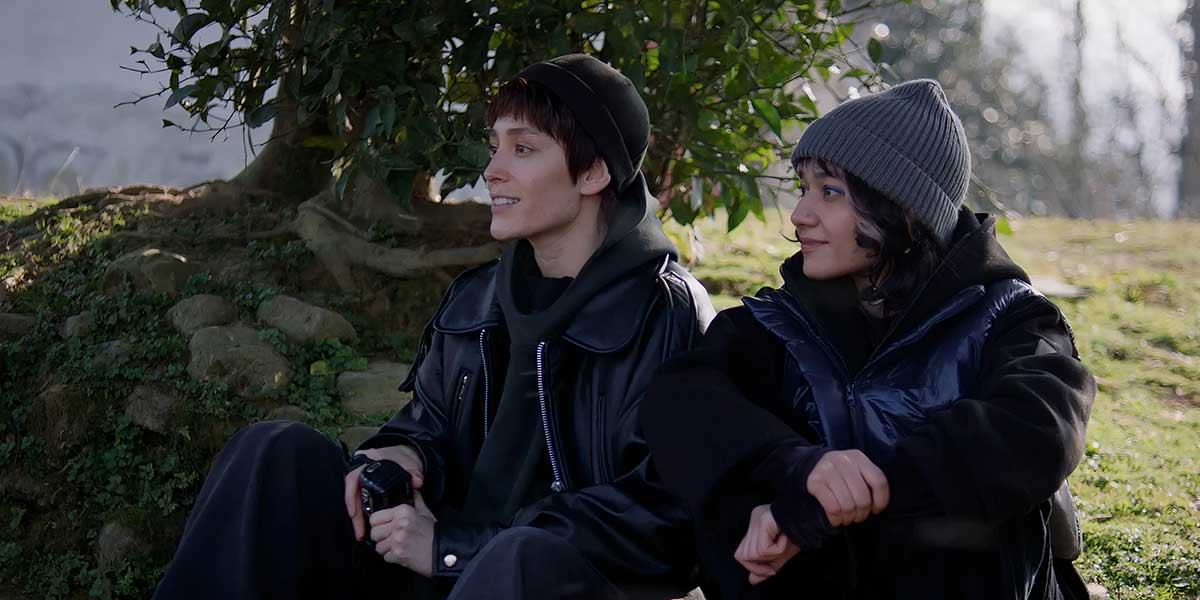
The film, written and directed by Samadi (“180 Degree Rule“), follows Azad, a young trans man navigating the fraught path toward gender affirmation in contemporary Iran. Portrayed captivatingly by Fereshteh Hosseini (“Dwelling Among the Gods“), Azad, alongside his partner Nora, played powerfully by Sadaf Asgari (“Until Tomorrow“), are thriving, surrounded by like-minded friends in a joyous haven of self-expression and acceptance in bustling Tehran. They live blissfully, until they are forced by convention to travel to a remote Iranian village to stand, face to face with Azad’s estranged, difficult father in order to obtain the necessary documents that would permit him to finally live authentically in a body that connects to his identity. Both (and all the others in the cast) are portrayed with breathtaking emotional clarity, anchoring the film with performances so lived-in that the boundary between acting and being feels porous. Their faces and bodies carry not only the story’s taut emotion, but the layered weight of authenticity, identity, shame, love, and persistence. As Azad attempts to reclaim a sense of self against all the roadblocks put in the way, Samadi avoids the expected narrative of Western liberation and instead gives us something rarer: a portrait of a person choosing to remain within a culture that both denies and defines them.
Struck by the film’s unflinching portrayal of emotional trauma born from systemic transphobia, particularly when that trauma is intertwined with cultural belonging and family, Azad’s struggle is not only with his body or his society’s gaze but with the deep psychic cost of wanting to belong to a place that continually rejects and threatens him. From the very beginning, in a quiet, devastating scene in which he visits a medical clinic, a brave standoff occurs before a panel of unwilling doctors. It’s sharply felt and written, unpacked with clever consciousness within these institutional walls that are both sterile and loaded with moral tension.
What’s most startling is the ambivalence of the encounter: the clinicians stand firmly in bureaucratic dismissal, but there is some sort of hesitant compassion in their gestures, however small. It suggests an evolving space between condemnation and care, although deeply hidden under forms and signatures. It’s unexpected, almost hopeful, to see such complexity within a system one might assume only enforces dismissal, and sometimes cruelty.
Samadi frames these moments with extraordinary sensitivity. The camera lingers not on the spectacle of transition, but on its subtleties: the trembling of a hand, the intake of smoke-filled breath, and the wordless distance between two people in love but afraid of the world they are trying hard to navigate. There’s a rhythm to the film that feels very symbolic and modern, with each shot holding just a second longer than expected, inviting us to dwell in the unease and beauty of becoming. The cinematography, suffused with soft light and long shadows by Salar Ardestani (“Noghreh“), gives the story a symbolic dark texture, poised somewhere in the locked space between the very real and the imagined, and between the dreams and the hope of its title.
What’s perhaps most moving is the bravery of staying. In a world where narratives of freedom so often equate to escape, “Between Dreams and Hope” insists on the dignity of those who remain, who fight to build meaning amid constraint, who carve authenticity out of danger. Azad’s journey becomes not just an act of self-definition, but a declaration of love for the very soil and family that refuse him. The tension that arrives during the second half is overwhelmingly honest, as we watch Nora refuse to be ignored. That paradox, of belonging and rejection intertwined, is rendered with heartbreaking honesty in the most visceral of ways. It keeps us tuned in, like a horrific murder mystery, baked with hate and violence by the very people who should love and be compassionate, and we hold our breath, collectively, praying for an outcome we can embrace.
As they drive away, we are left not with the grand triumph of transformation, but with something stronger and more human: perseverance and resilience. Samadi’s film understands what it takes to stand firm in your faith and truth; that healing is not always about resolution, but about continuing to exist in a world that does not yet know how to hold you. It is, in every sense of the words, a story told “Between Dreams and Hope“ — suspended in that fragile, luminous space where courage lives and drives off into the sunrise.

 front mezz junkies
Reading your review was a deeply moving experience.
Your words reached into the quiet layers of the film — the silences and uncertainties that were so important to me, yet so hard to express.
It means a lot to see such sensitivity and courage in your writing; I felt that you didn’t just watch the film — you breathed with it.
I’m sincerely grateful for your thoughtful and human perspective.
Your review felt like an extension of the film’s own conversation with the world,
and for that empathy and kindness, I thank you from the heart.
Farnoosh samadi
LikeLiked by 1 person
Thank you so much for your kind words. I hope you realize how much your words mean to me and how much I appreciate them and your film.
LikeLike