
The London UK Theatre Review: Ivo van Hove’s West End Production of All My Sons
By Ross
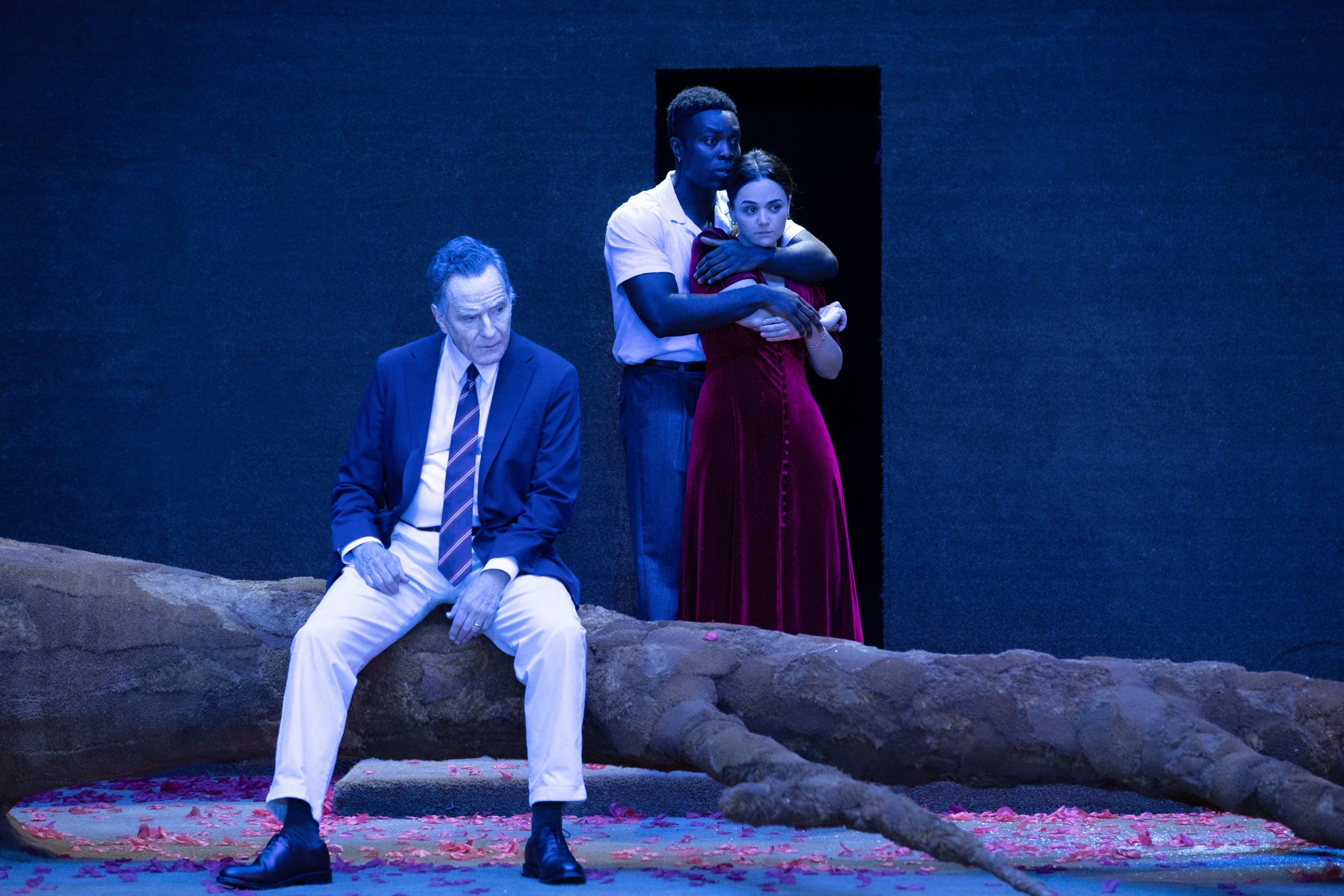
The play opens in thematic chaos, as wind roars through the Wyndham Theatre. Thunder cracks overhead and leaves whip violently across the stage. A tree cracks at the base, torn from the ground and brought crashing down. Marianne Jean-Baptiste stands in its path, battered by nature and grief alike, holding on to its trunk like her life depended on it. It feels less like an opening scene than a brutal overture, symbolically enriched with every aspect of the play. This fallen tree, planted in honour of a son lost in war, will remain, solidly, at the centre of Ivo van Hove’s astonishing West End production of Arthur Miller’s All My Sons, a silent, unavoidable monument to guilt, denial, and moral rot, and an obstacle to connection and healing. “I had two sons, now I have one,” Kate Keller says later, but the truth of that line has already been carved into the stage before a word is spoken. And no one, not us nor those on that stage, can forget it.
The direction by Van Hove (West End’s All About Eve; Broadway’s Network) strips Miller’s play to its core, rewiring it into a relentless, interval-free moral investigation that denies comfort or escape. Running straight through without a pause, the production continually tightens its grip minute by minute, relentlessly mirroring the unraveling of the Keller family. This is not a nostalgia-soaked slice of American apple pie, but a stark, solid, modern reckoning with capitalism, complicity, and the devastating human cost of business decisions made without conscience. Watching it now, as billionaires increasingly shape politics and profit, the play lands with chilling immediacy. Jan Versweyveld’s minimalist design, dominated by the shattered tree, becomes both a backyard landscape and an indictment, forcing the actors to step over, around, and through the physical embodiment of the myth and lie they live with.
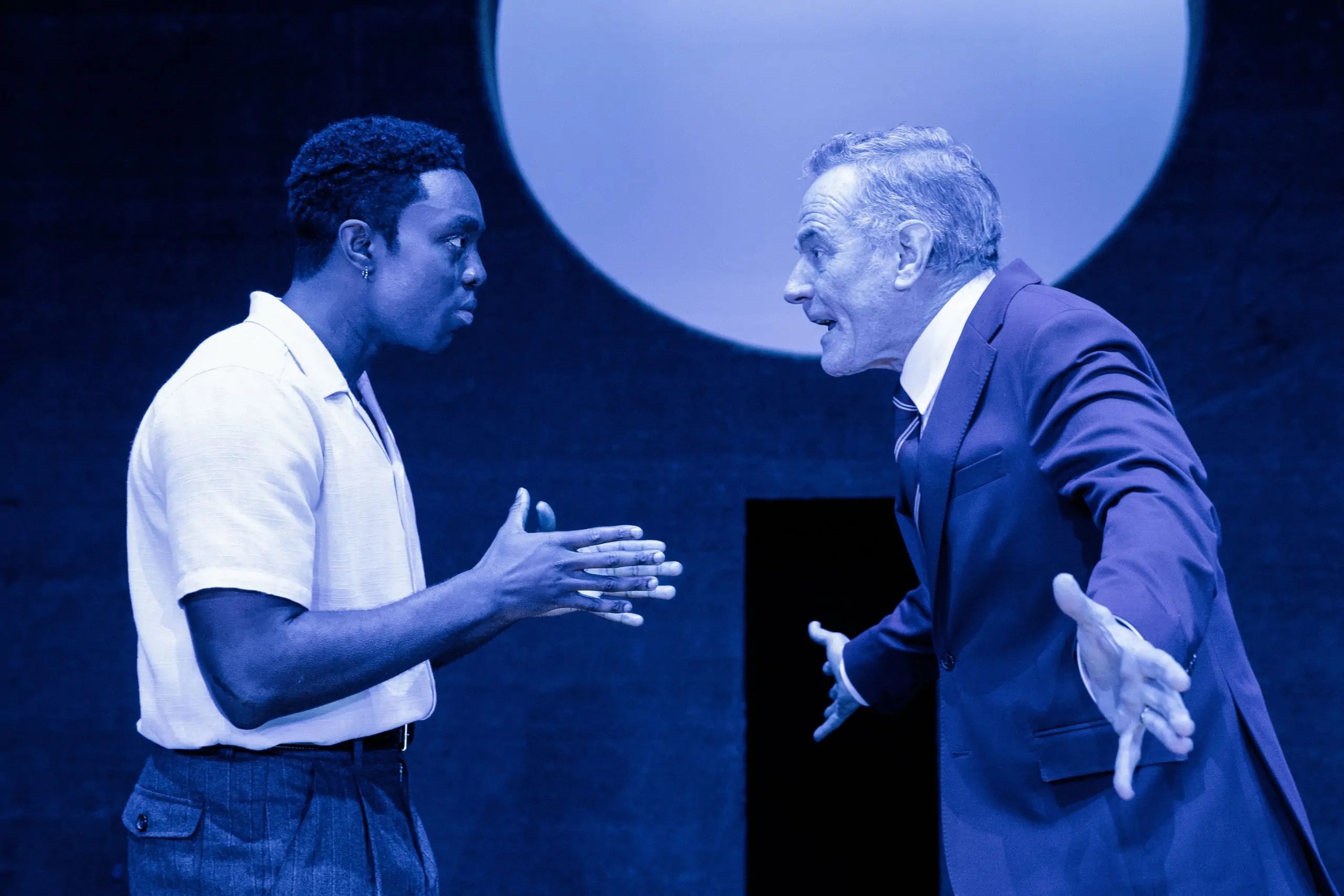
At the centre stands Bryan Cranston, delivering a Joe Keller of staggering complexity and big-grinned control. His performance is all charm and confidence on the surface, a brash, engaging patriarch adored by neighbourhood children and trusted by everyone around him (or so he wants to believe). That ease is precisely what makes him so unsettling. Cranston (Broadway’s Network) allows us to see how men like Joe succeed, how they thrive within systems designed to reward moral shortcuts, and how easily that success masks quiet atrocities. In many ways, he feels like a prosperous cousin to Willy Loman, cut from the same cloth but rewarded rather than destroyed by the American Dream. His ultimate fall from grace is slow, terrible, and utterly riveting.
Marianne Jean-Baptiste (“Broadchurch”; Mike Leigh’s “Secrets & Lies“) as Kate Keller is devastatingly magnificent, living deep inside the darkness of myth she cannot afford to release. She wears grief like a frightening coat of armour, her denial both protective and corrosive, and her control of silence is as powerful as any spoken line. Guilt and shame flicker across her face in subtle, devastating shifts, and when she finally lets the truth pierce her defences, the effect is horrifying. Paapa Essiedu (NT’s The Effect) plants his Chris Keller inside an extraordinary triangle of loyalty and connection with a stellar performance of raw emotional force, charting his journey from restraint to rage with heartbreaking clarity. His love for Ann (Hayley Squires), once labelled as “Larry’s girl,” and his unspoken certainty that his brother, Larry, will never return, collide painfully with his steadfast belief in decency and justice. His father/son dynamic with Cranston’s Joe is electric, filled with love, admiration, and a desperate need to believe he is a better man than the one standing before him.

Gathered around that tree is a supporting cast that is equally formidable. Tom Glynn-Carney (Broadway’s The Ferryman) as Ann’s brother, George, arrives like a fourth-wall rupture in the fabric of the play. He blows in like that initial storm, and his shift in understanding is signalled by a sharply calibrated lighting change (Versweyveld) that would lose all power if broken by an interval just before. Arriving from next door, Cath Whitefield’s Sue Bayliss emerges as a far more forceful presence than usual. Her anger is given the space to erupt rather than simmer in passivity, like I’ve witnessed before in other, more realistic productions. Behind it all, there is an undeniable low, foreboding musical pulse, designed by Tom Gibbons (Almeida/West End’s The Doctor), that underscores the action, a steady reminder of the truth pressing down on them as they continue to climb over the World War wreckage of the past.
Van Hove’s All My Sons is a masterclass in theatrical collision, where a visionary director, a perfect cast, and a great writer meet in devastating, and surprising harmony. Stylishly bare yet emotionally overwhelming, it builds inexorably toward its conclusion with a confidence that never wavers. Guilt takes root here. Shame breaks the bonds that bind them. And the cost of willful ignorance is laid bare with stunning clarity. It is a gripping, essential production that does not simply revive a Miller classic, but reclaims it as a living, breathing warning for our time.
 front mezz junkies
[…] All My Sons at Wyndham’s TheatreBrigadoon at Regent’s Park Open Air TheatreEvita at The London PalladiumIntimate Apparel at Donmar WarehouseInto The Woods at Bridge TheatreIndian Ink at Hampstead TheatreThe Weir at Harold Pinter Theatre […]
LikeLike
[…] fairy-tale collision Into the Woods. At the same time, the gripping drama Kenrex, Arthur Miller’s All My Sons, and the rock-infused Broadway transfer Stereophonic each earned six nominations. Jamie Lloyd’s […]
LikeLike
[…] the evening’s strongest showings were two productions I’ve had the chance to see firsthand. All My Sons, directed by Ivo van Hove, secured both Best Revival and Best Director, continuing its remarkable […]
LikeLike