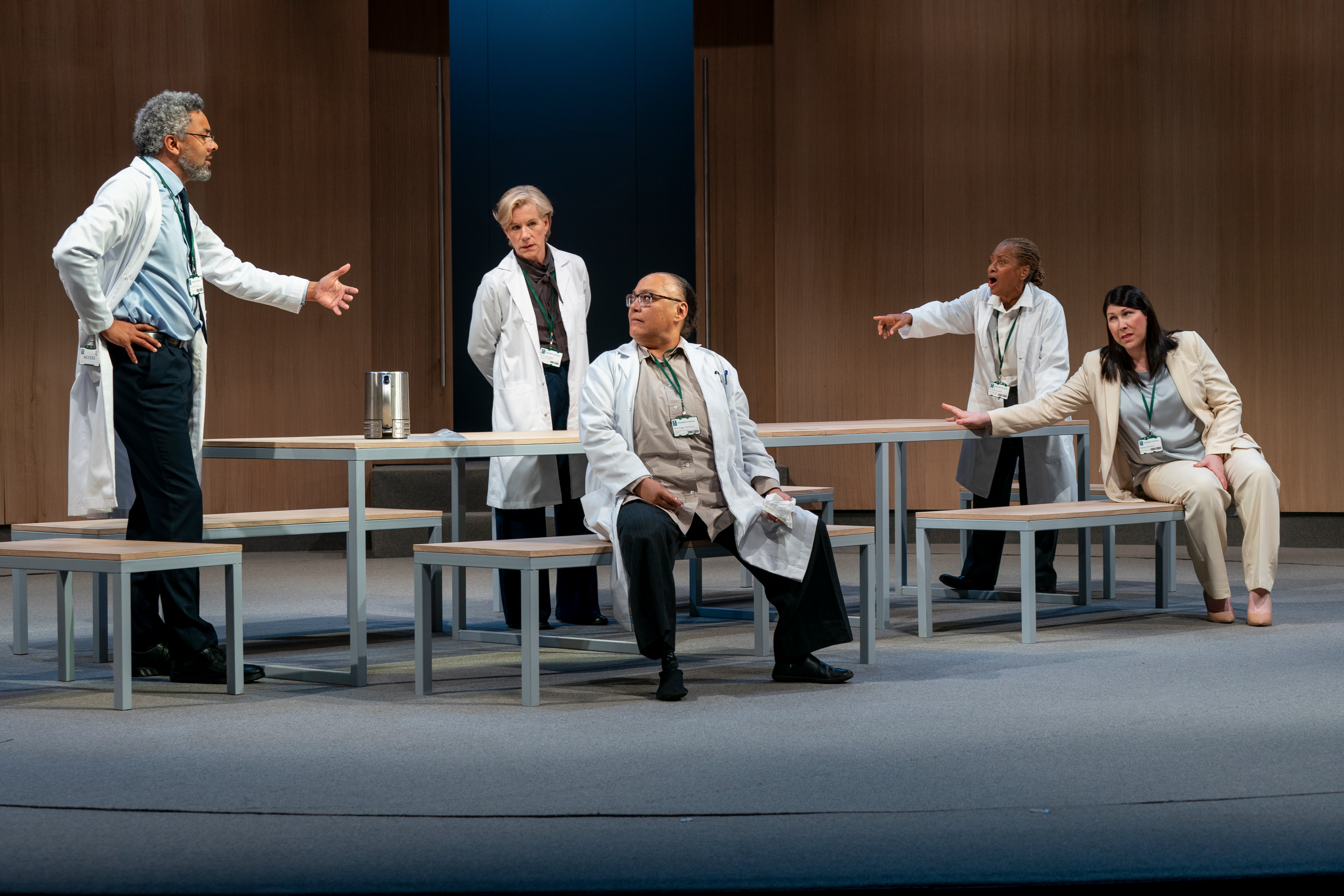
Photo credit: Stephanie Berger Photography/Park Avenue Armory
The New York Theatre Review: Almeida Theatre’s The Doctor at Park Avenue Armory
By Ross
I haven’t stopped talking about The Doctor since I was lucky enough to see it in the West End of London a few years ago. It might have been one of the best-written and constructed plays I’d seen in a long time, maybe since The Lehman Trilogy. And definitely, one that can’t be missed. So I was thrilled to be invited to its staging at the Park Avenue Armory this summer in NYC. Yet, when I heard a few days prior to my return to The Doctor that the lead, Juliet Stevenson, who has been involved in this production since 2019, was not going to be in attendance the night I was going, I was both disappointed (like many of those around me were verbalizing before the production began) and somewhat excited to get a chance to see another actor take on this magnificent part inside this meticulously constructed assault on our personal perceptions and unconscious biases. Would it register in the same way, to the same level of deep conscious rebuilding? Or would it falter a bit without the star power of Stevenson? Only time would tell (but I really didn’t think that would ultimately be the case).
With the insider knowledge about all the reveals ahead, Robert Icke’s play, The Doctor continues to stride confidently in, taking control of the expansive Park Avenue Armory stage with aplomb, as expected. Breathing some fresh, sharp air into Arthur Schnitzler’s 1912 play, Professor Bernhardt, Icke’s play stands as strong and stoically upfront as ever, unpacking the powerful complexities of medical ethics, identity politics, racism, antisemitism, and a whole bunch of other compelling conflicts that are rampaging through our society today with a brilliance that remains utterly astonishing.
One of the main focal points embedded in the construction is that it forces a confrontation within the constructs of our unconscious bias and projected ideals. The play sneaks in loudly, filling the space with a focused intensity from the moment the music and the lights pinpoint the actors intently walking in, placing their costume identities in a line across the front of the stage and stepping themselves back. They quickly make the rounds, reconfiguring themselves to a different place, stack, and identity, taking on their newly positioned role with complete assurance of their new stance. It’s a compelling beginning, one that sucks you in deeply, madly, and wonderfully, even when you already know what lies ahead. On repeat viewing, the texture that unpacks before us still dazzles and draws us in, giving us a moment to comprehend a deeper level of meaning that is being purposefully and secretly expressed in those first few minutes of this truly astonishing and powerfully smart play right to the bitter end.
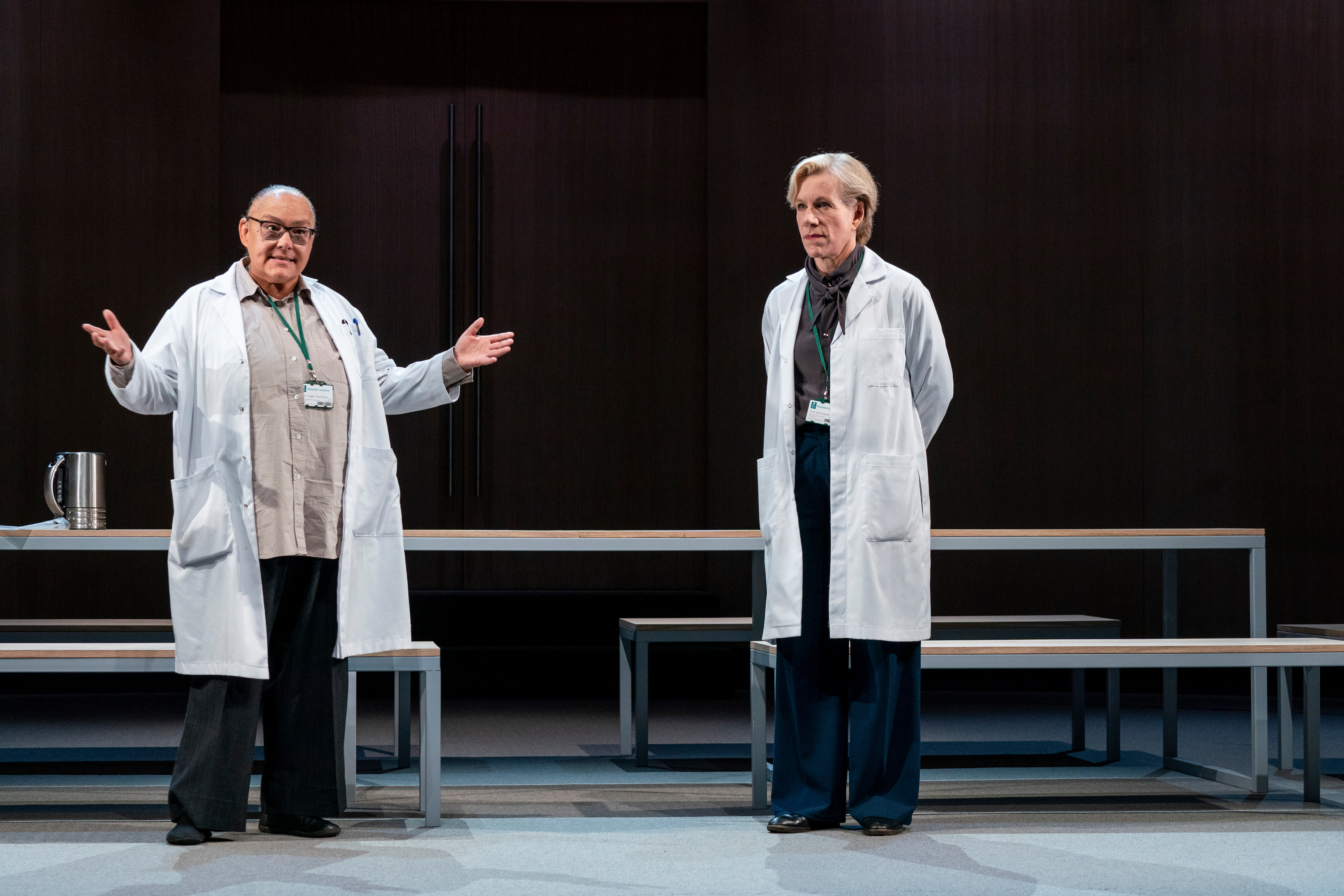
Photo credit: Stephanie Berger Photography/Park Avenue Armory.
As written and directed by Robert Icke (Almeida Theatre’s Oresteia), the conflict that reveals itself quickly is just the beginning of a cascade of constructs that never lets up, and never really shows its intricate ideals until it is ready. Icke, in all of his sharp reveals, has crafted something particularly intelligent and engaging. It takes its time, delivering forth characters with depth and complexities, one by one, and yet deliberately shifting our perception of them and finding a way for us to see them in a completely different light at a moment’s notice. Tense and abrasive, much like the doctor in question, the complete formulation is utterly astonishing and completely electric from beginning to end.
At the center of this rotation is The Doctor, the key that turns the long table round and around all in the name of Professor Ruth Wolff, a part usually played by the magnificent Juliet Stevenson (Robert Icke’s West End adaptation of Mary Stuart) but this time around portrayed equally as strong by Dee Nelson (Broadway’s The Heiress). With the impressive Stevenson in the part, her portrayal of the doctor was the strong-armed glue that held this majestic puzzle together and kept it from spinning out of control. The same can be said of Nelson, who never faulters or flinches from the task before her. She is, in her very being, a doctor, and secondary, the director of a leading medical institute where this play basically takes place. She doesn’t see herself as fitting into any other important groups, yet she does, at least in our eyes, which is, in essence, what this play is all about. What we see, and how we respond to it is the focal point. An important question that keeps being asked to her, by her, and by others, is “Would you have responded to that person differently if they were ___?” (filling in the blank with a different gender/race/identity/religious order, depending on the pinpointed moment in question). And the answer, even when we believe it is “No“, isn’t always so confidently easy to be one hundred percent certain about.
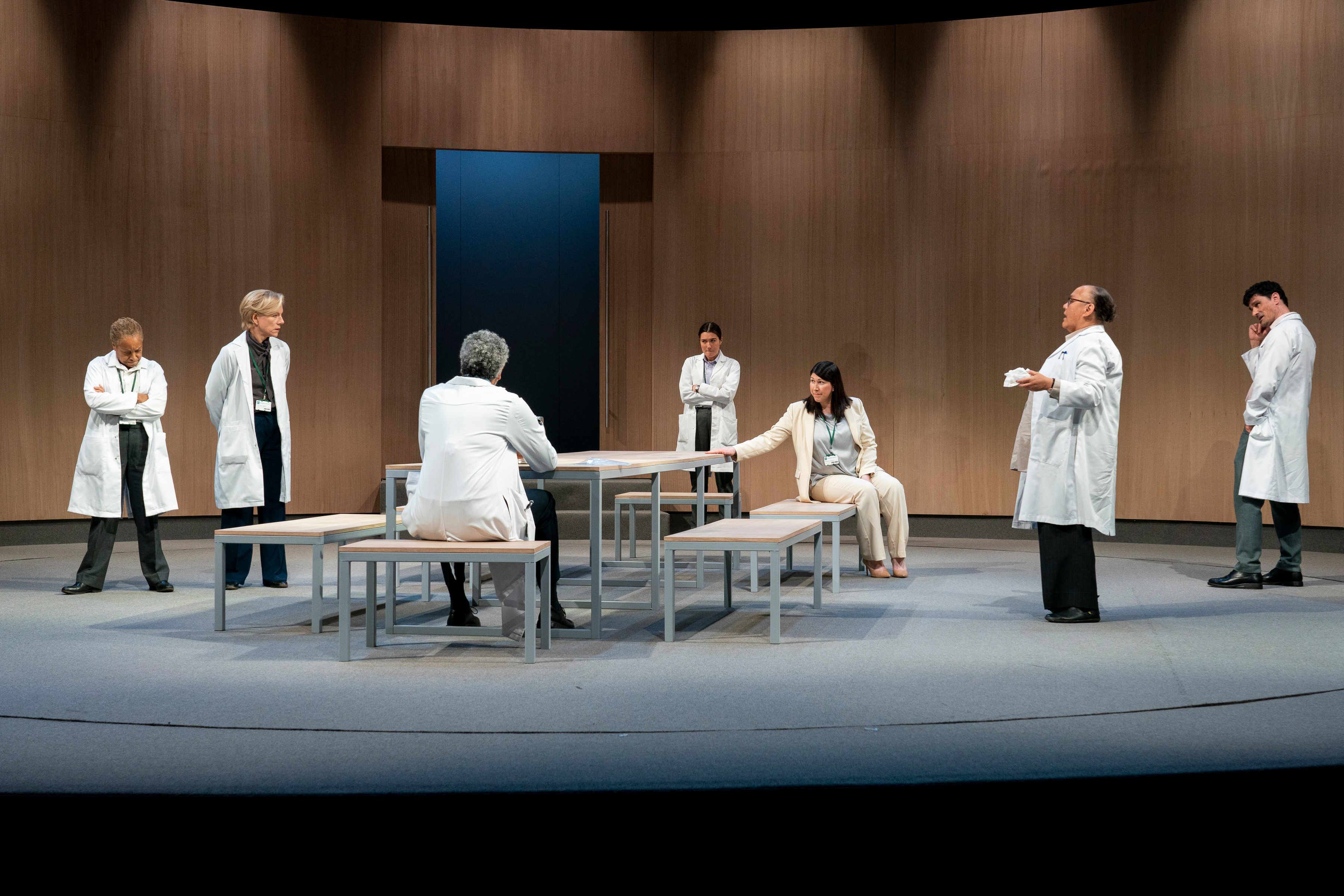
Photo credit: Stephanie Berger Photography/Park Avenue Armory.
Professor Wolff, the title she demands to be referred to by, isn’t an easy doctor to deal with. She is respected, that is clear, but not well-liked, we are told, and within minutes we see why. It’s also clear that she has a strong sense of what is right, and what is morally and clinically wrong. When she believes she has acted correctly, she holds to that moral standard of not apologizing when no wrong has been committed, even as the tables are turned on that dynamic set designed strongly by Hildegard Bechtler (Old Vic’s Mood Music), who also did the detailed costuming. It gives solid access to see and take in every argument from every angle, with compelling lighting by Natasha Chivers (Donmar’s Belleville), music and sound by Tom Gibbons (NT/St. Ann’s People Places & Things), and a drummer’s beat by musician Hannah Ledwidge (who is also credited for additional sound compositions). Nelson’s big bad Wolff, with two f’s, is steadfast and demanding, of herself and all those who work alongside her within her team. She can be abrasive and seen as arrogant and bullying, but ultimately, she believes fully in her role as a doctor as the most important part of her being.
“To be anything but a doctor,” is her calling and an ideal she subscribes to. The trouble that ignites the spinning forward of this drama is when a 14-year-old patient, her patient, is dying, pretty much without a doubt, as a result of a botched, self-administered abortion. Following her role as her doctor, Ruth refuses entry to a Catholic priest who the patient’s parents called in to read her last rites in the minutes before her death. The interaction is intense, strong-minded, yet smart, written with a complexity that becomes deeper and wiser as we walk through the mess that follows. She refuses because her patient didn’t ask for this or for him, and as her doctor, she doesn’t want to assume that her patient is as Catholic as her parents. She doesn’t want to add stress to her patient’s last few minutes, even though her death is without question quickly approaching. She refuses this man, unknown to anyone in the hospital, who walked off the streets saying that he is the priest connected to her patient’s parents. Rightly so, by the rules that these doctors live by. But that refusal is seen as having something to do with the doctor’s religious beliefs, as she is Jewish (or, as she likes to point out, that her parents are Jewish, not her), and this man is referring to himself as a Catholic priest (John Mackay), or is there something else we aren’t seeing just yet. He appears to be one thing, yet maybe he’s something quite different. A collar tells you something, but it doesn’t tell you all. It’s a brilliant setup that leaves many, including the audience, on opposite sides. But are we even assuredly aware of the rules that a doctor must live by, or are we just responding to our fired-up emotions? That is the question. Or at least one of many.

Photo credit: Stephanie Berger Photography/Park Avenue Armory.
The refusal sparks a firestorm, fueled by an online protest and the parents’ grief and rage, especially within the girl’s biological father, also played solidly by John Mackay (Almeida’s Machinal). The doctors and personnel of the medical center try their best to move around this issue, even when some of them strongly disagree with Wolff’s handling of the situation. The actors that are assembled around that meeting table playing an assortment of types are all superb, delivering forth remarks and attitudes that speak the emotional truth as strongly as the logical.
But it’s in the unpacking of what we are seeing before us where this drama really starts to wind itself up so wisely and strongly. One by one, we start to understand what that beginning rotation was all about. These actors are not a product of color-blind casting, which is what we might first imagine. Not at all. And It becomes clear through the dialogue that their race, ethnicity, sexual identity, gender identity, are not the same as the characters these fine actors play. But it’s not blindly done, it is specifically constructed with intelligence and determination, forcing us to come to terms throughout the play with all the aspects and ideas we have projected onto these characters based on how they appear on stage. And when we are told differently through the text, we must confront our unconscious bias and all the layers and attitudes we have laid at their feet. It’s a complete shock to the system, and in those moments, we realize quite intensely, that this is where the heart of The Doctor lives and breaths.

Photo credit: Stephanie Berger Photography/Park Avenue Armory.
The shoving at the center of this play shifts and morphs dramatically scene after scene, revealing layers of bias that we weren’t aware of. We are given different ways of looking at that moment and at Wolff’s response. It’s a fascinatingly complex and forever-shifting vantage point, even when we are already aware of the unraveling. The protest rises and becomes harder and harder to contain and deal with internally, with board members quitting their positions in protest of The Doctor‘s actions and stepping outside the fire that is building. The Minister of Health, played exceptionally well by Preeya Kalidas (Royal Court’s Oxford Street), gets involved, who also just happens to be one of Wolff’s old medical school colleagues. She states, that it’s “a good time to talk about Jews,” but as the play continues forward, spinning further and further out of Ruth’s control, loyalties and alliances are not strong enough to handle the identity politics that have taken over the medical center. And the timing couldn’t be worse, as it becomes clear. Money, specifically the donations needed for a newly planned building, is also a primary player in this three-ringed circus. Money, and how this all looks, speaks volumes to some of these characters. Far more than ethics.
It’s a superbly complicated takedown at the core of The Doctor, with symbolic nods toward the idea of doctors being the equivalent of witches back in the day. The burning of the town witch becomes the central theme with a governmental intervention, a medical board argument, and the antisemitic scapegoating of the doctor within the media. And the medical center duly taking on the role of the townsfolk chant for the burning at the stake. It’s an exceptional layering, stated by the strongly constructed “little friend,” Sami, who has keys to Ruth’s home. Their conversations and the revelations made about unsaid relationships are absolutely lovingly written, and expertly delivered by both Matilda Tucker (Guildford’s The Snow Queen) as the high school student friend, Sami, and Juliet Garricks (Hope Theatre’s 100 Paintings), as Ruth’s partner, Charlie, who floats in and out, dispensing love and warmth, two qualities that Ruth rarely shows outside of that safe space. There is little known about these two, and in one of the most meaningful ways, we learn early on, not to project, just like we did with the others in the cast: Chris Osikanlu Colquhoun (Young Vic’s Yellowman) as Copley; Doña Cross (Chichester’s Home) as Cyprian; Mariah Louca (Young Vic’s Best of Enemies) as Roberts; Daniel Rabin (Playhouse’s 1984) as Murphy; Naomi Wirthner (National’s Paradise) as Hardiman; and Jaime Schwarz (Hulu’s “Difficullt People“) as Junior. Because when we pull back, and make the vantage points wide and diverse, we are at our best to understand.

Photo credit: Stephanie Berger Photography/Park Avenue Armory.
The heart of the piece lies in the hands of Nelson and her Ruth, clinging to her hardened belief system that has its roots in medical science and not in religion. Her arguments are persuasive and logical yet she’s stuck in an inability to see that she might have missed something. It is in the same way that we find ourselves unpacking biases left, right, and center throughout that we weren’t aware we were holding onto so unconsciously. These biases hit hard when they are unveiled, quietly, in the sharp dialogue, even when we know they are coming. The formulations and contradictions are stunningly portrayed intellectually and emotionally, finding surprising and disconcerting connections in their determination and captivating honesty. The overall witch hunt politics astonishes, cause it’s all right there, in between the lines. It’s difficult to see upfront until it is uncovered by something so smart and ceaselessly strong in its emotional stance. The Doctor is as magnetic as one could hope for, so do what you need to do to get an appointment before it closes up shop at the Park Avenue Armory on August 19, 2023. You won’t regret it, cause it’s just so darn good and memorable in its double-edged lines.
For tickets and information, click here.

Photo credit: Stephanie Berger Photography/Park Avenue Armory.
 front mezz junkies
[…] West Side Story) and a detailed sound design by Tom Gibbons (Almeida Theatre/PAA’s The Doctor), this complicated show finds nuance and delight in the abstractionisms that both these Luis […]
LikeLike
[…] I had seen it earlier, I was thrilled to have the opportunity to have another appointment with The Doctor, playing out powerfully at the Park Avenue Armory, NYC. Yet, when I heard a few days before my […]
LikeLike
[…] Stage TheaterA.J. Shively, Philadelphia, Here I Come!, Irish Repertory TheatreJuliet Stevenson, The Doctor, Park Avenue ArmoryMichael […]
LikeLike
[…] Stage TheaterA.J. Shively, Philadelphia, Here I Come!, Irish Repertory TheatreJuliet Stevenson, The Doctor, Park Avenue ArmoryMichael […]
LikeLike
[…] Yet this production, when I saw it in early June, had McKellen in full true form, creating this delivery as expertly as one could hope for. Surrounded by talent on all sides, the curtain is pulled back in those first few moments of Player Kings, and all kinds of partying chaos flies forward in abundance. A bare-bottomed rendering destined to be king sends just the right energy into the air and we can’t help but lean into this expert production of the two Henry IV history plays combined into one, adapted and directed with strength and clarity by Robert Icke (Almeida/Park Avenue Armory’s The Doctor). […]
LikeLike