
The London Theatre Review: Hamnet
By Ross
Sitting up high above, legs dangling, she takes in the surroundings, as some wild spirits run circles around her down below. It’s a memory-filled landscape, overflowing with sadness and love. It ignites the unpacking, biting into the rich-apple-dense formula that elicits both fire and water, all at once inside the West End production of Hamnet, now playing at the Garrick Theatre. It’s a fantastic and intricate adaptation refigured in its timeframe for the stage, that breathes forth a revelation, around ghosts and untold stories, that reveal more than the obvious truths about these characters and our own selves.
Maggie O’Farrell, the esteemed author of the book that Hamnet, the play, is based upon, first imagined that the story she wanted to tell would revolve around a father and his son, much like Shakespeare’s own play, Hamlet, that was dutifully named for his son. It could have been an unpacking of all that is embedded in that type of attachment, and it would have been a fine construction, but something else flew out when she started to dig in. She found herself enthralled, sidetracked by a narrative that didn’t feel right, or honest. Somewhere in that unknown landscape, masked and coated with something akin to misogyny, was a framework that was more compelling in nature. It became clear that what had been written, and not, said much more about the historians than the history itself. And she wanted to know what was there, underneath it all.
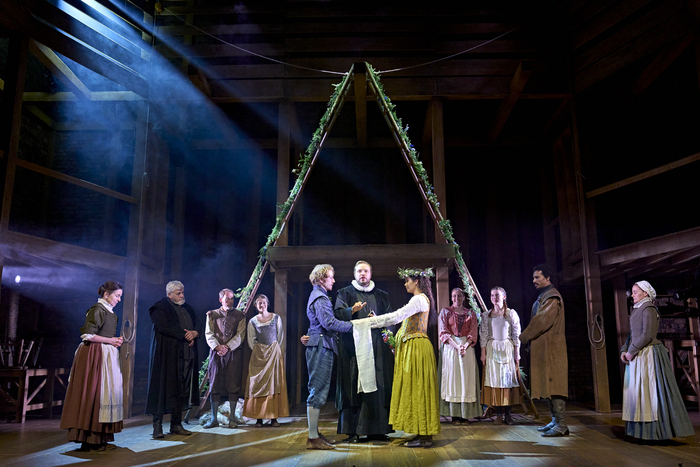
“We’ve only ever been taught one narrative about her,” she explains, when thinking about Shakespeare’s wife, a woman referred to as Anne Hathaway, but, at least in the eyes and will of her father, Richard, her name, as written, was Agnes. “With a silent g”, she, as portrayed most determinately by a very strong Madeleine Mantock (West End’s Blithe Spirit), boldly states, kindly asking this of the young Latin tutor by the name of Will that stands before her, portrayed adeptly by the handsome Tom Varey (Trafalgar Studios’ A Taste of Honey). Their electricity is palpable.
This woman, Agnes, not Anne, might actually be something quite different than the terrible detested wife that many male writers and biographers seem to have favored portraying in their historical unpacking. Frank Harris, wrote in 1911 that “For a dozen reasons I accept his view that she was a shrew of the worst” (“The Women of Shakespeare“) and that “among the very few facts of [Shakespeare’s] life that have been transmitted to us, there is none more clearly proved than the unhappiness of his marriage” (Thomas Moore, “Letters and Journals of Lord Byron“, 1830). Yet, O’Farrell, after digging around, came to the understanding, and belief system that Agnes might be something quite different, and that all those proposed theories suggesting that Shakespeare was lured into a hasty marriage by an illiterate “strumpet who had the nerve to get pregnant“, and that ultimately Shakespeare ran away to London, more to escape her than for any other reason, might not be as factually based as stated year after year, biography after biography. In fact, O’Farrell could find no evidence of this at all, just conjecture.
She also noticed that in many of Shakespeare’s plays, the wives, as written, seemed to be highly intelligent and faithful women, within marriages that worked well. Also, when looking at the grieving Ophelia in Hamlet, we see a woman whose grief is so strong that it seems to come out from nowhere, almost like a mother’s grief over the death of a child, possibly Agnes and Shakespeare’s own son, Hamnet. “He is dead and gone, lady,” Ophelia cry-sings. “He is dead and gone…” Ophelia, who might be a stand-in for a grieving Agnes, also hands out herbs to different characters within the play as she goes off mad from grief, drawing parallels to the natural healer that Agnes most likely was. Every single plant Ophelia delivers is a “well-known cure for some flaw that she perceives in them” and engaging with this, O’Farrell suggests, almost playfully, that she likes to “imagine Shakespeare writing that scene with Ophelia and not really knowing which herbal cures did what. How would he know? Maybe he had to ask Agnes – maybe she contributed to that scene.” A framing that paints a portrait of quite a different kind of wife, mother, and woman than what the historians wanted us to see. And also the impetus for the creation of one of his finest plays.
Hamnet, like the book, builds on these hints and whispers, creating a woman like few imagined. One that was illiterate, that is true – “but what daughter of a sheep farmer would have learned to read in those days? What use would it have been to her?” – Yet, maybe she was much more than all that; quite the opposite of this conniving woman a few years senior to Shakespeare whom he married quick by force. Possibly their union was of a different nature, a coming together for other, more passionate and emotional reasons. Who’s to know, really, but here, finally, in this deliberate and determined play, we get to be introduced to, not only a more humanized Shakespeare, but to a more thoughtful and determined young woman; one who became his wife, and filled with a different kind of knowledge and care. She is a natural healer, and someone who might contain far more cleverness than any young Latin tutor could fathom.
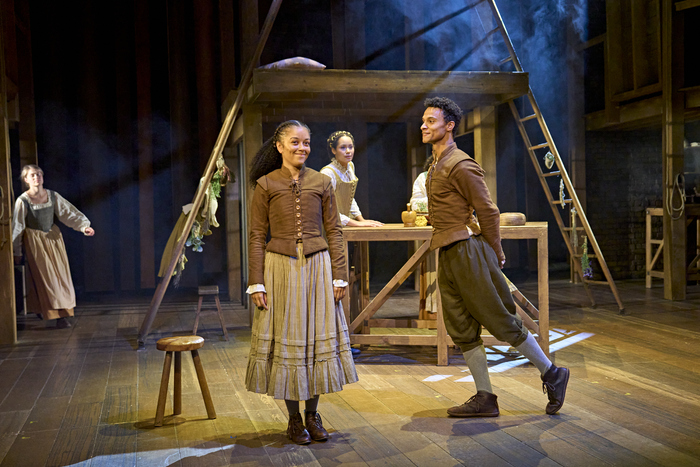
In Warwickshire, 1582, we watch the Falcon fly true and deliberate from Agnes’s steady arm, much like the woman herself, as the play, from an adaptation by Lolita Chakrabarti (West End/Broadway’s Life of Pi), soars just as powerfully under the direction of Erica Whyman (RST/BBC’s The Winter’s Tale). “I write what I can not say,” Will explains, and somewhere in this unveiling is an idea of the unwritten truth, slipping in between the lines, and somehow projecting an idea of the surefootedness of Agnes. Their initial intimate romance signals something deep and emotionally relevant, unraveling decades of possible misogyny within a few, somewhat heavily expositional scenes. Yet it all feels so fresh, and as the plot strides confidently along, giving light into Agnes’s magnificent powers of healing, her eye for prophecy, and into the circumstances of their marriage and family, the ghosts that run circles around them start to take on an intentional meaningful shape, pulling us in and attaching some griping sadness and warmth to the groundwork laid out before us.
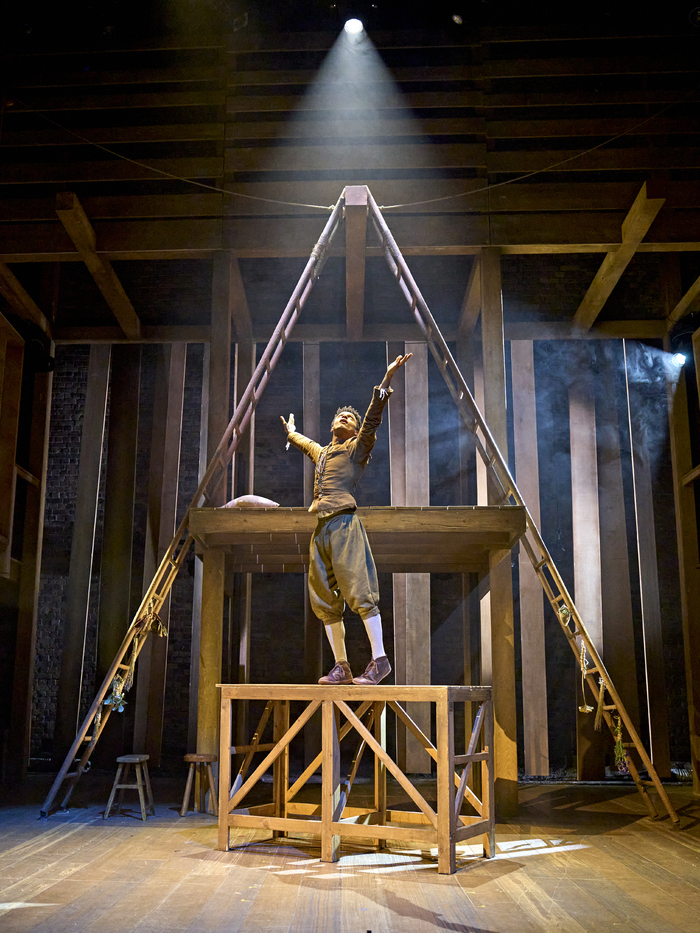
The contrasting landscapes of this family are beautifully woven into the fabric of that stage, purposefully designed with a warm, airy, rural feel, rendering strongly by designer Tom Piper (RSC’s The Tempest) with delicate and true lighting delivered by Prema Mehta (West End’s Mad House). Thematic structurings are unpacked impressively on that heath, many of which underpin the entire play and its reasonings, such as the entanglements and attachments of brother-sister twins, the dichotomies that exist between rural and urban life, and the discrepancies that slowly begin to take root between the scholastic writer and his country wife. None are all that complex to engage with, but as told here by a troupe of talented actors, they become tenderly engulfed in an understanding and establish a sophisticated system of attachment and despair that cleverly fills out the space with its knowingness.
There is an interior richness that comes with grief, and somewhere in this adaptation, the connection from the writing to the words spoken never really finds its way to fully come together, staying just an edge away from the deep suffering at the heart of this tale. This rendering keeps us one page away from being completely drawn in, holding us back from a flood of pain that the play and the book were trying so hard to convey. “I was looking the wrong way,” the mother of Hamnet cried out in agony, and although I intuitively understood her distress, the feeling never really entered my soul as fully as I was hoping it would.
This has little to do with the fine work that is being delivered by a cast determined to engage. Ajani Cabey (“The Fence“) as the lively and sweet Hamnet finds clarity and connection in his caring relationship with his twin sister Judith, wonderfully embodied by Alex Jarrett (NT’s Our Generation). Peter Wight (PPA’s Oresteia) as William’s brutish father, unwraps the difficult glove maker with a determined finesse, finding some sort of humanity underneath the hardened skin, as he also does with the role of the London actor Will Kemp. As Will’s mother, Liza Sadovy (Wyndham’s Oklahoma!) expertly renders a woman who we see slowly beginning to understand the worth of her daughter-in-law, inch by inch, step by step. And Sarah Belcher (Almeida’s Medea), as Agnes’ stepmother, Joan, finds testy power in her unleashed spite that comes fully enmeshed in her cold heart.
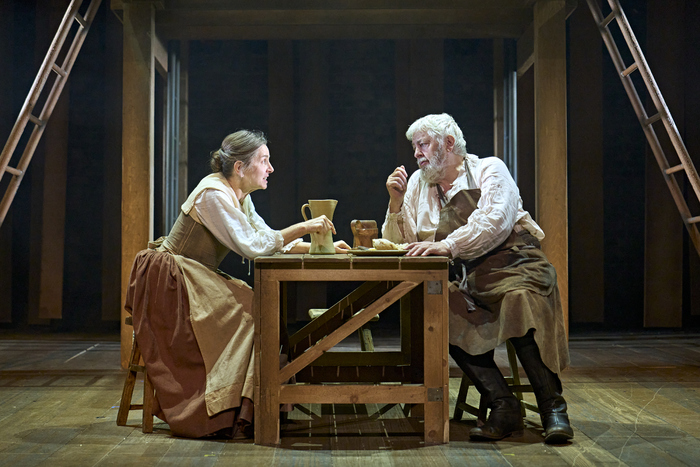
The story, with some solid help from dramaturg Pippa Hill (RSC’s My Neighbour Totoro), is told chronologically, which is different, I guess, from the book (that I am more determined to read than ever). A woman next to me in the theatre remarked, “There are so many women in the audience today, probably because of the book.” I wasn’t exactly sure what she meant by that, as I never did read the book. Was she saying something about grief and a mother’s pain? I’m not sure, but a father’s grief, or even just a man’s, can be just as heartwrenching as any. But maybe she was thinking about something else entirely. I should have been more curious, but in terms of the timeline, I wasn’t conscious of the way it altered the formulation and balance of the piece. Chakrabarti’s adaption, along with Whyman’s direction, tries to pull in the timeframe imbalance with the ghosts of the future, finding truth in the ways that Agnes knew more about the pain and loss that was in store for her, than the rest. But it does leave a lot of heavy emotional lifting for the character of Agnes to perform. Mantock excels at the task, finding strength and conviction in her presentation and presence, and uncovering a way to pull us into her tender attachment to Varey’s carefully constructed Will ever so completely.
William does eventually leave for London, trying to find his place in the world of theatre while also working hard to support his family back home. Does he disconnect while in the city? Or does he hold Agnes and their three children strong and meaningful in his heart, dedicated to their well-being and their prosperity as best as he can? The truth of that exists somewhere in the midst of ghosts and memories, but in Hamnet, he is presented as a thoughtful connected husband, who drops all when the plague enters his home, and eventually steals his 11-year-old son away from him and Agnes. But before that moment, maybe he wasn’t the best.
Loss is a force to be reckoned with, and each parent has to find their own way through. Was it something about their union that made William return to London so quickly, to mourn the loss on his own, or something more purposeful or private? Hamnet’s death is a heartwrenching scene, filled with compassion and love, even if the members of this family tend to be unwrapped superficially. William, himself, isn’t given as much depth in this rendering and becomes something distant when he leaves Stratford to engage in all that is to follow at the Globe Theatre in London. This is one of the areas where the play falters in its emotional directiveness. But not the only one.
Forging away on a road to his theatrical greatness, the journey of Hamnet overall remains true and engaging, even if the emotional landscape of grief and union remains somewhat flat. The music from composer Oğuz Kaplangı (RSC’s A Museum in Baghdad) coupled with the solid sound design by Simon Baker (Chichester’s Woman in Mind), write out a story of grief and heartache that does honor to the story, but scripted and adapted somewhat too broadly. It’s sentimental and sensitive, and makes sense that it should come to life at the Royal Shakespeare Company, a place enthralled by this mysterious great writer, down the street from the houses he lived and the wonderful, newly restored Swan Theatre. And now at the Garrick, Hamnet resonates and revitalizes this woman, even if it stays one page away from completely captivating its hungry audience.
 front mezz junkies
[…] West End’s Hamnet Engages Openly with Grief and a New Maternal View […]
LikeLike
[…] in multi-layered white starkness by Tom Piper (West End’s Hamnet) with an impressive play of shadow and light by lighting designer Ben Ormerod (Theatre Royal […]
LikeLike
[…] or “New Years Rev” (I’m leaning towards the film adaptation of the play, Hamnet), followed by “Hedda“. It’ll be quite the theatrical day, if it happens. I might […]
LikeLike