
The Broadway Theatre Review: David Henry Hwang’s Yellow Face
By ross
In modern sharply defined boxes of light, the lead character, going by the scripted name of “DHH” and played with wise relish by Daniel Dae Kim (Public’s The Chang Fragments; “Lost“), steps out strong. It’s clear that the box he is standing within is also David Henry Hwang’s, the playwright, best known for M. Butterfly for which he won a Tony Award, and when he steps forward telling us about an email he has received from a handsome white guy actor named Marcus, portrayed effectively with a clever sheepish grin by Ryan Eggold (Guild Hall’s All My Sons; “New Amsterdam“), our curiosity is ignited. Marcus is explaining a get-away trip to China in epic spiritual-journey tones that doesn’t quite seem to register from the audience box we are standing in, but we lean in, wondering where Broadway/Roundabout’s Yellow Face is leading us. And what is the meaning behind this man and his journey to the big song.
As directed with a quick wit and energy by Leigh Silverman (Broadway’s The Lifespan of a Fact), the opening lays out a boxed-in framing that takes time to unwind, shifting backward with clear intent. Following the rotating boxes to various times and places, the spaces are for a slew of others to have their soapbox to stand on with blurred-out journalistic articles presented in highlight by projection designer YeeEun Nam (Audible’s Long Day’s Journey…). It’s a captivatingly funny unwinding that follows the playwright’s stand-in to a profound moment in his life when he stood up and pointed out the problematic casting of Jonathan Pryce, a white-guy Welsh actor for the lead Asian role in the West End mega-musical, Miss Saigon. A slap in the face, that is clear, and he has a lot to say about this as it is about to transfer from London’s West End to Broadway. DHH created a big stir with his pointed protests against the ‘yellow face’ casting, but even after an initial halt, the production ultimately continued onward without changes being made to their casting choice. Yet it was his letter to the union that made it to the New York Times, fanning the flame and making DHH the ultimate Asian poster child of the movement, and a position he now would have to live up to. Easy, right?

So much goes wrong and right for DHH in Yellow Face, a play that was first produced off-Broadway at The Public Theater in December 2007 after premiering at the Mark Taper Forum earlier that same year. The plot, emotionally pulled along by DHH’s tight and uncomfortably loving relationship with his father, HYH, played gloriously by Francis Jue (Public’s Soft Power; Broadway’s Pacific Overtures), is comical in tone, but authentic in emotional undercurrents. The dialogue, even when it takes the long road, leads our main character through a reckoning of sorts after he mistakenly hires a handsome, masculine white guy to play an Asian character in his Broadway-bound next play, “Face Value”. It’s a comedy about white actors cast in Asian roles using yellowface, and the conflict rings loud and clear. The fallout doesn’t explode directly, but in-directly it is felt within the playwright’s playwright character as the truth comes out and the play bombs pretty much completely. First garnering really terrible reviews in its out-of-town tryout, “Face Value” later, after extensive rewrites, and the firing of Marcus, closes on Broadway before it can even open. That face has little value, but it does have a strong box to stand in when making a point of the whole process.
But that is only the beginning of the Marcus lingering, as Yellow Face spins its complicated web around the ideas of ‘face’, an idea often repeated for effect, alongside numerous moments of obvious and subtle racism, and the wildly disturbing interaction between race, media, espionage, and hate politics. So much happens in this semi-autobiographical play by the agile Hwang that it’s hard to fully summarize all that rotates outward as the play drives to the captivating meta-fantastic end in about 100 minutes. The play is sharply funny and entertains absolutely from beginning to end, giving delicious visuals on a stage designed with a modern flair by Arnulfo Maldonado (Broadway’s A Strange Loop), with distinct lighting by Lap Chi Chu (Broadway’s Suffs), clever costuming by Anita Yavich (ATC’s The Mother), and strong sound design by composers Caroline Eng (Irish Rep’s Belfast Girls) and Kate Marvin (RT’s Jonah).

Daniel Dae Kim is forever winning in the well-crafted role of DHH, finding humor and emotional relevancy at every turn of phrase and stage as he walks us through his career highs and lows. He is easily matched by the winning sly grin of Eggold’s Marcus, who looks out at us with a knowing puppy-dog twinkle, even as he finds himself being fashioned into something he is not, and then running with it for the most compelling of complicated reasonings. It’s pretty clever, this construct, unpacking levels of guilt and shame in one, and a needy attachment to community in another. And it’s only reinforced and highlighted by the other very wise construct that is Jue’s HYH and his optimistic desire to do it his way.
There’s touching beauty in this attachment, but it’s those other elastic cohorts; Kevin Del Aguila (Broadway’s Some Like It Hot); Marinda Anderson (RT’s You Will Get Sick); Greg Keller (Public’s Office Hour); and Shannon Tyo (Signature’s The Comeuppance); that really pull this piece forward out of the darkness of the box into something deliciously engaging and fascinatingly adept. These five gifted actors play a range of characters; pretty much all real people, ranging from Lily Tomlin to Margaret Cho, alongside far too many Broadway and theatre power players to list. Stepping in and out of the shadows with force, they each give us portraits of characters of different races and genders not of their own. And it works at the highest level, intriguing us with its undercurrent of meaning and obvious sharp playfulness.

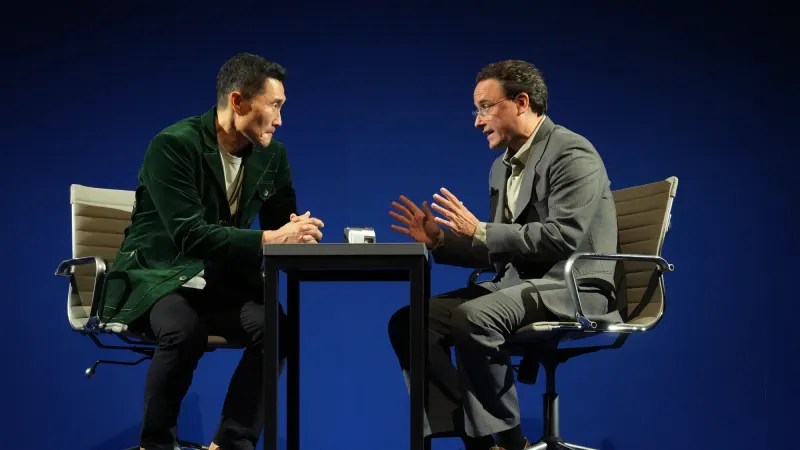
It all happens so easily, and so quickly, this carefully constructed framing, yet when it shifts into politics and espionage, the formula feels somewhat forced and unfocused. That is until the moment DHH is pulled out to the front, seated across from a very effective Keller as a reporter “without an agenda.” It is then that the true agenda of the moment and the framing gets very strong very quickly. This is when the play really hits its authentic mark on that big wide stage, when a Chinese Espionage Investigation finds its impressive emotionally disturbing space and the framing of all these different boxes comes into focus. It’s that “earth to narcissist” moment, as spoken true by Tyo’s Leah earlier in the play. A reclamation is needed, as well as a meta-confession that wraps the sin up and delivers it home to us in a well-formed comic jab. We get to go back to the beginning, to the part where we leaned in with wonder. And sit back, taking in all that has been constructed, and appreciate the rich complexities and the subtle playful power that is Hwang’s Yellow Face.
 front mezz junkies
[…] deserted bar, designed with a strong abstract reframing by Arnulfo Maldonado (RTC Broadway’s Yellow Face), with solid shifting lighting by Jen Schriever (2ST Broadway’s Mother Play), exacting costumes […]
LikeLike
[…] and ignorance of the Tate family home, designed imperfectly by Arnulfo Maldonado (Broadway’s Yellow Face), who creates island obstacles that get in the way of our connective engagement, cutting us off and […]
LikeLike
[…] Achievement Off-Broadway – were announced this past week by Francis Jue, star of Broadway’s Yellow Face, and Krysta Rodriguez, currently appearing in Smash on Broadway. The 2025 Awards will be presented […]
LikeLike
[…] by books, canvases, and colorful textiles. Outside the apartment (a beautifully realistic set by Arnulfo Maldonado), we can hear sounds of police and rioters, but inside, Bill (Grantham Coleman) is almost able to […]
LikeLike
[…] The Cherry OrchardEureka DayGhostsGlengarry Glen RossHomeOthelloRomeo and JulietA Streetcar Named DesireVanyaWine in the WildernessYellow Face […]
LikeLike
[…] Yellow Face […]
LikeLike
[…] the safe return of the young adventurer. Costumed authentically by Anita Yavich (Broadway’s Yellow Face), they each find their stance, searching the wide open spaces for an opportunity for something to […]
LikeLike
[…] Hold On to Me Darling, Job, Odd Man Out, Our Class, Still, Teeth, The Christine Jorgensen Show, and Yellow Face. While some members of the Floyd Collins creative team also worked on the original 1996 Playwrights […]
LikeLike
[…] Best Revival of a PlayEureka DayRomeo + JulietOur TownYellow Face […]
LikeLike
[…] Favorite Play RevivalEureka DayGlengarry Glen RossOthelloOur TownRomeo + JulietYellow Face […]
LikeLike
[…] Yellow Face […]
LikeLike
[…] Eureka DayOur TownRomeo + JulietYellow Face […]
LikeLike
[…] The Cherry Orchard**Eureka DayGhostsGlengarry Glen RossHomeOthelloRomeo and JulietA Streetcar Named Desire**VanyaWine in the WildernessYellow Face […]
LikeLike
[…] for their respective performances in Jonathan Spector’s Eureka Day and David Henry Hwang’s Yellow Face. The award acknowledges veteran performers, who are over the age of 50 and are a 25-year-plus AEA […]
LikeLike
[…] Ghost of John McCain) and directed by two-time Tony nominee Leigh Silverman (Broadway’s Yellow Face), this bracingly original spectacle is a musical reminder that surviving is what we do […]
LikeLike
[…] Yellow Face […]
LikeLike
[…] Eureka DayOur TownRomeo + JulietYellow Face […]
LikeLike
[…] Best Revival of a Play✅ Eureka DayRomeo + JulietOur Town🤞Yellow Face […]
LikeLike
[…] Best Revival of a Play🏆 ✅ Eureka DayRomeo + JulietOur Town🤞Yellow Face […]
LikeLike
[…] and flexible Ikechukwu Ufomadu (“Ziwe”), and the delicious Francis Jue (Broadway’s Yellow Face), there is a sense of strong individual work centered in clarity and commitment, even when the […]
LikeLike
[…] both expansive and tightly controlled arenas and conflicts. Marinda Anderson (Broadway’s Yellow Face) as Cheryl Mills brings clarity and authority to the floor as outside-the-box decisions are […]
LikeLike
[…] precise and emotionally engaged. Directed with precision by Leigh Silverman (Broadway’s Yellow Face), he moves between more than a dozen characters with an ease that never feels showy, each […]
LikeLike