The Broadway Theatre Review: Sanaz Toossi’s English
By Ross
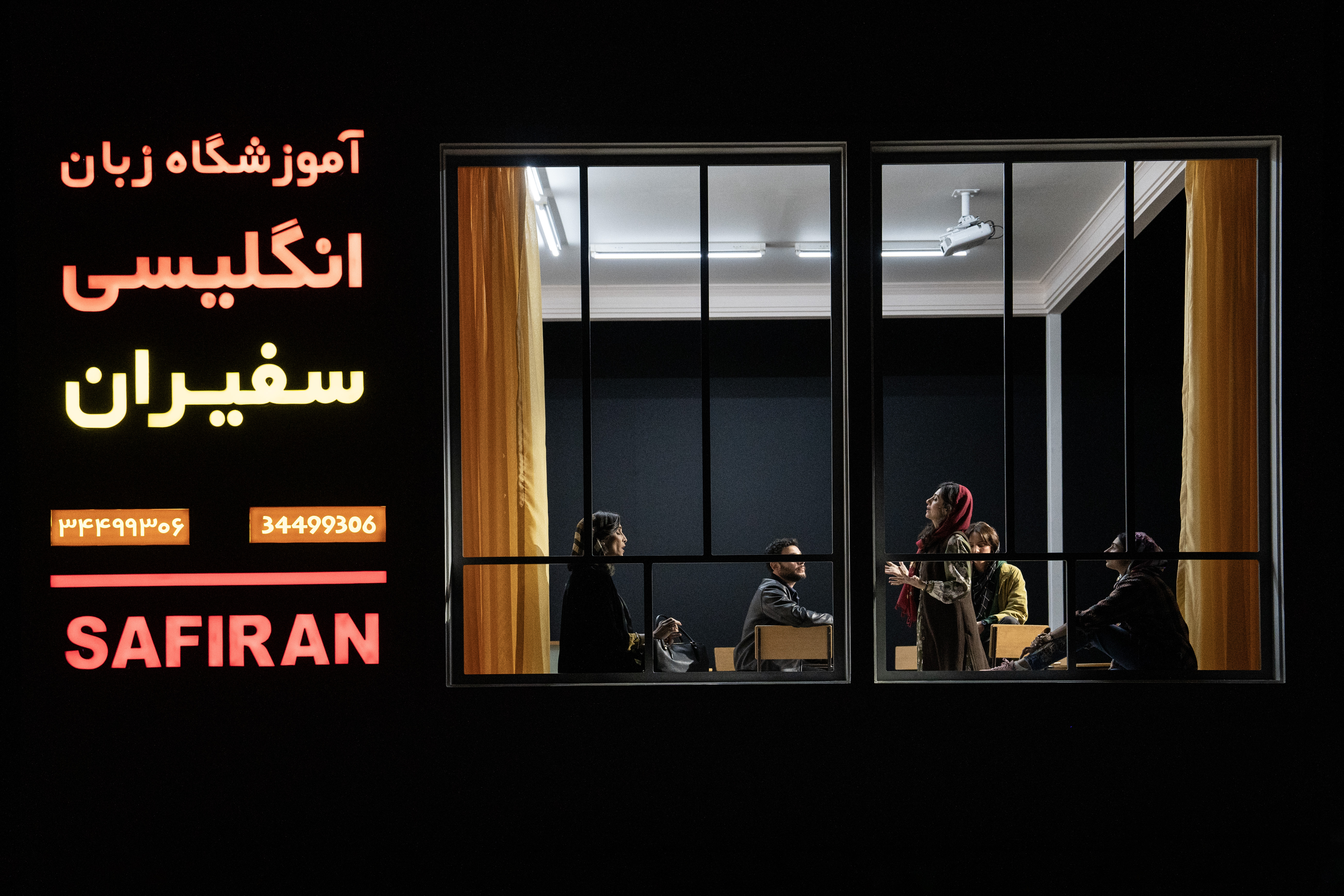
From a large rectangular window, the curtains are pulled back to the mystical sounds of something removed and aware. We are being given a quiet glimpse into something particular, special, and quietly superb, as this impressive and thoughtful production of English, transferring to Broadway after a successful run at the Atlantic Theater Company, rotates its way into our framing. Playwright Sanaz Toossi (Wish You Were Here) has crafted a brilliantly complex tale that maps out our frustrations and the deep humanistic consequences that come when trying to ingest a new language into our souls. Resonating deeply, the stories told here, thanks to the superb direction of Knud Adams (ATC’s I’m Revolting), dig deep into the ideas of acceptance, belonging, and connection, finding humor and honor in the difficult framework of a new complex language.
Much like it did downtown, the Roundabout/Atlantic Theater Company co-production of English plays within a wise composition of humor and pain on a stark set etched with other world complexities by Marsha Ginsberg (Barrow St.’s The Effect), with strong costuming by Enver Chakartash (Broadway’s Stereophonic), lighting by Reza Behjat (Public’s The Ally), and sound by Sinan Refik Zafar (Broadway’s What the Constitution…). The play finds its undeniable force in its interconnected wit and multiple angled vantage points, taking in the action and interaction in that bland classroom where four students have come together in Karaj, a large suburb of Tehran, Iran, to prepare for the Test of English as a Foreign Language (or TOEFL). But what transpires here is anything but bland or ordinary. It is alive with humanistic honest interactions that resonate on more levels than we can fathom in just one viewing.

Surging forth over a quick 115 minutes, the play unpacks the personal speed bumps for each of these four willing participants who hope that passing this test will usher them into a new chapter in life. Instructed with a kind, complicated force by their teacher, Marjan, played with an empathetic edge by Marjan Neshat (PH’s Wish You Were Here), the students, each with their own structural imbalance, find engagement and conflict within those four walls, particularly as Marjan insists that they inadvertently open themselves up to the vulnerability of only speaking English in class. A frustrating stance, one that I personally know all too well from years of unsuccessfully trying to learn French, and then Spanish and Italian in college and in private tutoring, but the stance clearly pushes the engine forward within an accurate ideal.
Speaking English, we are told, doesn’t want to be poetry, not like Farsi, which the characters do slip into every so often, and although the play is completely written in English, we are made conscious in the most elegant of ways when the language shifts from English to their primary. It’s a beautifully constructed and performed angle that subtly emphasizes the exploration and digestion of what it means to speak out and be understood, while unpacking layers and layers of emotional connection and disconnection.
When the students struggle with their English, we hear the nervous hesitation and the sharp accents, but when “Farsi is winning” and they switch to their native tongue, against the wishes of their teacher, their real selves are cleverly exposed. The strongest of the bunch, or should I say the most conflicted, is Elham, a hopeful med school student played intensely by Tala Ashe (PH’s The Profane). She can’t help herself. It’s as if she has to lash out at everyone to hold her place and position. She’s edgy and hard to like, although Ashe portrays her with such compassion, we can’t help but feel for her.

Another who seems to have an interior life that is working hard to stay as secret as possible, is the complex and rigid Roya, played stoically by the engaging Pooya Mohseni (Sarah Mantell’s In the Amazon Warehouse Parking Lot) whose estranged son has emigrated to Canada and learning English is the most obvious requirement needed so that she might be given the permission to see and know her granddaughter. The youngest and by far the most compassionately engaged is the smart Goli, tenderly portrayed by the wonderful Ava Lalezarzadeh (Apple+ TV’s “The Morning Show“), who finds a way to connect to us all as she works hard to unlock a more promising future.
There is one other, and his position in the class is more fascinatingly complex. The handsome Omid, delicately portrayed by the excellent Hadi Tabbal (Vineyard’s Russian Troll Farm), is obviously more advanced in his learning and seems to have a secret of his own as to why he is there. His flirtation with the teacher has a charm and a rom-com Hollywood appeal, beautifully mirrored in the movie watching done to take in the sound of the English language, but we can’t quite make him out, that is until it all gets thrown into the center.
Director Adams finds an energy and a pace that works, bridging the gaps and unearthing the undercurrents beautifully in the solid direction of this five-star Broadway premiere at the Roundabout Theatre Company‘s Todd Haimes Theatre. The big questions of assimilation and culture are stamped with authentic singularity on the outcome of a pass or fail test rotated out from all angles, with the personal secrets held close for all to see within those lessons. The characters and their subtleties deliver the meditation with a clear tender ease, producing a clever production and an insightful play that might just be the best of the season. Each moment sings with triumph, passing with high marks from every angled direction and through the purposeful portrayal of language and culture.

 front mezz junkies
[…] It’s a powerful, compelling formula, this Harmon family drama, and as directed with a cool, slow hand by Trip Cullman (Broadway’s Cult of Love), We Had A World finds its footing in as mesmerizing a way as the way Nanna altered and expanded the mind of Joshua. But the clean-up that is held and remembered by Ellen is also as important and traumatizing as any of the one-sided Paris stories told to Joshua about his fabulous Nanna. And they pack a punch, especially when the flip side of that recording is played back from a different vantage point and angle by mother Ellen, on that open wide stage, designed with crowded deliberation by John Lee Beatty (Broadway’s Sweat), with simplistic lighting by Ben Stanton (Broadway’s Maybe Happy Ending), tender costumes by Kaye Voyci (MTC’s Morning Sun), and a solid sound by Sinan Refik Zafar (Broadway’s English). […]
LikeLike
[…] AntiquitiesBecoming EveEnglishGood BonesGood Night, and Good LuckHere There are BlueberriesJohn Proctor Is the […]
LikeLike
[…] PlayEnglishThe Hills of CaliforniaJohn Proctor is the VillainOh, […]
LikeLike
[…] MincemeatPaul Mescal, A Streetcar Named DesireLouis McCartney, Stranger ThingsMarjan Neshat, EnglishJasmine Amy Rogers, Boop!Nicole Scherzinger, Sunset BoulevardHelen J. Shen, Maybe Happy […]
LikeLike
[…] only new elements eligible during this cycle: Buena Vista Social Club; Dead Outlaw; English; Hold On to Me Darling; Job; and Oh, Mary!. The following productions were not […]
LikeLike
[…] EnglishThe Hills of CaliforniaJohn Proctor is the VillainThe Picture of Dorian GrayPurpose […]
LikeLike
[…] AntiquitiesBecoming EveEnglishGood BonesGood Night, and Good LuckHere There are BlueberriesJohn Proctor Is the […]
LikeLike
[…] EnglishThe Hills of CaliforniaJohn Proctor is the VillainThe Picture of Dorian GrayPurpose […]
LikeLike
[…] PlayEnglish🤞The Hills of CaliforniaJohn Proctor is the Villain✅ Oh, […]
LikeLike
[…] PlayEnglish🤞The Hills of CaliforniaJohn Proctor is the Villain✅ Oh, Mary!🏆 […]
LikeLike
[…] fascinatingly barren set. But the motion can’t disguise the static pulse underneath. Reza Behjat’s lighting gleams, Peggy Schnitzer’s costumes nod at retro glamour, yet all that polished […]
LikeLike
[…] cramped, illegal basement apartment, rendered astonishingly by Marsha Ginsberg (RT/Broadway’s English) in a design that surprises, the play chronicles multiple generations of immigrant women whose […]
LikeLike
[…] The design work by Alexander Dodge (scenic), James + AC (costumes), Jen Schriever (lighting), and Sinan Refik Zafar (sound) provides a slick, well-appointed playground for the antics, and the laughs are undeniably […]
LikeLike