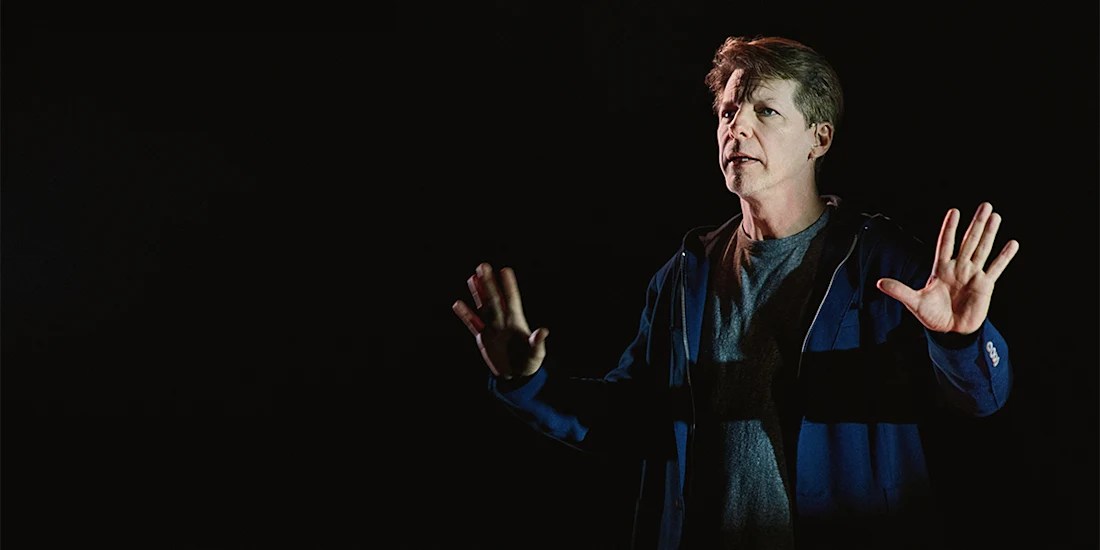
The Off-Broadway Review: Sean Hayes anchors David Cale’s psychological thriller with precision and presence
By Ross
“I was having a hard time writing,” he says, and I understand that completely. No rolling of the eyes here, even as he admits that he, himself, tends to greet that familiar struggle with impatience. It’s a line that immediately made me question his sincerity, and then, for seventy-five minutes, that uncertainty deepens. It begins to feel like a dare, or possibly a warning. Should we trust him, or simply follow along out of curiosity?
Watching Sean Hayes in The Unknown play that struggling writer feels like an act of self-sabotage masked as control. From the moment he steps into Elliott’s fractured world, the play locks into a rhythm that depends entirely on his ability to guide us through it. He does so with striking clarity and command. This is a tightly wound experience that leans into theatrical tension, inviting us to follow as the ground beneath it quietly begins to shift.
Written by David Cale (Harry Clarke), The Unknown unfolds as a psychological thriller with a distinctly paranoid edge. Elliott, a writer struggling to break through a creative block, retreats to a remote cabin in search of focus. What he encounters instead is a singing presence that may be imagined, constructed, or all too real. The play quickly relocates to a more familiar urban space, but the sense of stability never arrives. The boundaries between fiction and lived experience collapse, and the act of writing becomes inseparable from the act of surviving. At one point, he asks, “Is this a thriller?” The answer feels uncertain by design. The structure thrives on that instability, allowing scenes to blur and identities to slip until it feels like there is no turning back.
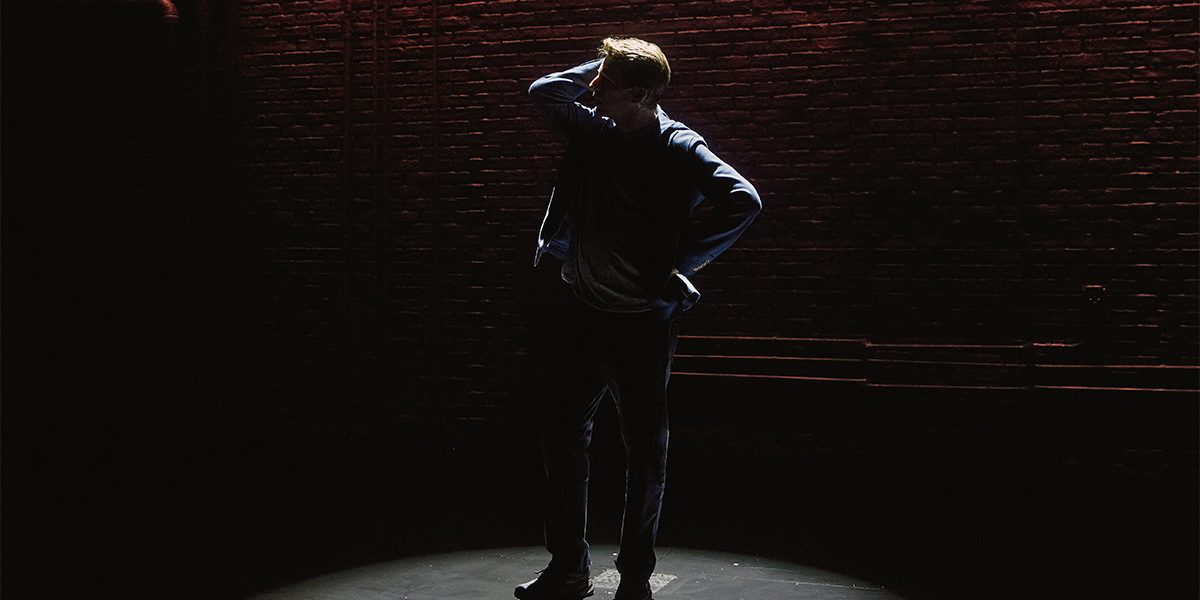
At the centre of that shifting landscape stands Hayes (Broadway’s Good Night, Oscar), delivering a performance that is technically precise and emotionally engaged. Directed with precision by Leigh Silverman (Broadway’s Yellow Face), he moves between more than a dozen characters with an ease that never feels showy, each transition clean and distinct without breaking the momentum of the piece. His Elliott carries a quiet desperation that deepens as the play progresses, grounding the more heightened elements of the story in something recognizably human. He navigates the language and pacing with control, holding the audience’s attention even when the narrative begins to test its own logic.
Cale’s writing leans into atmosphere over strict coherence, building a story that thrives on unease and suggestion. The plot twists arrive with frequency, each one shifting our understanding of what we are watching, though not always with the structural clarity needed to fully land, nor the subtlety. There are moments when the internal logic strains, when character motivations feel just a bit too strained to feel fully credible, and when the mechanics of the thriller begin to show. Even as our man runs through the streets of Queens trying to find safety on a nighttime bus, that looseness isn’t noticeable unless we take a streaming pause, as the play maintains a compelling forward drive, carried by the tension it so carefully constructs.
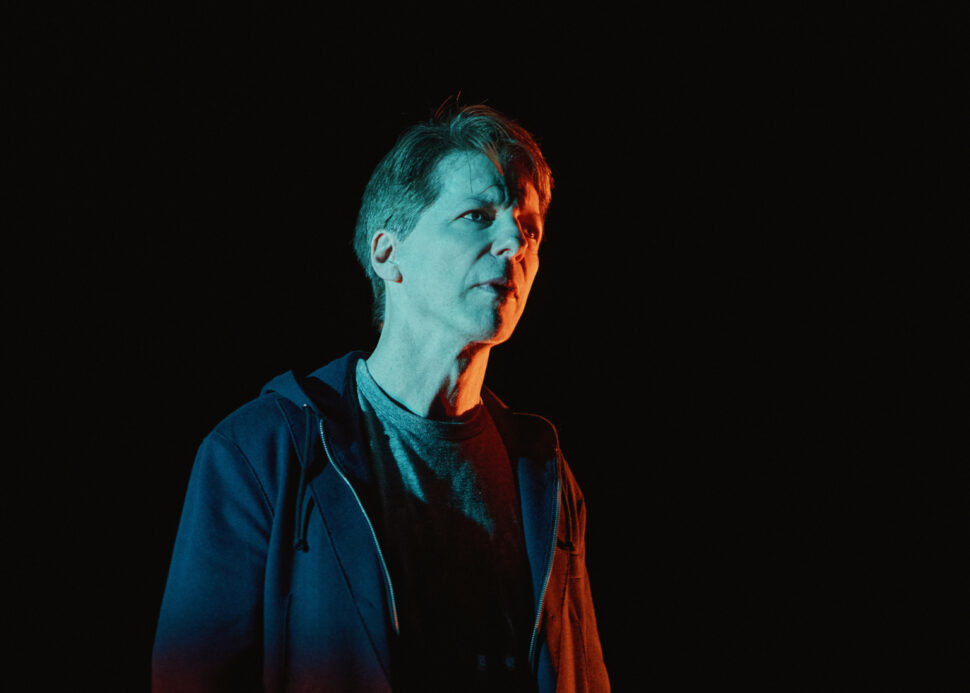
That tension is amplified by Silverman’s direction and the production’s technical design. Lighting designer Cha See (Broadway’s Oh, Mary!) and composer Isobel Waller-Bridge (West End’s The Son) create an environment that feels intimate, tight, and distinctively ominous. Shadows stretch and sound pulses in a way that keeps us slightly off balance and on edge. Every element works in concert to sustain a mood that is immersive and controlled, allowing the play’s more abstract turns to feel grounded in a consistent atmosphere.
The result is a piece that engages deeply in the moment, pulling the audience into its maze of obsession, authorship, and identity. At the same time, its impact shifts once the metaphorical lights come up – I streamed this production on its last weekend in the Seaview Theatre Off-Broadway. The questions it raises about creation and control linger, though the narrative itself resists easy resolution. There is a sense of having been guided through something intricate, even as its final shape remains elusive and filled with questions.
That tension between immersion and aftermath speaks to the play’s central idea. Elliott’s search for clarity becomes its own kind of trap, a loop where the need to understand overtakes the experience itself. Sitting in that space, watching Hayes hold the threads together with such precision, the pull of The Unknown becomes something to endure. It is a journey that grips tightly while it unfolds, then slips just out of reach with a shrug.


[…] Sean Hayes, The Unknown […]
LikeLike
[…] Horror ShowJesse Tyler Ferguson, TruSusannah Flood, LiberationIshmael Gonzalez, SpreadSean Hayes, The UnknownJoshua Henry, RagtimeGrey Henson, Bigfoot!André Holland, The Brothers SizeStephanie Hsu, The Rocky […]
LikeLike
[…] Sound Design of a PlayAngela Baughman, InitiativeCaroline Eng, The UnknownTom Gibbons, OedipusKieran Lucas, Weather GirlNevin Steinberg, Anna ChristieGiles […]
LikeLike
[…] Tullock and Frank Winters, performed by Jen TullockOther, written and performed by Ari’el StachelThe Unknown, by David Cale and performed by Sean […]
LikeLike
[…] Sean Hayes, The Unknown […]
LikeLike
[…] ShowJesse Tyler Ferguson, TruSusannah Flood, LiberationIshmael Gonzalez, SpreadSean Hayes, The Unknown***Joshua Henry, Ragtime***Grey Henson, Bigfoot!André Holland, The Brothers SizeStephanie […]
LikeLike
[…] Sound Design of a PlayAngela Baughman, InitiativeCaroline Eng, The Unknown***Tom Gibbons, Oedipus***WINNER***Kieran Lucas, Weather GirlNevin Steinberg, Anna ChristieGiles […]
LikeLike