The London England Theatre Review: Kip Williams’ technically ambitious solo adaptation dazzles in stamina and spectacle, but leaves the gothic heart of Bram Stoker’s classic frustratingly out of reach
By Ross
As jokingly stated in the previous reviews about my whirlwind London theatre trip, “madness” has somehow become the unofficial theme. After initially digging into fractured psychology and dangerous obsession in Equus, our second stop carried us into another type of darkness, one consumed by fear, desire, and unraveling minds. Bram Stoker’s Dracula should feel like a fever dream of lust, death, paranoia, and supernatural terror, but unfortunately for us all, this technically elaborate adaptation at the Noël Coward Theatre feels strangely detached from its own atmosphere of dread, racing breathlessly through the famous novel while keeping genuine passion and danger frustratingly at arm’s length.
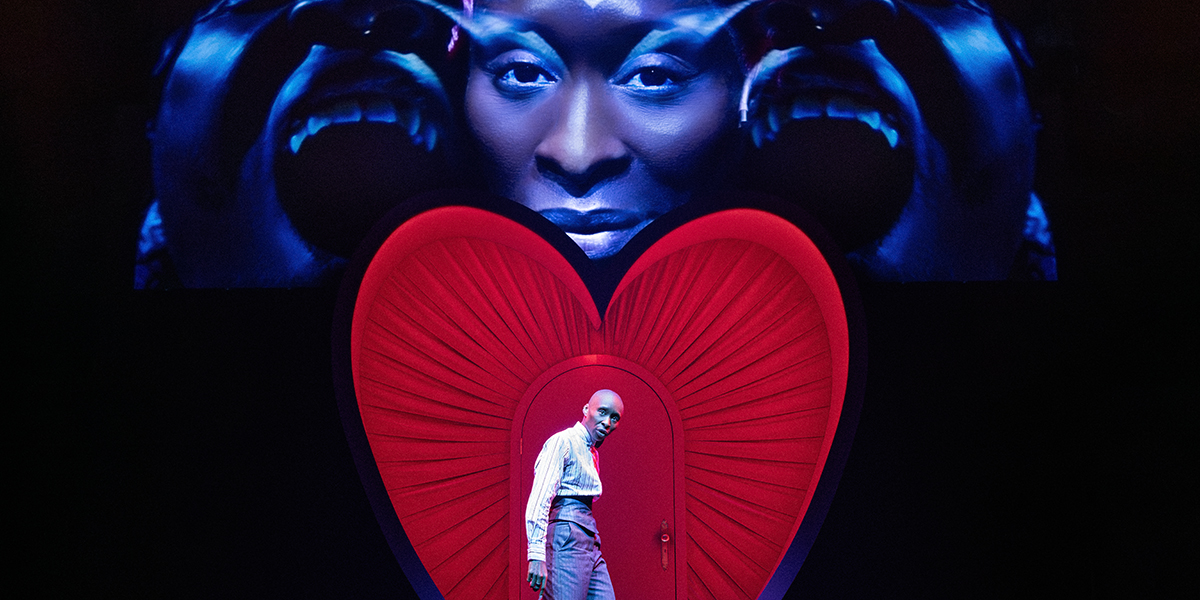
We first see Cynthia Erivo (Broadway’s The Color Purple) from above, as if from a bat’s eye view circling its prey. Her form already weighed down by the material, she breathes into the darkness before the machinery of the production fully begins to reveal itself. Directed and adapted by Kip Williams, whose enormously acclaimed and thrilling The Picture of Dorian Gray similarly fused live performance with pre-recorded video and camera work, this new Dracula places Erivo all alone at the centre of a sprawling cinematic theatrical experiment. Playing all twenty-three characters across a relentless two-hour-and-five-minute performance without an interval, Erivo delivers an astonishing feat of concentration, stamina, and technical precision. Watching her morph between Jonathan Harker, Mina, Van Helsing, Renfield, and Dracula himself is undeniably impressive. Yet the production spinning around her rarely allows that achievement to translate into emotional engagement or genuine horror.
The storytelling structure reveals its problems almost immediately. Williams and his adaptation hurtle through Stoker’s epistolary narrative at such speed that entire emotional foundations disappear before they can properly land. Characters arrive, narrate, panic, and vanish with audiobook efficiency. Important psychological turns feel skimmed over in a rush to reach the next narrative lamppost, visual trick, or camera transition. The opening sections, particularly Harker’s arrival at Dracula’s castle, unfold with such accelerated pacing that the atmosphere never has the opportunity to truly settle into dread or care. Instead of sinking into the gothic unease of isolation and seduction, the production continually pushes forward as though terrified of stillness or anything that might resemble silence.
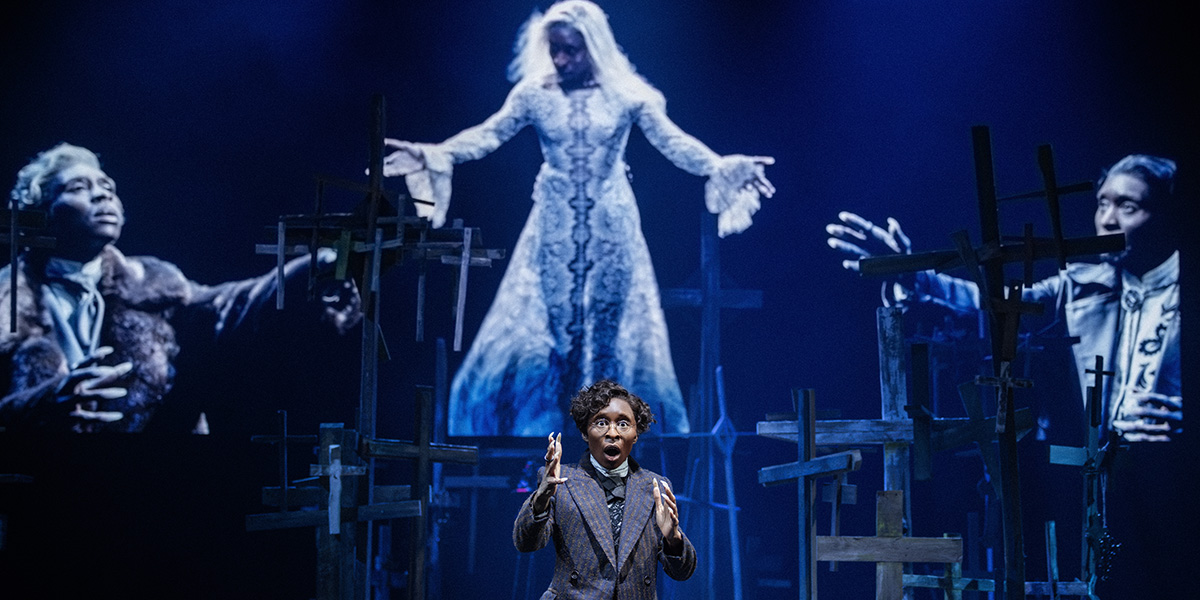
Ironically, despite the rapid-fire narration, the evening often feels emotionally sluggish. The sheer volume of spoken text creates an oddly numbing effect, especially because so much of the drama unfolds through prerecorded video projections rather than live interaction. Erivo frequently turns her back to the audience while performing directly into cameras, allowing her filmed embodiments to dominate the stage-sized screens descending above the performance space. Her physical presence onstage becomes strangely passive, functioning primarily as observer and narrator while the “real” action occurs in projected form above her head.
Unfortunately, that visual strategy creates practical frustrations. Seated beneath the overhang of the Noël Coward balcony, many audience members are forced to split focus awkwardly between the stage action and smaller side monitors whenever portions of the massive screen are obstructed. The result often feels closer to watching an elaborately assembled film set than experiencing immediate live theatre. Camera people, wig assistants, costume technicians, and visible backstage mechanics constantly swarm the stage space, drawing attention not to the emotional stakes of the story but to the complexity of the production’s technical execution. And after a while, we begin to disengage.
That distance proves particularly damaging in a story that depends so heavily on seduction, emotional connection, and mounting terror. This Dracula contains surprisingly little of that sense of danger. Horror never fully materializes. Suspense rarely tightens its grip. Even the climactic race back to Transylvania, which in Stoker’s novel plays like a desperate collision between supernatural evil and human endurance, arrives with little urgency or emotional payoff, despite how beautifully the snow falls. Because the adaptation rushes through relationships and internal struggles so quickly, the audience never develops strong enough attachments to feel genuine fear for any of these people. When Erivo’s narrator states, “He wanted to consume me,” the line lands with accidental irony, as the production itself feels consumed by its own stylistic machinery with little left for us to bite into.
Still, Erivo remains a magnetic force throughout, even when the material works against her. Her command of language and vocal modulation is extraordinary. She switches between accents, emotional registers, and physicalities with almost alarming fluidity. Near the climax, Erivo seductively offers us a brief haunting vocal passage that suddenly electrifies the theatre with the soulful immediacy the production has largely denied itself up until that point. The audience visibly leans into her voice, and for a fleeting moment, the evening discovers the haunting heartbeat it has been searching for. Then, almost immediately, the music disappears again.

Marg Horwell’s costume and scenic design occasionally struggle to balance theatricality and seriousness, with certain wardrobe choices unintentionally provoking laughter rather than unease. Clemence Williams’ score and Nick Schlieper’s lighting provide atmosphere where they can, but even these elements fight against the production’s overwhelming dependence on screens and narration. Although Williams has described this version of the vampire myth as a “queer retelling,” his adaptation, while gesturing vaguely toward contemporary themes involving queerness, invasion, and otherness, never meaningfully explores them. Stoker’s unsettling political and social undercurrents similarly remain largely untouched.
A technical glitch midway through the performance that I attended temporarily halted the production for nearly ten minutes, just as the final chase toward Dracula’s castle began accelerating. Ironically, that interruption briefly created more tension and anticipation in the room than much of the staging itself had managed beforehand. When she returned to the stage after being ushered out, Erivo remained poised and vocally unshaken, further proving the immense discipline behind her performance.
For all its visual ambition and astonishing technical choreography, Williams’s Dracula rarely finds the pulse beneath the machinery. The idea of “madness” that has been threading through our London theatre journey continues here, but instead of psychological terror or dangerous longing, it emerges as artistic overconsumption, a production so determined to reinvent itself through technology and narrative compression that it drains the blood from its own gothic heart. Cynthia Erivo fights valiantly against that current with intelligence, endurance, and undeniable stage presence, searching for emotional truth inside the storm of projections and monologues surrounding her. Occasionally, especially in those fleeting moments when her voice finally rises into song, you get a glimpse of the haunting production that is hiding somewhere underneath all the screens. Unfortunately, it has its back to us.


[…] From the psychological torment of Equus to the fractured identities and collapsing realities of Dracula and Jinkx falling apart at the End of the Rainbow, the theme keeps resurfacing in wildly different […]
LikeLike
[…] “madness.” It has echoed through nearly every stop on the itinerary, from Equus and Dracula to Romeo and Juliet, Inter Alia, and One Flew Over the Cuckoo’s Nest. Yet nowhere has madness […]
LikeLike
[…] by a powerhouse performance from Cynthia Erivo, the Oscar-nominated star of “Wicked” and TIFF ’19’s “Harriet“, this […]
LikeLike