
The Stratford Festival Review: Antoni Cimolino’s final directorial production as Artistic Director delivers a visually stirring and emotionally generous interpretation of Shakespeare’s enchanted farewell
By Ross
“Rough magic” hangs over the Stratford Festival this season with unusual emotional weight. Chosen as the thematic centre of Antoni Cimolino’s final year as Artistic Director, the phrase already carries the feeling of farewell, reflection, and release before a single production even begins. Sitting inside the Festival Theatre as Shakespeare’s The Tempest opened the Stratford Festival’s 2026 season, that emotional current became impossible to ignore. Like a genie rising from a bottle washed ashore, Marissa Orjalo’s luminous Ariel first emerges from the darkness and gently touches the keys of a weathered baby grand resting on the island. A few wistful musical notes drift outward, and suddenly Shakespeare’s world of storms, spirits, revenge, and forgiveness begins breathing all around us. In that moment, Cimolino’s production announces itself not simply as another staging of The Tempest, but as a deeply personal meditation on art, power, and letting go. Then the storm arrives.
Beautifully staged by Cimolino (StratFest’s The Winter’s Tale) alongside set and costume designer Julie Fox, the famous opening shipwreck sequence becomes a thrilling eruption of colour, sound, movement, and theatrical illusion. I could not watch it unfold without immediately thinking of the unforgettable opening moments of “Slings & Arrows” (that starred Paul Gross, who happens to be back at Stratford in Waiting for Godot, opening later this week). As the series memorably describes it, ”And as per the four-hundred-year-old stage direction, we begin with a ‘tempestuous noise of thunder and lightning.’ It is a storm of colour and sound. A dense, unnatural storm. And we see it in glimpses and flashes, as Miranda would have seen it.” (“Slings & Arrows” – s01e01 – Oliver’s Dream). Cimolino’s production captures that same feeling of theatre transforming into something mystical and dangerous.
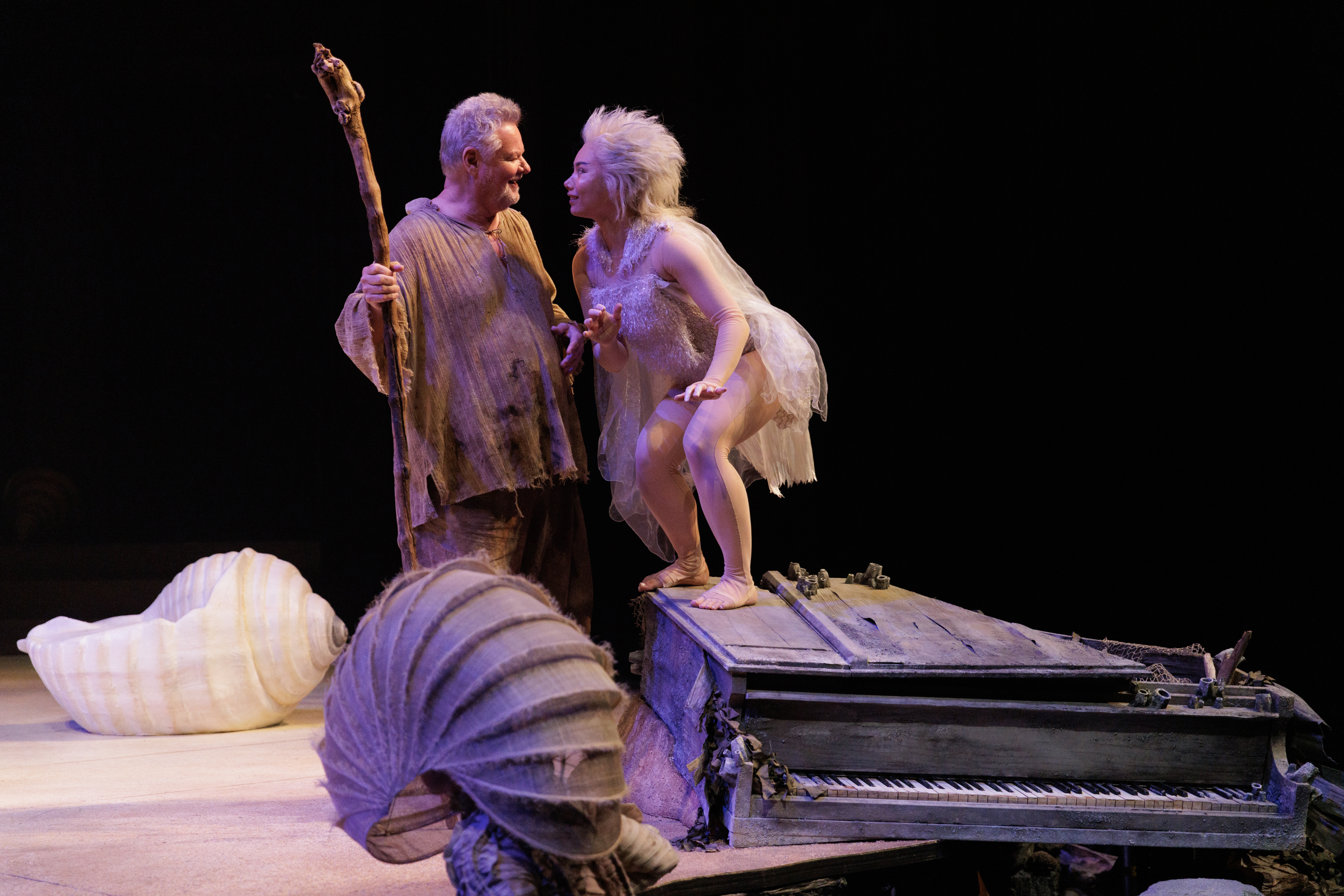
Here in Stratford, the Festival Theatre’s thrust stage fills with chaos as the ship’s enormous sail flies violently overhead while Prospero, passionately portrayed by Geraint Wyn Davies (StratFest’s Grand Magic), commands the tempest from atop a rotating stone structure resembling the throne of some ancient giant. The crew is hurled violently across the stage while lighting designer Imogen Wilson, composer Berthold Carrière, sound designer Ranil Sonnadara, and movement director Adrienne Gould combine forces to conjure a storm that feels both terrifying and strangely beautiful. When the collapsing sail transforms into crashing ocean waves that swallow the ship whole, the production fully embraces the illusionistic power at the centre of Shakespeare’s late masterpiece, and we are wonderfully swept away by its magic.
Cimolino approaches The Tempest with immense reverence for Shakespeare’s language and emotional architecture. This is not a revisionist production seeking radical reinvention (as many I have seen in the past). Instead, he trusts the strength of the play itself, allowing Shakespeare’s language to land with unusual clarity, detail, and emotional immediacy while still uncovering fresh textures inside it. Davies’s Prospero embodies that approach magnificently. His performance possesses command, intelligence, sorrow, and tightly controlled fury, while still allowing glimpses of exhaustion, vulnerability, and regret to emerge beneath the surface. Prospero’s magic feels genuinely electric and powerful throughout the production, particularly in his manipulations of the shipwrecked visitors he has drawn onto the island. Yet Davies also understands that the character’s deeper struggle lies in learning when to surrender that power. His scenes with Miranda, warmly and intelligently portrayed by Ashley Dingwell (StratFest’s Dangerous Liaisons), reveal a father whose love is inseparable from his need for control.
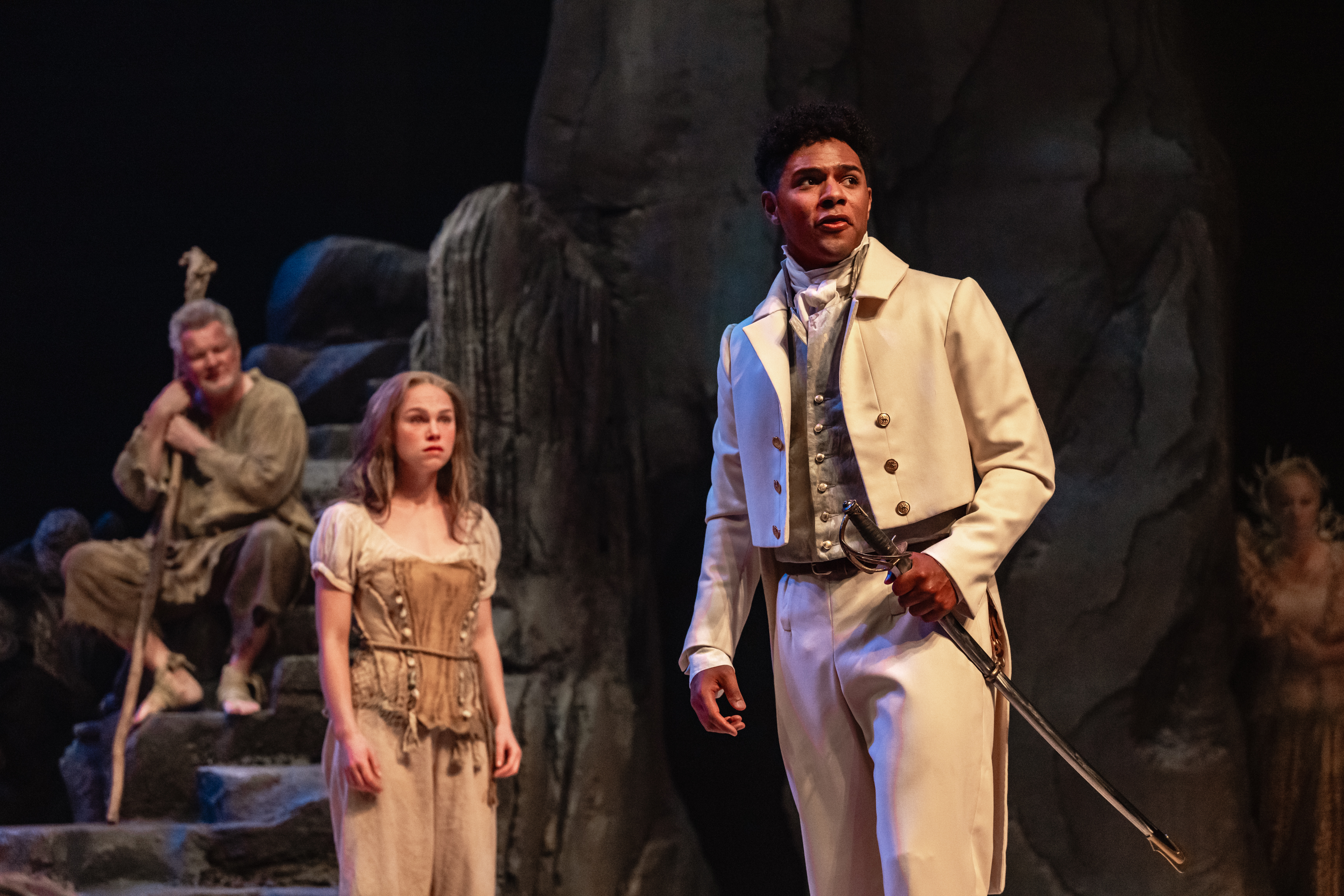
Dingwell’s Miranda proves particularly fascinating because the production quietly reframes her relationship to the men surrounding her. Often portrayed primarily through innocence and romantic wonder, this Miranda possesses emotional perception and intellectual confidence that frequently place her on equal footing with the man she falls instantly in love with, Ferdinand, played with earnest sincerity by Dakota Jamal Wellman (StratFest’s Macbeth). Shakespeare wrote The Tempest within a deeply male-dominated culture, giving Miranda the burden of existing as the play’s major female figure among fathers, kings, monsters, and spirits. Cimolino’s production subtly pushes against that imbalance without forcing modern commentary awkwardly onto the text. Miranda’s memories of the “four or five women” who cared for her before arriving on the island gain unusual resonance here, suggesting buried histories and identities Prospero himself would prefer remain forgotten. Even the joyous jellyfish-inspired masque celebrating Miranda and Ferdinand’s union carries a sense of political orchestration beneath its music and spectacle, reinforcing Prospero’s desire to shape both personal and societal harmony according to his own design.
That tension between authority and humanity echoes throughout the island itself. Fiona Reid’s inspired casting as Gonzalo/Gonzala introduces a compelling new dynamic into the courtly relationships, particularly in the dismissive treatment she receives from Alonso despite her wisdom and loyalty. David Collins (CanStage’s A Doll’s House) brings a weary dignity and quiet grief to Alonso, allowing the king’s guilt and emotional exhaustion to emerge gradually beneath his royal authority. Josue Laboucane’s Trinculo and Ben Carlson’s Stephano inject the production with delightful drunken chaos and sharp comic timing, and their absurd attempts to recruit Caliban into fantasies of rebellion and power carry sharp and unsettling colonial echoes beneath the humour.
Jonathan Goad’s Caliban emerges as one of the production’s most emotionally charged figures. With his reptilian physicality and simmering rage, Goad presents Caliban as both victim and threat, shaped by humiliation, dispossession, and longing. His bitterness toward Prospero burns through every scene, especially as the production leans thoughtfully into the play’s postcolonial interpretations. Caliban’s famous cry that “This island’s mine” resonates strongly within a production deeply aware of the colonial structures operating beneath Shakespeare’s fantasy. Prospero may frame himself as a restorer of justice and order, but his domination of both Ariel and Caliban carries undeniable and oppressive violence. The island spirits, gorgeously costumed in flowing oceanic imagery, reinforce that atmosphere of enchantment and unease, even if their constant presence occasionally overwhelms quieter dramatic moments. Carrière’s cinematic score, filled with haunting vocal textures and choral whispers, breathes an almost supernatural pulse into the island itself, surrounding the production with a constant atmosphere of enchantment and unease.
What gives this Tempest its emotional force, however, is not the spectacle of Prospero’s magic or his majesty, but his growing recognition of its moral cost. Cimolino’s production fully understands the importance of the play’s famous “rough magic” speech, especially within the context of his own departure from Stratford leadership after decades shaping the Festival’s artistic identity. Prospero’s decision to abandon his art becomes inseparable from questions of legacy, responsibility, and forgiveness. Throughout the evening, he has manipulated nearly everyone around him through illusion, fear, and supernatural authority. By the final act, Davies allows us to see the weight of that realization settling painfully onto Prospero’s shoulders. His embrace of the treacherous Antonio, portrayed by Gordon S. Miller (StratFest’s Grand Magic), carries genuine emotional vulnerability rather than hollow ceremony. Forgiveness here feels difficult, imperfect, and deeply human.
As the island slowly releases its grip and Prospero prepares to surrender both his power and his solitude, Cimolino’s production arrives at something quietly moving about the act of stepping away. The artistic director has shaped the production not simply as spectacle, but as an emotionally resonant farewell to the artistic vision that has guided Stratford for more than a decade. The storm that opened the evening with such fury eventually gives way to reconciliation, music, tenderness, and release. That spirit of release feels inseparable from Stratford itself this season, as one artistic era prepares to hand itself over to the next. Beneath all the spirits, shipwrecks, illusions, and theatrical splendour, this Tempest understands that Shakespeare’s play has always been haunted by the fragile hope that people can choose compassion after cruelty, grace after control, and forgiveness after injury. On opening night at the Stratford Festival 2026 season, that hope washed over the night with undeniable power.



[…] strange twist of theatrical fate, while writing about Stratford Festival’s opening production of The Tempest, I found myself quoting the series almost instinctively. I was trying to describe the overwhelming […]
LikeLike
[…] as Algernon Moncrieff, Joe Perry as John Worthing, Fiona Reid as the formidable Lady Bracknell, Allison Lynch as Gwendolen Fairfax, Marissa Orjalo as Cecily Cardew, Lucy Peacock as Miss Prism, and Ben Carlson […]
LikeLike
[…] in decorative ribbon. Orjalo (StratFest’s Ransacking Troy) and Lynch (StratFest’s The Tempest) never reduce their characters to caricatures, allowing both women to reveal wit, confidence, and […]
LikeLike
[…] has just announced its Pay-What-You-Can performances, with selected tickets starting at $25. The Tempest, Guys and Dolls, The Importance of Being Earnest, Death of a Salesman, and Something Rotten! all […]
LikeLike
[…] neighbour and his wife Elena, played lovingly by Michelle Giroux (StratFest’s The Tempest), bring their own histories, energy, and tensions into the family’s orbit. The dynamic among […]
LikeLike