
The London England Theatre Review: Rosamund Pike commands Suzie Miller’s emotionally shattering legal drama with fierce intelligence and aching vulnerability
By Ross
“Madness” continues to be the word we jokingly assigned to our whirlwind London theatre journey, following us from show to show with unsettling precision. From the psychological torment of Equus to the fractured identities and collapsing realities of Dracula and Jinkx falling apart at the End of the Rainbow, the theme keeps resurfacing in wildly different forms. Yet nothing prepared me for how deeply Inter Alia would cut into that idea, not in any way expected, but through the terrifying possibility that the carefully ordered life you built with intelligence, discipline, and love could easily unravel in a single night.
The first image arrives like a rock-star shockwave. Rising upward from below the stage while a concerto skips and restarts with the sharp pulse of live guitar, Rosamund Pike’s Jessica Parks emerges with the commanding energy of someone who has spent her entire life refusing to surrender control. It is a thrilling piece of theatrical framing that immediately tells us who this woman is before she even speaks. Jessica is a celebrated London Crown Court judge, razor sharp and deeply assured, presiding over sexual assault cases with an authority that feels absolute. Pike (“Saltburn“) inhabits her with fierce intelligence and restless movement, striding through the courtroom and her home with the confidence of a woman who believes completely in the structure she has devoted her life to creating and protecting.
Written by former lawyer Suzie Miller and directed with muscular precision by Justin Martin, Inter Alia quickly reveals itself to be about far more than the courtroom. Jessica’s professional life is only one piece of the pressure surrounding her. At home, she is balancing motherhood, marriage, emotional labour, and the exhausting expectation that she somehow maintain it all flawlessly. Her husband, Michael, portrayed with restrained frustration by Jamie Glover (“Waterloo Road“), exists uneasily within the shadow of her success, quietly wrestling with what it means to occupy the secondary role inside a marriage built around such a formidable woman. Their son Harry, devastatingly portrayed by Cormac McAlinden (“110%“), moves through their beautifully ordered household with the distracted speed and emotional volatility of adolescence, although every moment involving him carries a quiet fragility that keeps us on edge.
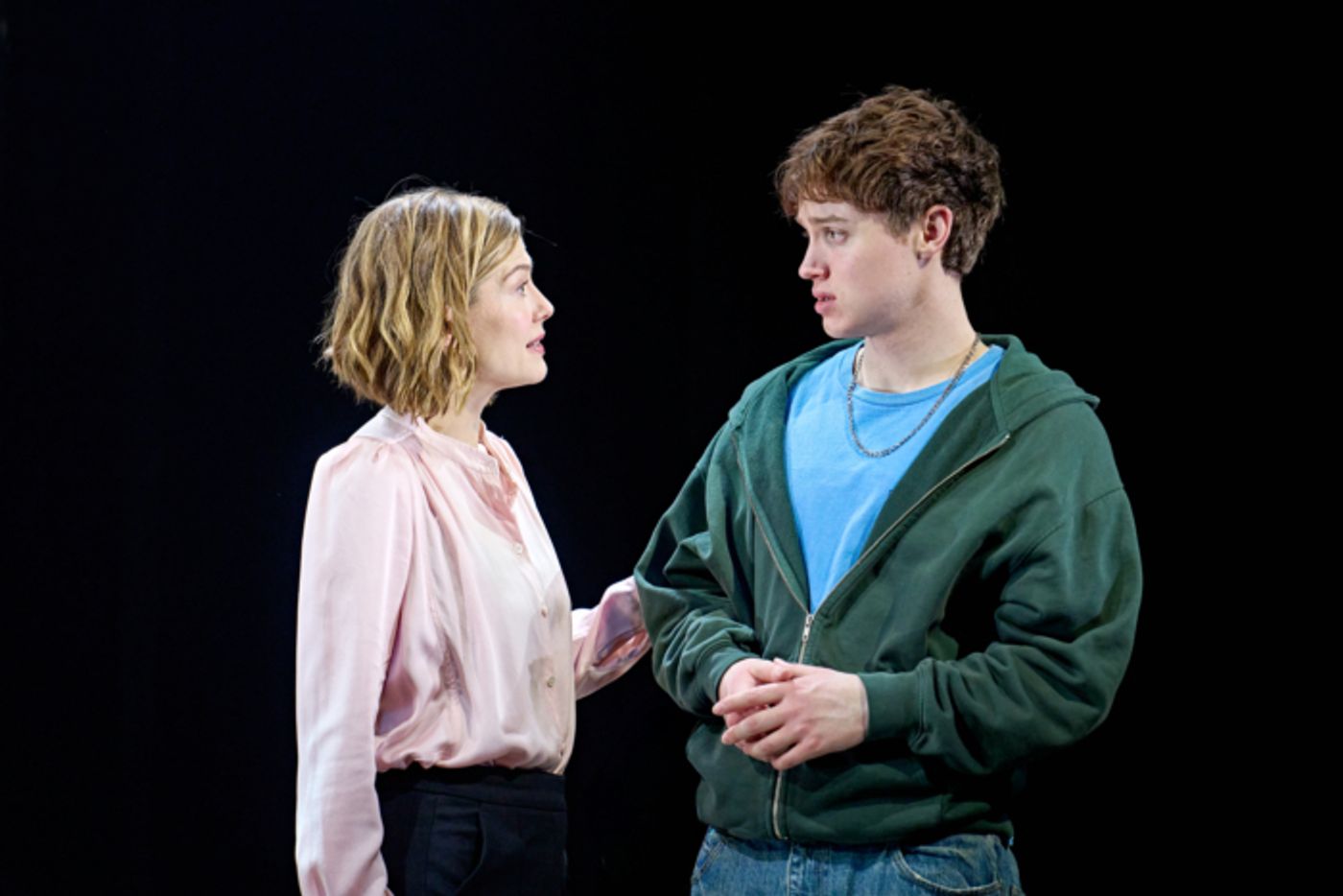
Running about and appearing from every possible nook and cranny, Harry’s yellow raincoat becomes one of the production’s most emotionally potent visual devices. It marks him both as a child still in need of protection and as a figure constantly slipping away from his parents’ grasp. Miller carefully plants the memory of a terrifying childhood incident in which Harry wandered off and disappeared, leaving Jessica emotionally shattered by panic and guilt. That fear never truly leaves her, and Pike allows us to see how deeply it has buried itself inside Jessica’s psyche. When Harry later heads out to a party and a devastating accusation follows him home, the entire emotional architecture of the play begins to crack wide apart, and we feel the fear fire up once again.
Anyone familiar with Miller and Martin’s Prima Facie may initially detect echoes of that earlier work in Inter Alia’s structure and thematic concerns, though the play eventually carves out its own bruising emotional terrain. The form develops its own electric momentum as Miller wisely interrogates motherhood, masculinity, pornography, justice, and the impossible contradictions of modern parenting. Jessica spends her professional life protecting vulnerable women from hostile cross-examinations and manipulative legal tactics, yet suddenly finds herself confronted with the possibility that her own son may have caused irreparable harm. The collision between her feminist principles and her instinctive need to protect Harry tears through the play with agonizing force and we can’t help but feel the turmoil.
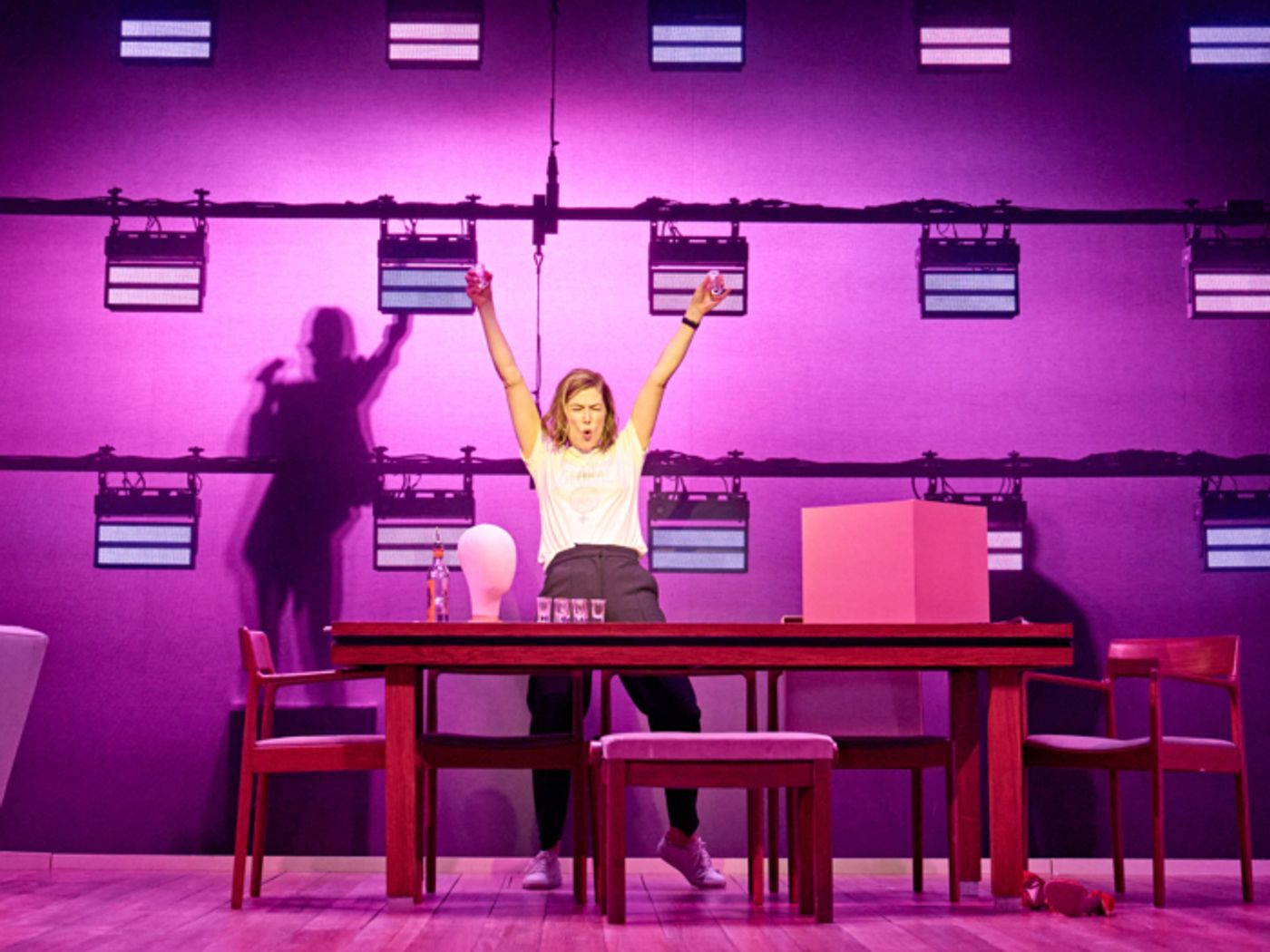
At the center, Pike’s performance is astonishing throughout. She attacks the role with physical urgency, emotional volatility, and complete commitment, often commanding the stage alone for extended stretches while spiralling through panic, denial, fury, and heartbreak. Her Jessica is brilliant and compassionate, but also controlling, obsessive, frightened, and deeply human. The production moves with relentless energy under Martin’s direction, and Pike never loses hold of the maternal emotional truth even as the pace becomes increasingly suffocating.
One of the production’s greatest achievements is the sleek set design by Miriam Buether (Broadway’s Patriots). The dynamic domestic spaces slide open and apart with almost invisible precision, transforming from courtroom to kitchen to emotional battleground in seconds. Cabinets vanish without warning, walls shift, and rooms subtly collapse around Jessica as her sense of certainty disintegrates. At one point, I became so consumed by the confrontation unfolding before us that I barely registered the kitchen walls slowly disappearing, an astonishing theatrical sleight-of-hand that quietly mirrors the destruction of Jessica’s carefully controlled world.
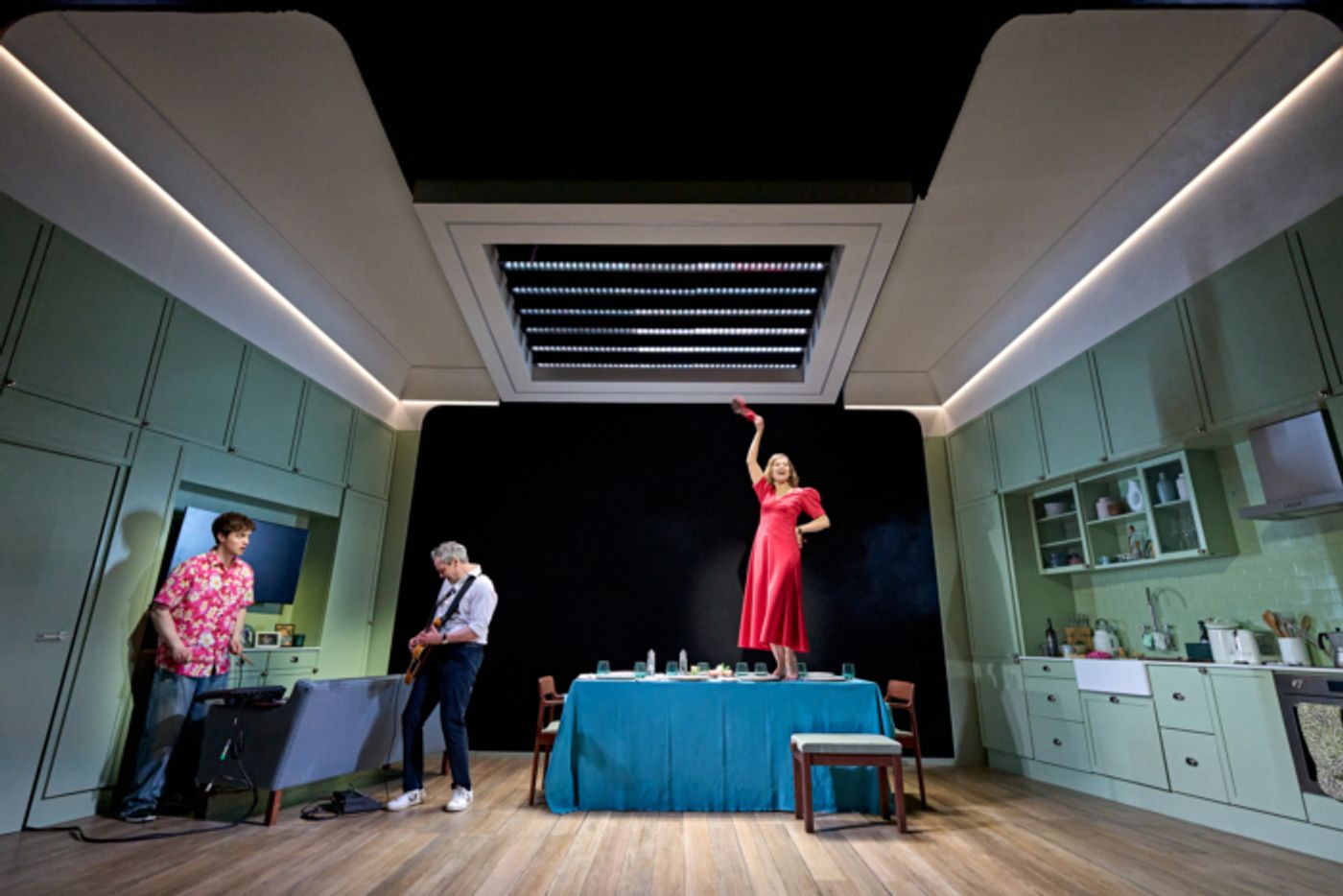
The production also carefully understands the power of rhythm and sound. The live onstage music, hidden almost outside our view, gives the play a pulsating familial vibration, driving scenes forward with mounting dread while amplifying and connecting the emotional chaos underneath Jessica’s composed exterior. The opening rock-infused concerto establishes that tension immediately, and the atmosphere only tightens from there.
Yet for all its legal arguments and political urgency, the play’s emotional centre rests inside something painfully simple: a mother trying desperately to reconcile the child she loves with the possibility that she may no longer fully know him or be able to protect him. That compelling sequence involving Harry’s childhood disappearance becomes almost unbearably moving in retrospect. Jessica’s anguished, guilt-infused cry, “I took my eyes off my Harry,” lands with devastating force because it reaches beyond the literal moment being described. It becomes the expression of every parental fear buried deep beneath the surface, the terror that love, vigilance, and care might still fail to protect the people we hold closest.
By the time the final moments arrive, that image of Harry in the yellow raincoat still hangs over everything, carrying with it all the fear, guilt, tenderness, and helplessness Jessica has spent the evening trying to contain. “Madness” may have started as the running joke of our London theatre marathon, but Inter Alia gives the word one of its most painful forms yet. Not chaos exploding outward, but the slow emotional collapse that comes when a parent realizes they cannot fully shield their child from the world, nor shield themselves from the truth of who that child might have become.



[…] days later, Pike will make her own Broadway debut in Inter Alia at the Music Box Theatre. Written by Suzie Miller and directed by Justin Martin, the legal drama […]
LikeLike
[…] has echoed through nearly every stop on the itinerary, from Equus and Dracula to Romeo and Juliet, Inter Alia, and One Flew Over the Cuckoo’s Nest. Yet nowhere has madness worn such impeccable manners as […]
LikeLike
[…] word that echoes through nearly every title on our itinerary, from Equus and Romeo and Juliet to Inter Alia and Les Liaisons Dangereuses, is almost too brazen and obvious. As we arrived at the Old Vic for […]
LikeLike
[…] brings the West End transfer, Inter Alia, with Rosamund Pike making her Broadway debut in Suzie Miller’s follow-up to Prima Facie. […]
LikeLike
[…] those accused of sex crimes unexpectedly becomes the accuser. Adapted by Australian playwright Suzie Miller from her globally acclaimed one-woman show, and directed by Susanna White (Our Kind of Traitor, […]
LikeLike