The Broadway Theatre Review: David Lindsay-Abaire’s sharp satire finds humour and discomfort in the fault lines of privilege and perception
By Ross
“What’s the worst that could happen?” It is a question that feels almost quaint when it is first raised, the kind of harmless provocation that belongs in a neighbourhood meeting where decorum is expected to hold. Inside David Lindsay-Abaire’s The Balusters, now playing at Manhattan Theatre Club‘s Samuel J. Friedman Theatre, that question becomes a sneaky spark that leads quickly down a more dangerous road. And what follows is a slow, steady unraveling, a collision of sorts, as politeness gives way to something far more revealing, and far less controlled.
Set within the Vernon Point Neighbourhood Association, a group that gathers to discuss the safety and aesthetic integrity of their carefully maintained enclave, the play finds its footing in the rhythms of civic engagement. These are people who pride themselves on being thoughtful, considerate, and aware, even as their conversations circle around stolen packages, misplaced dog waste, and the perceived threat of historically inaccurate porch railings. Under the astute direction of Kenny Leon (Broadway’s Purlie Victorious) , the meetings do their best to move with a deliberate precision, yet the cracks beneath that surface of civility begin to show with each interruption and carefully calibrated overlap.
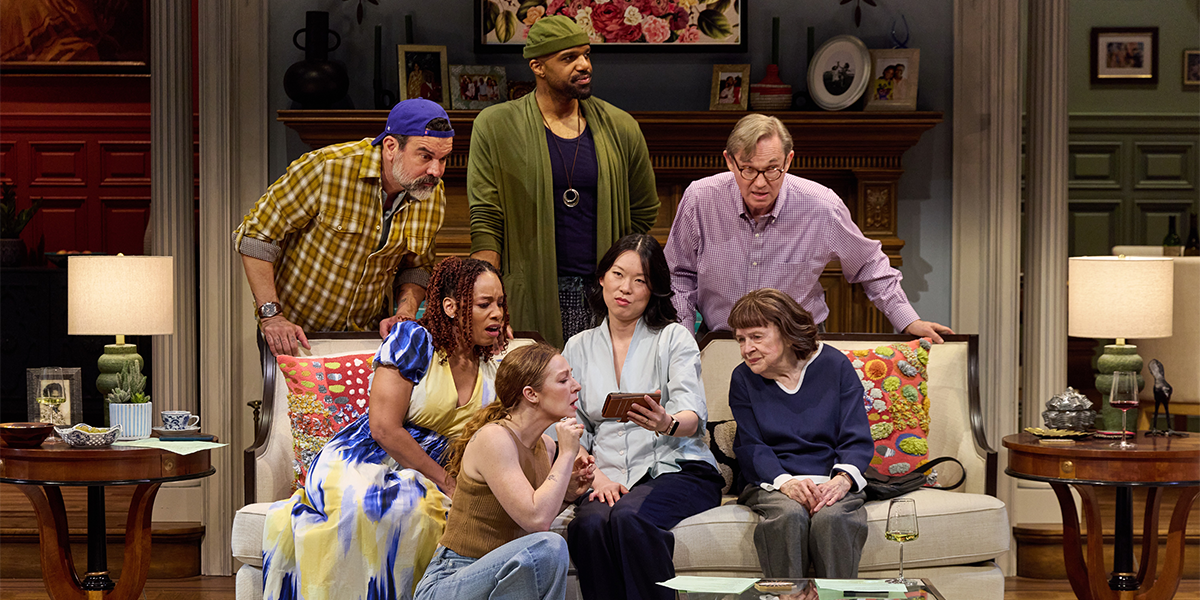
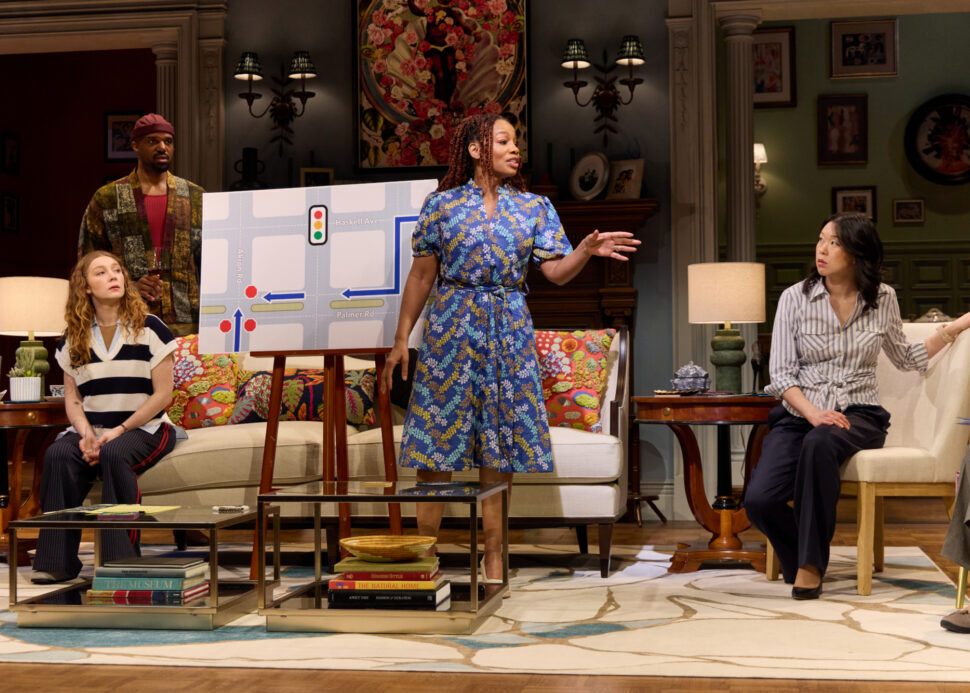
Our first foray begins with the introduction of their newest member, Kyra, played with composure and sharp awareness by Anika Noni Rose (CSC’s Carmen Jones), shifting the balance of the room in ways no one could have anticipated. Recently relocated from the Baltimore area under circumstances that linger just out of full view, she brings with her both a clear sense of community purpose and an understanding of how she should present herself. Her first dipping of the proverbial toe is a practical proposal that she believes to be a simple one. A dangerous intersection near her home needs an intervention. A stop sign might be just the thing the road needs to make the whole neighbourhood safer by slowing down the traffic. What begins as a straightforward request quickly entangles itself in the unthinkable questions of preservation, authority, and control, mostly coming from Richard Thomas’s tightly wound and quietly immovable Elliot, who tries to frame his resistance as a matter of protecting the neighbourhood’s character.
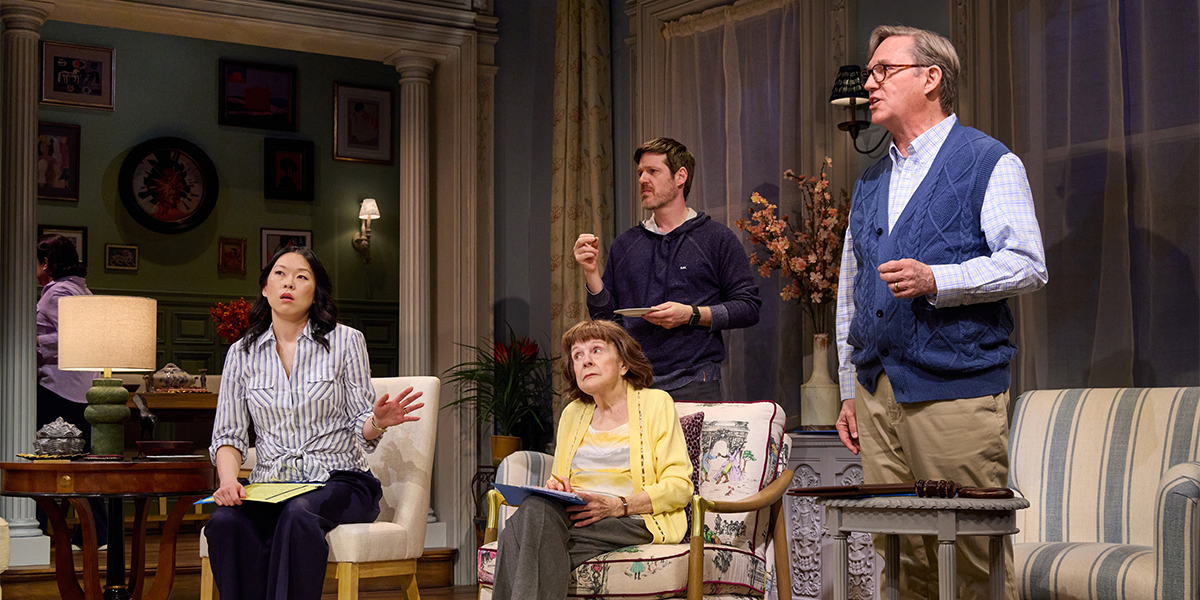
Lindsay-Abaire’s writing thrives in these tightly wound exchanges, where language becomes both a sword and a shield. The play is consistently funny, often sharply so, as it skewers the coded politeness and performative awareness that define the group’s interactions. Jokes land with ease, even when the writing leans toward the familiar, carried by a cast that understands exactly how to pace the rhythm of discomfort. Marylouise Burke’s Penny, the meeting’s dutiful note-taker, drifts through conversations with a gentle disorientation that masks a surprising clarity, while Jeena Yi’s Melissa, my personal favourite in the room, navigates each moment with a dry, watchful detachment. Margaret Colin’s Ruth also proves particularly memorable, as her blunt observations cut through the group’s careful phrasing with a directness that feels both shocking and, over time, increasingly honest.
As Willow, Kayli Carter (The Shed’s This World of Tomorrow) finds a sharp and revealing edge in moments of performative vulnerability, particularly in her handling of the character’s emotional unraveling, when “white girl tears” become both a shield and a spectacle. Michael Esper’s Alan charts a more complicated trajectory; his response to privilege shifts the room’s perception of his likability in ways that feel both deliberate and hysterically unsettling. Carl Clemons-Hopkins (Vineyard’s Lessons in Survival) brings a quieter, more restrained presence, offering a measured stance and counterpoint that draws focus through control rather than force.
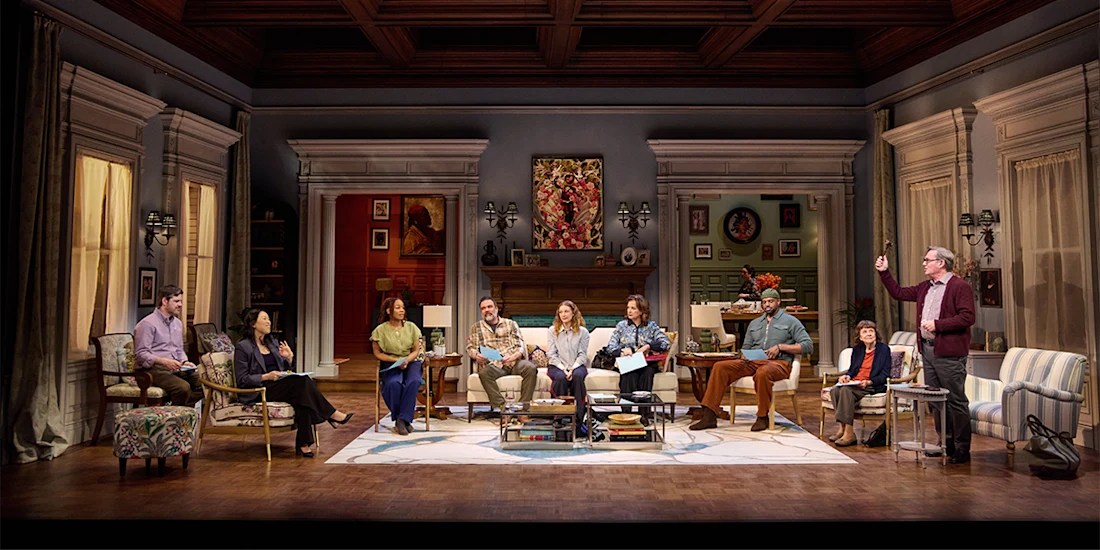
The design reinforces the world these characters inhabit. The richly detailed 1905 Victorian parlour, designed impressively by Derek McLane (Broadway’s Death Becomes Her), anchors the action within a space that feels preserved, curated, and modern, all at the same time. It is a room that deeply reflects the privileged values being debated within it, where history and culture are both points of pride and tools of exclusion. Costumes by Emilio Sosa (Broadway’s Ain’t No Mo’), lighting by Allen Lee Hughes (Broadway’s Ohio State Murders), and original music and sound design by Dan Moses Schreier (LCT’s Floyd Collins) each elevate the space into something electric and charged, like a subtle cultural war reenactment, rich with symbols and metaphors that sharpen the tensions unfolding within it.
At times, Leon’s blocking does not always land with the same precision, with characters often directing their energy outward toward the audience rather than toward one another. It is a construct that the production settles into, though it occasionally undercuts the immediacy of the interpersonal conflict. Yet, the staging does allow the ensemble to move fluidly within that well-appointed environment, maintaining a sense of order even as the conversations themselves begin to slip out of alignment into something that resembles alert caged animals biding their time.
As the meetings and the conflicts pile up on each other, one after the other, circling the same topics with a growing unease, the humour sharpens into something more pointed. All bets are on about “WGT” and the ‘discomfort’ of not being liked, as the debates grow less contained and the language less guarded. Issues of race, class, and belonging emerge not as abstract ideas but as lived tensions that cannot be easily smoothed over. The play’s structure, built around a series of meetings, allows these dynamics to accumulate, each scene adding another layer to the group’s carefully maintained image of itself. At times, the transition into more serious territory lands with a somewhat heavier hand, and the satire gives way to more direct confrontation. Within that battleground state, the production remains engaging, driven by the strength of its ensemble and the clarity of its focus.
The Balusters doesn’t get its impact from the escalation of conflict, but from the recognition of what has been present all along, bubbling underneath and from within. These characters do not transform into something better so much as reveal themselves, their beliefs and assumptions surfacing through the very systems they trust to contain them. Watching each attempt at holding onto order, the question that opened the evening drives back in with a different weight and speed. The worst does not arrive all at once. It settles in gradually, shaped by small decisions, careful words, and the quiet return of a gavel, an item, like so many others in the room, that represents far more than we could imagine when we arrived for that first meeting.


[…] The Balusters […]
LikeLike
[…] Production of a PlayThe BalustersCarolineCold War Choir PracticeDog Day AfternoonGiantKyotoLiberationMarcel on the TrainThe […]
LikeLike
[…] the play side, The Balusters emerges as a significant presence with eight nominations, including Outstanding Play, where it […]
LikeLike
[…] and Two Strangers (Carry a Cake Across New York) all vying for the top prize. On the play side, The Balusters, Giant, Liberation, and Little Bear Ridge Road step forward as this year’s contenders, offering a […]
LikeLike
[…] love of Golden Age musicals into a theatrical event worthy of top honours. In the play category, The Balusters earned Outstanding New Broadway Play, while the acclaimed revival of Ragtime was recognized as […]
LikeLike
[…] Production of a PlayThe BalustersCarolineCold War Choir PracticeDog Day AfternoonGiantKyoto***Liberation***Marcel on the TrainThe […]
LikeLike
[…] followed closely with four awards each, while Schmigadoon! was named Outstanding Musical and The Balusters received the award for Outstanding […]
LikeLike
[…] Broadway PlayThe BalustersGiantLittle Bear Ridge […]
LikeLike
[…] the play divisions, The Balusters and Giant shared Outstanding Broadway Play honours in a rare tie. Both productions also received […]
LikeLike
[…] The Balusters, David Lindsay-AbaireGiant, Mark Rosenblatt ✅🤞 Liberation, Bess WohlLittle Bear Ridge Road, Samuel D. Hunter […]
LikeLike
[…] Show surprisingly failed to convert any of its nine nominations into wins. Chess, Titaníque, The Balusters, Waiting for Godot, Little Bear Ridge Road, and several other productions likewise found themselves […]
LikeLike