The Broadway Theatre Review: John Proctor is the Villain
By Ross
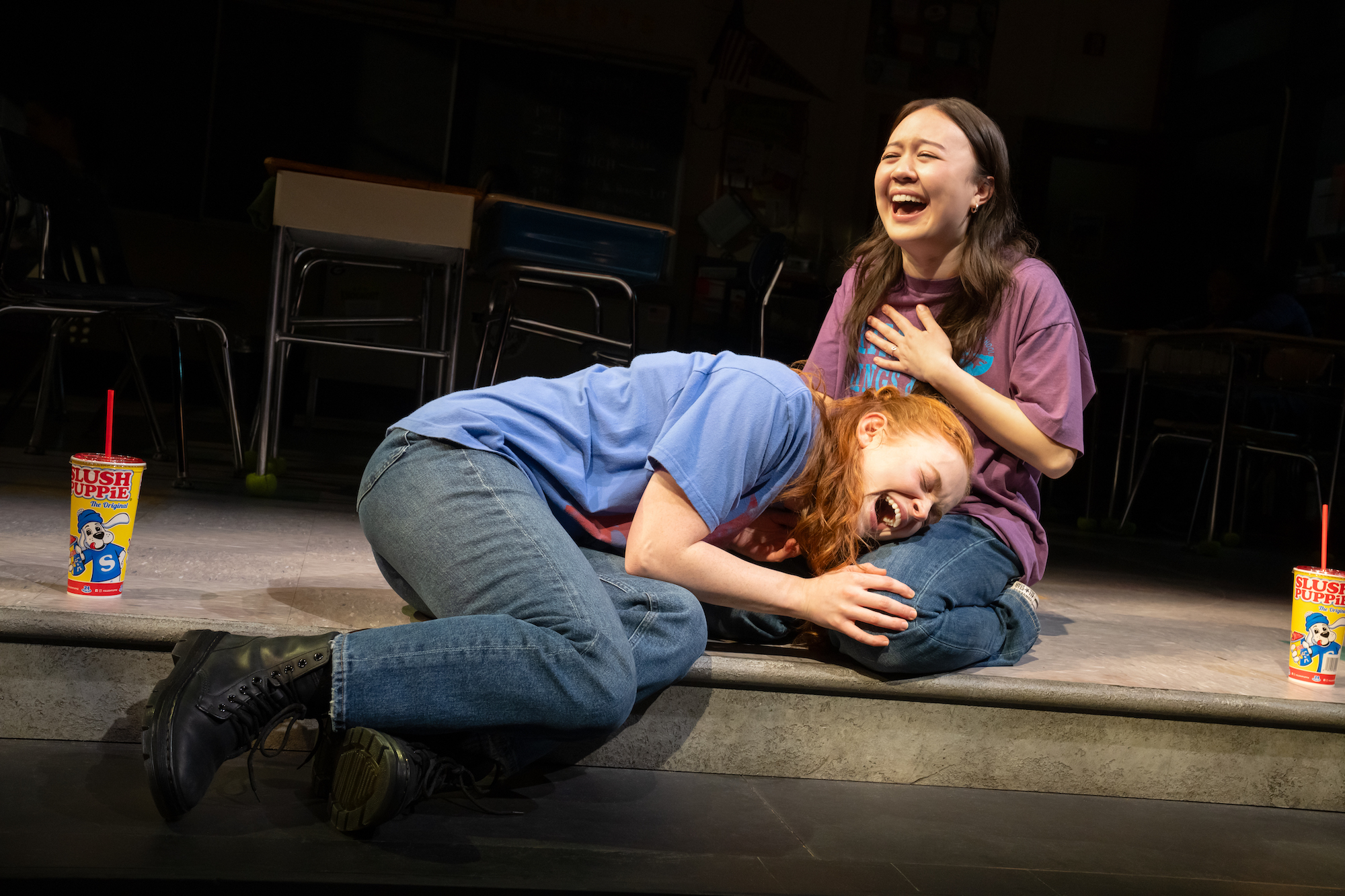
“Are we reading the whole play?” one of the teenagers who populate the electric and defiant John Proctor is the Villain, the new play at the Booth Theatre, asks in that way that only a teenager can. With a quick side slide reveal, after universally reciting some time-constricted sex education terms, this small Georgian town high school class, made up of only seven sharply defined students, dives in and dissects The Crucible, Arthur Miller’s classic allegory centered on Salem witch-hunts and McCarthyism. But as written most wisely and wickedly by Kimberly Belflower (Lost Girl), the meaning and scrutiny of the text, embedded within a selected playlist of pop music and rebellion, dances forth with power and fury, electrifying the stage and audience alike. And as directed with an undeniable force by Danya Taymor (RT’s Jonah), John Proctor is the Villain, as projected bold and bright across the stage, will not be sidelined, quieted, or pushed aside as some sort of simple mass hysteria of teenage girl angst, but as something boldly formed and delivered with focused brilliant determination.

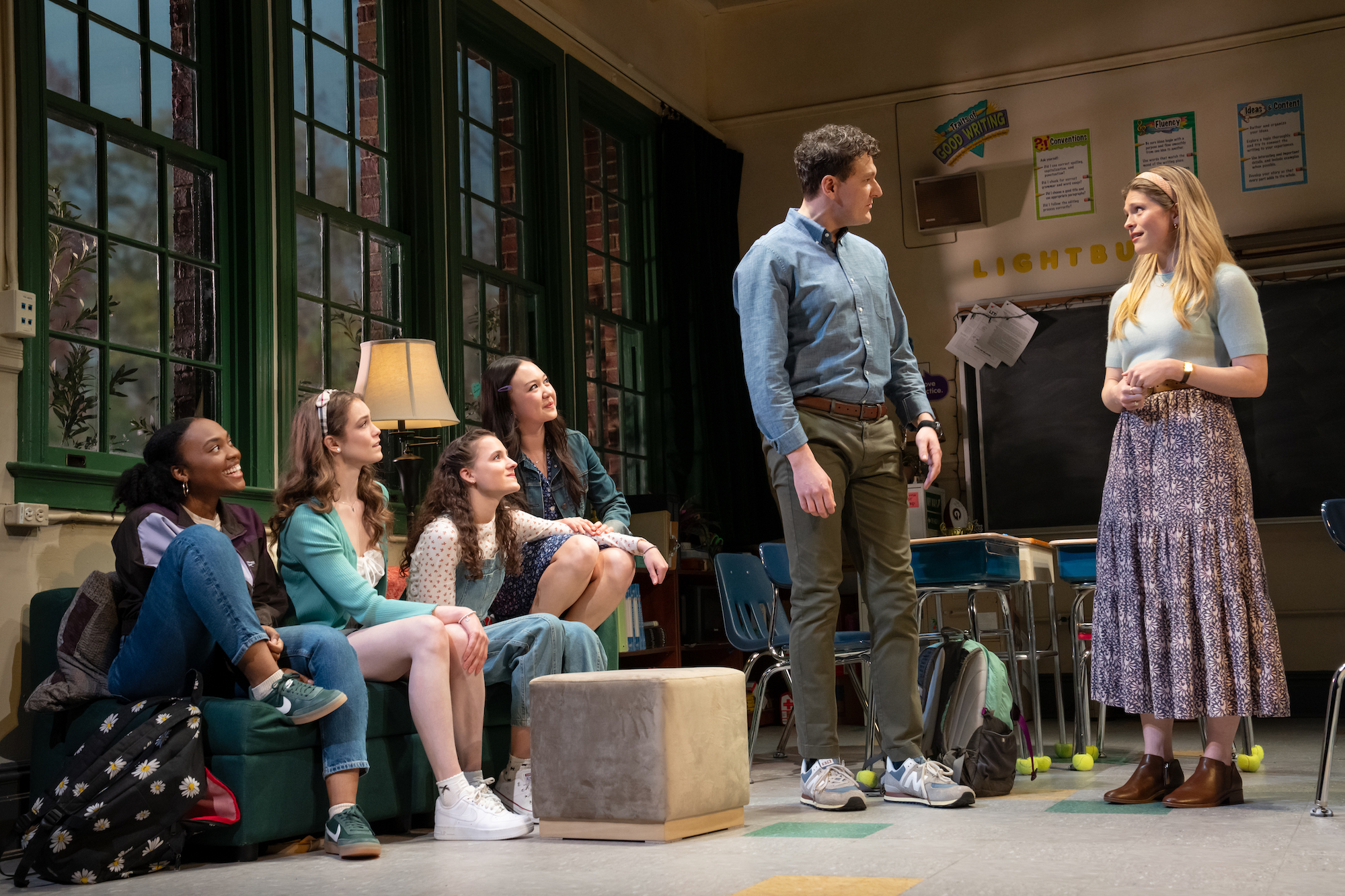
As the junior-year honors English course, led by their adored teacher Mr. Carter Smith, played distinctly by a very good Gabriel Ebert (Broadway’s Pass Over), begins to question the heroic nature of the male lead, John Proctor, in The Crucible, the debate starts to burn up from the floor. The play digs into its feminist notes, led by the anxiety-ridden, overachieving, binder-loving Beth, portrayed energetically by Fina Strazza (ATC’s Animal). She tries with all her desperate energy to save the endangered feminism club from the closure decision of the school’s counsellor, Bailey Gallagher, portrayed wisely by Molly Griggs (MTC’s Linda). Miss Gallagher believes it’s too elevated, complicated, and advanced for these teenage girls to investigate and discuss, but, in reality, it seems more embedded in Bailey’s own discomfort with the feminist stance.
This is an idea pointed out subtly by the informed enthusiasm of Beth’s newly befriended Neil, played masterfully by Morgan Scott (Broadway’s Jaja’s African Hair Braiding), who has just arrived into this small town from Atlanta. Luckily for all and their college applications, the group is allowed to proceed under the administrative sponsorship of their favorite English teacher, Mr. Smith, who saves it just in the nick of time. Mr. Smith even brings in a male member, the endearing Mason, played captivatingly by Nihar Duvvuri (Broadway’s Romeo + Juliet), to broaden the group’s horizons, but the horizons that are widened are far more colorful and unique than Mr. Smith had first imagined. As is Duvvuri’s embodiment of Mason, who keeps surprising us and them over and over again.
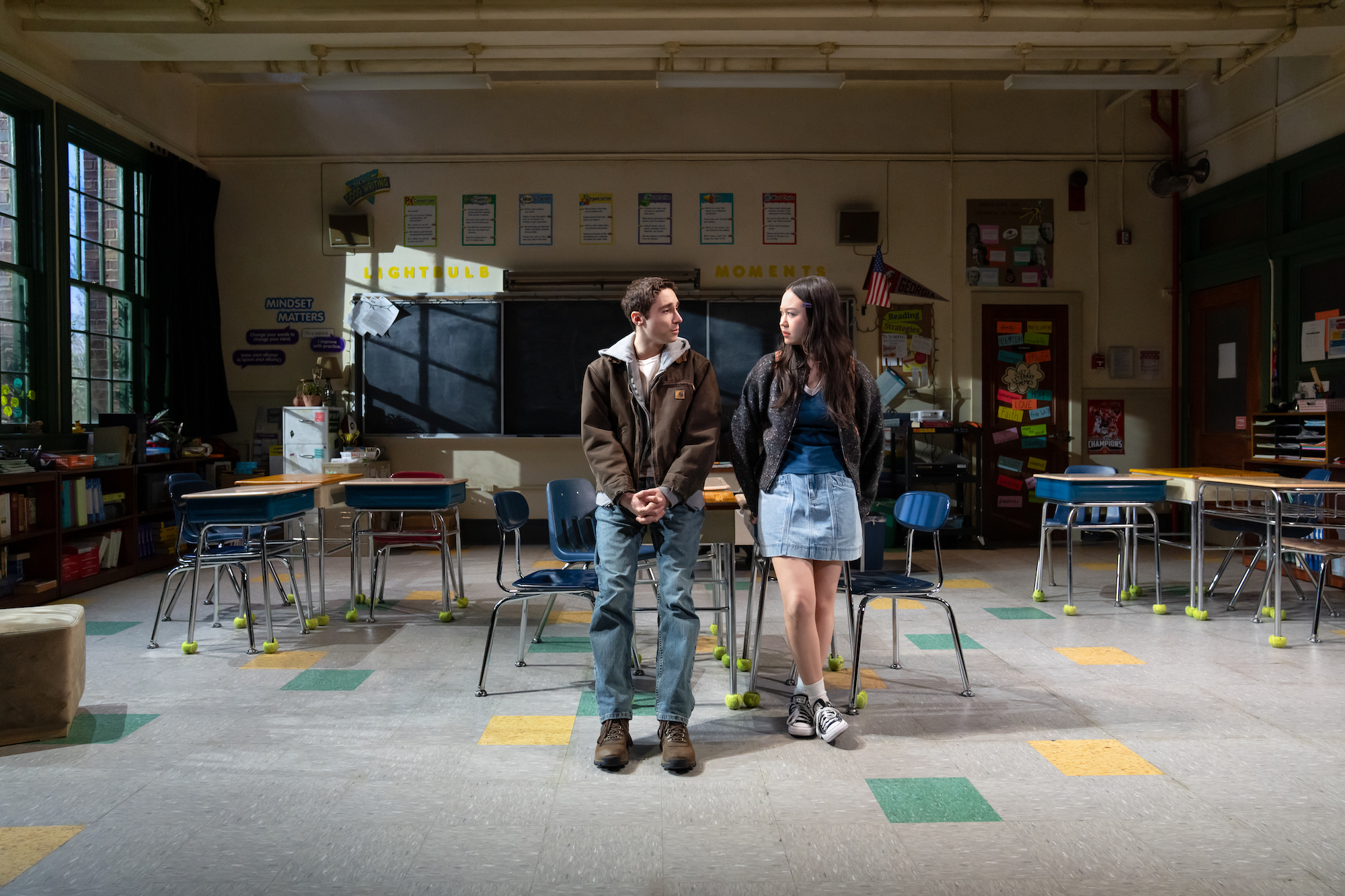
The group gathers, with two other founding members; Ivy, played by Maggie Kuntz (Broadway’s The Outsiders), and Raelynn, portrayed by Amalia Yoo (Netflix’s “Grand Army“), to discuss topics that Beth has compiled in that impressive and overwhelming binder of hers. Ivy and Raelynn seem somewhat more interested in just embracing this girl-group community to discuss boys and Taylor Swift songs, which feels as 2018 authentic as it is needed, as we watch both young women deal with emotional upheavals within family and with teenage love. Raelynn is leaning into her friendships heavily after a recent breakup with her long-time boyfriend, Lee, portrayed to unnerving perfection by Hagan Oliveras (Broadway’s Our Town). And that framing is only elevated with the return of Shelby, portrayed by the miraculously engaging Sadie Sink (Netflix’s Stranger Things), who embodies the central Shelby character with a forceful presence that spins this tale forward with a force that can’t be denied. It seems at first that she disappeared from the high school halls after supposedly seducing Raelynn’s now-ex-boyfriend, but as the teenage girls’ awkward re-engagement with their former friend flames forward, a new interpretation of the term ‘witch-hunt’ is ignited from within.
There is nothing obvious or simple in this play’s reckoning, as it sets up a fire-bed of issues around #MeToo accusations and perceptions of innocence and sexuality that waits patiently to the side to be ignited. Belflower finds the fuel embedded in The Crucible, but without digging around too deeply into Miller’s text with a fine-toothed comb. It’s all around that well crafted space, brought magnificently forward by the design team; with scenography crafted with detail by AMP (PH’s Magnificent Bird/Book of Travelers), exacting costumes by Sarah Laux (Broadway’s Dead Outlaw), superb lighting by Natasha Katz (Broadway’s Hell’s Kitchen), a solid sound design by Palmer Hefferan (RT’s Liberation), and invigorating projections by Hannah Wasileski (LCT’s The Skin of Our Teeth), fleshed out ferociously inside the giddiness and clarity of these young women and their eye-opening experience to what the world truly is giving them. The awkwardness and uncomfortable combustible power of Yoo’s Raelynn and Oliveras’ Lee is spectacularly well-drawn, as is the destruction of the young women’s ideals around those who deceive and manipulate them with ingredients that give us goosebumps of discomfort. And it isn’t pretty or classically clear, like the teen movies they admire so much parcel out to their hopeful hearts.
It’s more like the music, blasting out lyrics of empowerment and devastation that revolve around them, crashing into their ideals and desires with a force that almost knocks them down. But they get up, and dance it out, within their supportive structures. Sink is spectacularly distinct and defined in her portrayal of the central figure in this witch-hunt dissection, as they come together within a dance break that electrifies the theatre, especially when those others stand up and block the demands of those who want them to stop and settle down. “Enough“, they demand, but these young women, emblazoned with determination and a certain level of awareness, are led not by one but by the infectious power of finally seeing the bigger picture of how the world works. The young women find their power and their community, and Belflower captures it all ferociously inside the beat of a song and a dance that sends us all out of John Proctor is the Villain invigorated and enlivened, like a 16-year-old soul who just discovered Lorde and the world around them, for better or worse.
 front mezz junkies
[…] John Proctor Is the Villain […]
LikeLike
[…] AntiquitiesBecoming EveEnglishGood BonesGood Night, and Good LuckHere There are BlueberriesJohn Proctor Is the VillainLiberationOh, Mary!The Picture of Dorian GrayPurposeStranger Things: The First […]
LikeLike
[…] John Proctor is the Villain, by Kimberly Belflower […]
LikeLike
[…] the play categories, the intense John Proctor is the Villain, and the powerful The Hills of California both gathered up 7 nominations, including nods to their […]
LikeLike
[…] New PlayGood Night, and Good LuckJohn Proctor is the VillainOh, Mary!The Picture of Dorian GrayThe RoommateStranger Things: The First […]
LikeLike
[…] season, and many of the winners were my personal favorites. Yeah, I’m talking about you: John Proctor Is the Villain, Maybe Happy Ending, Liberation, Vanya, and both Laura Donnelly for The Hills of California and […]
LikeLike
[…] Theater Awards were announced. Death Becomes Her leads with seven nominations, followed closely by John Proctor is the Villain, Purpose, Sunset Blvd, each with six. The awards, chosen by the members of the theater wing of […]
LikeLike
[…] AntiquitiesBecoming EveEnglishGood BonesGood Night, and Good LuckHere There are BlueberriesJohn Proctor Is the VillainLiberation**Oh, Mary!The Picture of Dorian GrayPurposeStranger Things: The First […]
LikeLike
[…] John Proctor is the Villain wins two Drama Desk Awards, including Outstanding Director of a Play for Danya Taymore, and Outstanding Featured Performance in a Play for Amalia Yoo. For Outstanding Featured Performance in a Musical, there was a three-way tie, with the awards going to Jak Malone for Operation Mincemeat, Brooks Ashmanskas for Smash, and Michael Urie for Once Upon a Mattress. Death Becomes Her wins one for Outstanding Wig and Hair. […]
LikeLike
[…] the prize for Outstanding Broadway Musical, with the award for Outstanding Broadway Play going to John Proctor is the Villain. The cast of John Proctor is the Villain also won Outstanding Broadway […]
LikeLike
[…] the play categories, the intense John Proctor is the Villain, and the powerful The Hills of California both gathered up 7 nominations, including nods […]
LikeLike
[…] PlayEnglish🤞The Hills of CaliforniaJohn Proctor is the Villain✅ Oh, Mary!🏆 […]
LikeLike
[…] Water for Elephants); and a sparkling sound design by Palmer Hefferan (Broadway’s John Proctor Is the Villain) and Kai Harada (Broadway’s Dead Outlaw). But it is the delicious Oh, delivering the most […]
LikeLike
[…] Stereophonic), expands naturally without losing its grounding realism and its sense of safety, and Palmer Hefferan and Ben Truppin-Browan’s sound design and Qween Jean’s costumes all continue to vibrate in […]
LikeLike
[…] design hum at the edges like the ghosts the women can’t outrun. Sarah Laux (Broadway’s John Proctor is the Villain) anchors each era with her unobtrusive, authentic costumes that pile up like camouflage for an […]
LikeLike
[…] 4. Broadway’s John Proctor Is the Villain […]
LikeLike
[…] are washed away, created, or bandaged. Costumes, designed carefully by Sarah Laux (Broadway’s John Proctor is the Villain), are tugged and pulled on and off, and injuries are applied in full view, with Young often tending […]
LikeLike
[…] of casting that makes London theatre feel thrillingly unavoidable. Sadie Sink (Broadway’s John Proctor…) and Noah Jupe (“Hamnet“) in Romeo & Juliet promise a youthful, volatile urgency, […]
LikeLike
[…] the storytelling with confidence and care. The set design by Teresa L. Williams (Broadway’s John Proctor…) creates a playful but grounded environment that allows the action to flow effortlessly. Emily […]
LikeLike
[…] with fear and disturbance, raising the emotional and existential stakes with every rotating shift. Sarah Laux’s costumes, Heather Gilbert’s lighting, and Josh Schmidt’s sound design remain finely tuned […]
LikeLike
[…] Proctor is the Villain, directed by Danya Taymor, begins performances on March 20th following its acclaimed Broadway run. Watching the play in New York felt like witnessing a conversation ignite in real time. In my […]
LikeLike