
The Shaw Festival Theatre Review: The Orphan of Chao
By Ross
On a late morning in Niagara-on-the-Lake, Ontario, my friend and I were swept away to China inside Shaw Festival‘s Royal George Theatre within seconds by Michael Man’s The Orphan of Chao, a fifty-minute reframing of the classic Chinese drama “The Great Revenge of the Zhao Orphan” that was written by the 13th-century dramatist Ji Junxiang (紀君祥, d. late 1200s). Junziang is believed to have written at least six plays in his lifetime, but this one, the first piece of Chinese dramatic literature to be introduced to the Western world, is the only play of Junziang’s to have survived. Revolving around the central theme of vengeance and honor, it is referred to by many as “the Chinese Hamlet“, and after taking in this world premiere adaptation, I can see why.
Directed with clear sharp tones by Courtney Ch’ng Lancaster (Crow’s The Wolves), The Orphan of Chao has found its way in, delivering a five-act epic that draws us in and pulls us through with its gripping, poignant unpacking. Framed within traditional and classical Chinese structurings and commenting on the past and present, the play dives into a scenario when power and ambition engulf a leader, and it leads him into ruthless acts of corruption and murder. Through lies and subterfuge, a general by the name of Tu-an Ku, played forcibly by Jonathan Tan (Shaw’s On the Razzle), sets out to eliminate his political rival, Chao Tun, portrayed by Donna Soares (Shaw’s Blithe Spirit), the entire Chao family, and all who support him, in order to continue to hold supreme influence over Emperor Ling, portrayed by Lindsay Wu (Shaw’s The Shadow of a Doubt), and the court. It’s no surprise why that has relevance in today’s global political world.

Tu-an Ku will do whatever it takes to hold on, even if those lies, proclamations, and corrupt official plots bring death and destruction to those inside and out of the circles of power. And he’s mostly successful in his bloody attack on this good family, except for their infant grandson, Bo. Chao Tun’s newborn grandson manages to escape unharmed, due to the morality of many, who make personal life sacrifices to save this child’s life and the clan’s bloodline existence. Having escaped death, Bo, portrayed intently by Eponine Lee (Stratford’s R+J), is taken under the protective wing of Chao Tun’s retainer, Cheng Ying (Soares) and Chao’s old and loyal friend Gongsun Chujiu, beautifully embodied by John Ng (Studio 180/fu-GEN’s The Chinese Lady). But the threat still remains.
A plan is concocted by these two to protect the infant from certain death, once they realize that Tu-an has been informed that the young Chao orphan is still alive, hidden from view. Their idea represents the ultimate sacrifice, deciding to save this family’s legacy over their own, and numerous other lives beyond their circle. It works, and the infant is saved, unbeknownst to Tu-an, who believes he has killed the boy – in a beautifully enacted piece of symbolic theatre. But the Chao orphan lives on in the care of Cheng Ying, and eventually grows up believing himself to be his son and the adopted son of Tu-an. Here’s where the Hamlet reference comes in.

When the time appears to be right, Cheng Ying shares the true story with Bo; about his family history and who his actual father is. But more importantly, who is responsible for his family’s slaughter. The retelling is one of pure theatrical magic, as it winds its way back and through the tale using colors and frameworks symbolically, thanks to the expert cast and a strong creative team, specifically set and lighting designer Jareth Li (CS’s Topdog/Underdog), costume designer Christine Ting-Huan Urquhart (Grand’s Juno’s Reward), composer and sound designer Heidi Wai Yee Chan (Outside the March’s Trojan Girls…), and fight and movement designer (and ensemble player) Richard Lee (Soulpepper’s Kim’s Convenience). Bo finally has the clarity he needs to fully grasp his familial history and who played a part in their destruction.
Revenge is, naturally, the ultimate ‘filial piety‘, the virtue and honor of “exhibiting love and respect for one’s parents, elders, and ancestors“, so in the name of that duty, a framing central to Confucian role ethics, he revenges his victimized parents and grandfather. Although the parental ties are complicated in this play, as Tu-an has become, over the years of care, his adopted father, Bo doesn’t let his affection for this man who is now his enemy, cloud his mind or his determination to enact revenge. He, unlike Hamlet, doesn’t have the slightest compunction in turning the sword against Tun-an. It is the only fitting punishment possible for the man’s vicious crimes against his legitimate family.
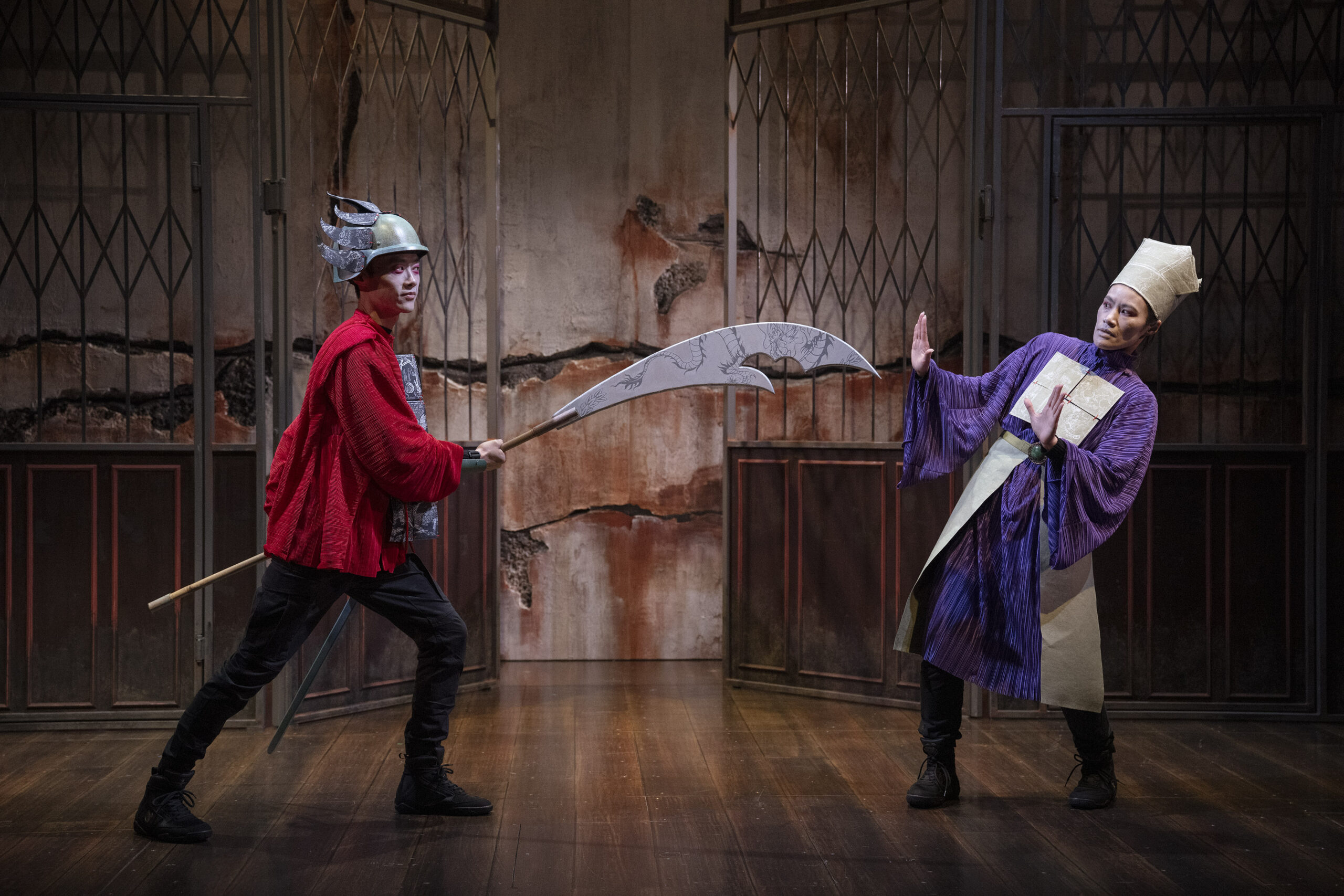
The Orphan of Chao is a compelling tale of tyrannical violence, told in a quick, sharp, highly entertaining, and engrossing tale of morality and immorality, unfolding conceptualizations that readily connect to our current worldview and political climate, all the while using traditional pageantry and art. More importantly, this is a play about preservation and sacrifice, when ordinary people make choices to safeguard larger issues of legacy and honor, while protecting their own sense of integrity and morality. The cast delivers this forth with a purposeful focus and duty to the art form, finding aspects of historical storytelling and presentation to lead us into and through this modern retelling.
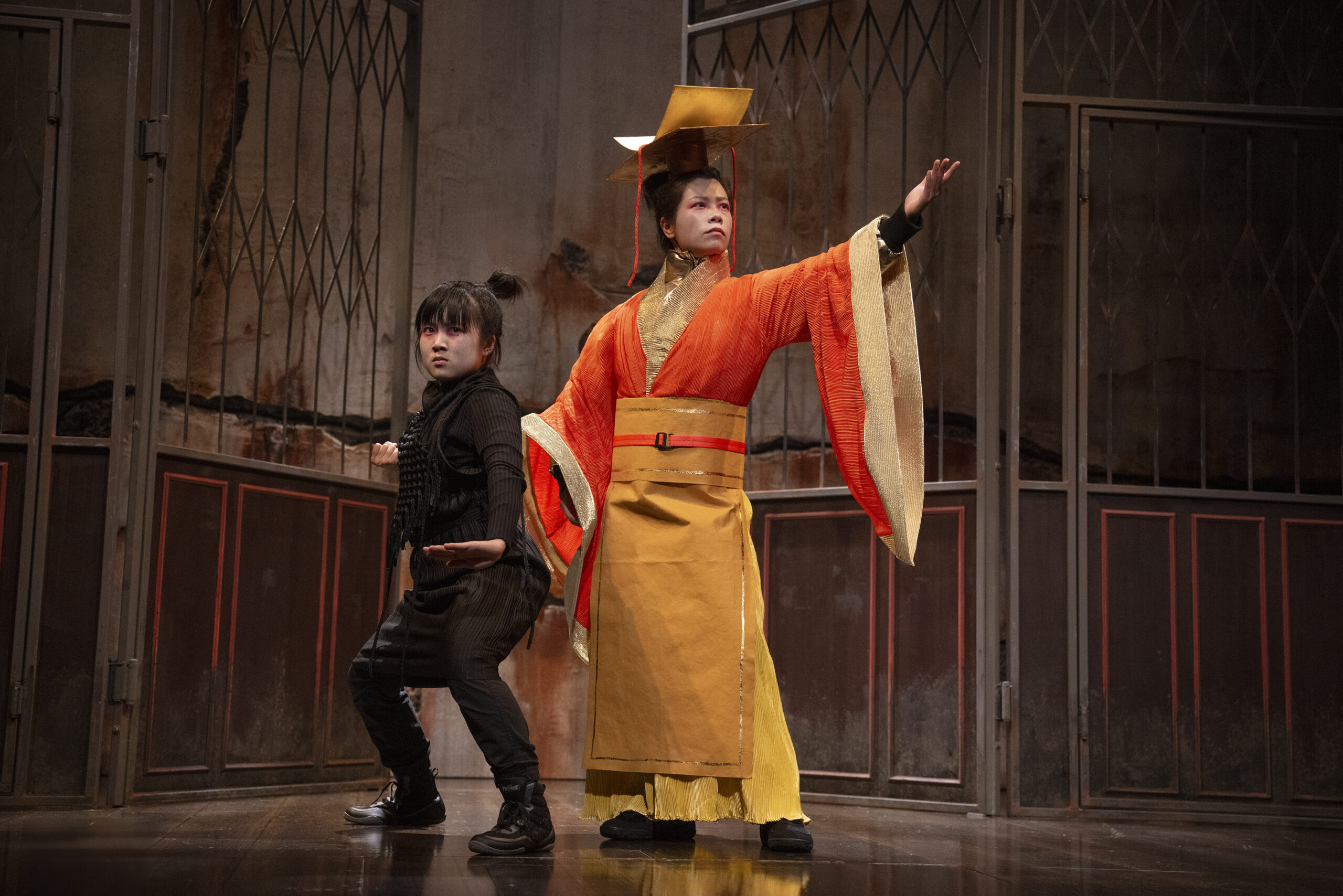
The story is unwrapped intensely and with great detailed intent to classical ideals and traditions, incorporating aspects of martial arts in the captivating choreography and magnificent nods to traditional Chinese opera and theatre. As written by Michael Man (CS’s As You Like It), The Orphan of Chao tugs at our senses, both visually and emotionally, relentlessly pulling us into the modern world through an act of rebellion and revolt against tyranny. Even if the ending is almost too sharp and quick for our liking (making us want a more detailed Act Two and an expanded Act One), it’s profoundly relevant, more than we’d like it to be, and should not be missed.
 front mezz junkies
[…] livingroom, designed dynamically by Christine Ting-Huan 挺歡 Urquhart (Shaw Festival’s The Orphan of Chao). It hangs with intent, giving us everything we need to know and understand about Tarragon Theatre […]
LikeLike
[…] TorontoFirst Preview: January 7, 2025Opening: January 15, 2025Starring: Ari Cohen), Sochi Fried, Richard Lee, and Rachel LesliePlaywright: Liz AppelDirector: Chris […]
LikeLike
[…] It’s strange, to review a show called Performance Review, but the writing by Small couldn’t be more thoughtful, engaging, sharp, and defined, leading you through seven bell-jarred stories that swim smartly through the complex rivers of being a woman in this world, filled with obstacles and debris, and hands that venture where they really shouldn’t. Without consent. Her one-page resume is smartly optimistic and somewhat naive, drenched in traumatic turns that are honest and abruptly delivered in the perfect authentic manner, throughout the well crafted and utilized space, thanks to fine work done by production designer Anahita Debbonehie (Tarragon’s The Hooves Belonged to the Deer) and sound designer/composer Heidi Chan (Shaw’s The Orphan of Chao). […]
LikeLike
[…] directed by Courtney Ch’ng Lancaster (Shaw’s The Orphan of Chao). A wickedly modern take on a Jacobean drama, in Witch, the devil himself […]
LikeLike
[…] For Measure), distinct costumes by Christine Ting-Huan 挺歡 Urquhart (Shaw’s The Orphan of Chao), and an amazingly precise sound design by Thomas Ryder Payne (Coal Mine’s People, Places and […]
LikeLike
[…] The couples: Orlando and Rosalind, Oliver and Celia, Silvius (Michael Man – Shaw’s The Orphan of Chao) and Phebe (Jessica B. Hill), and Touchstone and Audrey (Silvae Mercedes), all find their way into […]
LikeLike
[…] and matching with the ever-willing Jean Everard, joyfully embodied by Lindsay Wu (Shaw’s The Orphan of Chao), a friend of the Allingtons who has been waiting for years for the reconnection this play […]
LikeLike
[…] Osborne (Stratford’s Frankenstein Revived), the solid lighting by Jareth Li (Shaw’s The Orphan of Chao), and the captivating compositions by sound designer Jonathan Lewis, without dropping the essence […]
LikeLike
[…] Directed by Jonathan Tan (Shaw’s The Orphan of Chao) […]
LikeLike
[…] the newly anointed ‘Burglar’ Bilbo Baggins, Richard Lee (Shaw’s The Orphan of Chao) brings undeniable warmth and sincerity to Middle-earth. He captures the character’s inherent […]
LikeLike