Frontmezzjunkies reports: New works, landmark revivals, and a reimagined home at Astor Place shape The Public’s expansive fall and winter lineup
By Ross
The Public Theater has always carried a particular kind of electricity for me, a sense that something immediate and alive is about to unfold just beyond the lobby doors. That feeling deepened with the announcement of the company’s Fall 2026 and Winter 2027 season, a lineup that feels both expansive in scope and grounded in a clear commitment to artists, audiences, and the city it calls home.
Artistic Director Oskar Eustis and Executive Director Patrick Willingham have unveiled a season that brings together world premieres, bold revivals, and ambitious new musical works, all while continuing to center accessibility through the return of the Joseph Papp Free Performance Initiative. It is a season that embraces scale and intimacy at once, moving from large-scale community-driven productions to deeply personal solo performances.
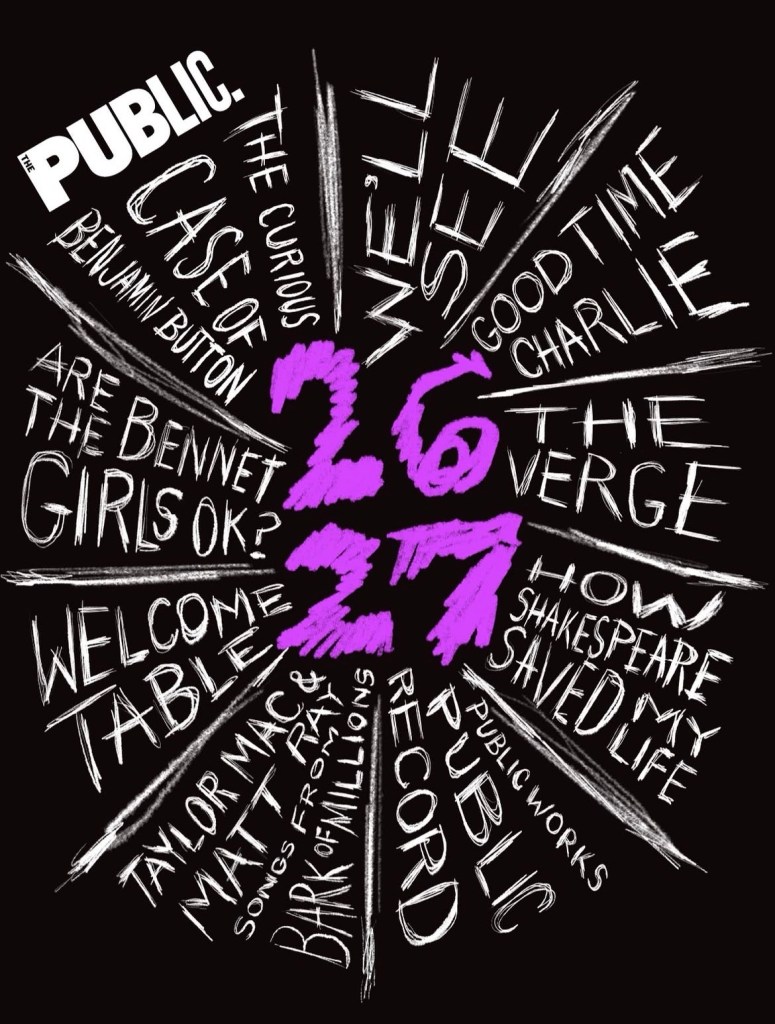
Among the highlights is Public Works’ Public Record, a North American premiere that gathers New Yorkers from all five boroughs into a cast of more than 100, shaping a live album onstage in real time. That sense of collective creation carries through the season, whether in the return of Richard Nelson’s Apple Family in We’ll See, set against the backdrop of a midterm election night, or in Ryan J. Haddad’s Good Time Charlie, a multigenerational story rooted in love, memory, and the theater itself.
The season also welcomes major new works from acclaimed voices. James Ijames’ Welcome Table reimagines the historic Baldwin-Kennedy meeting through a contemporary lens, while The Curious Case of Benjamin Button, a show I saw on one of my London theatre trips, arrives as a North American premiere. It’s an astonishing musical that transforms a familiar literary work into a theatrical event driven by actor-musicians and the inventiveness of storytelling. These productions sit alongside a rare revival of Susan Glaspell’s The Verge, directed by Jessie Austrian and featuring Miriam Silverman, and Bedlam’s return with Are the Bennet Girls OK?, offering a fresh perspective on a literary classic.
Performance remains at the center of the season’s offerings. Jacob Ming-Trent’s How Shakespeare Saved My Life promises a deeply personal exploration of language and identity, while Taylor Mac and Matt Ray bring Songs from Bark of Millions to Central Park for a limited run that celebrates music, community, and theatrical spectacle. Across venues, from the Delacorte Theater to Joe’s Pub, the programming reflects a wide-ranging vision of what performance can look like in this moment.
Beyond the stage, The Public is also reimagining its physical home. Renovations to the lobby, mezzanine, and library spaces at Astor Place aim to create a more welcoming and dynamic environment for gathering and connection. This transformation aligns with the theater’s broader mission, reinforcing its role as a civic space where audiences and artists meet not only for performances, but for conversation and community.
As The Public continues to mark significant anniversaries from its history, including milestone productions that have shaped the American theater landscape, this new season feels rooted in both legacy and forward momentum. It invites audiences into spaces that are at once familiar and newly energized, where stories unfold in ways that reflect the complexity and vibrancy of the city itself.
That feeling from the moment of walking through the doors lingers here as well, a sense of anticipation for what is to come. With a season that stretches across forms, voices, and generations, The Public once again opens its stages as a place where theater is not only performed, but shared, questioned, and lived.
 front mezz junkies